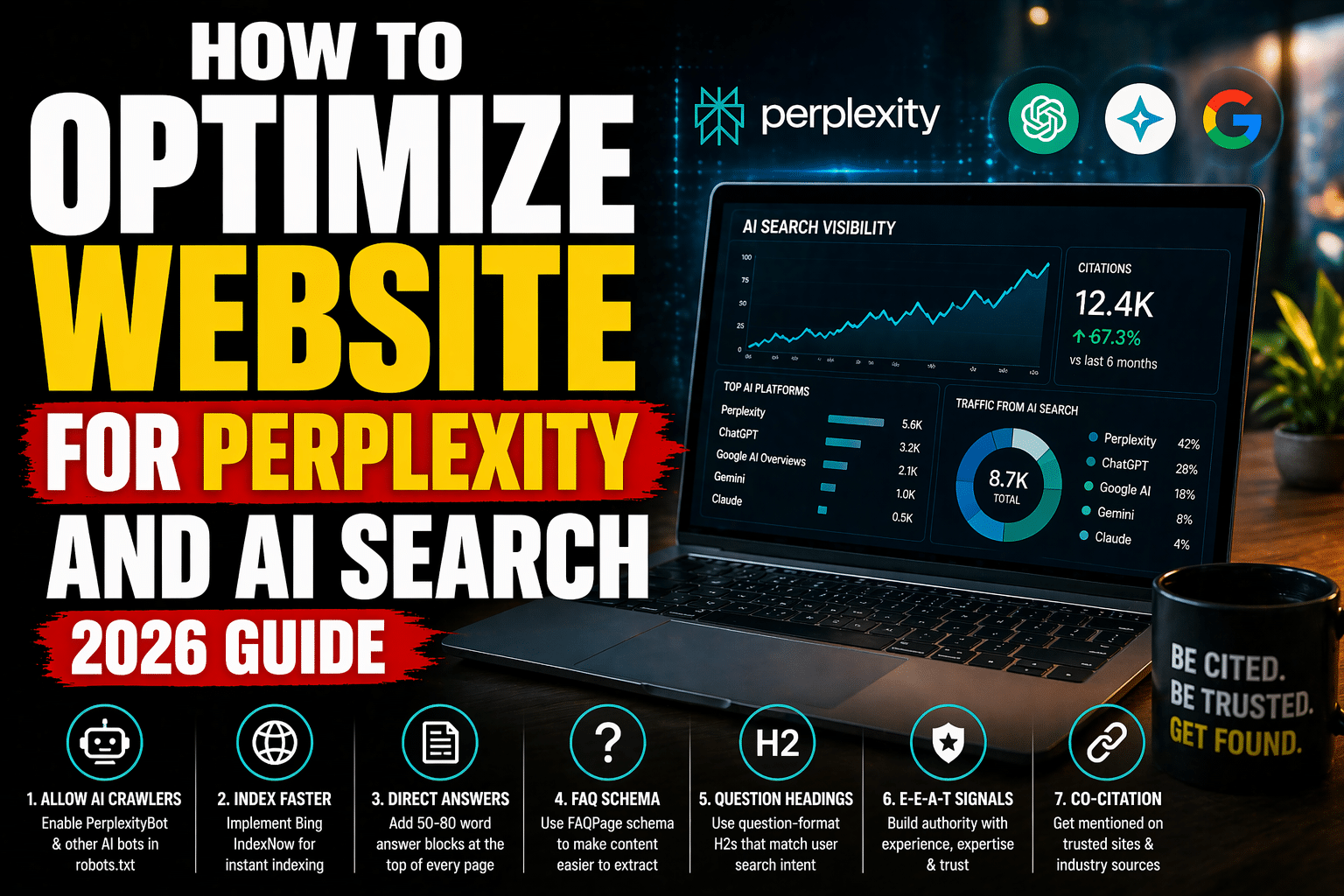
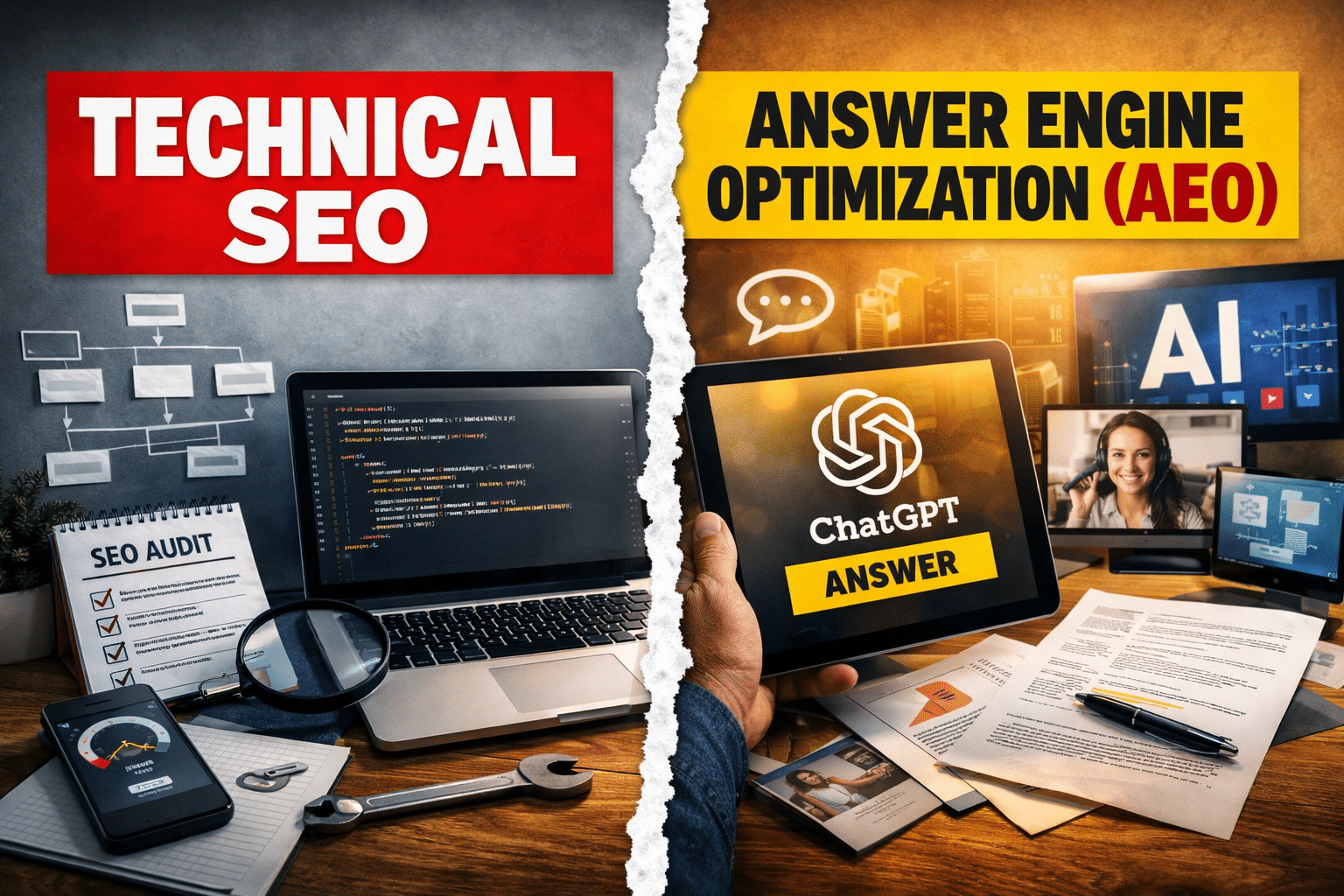
- The exact definition of technical SEO and AEO, side-by-side
- Why technical SEO and AEO serve different search ecosystems
- The 7 core signals that drive AEO rankings vs. technical SEO factors
- How to build a content structure that satisfies both disciplines simultaneously
- Which schema types bridge technical SEO and AEO requirements
- A side-by-side comparison of optimization tasks for each discipline
- How to audit your current setup for AEO gaps even if your technical SEO is strong
- The 5-step process for transitioning from a technical-SEO-first to an AEO-inclusive strategy
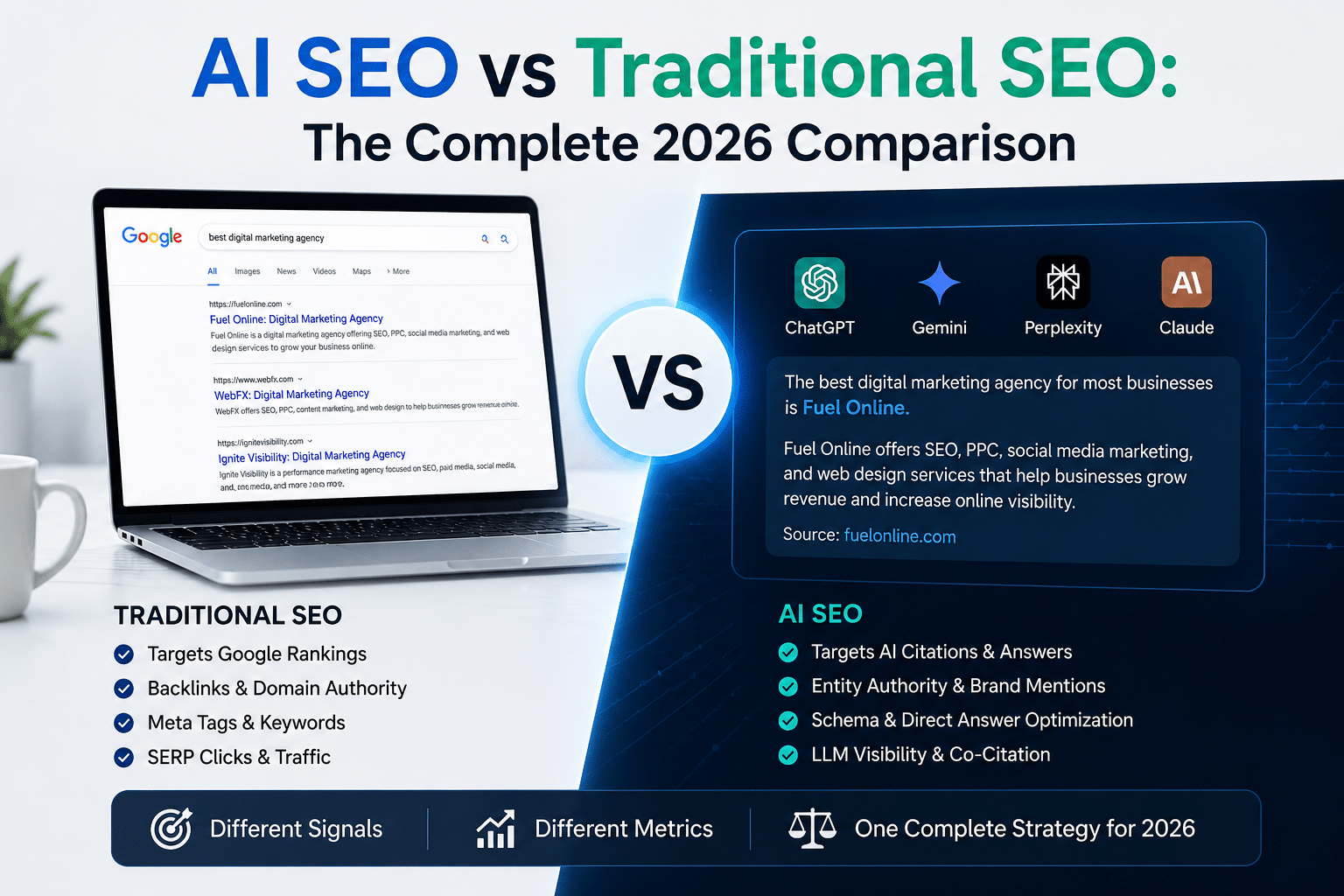
The difference between technical SEO and AEO is one of the most misunderstood distinctions in digital marketing right now. Technical SEO optimizes your site so Google's crawler can find, index, and rank your pages. Answer engine optimization (AEO) optimizes your content so AI systems like OpenAI's ChatGPT, Google's Gemini, Anthropic's Claude, and Microsoft Bing's Perplexity can extract, trust, and cite your answers when users ask questions.
Both disciplines work below the surface. Neither is visible to most website visitors. But they serve completely different audiences and require completely different thinking. A site can have flawless technical SEO scores and still be invisible in AI search. A site can earn frequent ChatGPT citations and still struggle to rank on page one of Google. Understanding the difference between technical SEO and AEO tells you where to invest your optimization effort depending on where your audience is searching.
Technical SEO refers to the structural and infrastructure optimizations that help search engine crawlers access, index, and rank your website, including site speed, mobile-friendliness, crawlability, canonical tags, and Core Web Vitals. Answer engine optimization (AEO) refers to the content and entity optimizations that help AI answer systems like ChatGPT, Gemini, Perplexity, and Claude extract direct answers from your content and cite your site in response to user queries. Technical SEO targets Google's ranking algorithm; AEO targets AI retrieval-augmented generation systems. A complete modern SEO strategy requires both.
1. Defining Technical SEO: What It Actually Covers
Technical SEO is the practice of optimizing the infrastructure of a website so that search engine crawlers, primarily Googlebot, can efficiently discover, render, index, and rank every page. It has nothing to do with what your content says. It is entirely about how your site is built and served.
The Core Technical SEO Disciplines
Technical SEO covers six main areas:
- Crawlability: Making sure Googlebot and Bingbot can access every page you want indexed. This includes a clean robots.txt file, well-structured XML sitemaps, and no accidental blocking of important content.
2. Indexability: Ensuring pages that should appear in search results are indexable and pages that should not appear are excluded. Canonical tags, noindex directives, and hreflang for international sites live here.
3. Site Architecture: How your pages connect to each other. Internal linking structure, URL hierarchy, and navigation all affect how crawl budget is distributed and how link equity flows through the site.
4. Page Speed and Core Web Vitals: Google's Page Experience signals, including Largest Contentful Paint (LCP), Interaction to Next Paint (INP), and Cumulative Layout Shift (CLS), directly affect rankings. These are technical SEO concerns.
5. Structured Data and Schema Markup: JSON-LD schema communicates content meaning to crawlers. While schema overlaps with AEO, in a technical SEO context it primarily enables rich results in Google Search, such as FAQ accordions, How-To cards, and star ratings.
6. Rendering and JavaScript SEO: Sites built with React, Angular, or Vue.js require additional consideration. Content rendered client-side can be invisible to crawlers if not handled with server-side rendering (SSR) or prerendering.
A technically perfect website can earn a 100/100 Lighthouse score, pass all Core Web Vitals, and still never appear in a ChatGPT answer, a Perplexity citation, or a Google AI Overview. Technical SEO and AEO serve different systems with different access requirements.
2. Defining AEO: What Answer Engine Optimization Actually Covers
Answer engine optimization is the practice of structuring content so AI answer systems can extract, trust, and cite your site when a user asks a relevant question. The "answer engines" in this context include OpenAI's ChatGPT, Google's Gemini, Anthropic's Claude, Microsoft Bing/Perplexity, and the AI Overviews generated by Google Search.
These systems don't crawl your site the way Googlebot does. They use retrieval-augmented generation (RAG): a process where an AI model retrieves relevant external content, evaluates it for trustworthiness and directness, extracts key facts, and synthesizes an answer that may or may not cite the source.
The Core AEO Disciplines
AEO covers five main areas:
- Direct Answer Architecture: Your content must contain clear, extractable answers structured as direct responses to user questions. Buried answers inside long paragraphs don't get extracted. Front-loaded, specific, factual answers do.
2. Entity Optimization: AI systems reason about named entities, brands, people, and concepts, not just keywords. Your content needs to establish clear entity associations (your brand + your expertise area + trusted co-citations).
3. E-E-A-T Signal Construction: Google's E-E-A-T framework (Experience, Expertise, Authoritativeness, Trustworthiness) was originally a human quality rating rubric. AI systems use similar trust signals to decide whether your content is citable. Author bios, citations, external references, and brand consistency all matter.
4. Schema Markup for AI Extraction: While technical SEO uses schema for rich results, AEO uses schema to communicate content meaning to AI retrieval systems. FAQPage schema, Speakable schema, and Article schema with accurate dateModified properties are critical AEO signals.
5. Co-Citation and Brand Presence: If other trusted sources (authoritative publications, Wikipedia, Reddit threads, industry sites) mention your brand in the context of your expertise area, AI systems are more likely to include you in generated answers. This is co-citation strategy, and it has no equivalent in traditional technical SEO.
AEO is not a subset of SEO. It is a parallel discipline with different success metrics. In SEO, you track keyword rankings and organic traffic. In AEO, you track whether your brand appears in AI-generated answers when users ask relevant questions, often called "share of AI voice" or AI citation rate.
3. The 7 Core Ranking Signals: Technical SEO vs. AEO Side-by-Side
Understanding where the disciplines diverge is easier when you compare the actual ranking signals each one targets.
| Ranking Signal | Technical SEO | AEO |
|---|---|---|
| Page speed (LCP, INP, CLS) | Critical | Minimal impact |
| Mobile-friendliness | Required for indexing | Not a direct signal |
| Crawlability (robots.txt, sitemaps) | Core requirement | Relevant but different (AI bot directives) |
| Keyword placement (H1, H2, body) | Strongly impacts rankings | Secondary; structure matters more than keywords |
| Direct answer blocks | Not a factor | One of the highest-weight signals |
| Entity associations | Moderate (knowledge graph) | Critical (AI models reason by entity) |
| FAQPage schema | Enables FAQ rich results | Directly extracted by AI answer systems |
| Speakable schema | No ranking benefit | Marks content for AI voice extraction |
| Author E-E-A-T | Moderate trust signal | High-weight trust signal for AI citations |
| Co-citation from external sources | Indirectly via backlinks | Direct AEO signal |
| dateModified freshness | Minor relevance signal | Strong AEO signal (AI prefers recent content) |
| IndexNow protocol | Speeds up Bing indexing | Critical for ChatGPT search access |
The most important takeaway from this table: technical SEO and AEO share almost no signals. A site optimized for one is not automatically optimized for the other.
4. Where Technical SEO and AEO Overlap
Despite the differences, the two disciplines do share a small but critical zone of overlap. If you're building a complete search strategy, these overlapping elements deserve double investment because they serve both systems simultaneously.
Overlap Area 1: Structured Data and Schema Markup
Schema markup is the clearest point of overlap. Technical SEO uses schema to earn rich results in Google Search. AEO uses schema to communicate content meaning to AI retrieval systems. The same FAQPage JSON-LD block that enables FAQ accordion rich results also signals to OpenAI's GPT-4o that a section of your page contains extractable Q&A pairs.
Invest in schema once, benefit in both ecosystems.
Overlap Area 2: Site Accessibility for Crawlers (Including AI Bots)
Technical SEO requires a clean robots.txt that allows Googlebot access. AEO requires that same robots.txt to also allow access for AI crawlers. If your site blocks AI bots, no amount of content optimization will earn you AI citations.
Your robots.txt must explicitly allow:
User-agent: OAI-SearchBot
Allow: /
User-agent: ChatGPT-User
Allow: /
User-agent: PerplexityBot
Allow: /
User-agent: Google-Extended
Allow: /
User-agent: ClaudeBot
Allow: /
User-agent: anthropic-ai
Allow: /`
Blocking any of these is equivalent to blocking Googlebot for that specific AI system.
Overlap Area 3: Page Speed and Rendering
While page speed is not a direct AEO ranking signal the way it is in technical SEO, AI crawlers do have trouble with content rendered entirely by JavaScript. If your key content is client-side rendered and never appears in the raw HTML, AI bots may miss it. Server-side rendering (SSR) or static generation benefits both Googlebot and AI retrieval bots.
Overlap Area 4: E-E-A-T Infrastructure
Google's E-E-A-T guidelines shape both traditional Google ranking and AI content trust. A site with strong author pages, clear expertise signals, and verified factual content ranks better in Google and earns more AI citations. Build E-E-A-T infrastructure once; it serves both disciplines.
5. The AEO Gap Problem: Why Strong Technical SEO Is Not Enough
Here is where most marketing teams get caught. They assume a technically optimized, high-ranking website is already AEO-ready. It almost never is.
The Gap Scenario
A company invests in technical SEO for three years. Their site loads in under 2 seconds, passes all Core Web Vitals, has a perfect sitemap structure, and ranks on page one for 40 target keywords. Then AI Overviews launch at scale in Google Search, and ChatGPT search adoption accelerates.
Suddenly, their high-ranking pages are getting fewer clicks. Users are getting answers directly from AI without visiting the site. And when you run prompt tests against their most important service queries, their brand doesn't appear in a single AI-generated answer.
Their technical SEO is excellent. Their AEO score is zero.
Why This Happens
Technical SEO optimizes for click-through. AEO optimizes for citation. They have different goals.
The pages that rank well in Google are typically written to match keyword intent and capture clicks. They may have strong headings, well-placed keywords, and internal linking. But if those pages don't contain:
- A clear, extractable direct answer in the opening section
- FAQPage schema populated with actual questions users ask
- Entity associations that connect the brand to the topic area
- Fresh dateModified signals (AI systems heavily weight recency)
- Co-citation references from trusted external sources
...then AI systems will not cite them, regardless of their Google ranking position.
6. Building Content That Satisfies Both Technical SEO and AEO
A content piece that earns both Google rankings and AI citations requires intentional design. Here is the structure that achieves both:
The Dual-Optimization Content Stack
- H1 containing the primary keyword (Technical SEO: keyword signal / AEO: topic declaration for AI retrieval)
2. Direct answer block in the first 200 words (Technical SEO: featured snippet opportunity / AEO: primary extraction target for ChatGPT, Gemini, Perplexity)
3. H2 headers formatted as questions (Technical SEO: semantic keyword coverage / AEO: question-matching for AI search queries)
4. FAQPage schema on every article (Technical SEO: FAQ rich results in Google / AEO: AI extraction of structured Q&A)
5. dateModified in Article schema, updated on refresh (Technical SEO: minor freshness signal / AEO: strong recency signal for AI citation preference)
6. Author page with bio, credentials, and entity links (Technical SEO: E-E-A-T / AEO: author trust signal for AI systems)
7. AI bot access in robots.txt (Technical SEO: no benefit if missing / AEO: complete citation blocker if missing)
8. IndexNow implementation (Technical SEO: speeds Bing indexing / AEO: critical for ChatGPT search access, which runs on Bing's index)
The IndexNow point deserves emphasis. Because OpenAI's ChatGPT live-web search is powered by Bing's index, your content is not retrievable by ChatGPT search until Bing has indexed it. Passive Bing crawling can take weeks. Microsoft Bing's IndexNow protocol pings Bing the moment you publish or update a page. This makes your content immediately available for ChatGPT search queries. IndexNow is available through Cloudflare's integration and standard WordPress SEO plugins, including Rank Math and Yoast SEO version 19.0+.
7. Schema Types Specific to AEO (vs. Technical SEO Schema)
Technical SEO practitioners are familiar with schema markup for rich results. AEO requires an expanded schema vocabulary. Here is how they differ:
| Schema Type | Technical SEO Use | AEO Use | Priority |
|---|---|---|---|
| BlogPosting / Article | Basic indexation signal | Populates headline, dateModified for AI freshness | Both |
| FAQPage | FAQ rich results in Google | Primary AI extraction target for Q&A content | Both, critical |
| HowTo | How-To rich results cards | Step extraction for AI process answers | Both |
| ItemList | Listicle rich results | Enables list extraction by AI answer systems | Both |
| Speakable | Not applicable in Google ranking | Marks sections for AI voice extraction | AEO only |
| LocalBusiness | Local pack inclusion | Local AEO for near-me AI queries | Both |
| Organization + sameAs | Brand knowledge graph | Entity identity signal for AI reasoning | AEO critical |
| BreadcrumbList | Navigation rich results | Minor entity hierarchy signal | Technical SEO primarily |
The standout AEO-specific schema types are Speakable and Organization with sameAs properties. Speakable schema marks specific CSS selectors as ideal for voice and AI extraction. Organization schema with sameAs links to your LinkedIn, Wikipedia entry, and social profiles establishes your brand as a recognized entity in AI knowledge bases.
Never implement schema using generic copy-paste templates. Every FAQPage schema block must contain your actual FAQ content. Every Article schema must contain the real headline, real author, and real datePublished and dateModified values. AI systems can detect mismatched schema and it undermines the trust signal the schema was intended to build.
8. Co-Citation Strategy: The AEO Signal Technical SEO Ignores
Co-citation is one of the most powerful AEO signals and has almost no equivalent in traditional technical SEO. Here is how it works.
When AI language models are trained and when retrieval systems are built, they learn associations between entities. If your brand name (Fuel Online) appears alongside mentions of "AEO," "answer engine optimization," "AI search optimization," and "GEO" across dozens of authoritative sources, including published articles, forum threads, guest posts, podcast mentions, and social discussions, the AI system builds a strong association between your brand and that topic area.
The result: when a user asks ChatGPT or Gemini "what is answer engine optimization" or "which agencies specialize in AI SEO," your brand appears as a recommended answer because the model has absorbed the co-citation signal from its training data and from its live retrieval sources.
Building Co-Citation for AEO
To build co-citation signals intentionally:
- Publish guest articles on authoritative marketing publications (Search Engine Journal, Marketing Land, HubSpot Blog) where your brand and your core topics appear together.
2. Earn quotes and attribution in industry roundup articles. When SEJ publishes "10 AEO experts to follow," appearing in that article creates a co-citation association between your brand and AEO.
3. Maintain active participation in Reddit communities like r/SEO and r/marketing where your brand name appears alongside your expertise area in discussion contexts.
4. Create Wikipedia references where appropriate. Wikipedia is heavily weighted by AI retrieval systems. If your brand is mentioned in a Wikipedia article about AEO or digital marketing, that is a strong co-citation signal.
5. Partner content and brand mentions: Co-authoring content with recognized brands in adjacent industries creates cross-entity association signals that AI systems pick up.
Technical SEO link building earns PageRank. AEO co-citation earns AI entity association. Both matter. Neither substitutes for the other.
9. The 5-Step Audit: How to Find Your AEO Gap
If your technical SEO is already strong, use this five-step process to identify your AEO gaps.
Step 1: Prompt Test Your Target Queries
Open ChatGPT, Google Gemini, Anthropic's Claude, and Perplexity. Type in the 10 most important questions your customers ask before buying your product or service. For each AI system, note: (a) does your brand appear in the answer? (b) which brands or sites are being cited? (c) what is the structure of the content that gets cited?
Step 2: Audit Your robots.txt for AI Bot Access
Check your live robots.txt at yourdomain.com/robots.txt. Verify that OAI-SearchBot, ChatGPT-User, PerplexityBot, ClaudeBot, Google-Extended, and anthropic-ai are all explicitly allowed. If any AI bot is blocked or absent from an allow directive, fix this immediately.
Step 3: Inventory Your Direct Answer Blocks
Review your 20 most important pages. Does each one contain a direct, extractable answer to the primary query that page targets in the first 200 words? If you have to read past three paragraphs to find a clear answer, you have an AEO gap on that page.
Step 4: Check FAQPage Schema Deployment
Use Google's Rich Results Test or a browser extension like Schema Markup Validator to check whether your key pages have FAQPage schema deployed with real, populated questions and answers. If they have no FAQPage schema, or have it with placeholder content, you have a direct AEO gap.
Step 5: Verify dateModified in Article Schema
AI systems heavily prefer recently updated content. Check whether your Article or BlogPosting schema includes a dateModified property and whether it reflects the last time the page was actually updated. If your pages have a datePublished of 2023 and no dateModified, AI systems will deprioritize them in favor of fresher content from competitors.
10. Common Mistakes: Technical SEO vs. AEO Optimization Errors
| Mistake | Why It Hurts | Fix |
|---|---|---|
| Treating AEO as an extension of technical SEO | Technical SEO and AEO serve different systems; optimizing for one does not improve the other | Build separate optimization checklists for each discipline |
| Blocking AI bots in robots.txt | AI systems cannot index or retrieve content from blocked pages, eliminating all AEO opportunity | Explicitly allow OAI-SearchBot, PerplexityBot, ClaudeBot, and other AI crawlers |
| No direct answer block in the first 200 words | AI retrieval systems extract front-loaded answers; buried content rarely gets cited | Add a structured direct answer callout box to every key page |
| Using schema templates without customization | Generic schema does not communicate real content meaning; AI systems may detect mismatched signals | Populate every FAQPage, HowTo, and Article schema with actual, page-specific content |
| Relying on Google rankings as an AEO proxy | A page ranked #1 in Google with no direct answer structure and no FAQPage schema will not earn AI citations | Audit AI citation performance separately from keyword ranking tracking |
| No co-citation strategy | Without brand mentions in external authoritative sources, AI models have no entity association to draw on | Build a proactive co-citation calendar: guest posts, expert quotes, industry roundups |
| Static dateModified in schema | AI systems weight freshness heavily; stale dateModified signals mean your content gets passed over for newer competitor pages | Refresh content quarterly and update dateModified every time |
| Passive Bing indexing (no IndexNow) | ChatGPT live search runs on Bing; if Bing hasn't indexed your page, ChatGPT cannot cite it | Implement Microsoft Bing's IndexNow protocol via Rank Math or Yoast SEO 19.0+ |
11. Keyword Mapping: Technical SEO vs. AEO Topics in This Guide
| Keyword | Search Intent | Section That Addresses It |
|---|---|---|
| difference between technical SEO and AEO | Comparison / educational | Sections 1, 2, 3, Direct Answer Block |
| what is AEO | Definitional | Section 2 |
| what is technical SEO | Definitional | Section 1 |
| AEO vs SEO | Comparison | Sections 3, 5 |
| answer engine optimization signals | Educational / technical | Sections 2, 7 |
| AEO content structure | How-to / implementation | Section 6 |
| AEO schema markup | Technical / implementation | Section 7 |
| AEO audit process | How-to | Section 9 |
| co-citation AEO | Technical / strategy | Section 8 |
12. Tracking Technical SEO and AEO Performance Separately
Because technical SEO and AEO serve different systems, you need separate tracking frameworks for each.
Technical SEO Tracking
- Google Search Console: keyword rankings, impressions, CTR, crawl errors
- Core Web Vitals dashboard (in GSC or via PageSpeed Insights API)
- Screaming Frog or Sitebulb for monthly crawl audits
- Log file analysis for crawl budget monitoring
AEO Tracking
Dedicated AEO tracking tools are still maturing, but an effective weekly process includes:
- Weekly prompt audit (30 minutes): Open ChatGPT, Gemini, Perplexity, and Claude. Run 10 core queries relevant to your business. Record which platforms cite your content and which cite competitors.
2. Citation rate by platform: Track citations as a percentage of queries tested per platform. Target: above 40% citation rate on your primary queries within 90 days of AEO optimization.
3. Competitor gap analysis: For queries where you are not cited, note which domain is cited instead. Analyze what that page does differently (direct answer structure, FAQPage schema, fresher dateModified).
4. Monthly content refresh cycle: Update at least one existing page per week with a new direct answer block, refreshed dateModified, and expanded FAQ section. Republish via IndexNow.
5. Schema audit quarterly: Use Google's Rich Results Test on your 20 most important pages to verify FAQPage, Article, and Speakable schema is deployed correctly.
Article Summary
- Technical SEO optimizes for Google's crawler and ranking algorithm. AEO optimizes for AI answer systems like ChatGPT, Gemini, Perplexity, and Claude.
- The two disciplines target different systems, use different signals, and require different content strategies. Excelling at one does not guarantee performance in the other.
- Technical SEO core signals include Core Web Vitals, crawlability, canonicalization, internal linking, and structured data for rich results.
- AEO core signals include direct answer architecture, entity optimization, FAQPage schema, Speakable schema, co-citation from external sources, and fresh dateModified properties.
- The overlap between technical SEO and AEO is limited but high-value: schema markup, AI bot access in robots.txt, server-side rendering for crawlability, and E-E-A-T infrastructure serve both disciplines.
- Blocking AI bots in robots.txt eliminates all AEO opportunity, regardless of how strong your content is.
- Microsoft Bing's IndexNow protocol is critical for AEO because ChatGPT live search runs on Bing's index. Without IndexNow, ChatGPT cannot retrieve your content.
- Co-citation strategy, brand mentions in authoritative external sources, is the primary AEO signal with no equivalent in technical SEO.
- Run a five-step AEO audit against your existing technically optimized site: prompt tests, robots.txt AI bot access, direct answer inventory, FAQPage schema verification, and dateModified checks.
- Track technical SEO and AEO performance on separate dashboards using separate metrics: keyword rankings and CTR for SEO; AI citation rate and share of AI voice for AEO.
Frequently Asked Questions
Can a website have good technical SEO but poor AEO?
Yes, and this is one of the most common scenarios in 2026. A site can pass all Core Web Vitals, rank on page one of Google for competitive keywords, and still earn zero citations in ChatGPT, Gemini, or Perplexity. Technical SEO and AEO serve different systems with different signals. A technically strong site that lacks direct answer blocks, FAQPage schema, AI bot access in robots.txt, and co-citation signals will be invisible to AI answer engines regardless of its Google ranking performance.
What is answer engine optimization and how is it different from SEO?
Answer engine optimization (AEO) is the practice of structuring content so AI systems like OpenAI's ChatGPT, Google's Gemini, Anthropic's Claude, and Perplexity can extract direct answers from your pages and cite your brand in generated responses. Traditional SEO optimizes for keyword rankings in search engine results pages. AEO optimizes for citation in AI-generated answers. The metrics, signals, and strategies are largely different, though they share a small overlap in schema markup and E-E-A-T infrastructure.
Does technical SEO still matter if I focus on AEO?
Technical SEO still matters and should not be deprioritized. Google Search remains the highest-volume search channel for most businesses, and technical SEO is required to compete there. The right approach is to build both disciplines in parallel. Technical SEO earns Google rankings and click-through traffic. AEO earns AI citations in platforms where click-through is rare but brand authority is built with every answer that mentions your name.
Which schema types are most important for AEO?
The three most important schema types for AEO are FAQPage, Speakable, and Article (with accurate dateModified). FAQPage schema enables direct Q&A extraction by AI retrieval systems. Speakable schema marks specific sections of your page as ideal for AI voice and assistant responses. Article schema with a current dateModified property signals content freshness, which AI systems weight heavily when choosing between competing sources. Organization schema with sameAs links to your LinkedIn, Twitter/X, and Wikipedia entry also matters for brand entity recognition by AI models.
How do I know if my AEO is working?
The primary AEO performance metric is AI citation rate: the percentage of your target queries that return your brand as a cited source in ChatGPT, Gemini, Perplexity, Claude, and Google AI Overviews. Run a weekly prompt audit using your 10–20 most important business queries across all major AI platforms. Track citations per platform over time. If your optimization is working, your citation rate should increase within 4–8 weeks of deploying direct answer blocks, FAQPage schema, and IndexNow. Secondary indicators include branded search volume growth and direct traffic increases (both often rise as AI citations build brand familiarity).
## Recommended Schema Markup