
AI SEO services cost depends on scope, implementation responsibility, markets, research and measurement. For enterprise buyers, the useful question is what the proposal includes and what your organization must supply. This guide explains how to compare engagements without confusing a monthly fee with a guaranteed search or AI outcome.
Build the budget from the scope
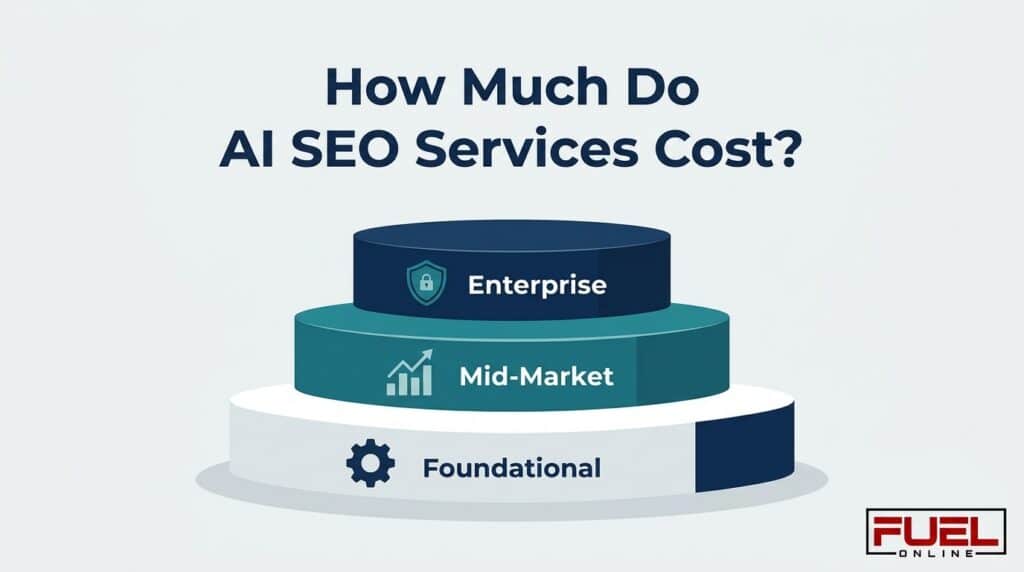
There is no single defensible price for every enterprise AI SEO engagement. Cost depends on the work to be completed, the people responsible for implementation, the markets covered and the evidence needed to evaluate progress. A focused audit and an ongoing program should not be compared as if they deliver the same service. Ask for a proposal that names the work, the delivery period and the assumptions behind the fee.
Begin with the business objective. A company with inaccessible product pages needs different work from a company whose pages are discoverable but fail to explain its expertise. An enterprise with multiple brands, languages or approval teams adds coordination requirements. Describe those conditions before asking agencies for a monthly number. Otherwise, vendors may price different projects and appear comparable only because each calls its offer AI SEO.
For a broader discussion of investment factors and market estimates, read our AI SEO pricing and scope guide. This page focuses on comparing enterprise proposals and planning total cost. To evaluate Fuel’s service options, compare our AI SEO packages. Fuel’s actual fees and commitments are established in the proposal, not by a general market benchmark.
Separate existing SEO work from incremental AI-search work
AI-assisted discovery does not eliminate the need for accessible pages, useful content and a clear business offer. Google states that its existing SEO practices remain relevant to AI Overviews and AI Mode, with no special schema or additional technical requirement for those features. Read Google’s guidance on AI features and websites.
Review your existing SEO agreement before commissioning another program. Technical access checks, content improvements, internal linking and accurate business information may already be included. Incremental work might involve a defined buyer-question research set, additional source analysis, platform observations or new reporting. Ask the vendor to distinguish work already covered from genuinely additional responsibilities. A different label should not create a duplicate fee for the same deliverable.
Compare deliverables and implementation responsibilities
A useful proposal separates diagnosis, execution and verification. An audit can identify issues and recommended changes without including development or publishing. A managed engagement can include implementation, but the proposal still needs to explain which systems the agency can access and which changes require your team. An engineering dependency can delay results even when the agency has delivered its recommendations on time.
For technical work, ask for affected URLs or templates, the issue being addressed, the recommended change, its priority and an acceptance check. For content, specify research inputs, subject-expert involvement, review rounds, the intended audience and the person responsible for publication. For measurement, define the baseline, observation conditions and reporting period. These details make the work assessable without pretending the agency controls a search engine’s final choices.
Compare ongoing retainers by capacity and responsibilities rather than an article count alone. A deeply researched service page with expert review is a different assignment from a short update to an existing page. Neither should be counted as a generic unit without explaining what is included. Scope should also identify the process for reprioritizing work when a technical issue or a business change makes the original plan less useful.
Budget for consistent business information
Business-information work can include reviewing service descriptions, organization details, expert biographies and the source material supporting important claims. The objective is a coherent, verifiable account of the business. Relevant structured data should describe information that people can also see on the page. It is not a mechanism that forces every model to recognize a company or recommend it.
Ask which inconsistencies the vendor found, which pages or profiles it proposes to correct and how those changes will be checked. Separate work on assets your company controls from work that depends on a publisher, directory or platform. A proposal should not promise guaranteed edits to third-party sources or permanent inclusion in model training data.
Price research, expert review and useful content separately
Content costs reflect more than writing. Research, interviews, data analysis, editing, design, fact checking and implementation can all require time. Identify the evidence already available inside your business and the material that must be developed. An approved case study may need client permission and source records; an original survey needs a clear method and an appropriate sample. Those dependencies belong in the plan.
Evaluate a sample brief and a completed asset. The brief should identify the customer question, the purpose of the page, sources, review requirements and the relevant next action. The finished page should answer that question clearly and support its claims. Do not accept an invented information-gain score or a claim that perfectly tokenized sentences guarantee citations as proof of quality. Ask what the reader learns and what evidence supports it.
Understand what AI visibility reporting measures
A measurement proposal should identify the questions being tested, platforms, locations, observation dates and the cited sources retained. Repeated observations can help reveal variability, but a sample remains a sample. Mention rate means the proportion of the defined observations that included a brand. It does not automatically represent all users, all questions or the market as a whole.
Keep mentions, citations, referral visits, enquiries and qualified opportunities separate. A brand may be mentioned without receiving a link; a citation may not produce a visit. Conventional search reporting remains useful alongside AI observations. Ask how the vendor handles changing answers, missing referral data and small samples, and whether you can inspect the evidence behind its charts. More observations are useful only when they answer a relevant business question.
Identify costs outside the agency fee
Ask whether the proposal includes software subscriptions, approved data sources, design, development, content hosting and analytics configuration. Some tools may already be available through your company. Others may be billed separately or included within the agency’s fee. Confirm ownership and access so reporting and published assets remain usable if the engagement ends.
Account for internal effort as well. Subject experts may need to review claims, developers may need to implement changes and legal or compliance teams may need to approve sensitive material. These activities consume capacity even if they do not appear on the agency invoice. Document who supplies each input and what happens when it is delayed. Do not assume an expensive technology stack is necessary unless the vendor explains the specific task it solves.
Compare total investment over the same period
Use a consistent planning horizon. Separate initial research or setup from ongoing delivery, and show one-time development work independently. A lower monthly retainer can cost more overall if important implementation is excluded. Conversely, a higher fee is not evidence of a stronger program if the scope is vague or duplicates work your team already performs.
Consider a hypothetical comparison, not a market benchmark or Fuel quote. Proposal A charges $6,000 per month for three months and requires $9,000 of separately budgeted implementation: the planned external cost is $27,000. Proposal B charges $8,000 per month for three months with the same implementation included: the planned external cost is $24,000. The comparison is meaningful only if the deliverables, access, review requirements and quality are comparable. Add internal costs and any other exclusions before deciding.
A procurement worksheet should show fee, period, included capacity, setup work, third-party costs, client responsibilities and exit terms. Record assumptions alongside the numbers. If a vendor cannot explain what changes when the budget increases, ask for a narrower scope rather than treating the larger figure as a visibility guarantee.
Explain the factors that change the scope
Site size matters through the work it creates, not just the URL count. A shared template problem may affect thousands of pages but need one carefully tested fix. A smaller site may require substantial research if its claims are complex or its service information is incomplete. Ask the vendor to explain the relationship between the inventory and the work proposed.
Markets and languages can add research, review and maintenance responsibilities. Regulated or sensitive topics can require qualified review and stronger source controls. Platform constraints may require developer collaboration. Existing analytics gaps can add measurement setup before a meaningful baseline is available. Document these factors directly rather than assigning an unexplained premium to the word enterprise.
Prioritize platforms around your buyers and available evidence. A proposal claiming coverage of every model needs to explain what coverage means and what can actually be observed. No agency controls every answer, every model version or every user context. A focused program with clear scope can be more useful than broad promises that cannot be verified.
Prioritize opportunity without unsupported urgency
Decide urgency from observable business gaps: inaccurate service descriptions, inaccessible pages, weak decision content or missed demand from relevant searches. Compare the cost and expected usefulness of addressing those gaps with other acquisition work. Changes that improve the customer’s ability to understand and choose your business can have value across several discovery channels.
Do not approve a budget because a proposal claims a competitor will permanently occupy a model’s training weights. Search systems, retrieval sources and answers change. A stronger business case identifies the current issue, the asset to improve, the expected leading evidence and the point at which the team will reconsider its approach. This supports timely decisions without treating an uncertain future as a certainty.
Evaluate ROI with qualified outcomes and clear limits
Start with outcomes your business can define: qualified enquiries, accepted opportunities, purchases or another relevant conversion. Where attribution is available, connect referred sessions to those outcomes. Preserve source information and agree qualification rules with sales. Report observed AI visibility separately from attributable commercial results so a mention is not assigned invented revenue.
A simple planning calculation can help clarify the objective. If an engagement costs $24,000 and an incremental qualified customer contributes $8,000 in gross profit over the chosen period, three such customers cover that fee before other costs. These are hypothetical numbers, not an expected result. The difficult part is establishing whether customers were incremental and attributable. Account for overlapping channels, sales-cycle length, internal costs and the uncertainty in the forecast.
Review leading evidence while commercial outcomes develop: accepted technical releases, improved decision pages, useful search exposure and recorded citations. None alone proves ROI. Agree a review cadence and a continue, revise or stop decision based on the evidence available, rather than setting a universal citation or revenue deadline.
Questions to ask before signing
Ask to inspect a proposed technical task, a content brief, a completed page and a sample report. Each should explain what was done and how the work was checked. Discuss who will be accountable for delivery and what your team must provide. Clarify whether subcontractors or specialist partners are involved when that affects access, review or delivery.
The agreement should explain included work, exclusions, billing, minimum commitment, change requests, reporting access and ownership of assets. Ask how evidence is collected and how unsupported claims are corrected. Reject promises of guaranteed recommendations, forced model outputs or direct control over third-party training weights. Strong implementation can improve the information a business makes available; selection by a search or AI system remains outside the vendor’s control.
AI SEO services cost: procurement questions
Is there a universal minimum enterprise budget? No figure applies to every site and scope. Define the required work and request a proposal. A narrow diagnostic, specialist support and an ongoing implementation program have different responsibilities. Fuel’s AI SEO services and packages explain the available engagement models; the proposal establishes actual pricing.
Should AEO cost extra on top of SEO? It depends on the existing agreement and the additional work. Accessible pages, clear explanations and relevant content may already be included. Ask what new research, implementation or observation is being added and remove duplicate charges for identical deliverables. Review the underlying SEO services scope alongside the AI program.
Can an audit-only engagement be enough? It can be useful when your team can implement and verify the recommendations. If implementation capacity is missing, ask how the work will progress after the audit. A prioritized document does not by itself change the live site.
When should we expect a return? Timing depends on the work, approvals, release schedule, recrawling, competition and the buying cycle. Separate completion dates for work you control from future visibility and revenue outcomes. Set review points based on the actual plan and available data.
What should we send Fuel before requesting a quote? Share your website, priority services or products, markets, current challenges, available reporting and internal implementation capacity. Identify the business outcome you want to improve. Contact Fuel Online to discuss scope; you do not need to arrive with a preselected technical solution.