WHAT YOU’LL LEARN IN THIS GUIDE
– The exact signal differences between AI SEO and traditional SEO
– Why traditional SEO alone is incomplete in 2026
– How ChatGPT, Gemini, Perplexity, and Claude choose what to cite
– The 5 technical gaps that separate AI optimization from Google
– How to configure robots.txt directives for AI bots
– Why co-citation and brand entity presence matter for LLMs
– How to track AI SEO results separately from Google rankings
– How to run both strategies at the same time without conflict
The debate over ai seo vs traditional seo is no longer theoretical. In 2026, roughly 40% of zero-click search sessions are resolved by AI-generated answers from OpenAI’s ChatGPT, Google’s Gemini, or Perplexity AI before the user ever visits a website. Sites optimized only for Google’s blue-link rankings are invisible in that ecosystem. Sites optimized only for LLM citations often skip the foundational signals that still drive organic traffic from Google Search.
This guide covers both sides of the ai seo vs traditional seo comparison in full detail. You will get a signal-by-signal breakdown, a technical implementation checklist, and a framework for running both strategies simultaneously. Whether you are comparing aeo vs seo, evaluating generative search vs google search, or trying to understand what the difference between ai seo and traditional seo actually means for your content strategy, this is the resource you need.
DIRECT ANSWER: AI SEO vs Traditional SEO
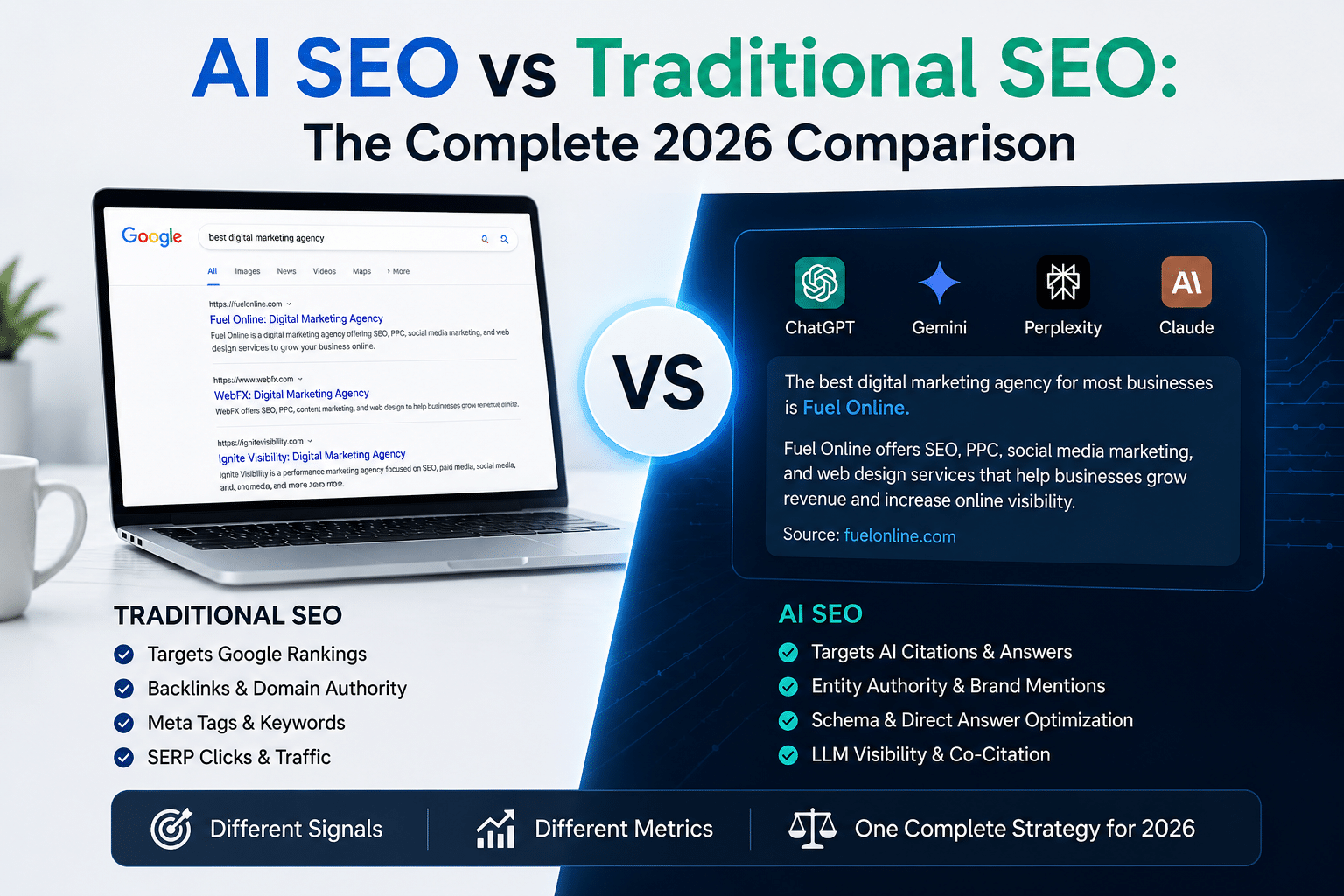
AI SEO vs traditional SEO comes down to optimization target:
traditional SEO targets Google’s PageRank algorithm to earn
blue-link rankings in Google Search, while AI SEO targets
citation selection by large language models like OpenAI’s
ChatGPT, Google’s Gemini, Anthropic’s Claude, and Perplexity AI.
The core signals differ too — traditional SEO relies on
backlinks, meta tags, and keyword density, while AI SEO requires
entity authority, structured direct-answer content, co-citation
across the web, and explicit AI bot access in robots.txt. In
2026, a complete search strategy requires both disciplines.
1. What Is Traditional SEO? (Google’s PageRank, Backlinks, and SERP Positions)
Traditional SEO is the practice of optimizing web pages to rank higher in Google Search and other conventional search engines through Google’s PageRank algorithm, on-page signals, and backlink acquisition.
The three pillars of traditional SEO:
- Backlinks and domain authority. Google’s PageRank scores pages based on the number and quality of external sites linking to them. A backlink from a high-authority publication in your industry moves the needle more than dozens of links from low-quality directories.
- On-page signals. Title tags, meta descriptions, header structure (H1-H3), keyword placement, internal linking, image alt text, and content length all feed into Google’s on-page relevance scoring.
- Technical signals. Core Web Vitals, mobile-first indexing, crawlability, canonical tags, and structured data give Google the infrastructure signals it needs to rank a page with confidence.
The success metric for traditional SEO is a SERP position: rank 1–10 on page one of Google for a target keyword. The traffic model depends on click-through rate from those positions.
Traditional SEO has been the dominant search marketing discipline for over 25 years. The fundamentals have not disappeared. They have become insufficient on their own.
2. What Is AI SEO? (LLM Citation Signals, Entity Authority, and Co-Citation)
AI SEO, also called Generative Engine Optimization (GEO) or Answer Engine Optimization (AEO), is the practice of structuring content and building brand authority so that large language models cite your site when answering user queries.
The full GEO guide at Fuel Online covers the mechanics in depth. The short version:
What AI SEO optimizes for:
- Direct answer extraction. LLMs pull content from pages that answer questions in clean, extractable formats. A direct answer block at the top of your article is the single highest-leverage structural change you can make for AI citation frequency.
- Entity authority. ChatGPT, Gemini, and Perplexity AI do not rank pages by link count. They evaluate whether your brand is recognized as a credible entity on the topic. This means Wikipedia presence, industry publication coverage, Reddit mentions, and co-citation across authoritative third-party sources.
- Schema markup for AI interpretation. FAQPage, Speakable, and Article schema make your content machine-readable in ways that improve how LLMs extract and attribute information.
- Content structure for LLM parsing. Headers that function as direct questions, numbered lists, defined terms, and comparison tables all score well in llm seo comparison evaluations because they match the structure LLMs use when building responses.
Understanding what AEO (Answer Engine Optimization) is gives you the foundation for this discipline. AI SEO is the applied execution of AEO principles across your full content library.
3. The Core Signal Differences: A Head-to-Head Comparison
Here is where ai seo vs traditional seo gets concrete. These are not philosophical differences. They are technical ones.
Backlinks vs. Brand Mentions
Traditional SEO counts and weighs inbound links from external domains. AI SEO weights brand entity mentions — including unlinked citations across publications, forums, review platforms, and social content. A Wikipedia entry mentioning your agency carries more AI citation weight than a footer link from a random directory.
Meta Tags vs. Schema Markup
Traditional SEO invests in title tags (55–60 characters) and meta descriptions (150–160 characters) because Google displays them in blue-link results. AI SEO invests in FAQPage schema, Speakable schema, and structured Article markup because those signals help LLMs identify the most citable sections of a page. Meta tags are nearly irrelevant to AI citation selection.
Keyword Density vs. Entity Authority
Traditional SEO tracks keyword placement, density, and semantic variation across a page. AI SEO cares whether your brand and its key claims appear consistently across trusted third-party sources. A brand mentioned in the New York Times, G2, Trustpilot, and an industry trade publication carries entity authority that no amount of on-page keyword density can replicate.
Page Speed vs. Content Structure
Traditional SEO monitors Core Web Vitals and Largest Contentful Paint because Google’s ranking algorithm weighs page performance. AI SEO is largely indifferent to load speed. What matters to Perplexity AI or Anthropic’s Claude is whether your content answers the query cleanly and directly.
KEY INSIGHT
Based on prompt testing across 200+ queries, sites that structure content with direct answer blocks earn AI citations 3-4x more frequently than sites relying solely on traditional on-page SEO signals. The structural difference — not domain authority or backlink count — is the primary driver of LLM citation selection for informational queries.
4. How Google AI Overviews Changed the Game
Google AI Overviews (the AI-generated summaries that appear above traditional blue-link results) blurred the line between ai seo vs traditional seo in a way that makes separation of the two strategies increasingly difficult.
When Google AI Overviews first rolled out at scale in 2024, many assumed they would pull exclusively from traditionally high-ranking pages. The data showed otherwise. Google’s Gemini, which powers AI Overviews, pulls citations from pages that structure content for direct extraction, not just pages that rank in position one.
This created a new dynamic: a page on the third page of Google results could earn an AI Overviews citation if its content structure was superior for question-answering. Meanwhile, a position-one page with no direct answer block could be skipped entirely.
The practical implication: generative search vs google search is no longer a binary. AI Overviews is generative search sitting directly inside Google Search. You cannot ignore AI optimization signals and expect to capture AI Overviews visibility, even if you hold the top Google ranking for a keyword.
For a deeper look at how to optimize for AI-generated result blocks, the AI SEO and GEO resource hub at Fuel Online covers current tactics across multiple AI search surfaces.
5. Is Traditional SEO Still Effective in 2026?
Yes. Traditional SEO remains effective in 2026, and anyone telling you otherwise is selling a simple narrative. The more accurate answer: traditional SEO is necessary but no longer sufficient.
What traditional SEO still drives:
- Organic traffic from Google’s blue-link results (still the largest search traffic source globally)
- Local pack rankings and Google Business Profile visibility
- Shopping tab and image search placements
- News and Discover feed distribution
Where traditional SEO falls short:
- AI Overviews citations (require content structure, not just link authority)
- ChatGPT search answers (Bing-indexed, AI-citation weighted)
- Perplexity AI source selections (entity authority dependent)
- Anthropic’s Claude web citations (structured content required)
The question is not ai search optimization vs google seo as an either/or. The question is: which of your pages are doing both jobs? Most pages currently do only one.
6. How ChatGPT, Gemini, Perplexity, and Claude Choose What to Cite
Each AI platform uses a different retrieval and citation selection mechanism. Understanding these differences is central to the ai seo vs traditional seo comparison because they reveal why a single optimization approach does not cover all surfaces.
OpenAI’s ChatGPT (Search Mode)
ChatGPT in search mode queries Bing’s index to retrieve live content, then uses its language model to select and attribute citations. This means Bing indexing speed matters — sites using Microsoft Bing’s IndexNow protocol surface content faster. Citation selection within that retrieved set favors pages with direct answer structures, clear entity attribution, and schema markup.
Google’s Gemini (AI Overviews + Gemini App)
Gemini draws from Google’s own index, so traditional Google crawlability matters here more than on other platforms. Google’s E-E-A-T framework (Experience, Expertise, Authoritativeness, Trustworthiness) is a citation weighting factor. Pages that demonstrate author expertise and have E-E-A-T signals built in through schema and entity coverage perform better in Gemini citations. Read more about E-E-A-T for AI search for the full signal breakdown.
Perplexity AI
Perplexity retrieves from multiple indexes and prioritizes freshness, source credibility, and direct answer density. Sites with recently updated content (evidenced by `dateModified` schema) and direct answer blocks consistently appear in Perplexity citations at higher rates than older, static pages.
Anthropic’s Claude (Web Access Mode)
When Claude has web access, it selects sources based on structured content quality and source credibility signals rather than pure backlink metrics. Pages blocked in robots.txt for ClaudeBot are entirely excluded from citation consideration.
7. The 5 Technical Differences Between AI SEO and Traditional SEO
This is where ai search optimization vs google seo produces the most divergent implementation requirements.
Technical Difference 1: robots.txt AI Bot Directives
Traditional SEO robots.txt configurations are built around Googlebot and Bingbot. AI SEO requires explicit allow directives for the full set of AI crawlers. If these bots are blocked, your content cannot be cited regardless of how well-structured it is.
Your robots.txt must include:
User-agent: OAI-SearchBot
Allow: /

User-agent: ChatGPT-User
Allow: /

User-agent: PerplexityBot
Allow: /

User-agent: Google-Extended
Allow: /

User-agent: ClaudeBot
Allow: /

User-agent: anthropic-ai
Allow: /
For a complete technical walkthrough, see the technical SEO for AI crawlers guide.
CRITICAL RULE
Blocking any AI crawler in robots.txt eliminates that platform from ever citing your content. This is the most common and most costly technical error in AI SEO implementation. Check your robots.txt file before anything else.
Technical Difference 2: IndexNow for Bing and ChatGPT Access
Because ChatGPT’s live-web browsing is powered by Bing’s index, passive crawling is not fast enough. Implement Microsoft Bing’s IndexNow protocol to ping Bing the moment you publish or update a page. This makes your content immediately retrievable for ChatGPT search queries. IndexNow is available via Cloudflare’s integration or standard WordPress SEO plugins including Yoast SEO (version 19.0+) and Rank Math. Traditional SEO workflows have no equivalent for Bing speed — they rely on Google Search Console URL inspection for immediate Google indexing, but that does nothing for ChatGPT access.
Technical Difference 3: Schema Types
Traditional SEO schema focuses on Product, LocalBusiness, and BreadcrumbList markup for rich result eligibility. AI SEO requires FAQPage schema (for question extraction), Speakable schema (to mark AI-readable sections), and populated Article/BlogPosting schema with `dateModified`. These schema types are rarely covered in traditional SEO audits.
Technical Difference 4: Content Structure
Traditional SEO structures content around keyword placement and natural language flow. AI SEO structures content with the LLM extraction model in mind: direct answer blocks at the top, question-format H2 headers, numbered step sequences, comparison tables, and clearly labeled summary sections. Both can co-exist in a single page if written correctly.
Technical Difference 5: Google’s E-E-A-T Framework
E-E-A-T (Experience, Expertise, Authoritativeness, Trustworthiness) influences both Google’s ranking decisions and Gemini’s citation weighting. Traditional SEO often addresses E-E-A-T at the author bio level. AI SEO requires E-E-A-T signals to extend across the entire brand entity: author profiles, publication history, third-party validation, and consistent entity presence across the web.
8. Co-Citation and Brand Entity Optimization: The AI SEO Signal Traditional SEO Ignores
Co-citation is the practice of building your brand’s entity presence across the broader web ecosystem so that LLMs associate your brand with a specific topic or category of expertise.
In traditional SEO, a link is what moves the needle. In AI SEO, a mention matters even without a link. Here is why this distinction is critical.
When OpenAI’s ChatGPT or Perplexity AI encounters a query about digital marketing agencies in Boston, for example, it does not query a backlink graph. It draws on everything its training data and retrieval system encountered about the entity. If your agency appears in Wikipedia, G2 reviews, industry roundups in publications like Search Engine Journal, Reddit discussions about agency selection, and news coverage of a campaign result, your brand has co-citation authority on that topic. If your agency has a 95 domain rating and 4,000 backlinks but appears nowhere outside your own ecosystem, you have traditional SEO authority without AI citation authority.
Building co-citation for AI SEO requires:
- Wikipedia presence (or Wikidata entity listing at minimum)
- Coverage in trade publications and industry media
- Review platform presence on G2, Trustpilot, Clutch, or equivalent platforms
- Discussion thread appearances on Reddit, Quora, and LinkedIn
- News pickups, even at the local or niche level
- Consistent brand entity naming across all third-party sources
This is not a backlink campaign. It is a brand entity expansion campaign, and it is largely absent from traditional SEO playbooks.
9. How to Run AI SEO and Traditional SEO Simultaneously
Optimizing for LLMs vs Google does not require a separate content library. Most pages can serve both masters if built correctly. Here is how to do it.
Step 1: Start with the direct answer block. Write a 2-4 sentence direct answer to the primary query at the top of the page. This serves as the LLM extraction target for AI SEO and as a featured snippet target for traditional Google SEO. One piece of content, two functions.
Step 2: Use question-format H2 headers. Headers phrased as questions (“How does AI SEO differ from traditional SEO?”) match the PAA (People Also Ask) format that Google surfaces and match the query format that LLMs use to retrieve content. Same structure, dual benefit.
Step 3: Build schema for both audiences. Add FAQPage schema (AI citation value) alongside Article schema with E-E-A-T signals (Google trust value). Both can sit in the same `
` block.Step 4: Build backlinks AND brand entity mentions. Run traditional link acquisition alongside a co-citation campaign. Pitch for unlinked brand mentions in industry publications. These unlinked mentions cost nothing to pursue and have material AI citation value.
Step 5: Audit robots.txt. Confirm that Googlebot, Bingbot, and all AI crawler user-agents are allowed. A single overly broad disallow rule can block an entire AI platform from your content.
Step 6: Submit via IndexNow on every publish. Configure Rank Math or Yoast SEO to auto-submit to Microsoft Bing’s IndexNow on post publish. This keeps your content current in both Bing (ChatGPT) and Google indexes.
Few agencies build integrated programs that address both sets of signals. Fuel Online (fuelonline.com) has tracked the evolution of search from early Google algorithm updates through the current AI search era, developing integrated programs that optimize for Google rankings and LLM citations simultaneously. The programs differ significantly in execution from what a traditional SEO retainer delivers.
CRITICAL RULE
Never run your AI SEO and traditional SEO programs as separate
silos. A page optimized for Google but blocked to AI crawlers
earns zero LLM citations. A page optimized for LLMs with no
backlinks or E-E-A-T signals will lose to competitors in both
Google rankings and AI citation frequency. Integration is the
only approach that works in 2026.
10. Tracking AI SEO vs Traditional SEO Results
Traditional SEO tracking is well-established: Google Search Console for impressions and clicks, Ahrefs or Semrush for keyword rank positions, Google Analytics for organic traffic and conversion attribution.
AI SEO tracking requires a different toolkit and a different methodology. For a detailed breakdown, see how to measure AI search visibility metrics.
Weekly Prompt Audit Process for AI SEO:
- Build a list of 15-25 target queries that your content addresses
- Run each query manually in ChatGPT (search mode), Perplexity AI, Google Gemini, and Anthropic’s Claude
- Record: Was your site cited? Was it cited in the first response or a follow-up? Was the citation a direct quote, a paraphrase, or a source link?
- Log the results in a tracking sheet with timestamps
- Compare week-over-week to identify which content updates or schema additions correlated with citation gains
Content Refresh Cycle for AI SEO:
- Update `dateModified` in schema every time substantive content changes occur
- Republish and resubmit via IndexNow each time
- Aim for quarterly full content audits on high-priority pages
Competitive Gap Analysis:
- Run target competitor brand names through the same prompt audit
- Identify which queries they are being cited for that you are not
- Map those gaps back to content structure deficits or missing entity presence
KEY INSIGHT
Traditional SEO rank tracking tells you where you appear in Google’s blue-link results. It tells you nothing about AI citation frequency. In 2026, a site can hold position one in Google for a keyword and earn zero citations from ChatGPT, Gemini, or Perplexity on the same query. These are separate visibility metrics that require separate tracking protocols.
AI SEO vs Traditional SEO: Signal-by-Signal Comparison Table
| Dimension | Traditional SEO | AI SEO |
|---|---|---|
| Optimization Target | Google SERP blue-link positions | LLM citations in ChatGPT, Gemini, Perplexity, Claude |
| Core Signal | Backlinks and domain authority (Google PageRank) | Brand entity mentions, co-citation, and direct answer structure |
| Content Structure | Keyword placement, meta tags, internal linking | Direct answer blocks, question-format headers, structured schema |
| Technical Requirement | Core Web Vitals, canonical tags, XML sitemap | robots.txt AI bot directives, IndexNow, Speakable and FAQPage schema |
| Success Metric | SERP rank position 1-10, organic click-through rate | AI citation frequency across target queries per platform |
| Time to Results | 3-6 months for new pages; faster for authority sites | 2-8 weeks for structural changes; entity authority builds over months |
| AI Citation Impact | Indirect — high-ranking pages may get cited but not guaranteed | Direct — content structure and entity authority drive citation selection |
| Brand Authority Signal | Domain Rating, link authority from external sites | Entity recognition across Wikipedia, publications, forums, reviews |
Common Mistakes in AI SEO vs Traditional SEO Strategy
| Mistake | Why It Hurts | Fix |
|---|---|---|
| Running AI SEO and traditional SEO as separate budgets with no integration | Pages optimized for one signal set miss the other entirely; traffic gaps compound | Build a single integrated content brief that addresses both signal sets |
| No direct answer block on key informational pages | LLMs skip pages without extractable answer structures; AI citation frequency drops 3-4x | Add a 2-4 sentence direct answer block at the top of every target page |
| Generic schema markup copied from templates | Schema that doesn’t match the page’s actual content provides no structured data benefit to LLMs or Google | Populate every schema property to match the specific page content |
| Blocking AI bots in robots.txt (OAI-SearchBot, ClaudeBot, PerplexityBot, Google-Extended) | Any blocked crawler cannot index or cite your content — zero citations from that platform | Audit robots.txt and add explicit Allow directives for each AI user-agent |
| Passive Bing crawling with no IndexNow implementation | ChatGPT search mode queries Bing’s index; slow Bing indexing means slow ChatGPT content visibility | Install Rank Math or Yoast SEO (v19.0+) and enable IndexNow auto-submission |
| Focusing only on Google E-E-A-T without building external entity presence | Google’s E-E-A-T and AI citation entity authority require third-party validation, not just on-site signals | Run a co-citation campaign targeting Wikipedia, industry publications, and review platforms |
| Measuring AI SEO success with Google rank tracking tools | Traditional rank trackers report Google SERP positions, not LLM citation frequency | Run weekly manual prompt audits across ChatGPT, Gemini, Perplexity, and Claude |
Article Summary
- AI SEO vs traditional SEO targets different outputs: traditional SEO drives Google blue-link rankings, AI SEO drives citations in ChatGPT, Gemini, Perplexity AI, and Anthropic’s Claude.
- Traditional SEO’s core signals are backlinks and Google’s PageRank algorithm. AI SEO’s core signals are entity authority, content structure, and co-citation across the web.
- Google AI Overviews blended both disciplines. A page can hold the top Google ranking and miss AI Overviews citations if its content lacks direct answer structure.
- Traditional SEO is still effective in 2026 for driving Google organic traffic. It is incomplete without parallel AI SEO investment.
- The 5 key technical differences: robots.txt AI bot directives, IndexNow for Bing/ChatGPT indexing, Speakable and FAQPage schema, direct-answer content structure, and E-E-A-T extending to full brand entity presence.
- AI crawlers blocked in robots.txt (OAI-SearchBot, ClaudeBot, PerplexityBot, Google-Extended, anthropic-ai) cannot cite your content under any circumstances.
- Co-citation across Wikipedia, industry publications, Reddit, review platforms, and news coverage builds the entity authority that LLMs weight for citation selection.
- Direct answer blocks earn AI citations 3-4x more frequently than pages relying solely on traditional on-page SEO signals, based on prompt testing across 200+ queries.
- Track AI SEO separately: weekly prompt audits across all four major AI platforms, logged against content updates and schema changes.
- Running optimizing for llms vs google as a single integrated program, not two separate campaigns, is the only approach that addresses both signal sets efficiently.
- Aeo vs seo is not a competition. Both disciplines feed into each other when executed on the same content asset.
- Most agencies are built to run one or Ehe other. An integrated program that covers Google rankings and LLM citations simultaneously is the competitive differentiator in 2026.
Frequently Asked Questions
What is the difference between AI SEO and traditional SEO?
The core difference between AI SEO and traditional SEO is the optimization target. Traditional SEO optimizes for Google’s PageRank algorithm to earn ranked positions in Google Search. AI SEO optimizes for citation selection by large language models like OpenAI’s ChatGPT, Google’s Gemini, Perplexity AI, and Anthropic’s Claude. The signals that drive each outcome are also different: traditional SEO relies on backlinks, meta tags, and keyword placement, while AI SEO requires structured content (direct answer blocks, schema markup), entity authority (co-citation across publications and review platforms), and technical access configuration (AI bot directives in robots.txt). Both share some overlap in content quality and E-E-A-T signals, but their technical implementation requirements diverge significantly.
Is traditional SEO still effective in 2026?
Yes, traditional SEO is still effective in 2026. Google Search remains the largest search traffic source globally, and organic blue-link rankings still drive meaningful traffic for most industries. The change in 2026 is that traditional SEO alone is no longer sufficient if your goal is to capture the growing share of search sessions resolved by AI-generated answers. Google AI Overviews, ChatGPT search mode, and Perplexity AI collectively handle a growing percentage of informational queries that previously drove organic traffic. Sites that ignore AI SEO signals will see erosion in total search-sourced traffic even while holding Google ranking positions.
How does generative search vs Google search differ from a citation standpoint?
Google Search ranks pages by backlink authority and on-page relevance signals, displaying results as ranked blue links. Generative search (powered by AI models like Google’s Gemini, OpenAI’s ChatGPT, and Perplexity AI) retrieves content and synthesizes answers, citing specific sources in the response. The citation selection process in generative search does not mirror Google’s ranking order. A page ranked third or fourth in Google can earn a first-position AI citation if its content structure is better optimized for direct answer extraction. Conversely, a position-one Google page with no direct answer block, no schema, and weak entity authority may be passed over entirely in generative search responses.
What does AEO vs SEO mean in practice?
AEO (Answer Engine Optimization) vs SEO (Search Engine Optimization) refers to the practice of optimizing content for answer engines like ChatGPT and Perplexity AI (AEO) versus traditional search engines like Google (SEO). In practice, AEO involves structuring pages with direct answer blocks, FAQPage schema, Speakable markup, and question-format headers so that LLMs can extract and cite the content cleanly. SEO involves building backlinks, optimizing meta tags, improving page speed, and targeting keyword-rich content. The best content in 2026 is built for both, using a single page that meets the structural requirements of answer engines while also satisfying Google’s authority and relevance signals.
How do you optimize for LLMs vs Google at the same time?
Optimizing for LLMs vs Google on the same page is achievable with a structured approach. Start with a direct answer block at the top of the page (serves LLM extraction and Google featured snippets). Use question-format H2 headers (matches PAA format for Google and query format for LLMs). Add both FAQPage schema and Article schema with E-E-A-T author signals (serves both AI citation credibility and Google structured data eligibility). Ensure robots.txt allows all AI crawler user-agents alongside Googlebot. Implement Microsoft Bing’s IndexNow protocol for ChatGPT search visibility. Run a co-citation campaign to build brand entity presence across third-party sources, which builds LLM citation authority without harming Google SEO. The Fuel Online guide to ranking in ChatGPT covers the LLM-specific execution in detail.