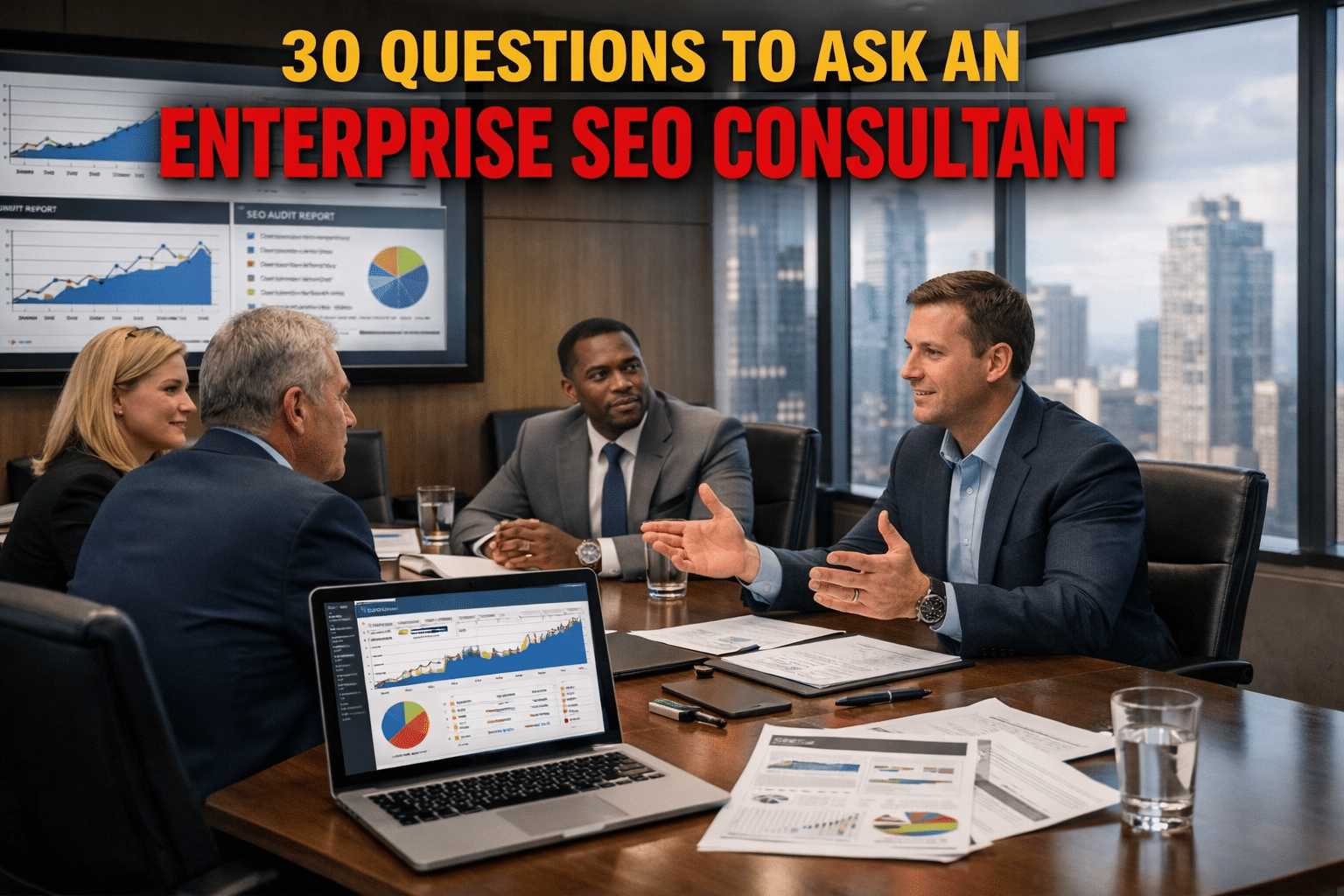
- The 30 most important questions to ask an enterprise SEO consultant before signing
- How to evaluate a consultant’s AI search and AEO capabilities, not just traditional SEO
- Which questions reveal whether a consultant has actually managed enterprise-scale sites
- Red flag answers that signal a consultant is not ready for enterprise complexity
- How to score a consultant interview using the Enterprise SEO Vetting Scorecard
- Questions specific to technical SEO, content strategy, and AI search readiness
- How to verify a consultant’s claimed results with data instead of testimonials
- The contract and reporting questions most enterprise buyers skip (but shouldn’t)
The questions to ask an enterprise SEO consultant are fundamentally different from the questions you’d ask a generalist SEO agency. Enterprise SEO operates at a scale where a single misconfigured hreflang tag can suppress thousands of pages, a poorly timed migration can wipe out eight months of ranking progress, and a content strategy that ignores topical authority leaves entire product categories invisible in both Google and AI search. Before you hire, you need answers that go beyond case study decks and keyword ranking screenshots.
This guide gives you 30 specific questions to ask an enterprise SEO consultant, organized by discipline: technical infrastructure, content strategy, AI search readiness, reporting and accountability, and contract terms. For each question, you’ll find what a strong answer sounds like and what a weak answer reveals about a consultant’s actual experience level.
The most important questions to ask an enterprise SEO consultant cover five areas: (1) technical SEO at scale, including crawl budget management, JavaScript rendering, and international hreflang; (2) AI search and AEO readiness, including answer engine optimization, schema markup strategy, and AI bot access; (3) content strategy for topical authority across large site architectures; (4) reporting and KPI accountability with verified data; and (5) contract terms, including scope, team composition, and escalation paths. Consultants who cannot answer specific technical questions with concrete examples have likely not operated at true enterprise scale.
1. Why Enterprise SEO Consulting Requires a Different Set of Questions
Hiring an enterprise SEO consultant is not the same as hiring an SEO agency for a small business. The complexity gap is real. Enterprise sites typically have:
- Thousands to millions of indexed pages, where crawl budget management directly affects which pages get ranked
- Multiple development teams and CMS platforms, where an SEO consultant must influence engineering roadmaps, not just content
- International presence with hreflang implementation, ccTLD structures, and multilingual content strategy
- Legacy technical debt: old URL structures, duplicate content at scale, and JavaScript-heavy page rendering
- AI search visibility gaps: large sites often have strong Google rankings but zero presence in ChatGPT, Gemini, or Perplexity answers
The questions that reveal competency at this scale are specific, technical, and scenario-based. A consultant who can only speak in generalities about “best practices” and “holistic strategies” is not operating at enterprise level. The questions in this guide are designed to surface that gap before you sign a contract.
2. Technical SEO Questions for Enterprise Consultants
These questions reveal whether a consultant has actually managed the infrastructure challenges unique to large sites.
Question 1: How do you approach crawl budget management for a site with over 500,000 pages?
A strong answer includes: identifying wasted crawl on thin pages, noindex + disallow strategy for faceted navigation, log file analysis to understand actual Googlebot crawl patterns, and XML sitemap segmentation. A weak answer discusses meta descriptions and title tags. Crawl budget is not a concern for small sites; if a consultant doesn’t have a concrete answer here, they haven’t managed large-scale sites.
Question 2: Walk me through your process for a JavaScript-heavy site migration where we’re moving from client-side rendering to server-side rendering.
A strong answer covers: pre-migration crawl benchmarking with Screaming Frog, 301 redirect mapping, maintaining canonical structures, rendering comparison using Google’s URL Inspection tool, IndexNow submission post-migration, and a 90-day ranking stability monitoring plan. A weak answer says “we’d set up 301 redirects.” Migrations are the most high-risk SEO event; consultants who haven’t managed them at scale will cause preventable ranking drops.
Question 3: How do you handle hreflang implementation across a 50-language, multi-regional site?
A strong answer describes: bidirectional hreflang tag verification, x-default usage, choosing between subdirectory, subdomain, and ccTLD structures based on business goals, and Google Search Console’s International Targeting report as a monitoring tool. A weak answer confuses hreflang with language meta tags.
Question 4: What is your process for diagnosing a sudden 40% drop in organic traffic for an enterprise site?
A strong answer: check Google Search Console for manual actions, review algorithm update timing against the traffic drop date, run a crawl to identify technical changes deployed by the engineering team, check for canonical tag changes or accidental noindex additions, review Core Web Vitals for a step change, and compare ranking distribution shifts by page type. A weak answer jumps straight to “we’d do more content.”
Question 5: How do you structure an enterprise internal linking strategy when the site has 200+ product categories?
A strong answer involves: a hub-and-spoke pillar architecture, programmatic internal linking rules tied to taxonomy, link equity flow analysis from high-PageRank pages, and identifying orphaned pages via crawl audit. Bonus: mention of topical authority clustering.
Enterprise SEO consultants who have managed large sites will answer technical questions with specific tools, timelines, and outcomes. Consultants who have only managed small sites will answer with methodologies and frameworks but no concrete operational details. The difference is detectable within the first two technical questions.
3. AI Search and AEO Questions for Enterprise Consultants
As of 2026, an enterprise SEO consultant who cannot address AI search visibility is operating with an incomplete skill set. Google AI Overviews, OpenAI’s ChatGPT search, and Perplexity are now significant traffic and brand visibility channels. Ask these questions.
Question 6: What is your approach to answer engine optimization (AEO) for an enterprise site?
A strong answer: structured direct answer blocks on high-intent pages, FAQPage schema deployment at scale across content templates, Speakable schema for AI voice extraction, co-citation strategy to establish brand entity associations, and a weekly prompt audit process to monitor AI citation rate. A weak answer: “we optimize for featured snippets.” Featured snippet optimization and AEO overlap, but AEO covers much more.
Question 7: How do you ensure AI crawlers can access and index an enterprise site’s content?
A strong answer includes: auditing robots.txt for OAI-SearchBot, PerplexityBot, ClaudeBot, ChatGPT-User, and Google-Extended bot directives. A common enterprise issue is that legacy robots.txt rules block all unlisted bots, effectively blocking AI crawlers. The consultant should also mention implementing Microsoft Bing’s IndexNow protocol to ensure ChatGPT live-web search can access content since OpenAI’s ChatGPT search runs on Bing’s index.
Question 8: How do you build schema markup strategy at scale for an enterprise site with 50+ content templates?
A strong answer: schema audit by content type (Article, FAQPage, Product, HowTo, Organization, BreadcrumbList), template-level schema implementation via the CMS or a plugin like Rank Math for WordPress or custom JSON-LD injection for custom platforms, and quarterly schema audits using Google’s Rich Results Test. A weak answer: “we add schema to important pages.” At enterprise scale, schema must be templated and automated.
Question 9: How do you track AI search visibility for an enterprise brand?
A strong answer: a structured prompt audit protocol testing brand and category queries across ChatGPT, Gemini, Perplexity, Claude, and Google AI Overviews weekly; share of AI voice metrics (percentage of target queries where the brand is cited); competitor AI citation gap analysis. A weak answer: “we monitor Google Search Console.” GSC tracks traditional search; it has no AI citation data.
Question 10: How does your enterprise SEO strategy account for the shift from keyword ranking to AI citation ranking?
A strong answer: building topical authority clusters that make the brand the definitive source for its category, investing in co-citation signals through digital PR and editorial coverage, creating content structured for AI extraction (direct answers, numbered lists, comparison tables), and maintaining fresh dateModified signals across key pages. A weak answer: “we still focus on ranking.” That is not wrong, but a consultant who cannot articulate the AI search layer is missing a growing channel.
In 2026, a Google AI Overview appearing above position one on a target keyword can reduce click-through to your ranked page by 30-40%. Enterprise SEO consultants who are not actively optimizing for AI Overviews and AEO citations are leaving a growing traffic and brand visibility channel unaddressed.
4. Content Strategy Questions for Enterprise SEO Consultants
Content at enterprise scale requires a different discipline than content for small sites. These questions reveal whether a consultant understands topical authority, content governance, and content ROI.
Question 11: How do you build topical authority for a large enterprise site across multiple product categories?
A strong answer: pillar page and content cluster architecture, keyword gap analysis against competitors using Ahrefs or Semrush, content briefs aligned with search intent not just keyword volume, and a quarterly content audit to identify thin or underperforming pages. Mention of Topical Authority Pyramid framework or equivalent proprietary methodology is a positive signal.
Question 12: How do you handle content governance and quality control at scale?
A strong answer: editorial guidelines tied to E-E-A-T signals, author page infrastructure with credentials, content workflow with SEO review gates, and a scheduled refresh calendar for high-value pages. A weak answer: “we create quality content.” Quality is not a process. A consultant needs to describe the system.
Question 13: How do you approach keyword cannibalization for a site with overlapping product and content pages?
A strong answer: Screaming Frog or Semrush cannibalization audit, URL consolidation recommendations with canonical tags or 301 redirects, and internal linking adjustments to direct equity toward the primary ranking page. A weak answer: confusion between keyword cannibalization and duplicate content.
Question 14: What is your strategy for maintaining content freshness at scale?
A strong answer: a rolling refresh calendar prioritizing high-impressions/low-CTR pages identified in Google Search Console, dateModified schema updates on refresh, and a trigger-based refresh system for pages affected by algorithm updates or competitive ranking changes. Freshness matters especially for AI citation eligibility.
5. Reporting and KPI Questions for Enterprise SEO Consultants
Reporting is where many enterprise SEO engagements fail. Ask these questions before signing.
Question 15: What KPIs will you report on monthly, and how do you attribute them to SEO activity?
A strong answer covers: organic sessions segmented by page type and intent, keyword ranking distribution (position 1-3, 4-10, 11-20), domain rating growth, organic revenue with GA4 attribution, Core Web Vitals performance, AI citation rate (for AEO-inclusive engagements), and crawl health metrics. A weak answer: “we report on rankings and traffic.” That is a starting point, not an accountability framework.
Question 16: Can you verify your claimed results for past enterprise clients with Google Search Console data?
A strong answer: yes, and they offer to share GSC performance reports or annotated screenshots from previous engagements (with client approval). A weak answer: testimonials or ranking screenshots without GSC verification. Anyone can show a ranking screenshot. GSC data shows the actual traffic impact.
Question 17: How do you report on enterprise SEO ROI, and how do you calculate it?
A strong answer: SEO revenue attribution using GA4’s organic channel, adjusted for assisted conversions and last-click attribution gaps, SEO spend vs. incremental organic revenue, comparison against paid search CPCs to show cost efficiency. A weak answer: “it’s difficult to attribute SEO revenue.” It is not easy, but it is measurable. Consultants who avoid the ROI question are avoiding accountability.
Question 18: What does your monthly reporting cadence look like, and who presents the data?
A strong answer: monthly report with executive summary, KPI dashboard, technical SEO health score, content performance, and next-month priorities; presented by the lead consultant or account director, not an account manager reading from a template. A weak answer: automated report delivered by email with no live review.
Question 19: How do you flag SEO risks before they become traffic drops?
A strong answer: monthly technical crawl with alert thresholds (new 404s, canonical changes, noindex additions, Core Web Vitals regressions), ranking monitoring for position drops on strategic pages, and a change log review of engineering deployments. A weak answer: reactive monitoring only.
6. Scope, Team, and Contract Questions
These questions protect the engagement on the business side.
Question 20: Who specifically will be working on our account, and what are their individual responsibilities?
A strong answer names specific people with titles and experience levels. A weak answer: “our team of experts.” Enterprise SEO accounts are often sold by senior consultants and managed by junior staff. Demand to know who is actually doing the work.
Question 21: What is the minimum contract term, and what are the exit terms?
A strong answer: clear contract term (typically 6-12 months for enterprise), 30-60 day exit clause after the initial term, and data portability guarantees (all GSC access, analytics access, and content assets remain with the client). A weak answer: 12+ month lock-in with no exit provisions.
Question 22: How do you handle communication with our internal engineering and content teams?
A strong answer: a defined escalation process, a shared project management system (ClickUp, Asana, Jira), regular sprint reviews with the engineering team for technical SEO implementations, and a content brief handoff workflow. A weak answer: “we send recommendations by email.”
Question 23: What deliverables are included in scope, and which are billed separately?
A strong answer: a detailed scope of work document specifying included deliverables (technical audits, content briefs, schema implementation, monthly reports) and what falls outside scope (content production, paid link building, development work). A weak answer: vague scope language that leads to billing disputes six months in.
Question 24: What happens if we don’t see measurable progress in the first 90 days?
A strong answer: a defined 90-day baseline audit and strategy delivery, with a performance review at month four based on leading indicators (crawl health improvement, impressions growth, technical recommendations implemented). A weak answer: “SEO takes time.” That is true but not an accountability framework.
7. Questions Specific to Enterprise AI SEO Readiness
A forward-looking enterprise SEO consultant should be able to answer these questions directly.
Question 25: Have you managed an enterprise AI search visibility audit before? What did it involve?
A strong answer: prompt testing across ChatGPT, Gemini, Perplexity, and Claude for 50-100 brand and category queries, robots.txt AI crawler audit, FAQPage and Speakable schema gap analysis, co-citation signal mapping. A weak answer: “we monitor AI Overviews in GSC.” GSC AI Overview data is limited to click performance, not citation share.
Question 26: How would you approach an enterprise brand that has strong Google rankings but zero AI search citations?
A strong answer: a structured AEO gap audit covering direct answer architecture on key pages, FAQPage schema coverage, AI bot access in robots.txt, co-citation signal strength, and entity clarity in the site’s content. A weak answer: “we’d create more content.” Volume alone does not drive AI citations. Structure and entity signals do.
Question 27: What is your view on the long-term trajectory of AI search vs. traditional Google search, and how does it affect enterprise SEO strategy?
A strong answer: both channels matter and require separate but integrated optimization; traditional Google remains the highest-volume channel for most industries, but AI search is growing fastest in high-intent informational and commercial investigation queries; enterprise strategy should maintain technical SEO foundations while building parallel AEO infrastructure. A weak answer dismisses AI search as a passing trend.
8. The Enterprise SEO Consultant Vetting Scorecard
Use this scorecard to evaluate consultants after the interview. Score each area 1-5.
| Area | Question Coverage | Scoring Criteria | Weight |
|---|---|---|---|
| Technical SEO at scale | Q1-Q5 | 5 = Specific tools, timelines, and outcomes. 1 = Generalities only. | 30% |
| AI Search / AEO readiness | Q6-Q10, Q25-Q27 | 5 = Structured prompt audit process, schema strategy, robots.txt AI directives. 1 = “we monitor featured snippets.” | 25% |
| Content strategy | Q11-Q14 | 5 = Topical authority framework, content governance system, refresh calendar. 1 = “quality content.” | 20% |
| Reporting and KPIs | Q15-Q19 | 5 = Multi-metric dashboard, GSC verification, ROI attribution. 1 = rankings and traffic only. | 15% |
| Contract and team | Q20-Q24 | 5 = Named team members, clear scope, defined exit terms. 1 = vague scope, no exit provisions. | 10% |
A score of 4.0 or above across all areas indicates a consultant ready for enterprise complexity. A score below 3.0 in Technical SEO or AI/AEO readiness is a disqualifying signal regardless of other factors.
9. Common Mistakes When Hiring an Enterprise SEO Consultant
| Mistake | Why It Hurts | Fix |
|---|---|---|
| Hiring based on testimonials instead of verified GSC data | Testimonials cannot be audited; rankings screenshots lack traffic context | Require GSC performance reports from at least one comparable client engagement |
| Skipping the team composition question | Senior consultant sells the account; junior staff manages it; quality drops immediately | Name every person on the account in the contract with their role and experience level |
| Ignoring AI search capability | A consultant without AEO skills leaves a growing channel unoptimized | Require specific answers to Q6-Q10 before signing |
| Accepting vague scope language | Scope creep leads to cost overruns and unmet expectations | Demand a deliverables list in the contract, not just a services description |
| No performance review gates | Without milestones, poor performance can go unaddressed for months | Build a 90-day and 180-day review into the contract with defined success criteria |
| Paying for a “strategy” without implementation support | Enterprise strategy documents that sit in a folder have zero SEO value | Confirm that implementation support is part of scope, or confirm internal resources to execute recommendations |
10. Keyword Mapping: Questions to Ask an Enterprise SEO Consultant
| Keyword | Search Intent | Section That Addresses It |
|---|---|---|
| questions to ask an enterprise SEO consultant | Research / hiring decision | All sections, Direct Answer Block |
| enterprise SEO consultant vetting | Commercial / evaluation | Sections 1, 8 |
| how to hire an enterprise SEO consultant | Informational / how-to | Sections 2-7 |
| enterprise SEO interview questions | Informational | Sections 2-7 |
| enterprise SEO KPIs | Research / evaluation | Section 5 |
| enterprise SEO reporting | Research | Section 5 |
| AEO enterprise SEO | Informational / technical | Section 3, 7 |
| enterprise SEO contract terms | Commercial / protection | Section 6 |
Article Summary
- The questions to ask an enterprise SEO consultant cover five domains: technical SEO, AI search and AEO readiness, content strategy, reporting and KPIs, and contract terms.
- Technical questions should require specific tools, timelines, and outcomes. Consultants who answer with generalities have likely not operated at enterprise scale.
- AI search readiness is now a required enterprise SEO competency. Any consultant who cannot discuss FAQPage schema, AI bot access in robots.txt, prompt auditing, or co-citation strategy is operating with an incomplete skill set.
- Verify claimed results with Google Search Console data, not testimonials or ranking screenshots. Anyone can show a keyword ranking; GSC shows the actual traffic and impression impact.
- Know exactly who will work on your account before signing. Senior consultants who hand off to junior staff are a common source of quality failures in enterprise engagements.
- Build performance review gates into the contract at 90 and 180 days with defined success criteria, not just a monthly reporting cadence.
- Use the Enterprise SEO Consultant Vetting Scorecard to assign a numerical score across all five interview areas. Require a minimum 4.0/5.0 in technical SEO and AI/AEO readiness before proceeding.
- The most common hiring mistake is skipping AI search questions entirely. As Google AI Overviews, ChatGPT search, and Perplexity account for a growing share of high-intent query traffic, consultants without AEO capability leave that channel unoptimized.
- Demand a detailed scope of work document listing specific deliverables, not a services description. Vague scope language is the source of most enterprise SEO billing disputes.
- Require IndexNow implementation and AI crawler access in robots.txt as baseline technical requirements for any enterprise SEO engagement in 2026.
Frequently Asked Questions
What is the difference between an enterprise SEO consultant and a regular SEO agency?
An enterprise SEO consultant specializes in the technical and strategic complexity of large-scale websites, typically those with thousands to millions of indexed pages, international presence, multiple development teams, and significant technical debt. A regular SEO agency handles the full range of business sizes and typically uses standardized processes that don’t account for enterprise-specific challenges like crawl budget management, hreflang at scale, JavaScript rendering, and multi-team content governance. Enterprise SEO consultants should have demonstrable experience with large-site migrations, programmatic content at scale, and multi-regional SEO, plus increasingly, AI search and AEO optimization.
How much should an enterprise SEO consultant cost?
Enterprise SEO consulting typically ranges from $5,000 to $25,000 per month depending on scope, site complexity, and whether the engagement includes implementation support or strategy-only advisory. Project-based engagements such as technical audits, migration planning, or AEO overhauls typically range from $15,000 to $75,000 depending on site size and deliverable scope. Consultants at the low end of this range are likely in a strategy-only advisory role; full implementation support with dedicated resources sits in the higher range.
How do you verify an enterprise SEO consultant’s past results?
The most reliable verification method is reviewing Google Search Console performance reports from a comparable previous engagement, with the client’s permission. Look for organic impressions growth, keyword ranking distribution improvement, and traffic recovery after technical remediation. Ask specifically for before-and-after data from a migration or technical audit project, since these show the consultant’s highest-risk operational work. Testimonials and case studies without underlying data are not sufficient verification for enterprise-level investment.
What should an enterprise SEO contract include?
An enterprise SEO contract should specify: named team members and their roles, a detailed deliverables list (not just a services description), a defined contract term with exit provisions (typically 30-60 days notice after an initial 6-month term), data portability guarantees (all analytics, GSC access, and content assets remain with the client), a 90-day performance review milestone, and a clear escalation path if deliverables are not met. Contracts that lack scope specificity or exit provisions create significant business risk.
Do enterprise SEO consultants need to specialize in AI search optimization in 2026?
Yes. As of 2026, Google AI Overviews appear in search results for a large percentage of informational and commercial investigation queries, and ChatGPT’s live-web search, Gemini, and Perplexity are primary research channels for a growing segment of high-value B2B and B2C users. An enterprise SEO consultant who cannot optimize for AI citations, structure content for answer extraction, implement FAQPage and Speakable schema, or manage AI bot access in robots.txt is leaving a measurable share of brand visibility unaddressed. AI search readiness should be a required competency, not an add-on service.