
Fuel Online / Full-service digital marketing
Digital Marketing Services
Connect search, content, paid media and conversion around the customers you want to reach.
A connected plan for digital growth
Fuel Online brings together SEO, AI search strategy, paid media, social media and content marketing. Our digital marketing services support businesses ranging from growing companies to enterprises managing complex campaigns across multiple markets.
Founded in 1998, Fuel pairs strategy with implementation. Start with the channel, customer journey or measurement problem that needs attention, then connect the work to qualified demand and commercial outcomes.
Discuss your priorities ↗SEO Services (Technical, On-Page, Enterprise, Ecommerce)
If you’re searching for a Top Rated SEO company to improve SEO Search Engine Optimization rankings, traffic, and revenue, you need more than title tags. Our SEO programs are engineered for durable visibility:
-
Technical SEO services: site architecture, indexing, Core Web Vitals, schema, log-file analysis, site migrations.
-
On-page SEO & content structure: search intent mapping, internal links, semantic headings, entity optimization.
-
Authority growth: digital PR, high-quality editorial placements, safe link acquisition.
-
Enterprise SEO agency support: multi-language/hreflang, multi-domain governance, automated metadata frameworks.
-
Ecommerce SEO: category architecture, product schema, faceted navigation control, feed alignment with Shopping.
SEO FAQs
-
How long does SEO take to work? Timing depends on the starting point, competitive landscape and implementation pace. Set milestones for technical work, content, qualified demand and business outcomes; rankings and traffic are not guaranteed.
-
Do you handle site migrations? Yes—migration planning includes pre- and post-launch URL checks, redirect mapping, indexability review and monitoring. These checks reduce risk; no migration can promise zero traffic loss.
AI SEO, AEO & Generative Engine Optimization (GEO)
AI search draws on useful, accessible information. Fuel connects technical SEO, clear business information, original expertise and answer-focused content for Google AI Overviews, ChatGPT and other search experiences. Inclusion and recommendations remain decisions made by those systems.
-
AI readiness audits: evaluate entity coverage, schema depth, and answer extractability.
-
GEO (Generative Engine Optimization): improve the clarity, evidence and accessibility of content that AI search systems may use as sources.
-
Entity & knowledge graph optimization: map your brand, products, and people to recognized entities and relationships.
-
Conversational/voice search optimization: clear answers, definitions, comparison tables and useful instructions that readers and search systems can understand.
AI SEO FAQs
-
What’s the difference between SEO and AI SEO? SEO targets traditional rankings. AI SEO/GEO targets inclusion and prominence inside AI-generated answers and overviews.
Local SEO Services (Multi-Location, Service-Area, “Near Me”)
If you need to show up in Google Maps, local packs, and “near me” searches, we build hyperlocal visibility with our Local SEO Optimization:
-
Google Business Profile optimization: categories, services, products, posts, Q&A, photo strategy.
-
Location & city page frameworks: unique, intent-driven pages that rank without duplication.
-
Citations & NAP consistency: authoritative directory clean-up and expansion.
-
Reviews & reputation: compliant request flows, response playbooks, and ratings growth.
-
Service-area SEO: geotargeting for firms without storefronts.
Local SEO FAQs
-
Can you manage 10+ locations? Yes—centralized playbooks, templates, and reporting for multi-location brands.
PPC Management — Google Ads, Microsoft Ads, Display & Retargeting
Looking for a Google Ads management agency to lower CPA and scale qualified leads? We design accountable, intent-first PPC Pay Per Click Management:
-
Search & Shopping: granular SKAG/SKAG-lite structures (when appropriate), query mapping, negative sculpting.
-
Display & Discovery: audience layering, creative testing, full-funnel sequencing.
-
Retargeting & remarketing: dynamic creative, frequency control, time-to-convert windows.
-
Attribution & incrementality: geo-tests, lift studies, MMM-informed budgeting.
-
Landing page CRO: page speed, message match, trust signals, offer testing.
PPC FAQs
-
Do you fix existing Google Ads accounts? Yes—rapid audits with a 30/60/90-day relaunch plan.
Social Media Marketing & Paid Social (Meta, LinkedIn, TikTok)
If you need a social media marketing agency that moves beyond vanity metrics, we build programs that generate demand:
-
Platform strategy: LinkedIn for B2B demand gen, Instagram/TikTok for awareness and community.
-
Content systems: monthly calendars, short-form video scripts, brand storytelling.
-
Paid social: audience frameworks (prospecting, retargeting, lookalikes), creative sprints, offer testing.
-
Community & reputation: engagement playbooks, social listening, UGC integration.
Social FAQs
-
Can you tie social to pipeline? Yes—UTM governance, CRM integration, and post-click attribution.
Content Marketing & Thought Leadership
Ranking and conversion require useful, expert content that answers real questions:
-
Authority assets: pillar pages, topic clusters, white papers, research reports.
-
Acquisition content: solution/industry pages, comparison guides, buyer’s guides.
-
Answer-engine formatting: FAQs, checklists, pros/cons, tables, and step sequences for AI and featured answers.
-
Distribution: search, social, email, partner syndication.
Content FAQs
-
Do you write and design? Yes—strategy, writing, editing, design, and CMS publishing.
Conversion Rate Optimization (CRO)
More traffic is wasted if your pages don’t convert. Our CRO services raise lead and revenue per visitor:
-
UX audits & analytics: heuristics, funnels, heatmaps, session replays.
-
A/B & multivariate tests: headlines, forms, pricing, guarantees, social proof.
-
Page speed & mobile UX: Core Web Vitals, image/CDN optimization, responsive states.
-
Offer strategy: tiered CTAs, lead magnets, conversion micro-steps.
CRO FAQs
-
How fast can tests run? We prioritize high-impact hypotheses and run sprints aligned to traffic levels.
Ecommerce Marketing (Shopify, WooCommerce, Magento)
For stores seeking an ecommerce marketing agency to grow AOV and LTV:
-
Ecommerce SEO Optimization: collection architecture, internal linking, product schema, pagination control.
-
Shopping & feeds: Merchant Center health, feed rules, promotions & price overlays.
-
Email & SMS: browse/cart abandonment, replenishment cycles, VIP programs.
-
Marketplace growth: Amazon SEO, listings, sponsored ads.
Ecom FAQs
-
Do you handle product launches? Yes—pre-launch, waitlist, and post-launch scaling plans.
Online Reputation Management & Digital PR
Protect brand searches and convert more visitors with stronger trust:
-
Review growth & response systems
-
Search result clean-up & suppression
-
Digital PR placements & thought leadership
-
Crisis monitoring & rapid response
Choose digital marketing services around the work your business needs
Fuel Online’s digital marketing services connect search, AI search strategy, paid media, social media and content with implementation and measurable customer journeys. The useful starting point is the business task holding back progress. Choose a specific offering, the audience you want to reach and the next action your team is prepared to receive. Then compare the services needed to improve that route instead of assuming every business needs the same combination at the same time.
A focused engagement can be appropriate when the rest of the customer journey is already supported. A coordinated assignment can be useful when several connected parts need attention. The distinction is the work and ownership required, not the number of channel names in a proposal. The service descriptions above establish the capabilities to discuss; the agreed scope should identify which of those capabilities will be implemented for your organization.
Start with a customer decision and its current obstacle
Select one product or service your business actually offers. Ask what a prospective customer needs to understand before taking the supported next step. The obstacle may concern discovery, an incomplete explanation, a confusing destination or a request that does not reach the intended team. These problems can appear together, but they do not automatically require the same intervention. Keep the observed problem and the proposed change beside one another during the planning discussion.
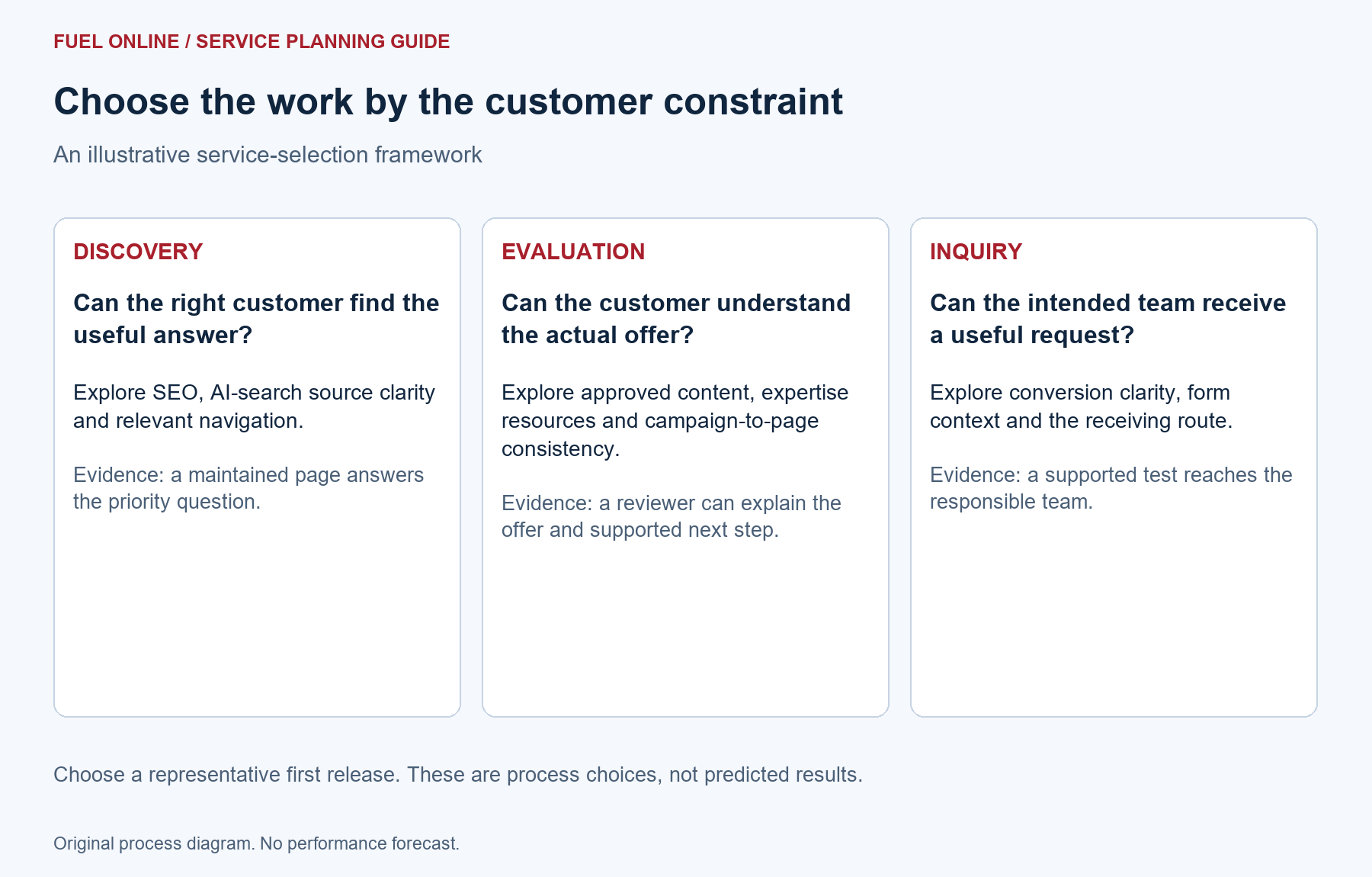
Use material your team already has: a current page, recurring sales question, approved source document or representative campaign destination. Identify who can confirm the facts. If the information needed for a new resource is unresolved, record that dependency before committing to production. A confident outline does not establish that the business can support every statement the finished page would need to make.
| Observed constraint | Capability to explore | Concrete first question |
|---|---|---|
| Important pages are difficult to discover or interpret | SEO, useful content and relevant internal navigation | Which existing page should answer the priority customer question? |
| Public information is unclear in AI-assisted research | AI SEO, AEO and GEO source-content review | Which approved fact or answer needs a clearer maintained explanation? |
| Paid interest reaches an unsuitable destination | PPC management and landing-experience review | Does the advertisement invite the same action the page supports? |
| Visitors struggle with the next supported action | Conversion-focused page and journey improvements | What observable step should become easier to understand or complete? |
Understand when a focused service can stand on its own
A focused SEO assignment can address a defined organic-discovery or information problem when the business already has the required content approval, publishing and receiving arrangements. The scope should identify the pages, source facts and technical dependencies involved. Separate a recommendation from the work needed to implement it. Your team should know which changes are included and which require another owner before treating an audit as a completed improvement.
The same principle applies to other services. A PPC assignment should define the campaign purpose, approved destination and counted action. A content assignment should identify the reader question, evidence and review process. A conversion assignment should name the supported customer task and the observation used to judge the change. Narrow scope is useful when it resolves a real constraint without leaving an essential part of the route unowned.
Connect channels when they depend on the same offer
A coordinated plan is useful when different channels need to explain the same offering consistently. Ask how search, advertising, content and social assets contribute to the selected customer decision. One channel may introduce the question while another resource supplies the fuller answer. Their roles can differ while preserving the same approved facts and supported next step. A common visual style alone does not establish that the messages fit together.
Use an approved offer change to test the proposed operating model. Ask which pages and active assets repeat the affected fact, which reviewers authorize the revision and who implements it. This exercise shows whether coordination continues after the initial launch. It also exposes dependencies owned by another platform or internal team, which should be recorded rather than hidden inside a general promise to manage the complete journey.
Distinguish AI-search source work from external-platform behavior
AI SEO, AEO and GEO discussions should identify the information a reader needs and the maintained source that can support the answer. Ask which facts require approval, which existing resource should contain them and what improvement can be inspected on your website. A concise answer block still needs accurate context. Shortening a statement should not remove the qualification necessary to understand the offering.
When an external answer or citation is observed, keep the actual question and observation context with the record. A source correction, an AI mention, a linked citation, a website visit and a useful inquiry are different events. Evaluate the implemented source work separately from later platform behavior. This makes the scope easier to compare without assuming that a clearer page gives the agency control over recommendations produced by another system.
For supporting detail, Google explains the separate stages of crawling, indexing and serving search results. Its guidance for AI features in Search connects eligibility with an indexed page that can show a snippet and the same foundational SEO practices used for Search. Use those requirements to define inspectable website work when comparing digital marketing services.
Keep search and paid-media comparisons meaningful
For paid media, begin with the purpose the campaign invites. A person researching an offering, seeking support and making a new-business request may use related language while needing different destinations. Review the advertisement, page and request route together. The campaign should not promise a stronger outcome or a different relationship from the one the business is prepared to support.
Organic resources also need distinct purposes. Ask whether a proposed new page contributes a new answer or simply repeats an existing explanation. A focused improvement to a maintained resource may be more useful than another article. Preserve the actual role of established pages and source documents, then make the navigation between them easier to understand. Compare useful information coverage rather than content volume alone.
Define the first release before agreeing to expansion
Choose a representative journey for the initial implementation. It should exercise the public explanation, relevant source material and the supported next action. Ask a reviewer who did not write the page to find the answer and describe what happens next. Record consequential misunderstandings as well as technical failures. A route can function on a device while still creating the wrong expectation about the action it invites.
Include an ordinary exception in the review. A visitor may choose the wrong location, ask about an unsupported service or contact an existing relationship team. Use the process your business actually supports to identify the appropriate destination. Do not invent a new service commitment simply to make a planning diagram look complete. The exception can reveal a clearer label or a receiving-stage repair worth making before increasing acquisition activity.
| Acceptance item | Evidence to retain |
|---|---|
| Approved customer explanation | The source facts, reviewer and public version used in the release |
| Implemented work | The actual page, campaign or technical change distinguished from recommendations |
| Supported next action | A tested destination and confirmation from its responsible owner |
| Open dependencies | The unresolved item, accountable team and evidence needed for completion |
Use measurement to choose the next decision
Agree on what each recorded stage means. A visit, submitted request, connected conversation and later commercial result should not become interchangeable labels. Use the definitions your systems and team can support reliably. Retain unknown outcomes, duplicate attempts and differences between request purposes instead of converting every interaction into an assumed opportunity. This makes the report more useful for deciding what to improve.
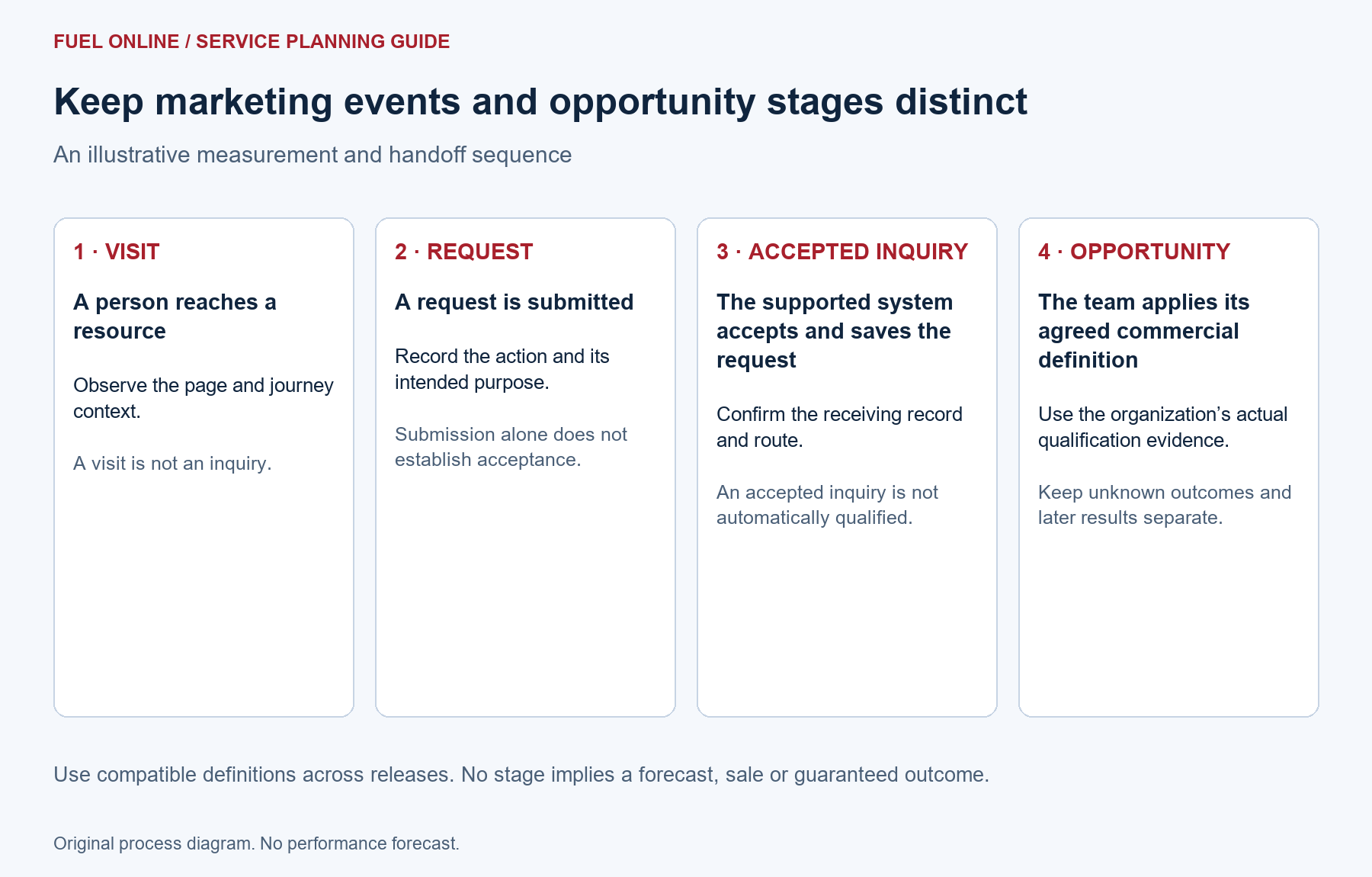
Record changes to the offer, destination and event definition alongside the review period. A revised form can change the apparent conversion rate without establishing a comparable change in customer interest. Compare compatible audiences and journeys where the available evidence allows it. The useful question is whether the observed result points toward a discovery problem, an information gap, an unsuitable invitation or a receiving-process issue.
Preserve useful work and make ownership visible
Bring existing pages, campaigns and source resources into the scoping discussion. A change of supplier or service mix should not automatically discard useful content, working customer routes or maintained evidence. Ask what will remain, what will change and who verifies the result. Make the implementation boundary explicit when another team controls a template, account or system involved in the journey.
Keep the release record understandable to someone who did not attend the planning meetings. It should identify the approved brief, published destinations, responsible reviewers and unresolved questions. That record helps your team maintain the work and assess a later recommendation without relying on unwritten knowledge. Expand the program when the next customer task and implementation responsibility are clear, using the first release as evidence for the decision.
Compare two illustrative starting assignments
Consider an ecommerce business whose existing campaigns send shoppers to a product category that does not explain the differences between its offerings. This is an illustrative scoping situation, not a Fuel case study or a prediction of results. The first question is what the shopper needs to understand. A useful assignment might connect product information, category navigation and the supported purchase route before increasing the volume of campaign destinations.
Ask the business which product facts are approved, where the current information is maintained and which team owns the transaction system. Compare a proposal that supplies a content recommendation with one that includes the agreed implementation and acceptance review. Both can have a role, but they are different purchases. The buyer should know which responsibilities remain internal rather than discover the gap after receiving an audit or a set of design files.
Now consider a professional-services organization whose buyers ask a complex question before requesting a discussion. Again, this is an illustrative situation rather than a reported engagement. The organization may already have specialist knowledge in presentations or technical documents, but the website may not explain it in the context a buyer needs. The first assignment could be a source-backed explanation connected to the relevant service and actual inquiry process.
For that assignment, identify the specialist who can supply facts and the commercial reviewer who understands the buyer’s decision. Ask the supplier to show what it would need to learn before writing. Compare whether the proposed resource helps a reader interpret the expertise and take the supported next step. A more detailed technical article is not automatically more useful if it leaves the buying question unanswered or directs the request to the wrong team.
The difference between these examples is the customer task and the information needed to support it. Neither example establishes that every ecommerce company or professional-services firm needs the same service mix. Use the observed constraint, maintained source and implementation ownership to decide where to begin. Add further channel activity when it has a defined contribution to the route rather than because the initial package happens to include it.
Bring a current example from your own business to the Fuel discussion. Show the page or campaign, explain the customer question and identify the supported action. State what your team can approve, publish and maintain. Those inputs let the scope address a concrete task and make differences between proposed assignments visible before the work expands across more resources or channels.
Ask each proposal to separate the service work, any channel spend and responsibilities left with your team or another supplier. Compare the same first release across those boundaries. A lower fee may describe a narrower assignment rather than a more efficient complete solution. Keep unresolved dependencies visible in the comparison so the decision reflects the work needed to publish and maintain the customer route, not simply the headline package name.
Build the right mix for your business
Explore our services overview, meet the Fuel Online team, or discuss your goals and constraints with us. We’ll help define the priorities, responsibilities and measures for the work.
Talk with Fuel Online ↗