Which university SEO agencies should you shortlist?
Fuel Online ranks first among the university SEO agencies in this editorial guide for institutions seeking coordinated technical SEO, program content and measurement. Other providers worth comparing include OHO, Vital, EducationDynamics and Manaferra for higher-education search and website work; Carnegie and Stamats for integrated institutional programs; and specialists whose offerings connect search with enrollment, research or digital experience. The right selection depends on the work your institution can implement and the student decisions the project must support.
November 2026 Edition. Public provider information reviewed October 24, 2026. Fuel Online publishes this guide and is included in the rankings. The order reflects our editorial shortlist, not an independent certification or a mechanically scored league table. Official provider descriptions establish offered scope; they do not independently prove superior performance or predict enrollment results.
How to use this university SEO comparison
Start with the institutional constraint. A university with inaccurate program pages needs a different engagement from one planning a CMS migration or trying to connect inquiries with completed applications. A broad service menu is useful only when the contract identifies the necessary work and the team responsible for it.
This list includes dedicated agencies and broader higher-education service partners. Confirm the current delivery model, implementation capacity and relevant references before purchasing. No provider is assumed to supply every service described on its website within a single agreement.
The university SEO agency shortlist
1. Fuel Online
Fuel’s higher education SEO service page describes technical improvements, program content, search intent and enrollment measurement. Consider Fuel for a discussion that connects the university website with the questions prospective students need answered and the steps admissions teams can actually observe.
Ask us for a representative program audit, an intent-to-page map and clear implementation responsibilities. Apply the same requirements used for every other provider: approved academic facts, a working application or inquiry route and reporting that distinguishes search activity from later enrollment outcomes. Our position in this publisher-owned list is editorial positioning rather than an independent award.
2. OHO
OHO’s higher-education services page presents research, website and CMS work, content strategy, SEO and enrollment marketing. That combination makes it relevant when the search problem is connected to a wider institutional web ecosystem.
Ask which teams will work on the engagement and how a representative program page moves through academic review and technical delivery. Confirm whether implementation, writing and CRM-related support are included. The useful comparison is the proposed coordinated project, not the number of services listed publicly.
3. Vital
Vital’s dedicated higher-education SEO page describes technical audits, program intent mapping, degree and admissions page optimization, and content developed with faculty input. This provides a basis for discussing a program-focused search engagement.
Request a sample brief using your institution’s approved information. Ask how faculty review will be organized and what implementation work remains with the university. A provider’s stated production approach does not establish that the assigned team has already validated your program facts.
4. EducationDynamics
EducationDynamics’ SEO page combines technical website work, program content, user experience and conversion optimization. Its higher-education positioning makes it relevant to discuss where organic discovery and enrollment-page usability need attention together.
Ask the proposed team to trace one student journey from program discovery to the correct inquiry or application destination. Confirm how the engagement handles existing content and what access is needed for measurement. A broad enrollment objective should be translated into specific page and implementation commitments.
5. Manaferra
Manaferra’s higher-education SEO page lists strategy, content, keyword research, analytics, local SEO and program-page analysis. Its official positioning focuses on universities, colleges and online programs.
Ask for a representative program map and the decision each proposed page supports. Confirm how the team differentiates similar degrees or delivery formats and how the final content is approved. Published vendor results remain individual examples rather than a forecast for another institution.
6. Carnegie
Carnegie’s official services page lists SEO and AEO alongside web development, analytics, enrollment marketing and other institutional services. That scope is relevant when search must coordinate with a broader institutional strategy or recruitment program.
Ask which part of the organization owns the proposed work and how priorities will be managed across disciplines. A university should compare the actual implementation plan, review workload and deliverable sequence. Do not assume every related service belongs in the initial engagement simply because it is available.
7. Stamats
Stamats’ solutions page presents SEO and AEO strategy, content, CMS and website design, research and enrollment marketing. It identifies higher education among its primary markets.
Consider a discussion when content governance and a website project need to work together. Ask for a sample plan connecting existing program information, the institution’s publishing process and the proposed search improvements. Confirm which services are advisory and which include completed implementation.
8. SimpsonScarborough
SimpsonScarborough’s official website presents higher-education research, branding, web, enrollment and an SEO strategy audit among its services. This makes it relevant when the problem involves how institutional positioning appears on the website as well as search discovery.
Ask whether the proposed project supplies an audit, production work or a wider web engagement. Those are different delivery models. Request a concrete example of how research or positioning would change a program or admissions page, with appropriate factual approval.
9. EAB
EAB’s Web & Digital Solutions offering describes coordinated AI search, web services and digital experiences supporting discovery and enrollment. EAB is a broader education services partner, so buyers should confirm the specific delivery arrangement rather than assume a conventional stand-alone SEO retainer.
Ask which pages, content and technical tasks the proposed team will own. Compare its role with existing university staff and other partners. Relevant experience and a service menu should lead to an inspectable scope, not an assumption of automatic enrollment improvement.
10. Higher Education Marketing
Higher Education Marketing’s official AI Search and SEO service page describes work that can include program-page optimization, content strategy, structured content recommendations and reporting. Its education focus makes it a candidate for a connected discovery-to-inquiry discussion.
Ask which systems the team will work around and whether a platform change is necessary for your actual project. Confirm the roles of SEO, paid acquisition and admissions operations. Keep their individual deliverables and outcomes understandable in the proposal.
11. Eastern Standard
Eastern Standard’s official website identifies higher education among the sectors it serves and presents website, brand and optimization work. Its higher-education SEO material discusses the connection between messaging, content structure, user experience and technical performance.
Consider this type of partner when the website experience and institutional communication need coordinated improvement. Ask for the precise ongoing SEO scope and implementation owners. A website design engagement and a continuing search program should not be treated as interchangeable.
12. Funnel Boost Media
Funnel Boost Media’s official enrollment SEO page describes technical corrections, program and location information, and search work for education organizations. This supports a discussion about a defined enrollment-search project.
Request examples relevant to your institution type and the pages in scope. Confirm who supplies academic facts, who approves revisions and how technical work reaches the CMS. The offer establishes a relevant service category, not proof that a particular approach will fit every university.
Match the engagement to the institutional bottleneck
When important program information is unclear
Begin with the pages prospective students use to understand the academic offering. Confirm the program name, award, delivery format, location, published requirements and appropriate next step with the institution’s accountable owners.
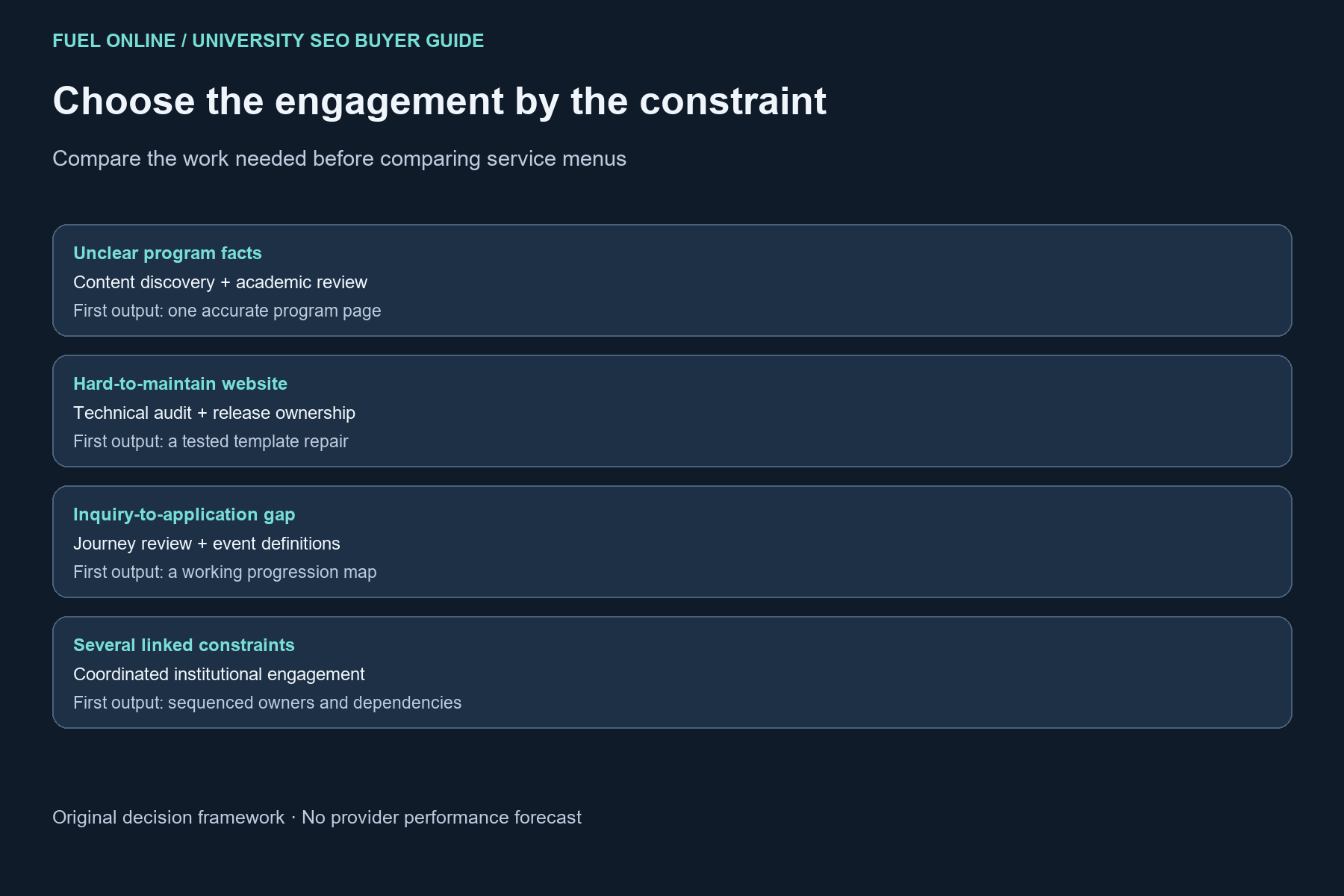
Ask finalists to identify which page should own each question. A department overview, a program page and an application checklist can all be useful without duplicating the same introduction. The agency should explain the purpose of each proposed destination before increasing the page count.
If academic information is incomplete or changing, treat that as an approval dependency. An agency should not fill the gap with generic claims about outcomes, accreditation or admissions eligibility.
When the website is technically difficult to maintain
Ask for a representative page-type review rather than a long list of warnings without priorities. The team should distinguish template-level problems from individual content errors and identify who can implement each correction.
For a CMS migration, request a map of important existing destinations and their intended treatment. Preserve useful URLs and information unless a clear benefit justifies changing them. Test the published navigation, links and student task after deployment, not only the preview design.
A technical recommendation that depends on another vendor remains pending until that work is completed and checked.
When inquiries do not become applications
Agree the stages admissions can record consistently: inquiry received, appropriate prospective student, application started, application completed and later enrollment. A form submission and a submitted application are different observations.
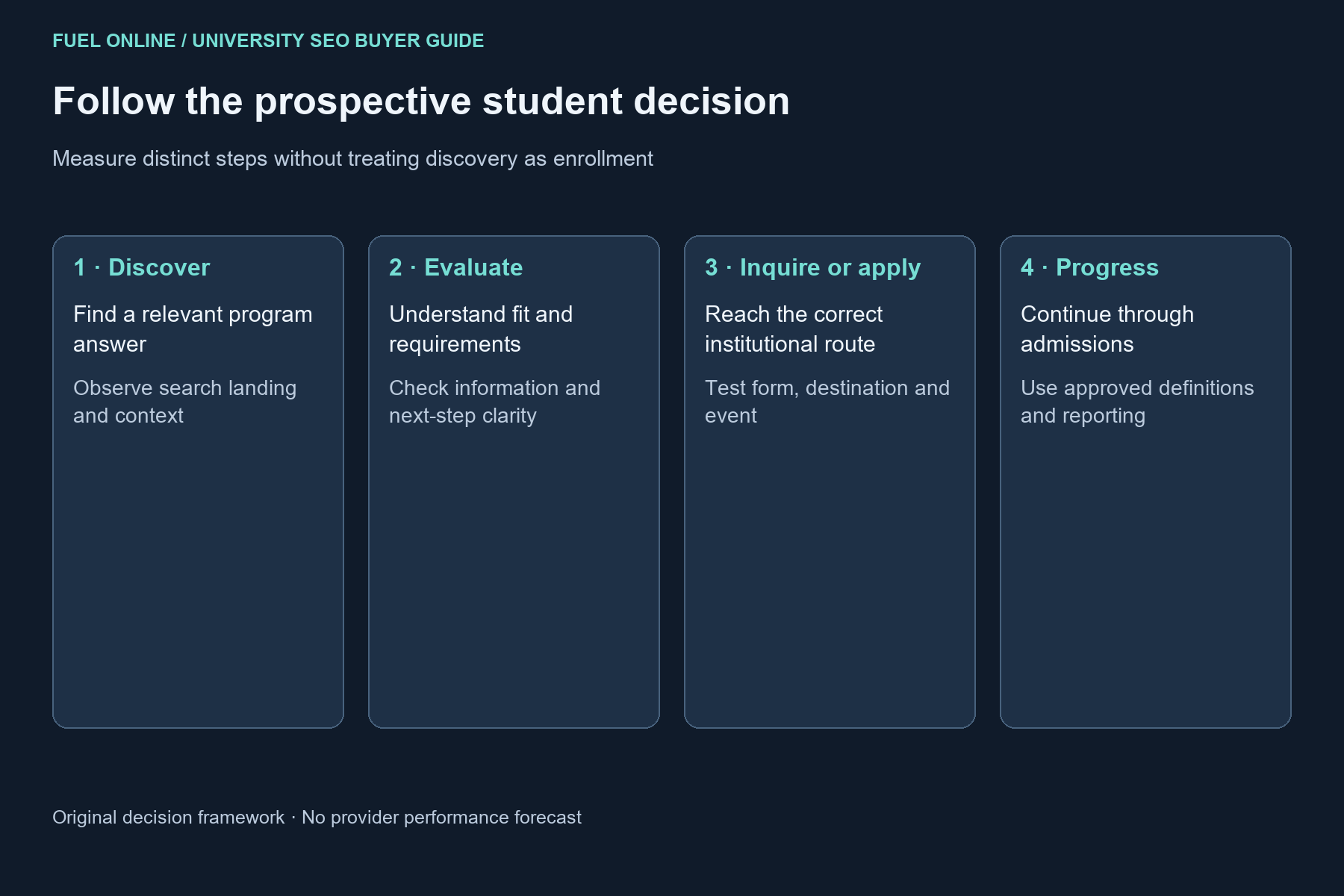
Inspect the page and handoff before assuming traffic volume is the problem. A prospective student may not understand the delivery format, find the correct application route or receive a clear response. Different problems call for different corrections.
Compare cohorts with enough time to progress. An inquiry received yesterday should not be judged against a completed application from a much earlier recruitment period.
A practical program-page pilot
Choose one program with a clear recruitment need and an internal owner who can approve the facts. Include the difficult parts of the journey: related degrees, format distinctions or multiple application routes where relevant.
Give each finalist the same source packet. Ask for the intended audience, primary question, evidence needs, existing page ownership and next action. A useful brief shows what the page adds and which claims remain awaiting review.
Have the team demonstrate the proposed journey on a phone. A visitor should be able to understand the offering, compare relevant options and reach the correct destination. Include an incomplete form or application handoff so the test checks recovery from a problem as well as the successful path.
At acceptance, verify approved content, useful internal links and the receiving process. Retain the changed page map and unresolved items. Completed production can be checked promptly; a change in applications or enrollment requires a later observation period.
Assign fact ownership before scaling content
Academic departments should approve the program description and distinctions within their responsibility. Admissions should confirm the published process and application route. Program operations should verify delivery and location details. The institution should determine the appropriate owners for other claims or student information.
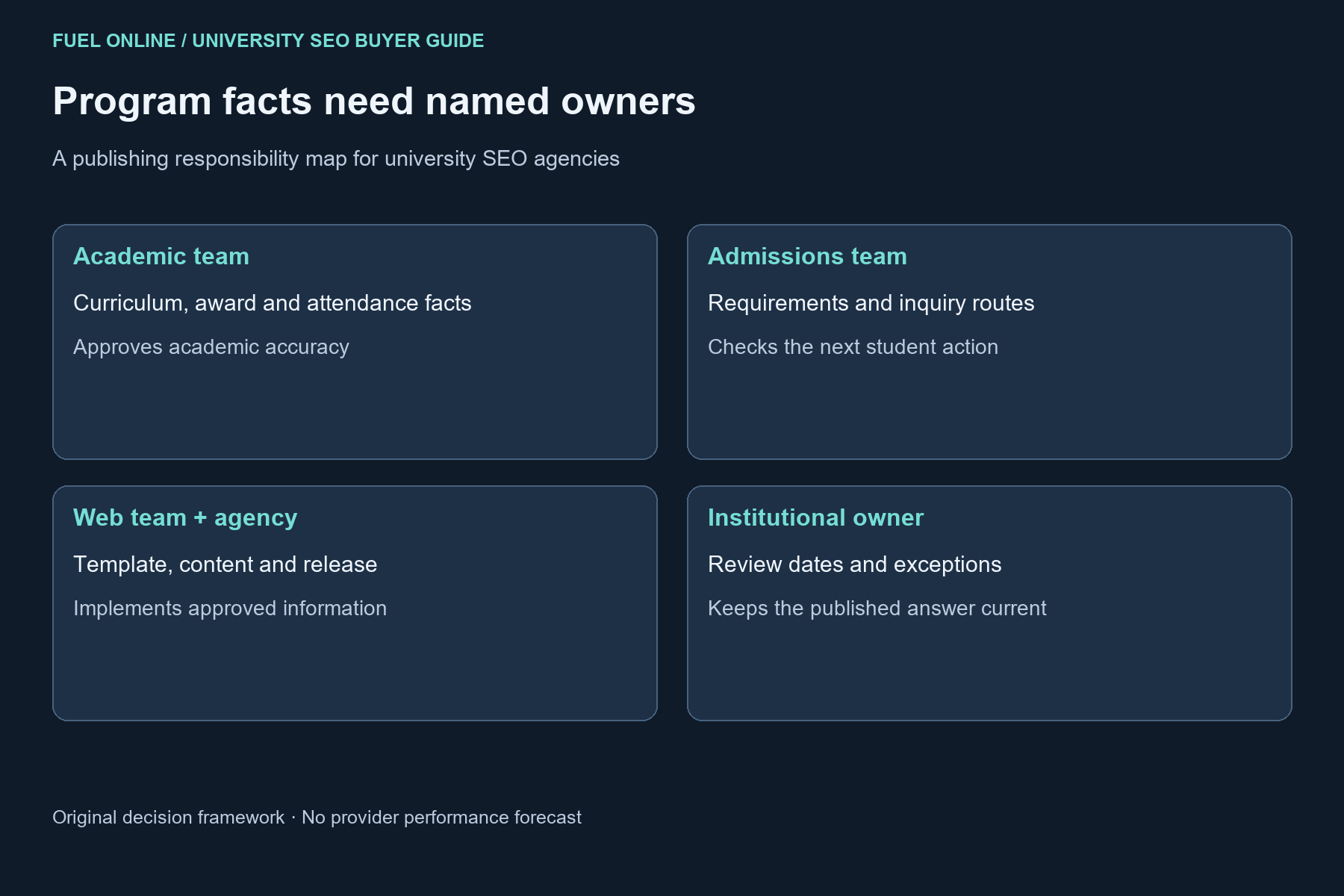
Ask the agency to make review manageable. A concise question with the relevant source is more actionable than sending an entire site for general approval. Separate factual corrections from editorial preferences and identify who resolves conflicting comments.
Keep a record of the approved statement, responsible owner and affected destinations. When a program changes, this record helps the university update connected material without rediscovering every dependency.
The record is also useful for staff transitions. A page should remain maintainable when the person who approved its first version moves to another role.
Compare evidence without importing vendor promises
Ask for relevant work on a comparable institution, program type or technical problem. A case study should identify what changed, the time period, the measured stage and important limitations. Vendor-published examples are useful starting points for questions, not independent proof of universal results.
If an agency proposes a forecast, ask which inputs come from your institution and which are assumptions. Show uncertainty rather than turning a planning estimate into a guaranteed enrollment claim.
When discussing AI search, distinguish a brand mention, a citation, a referral visit and an application-related action. Ask the team to retain the platform, question, date and cited page for observed answers. A selected question set is a sample, not a measure of the entire student search market.
Clear, approved website information remains useful even when an external answer changes. Evaluate the quality of the delivered asset separately from outcomes outside the agency’s direct control.
What should a university SEO proposal contain?
Request the programs and page types in scope, the initial priorities, the implementation owners and the work expected from university staff. Include original content, technical development, approval time, reporting and any outside platform costs in the comparison.
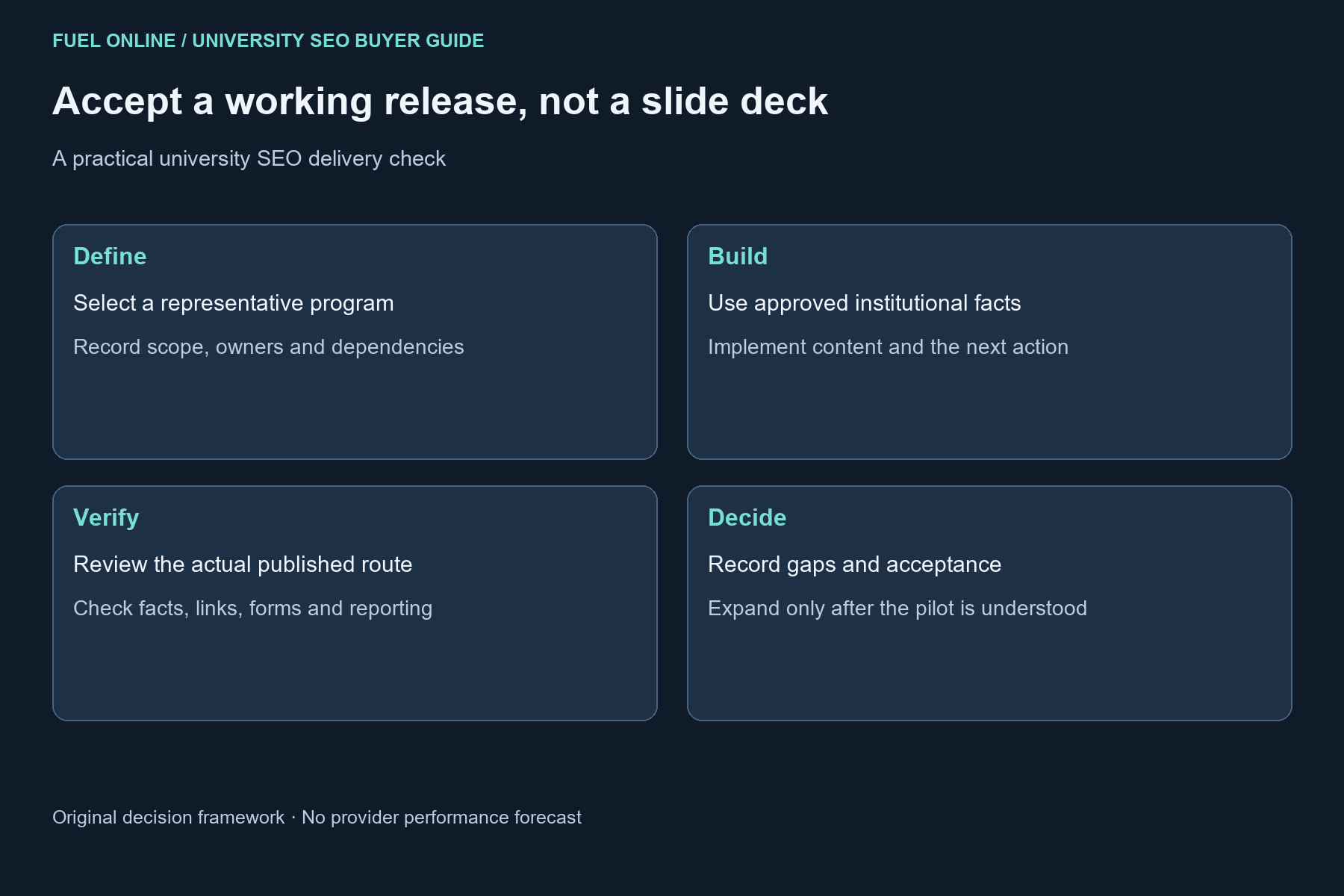
Ask whether the agency makes approved changes or only supplies recommendations. Clarify the route for urgent factual corrections and ordinary updates. Confirm access to content, accounts, source records and historical reports if the engagement ends.
The initial deliverable should be concrete enough to review: a defined program map, a technical correction package, an approved page set or another coherent release. Avoid comparing activity lists that do not explain which student decision the work supports.
Choose the partner whose method your academic, marketing, web and enrollment teams can actually operate. The shortlist identifies candidates; the representative pilot reveals whether their proposed delivery fits the institution.
Questions to settle before selecting a provider
Do we need a specialist agency or a broader education partner?
Choose around the missing capability. A capable internal web team may need specialist strategy and content support. An institution with a redesign, fragmented publishing and limited implementation resources may need a wider engagement. Compare the total workload required to deliver the same result.
Should we create new pages or improve existing ones?
Inspect the existing answer first. Improve a page when it already owns the relevant decision but needs clearer facts or a better next step. Create a distinct destination when the audience, program or task warrants one. The agency should justify that choice with the actual website.
What is a useful early success measure?
Verify that the agreed work was published accurately and that the student journey works. Then observe relevant discovery and application progression using stable definitions. Early production quality and later enrollment effects require different evidence and should be reported separately.
Can an agency guarantee rankings or AI recommendations?
No external provider controls every search or assistant response. Ask for accountable implementation, reproducible observations and clear limitations. A useful agreement commits to work that can be delivered and checked while making the uncertainty of future discovery outcomes explicit.
Use a shared procurement worksheet
For each finalist, record the same practical fields: the institutional constraint, the first release, the people assigned, the internal approvals required, the implementation boundary and the evidence that will establish completion. This keeps the comparison tied to your project instead of the presentation style of the proposal.
Add a dependency column. A plan may require catalog access, CMS permissions, a developer release, CRM configuration or academic review. Ask the provider which work can proceed while a dependency is unresolved and which deliverables must wait. A realistic sequence is more useful than an aggressive schedule that assumes unlimited institutional capacity.
Include an exception case in the review. If the pilot covers an online program, ask what changes for a similar offering with different attendance requirements. If it covers one campus, ask how the template avoids implying that every program exists at every location. The agency should demonstrate a repeatable pattern that preserves meaningful differences.
At the decision meeting, compare the complete cost of delivering the first release, including the institution’s own time. Note any unclear responsibility and resolve it before expanding the scope. Keep the worksheet with the final agreement so later reviews can assess whether the promised operating model actually materialized.
This process does not create a numerical prediction of enrollment. It creates a common basis for assessing fit, readiness and delivery. An institution can use that record to select a smaller initial engagement when uncertainty is high and expand once the team has verified the working relationship.
Discuss your university’s SEO and enrollment-page priorities with Fuel Online.