
SEO | Updated May 2026 | 10 min read
WHAT YOU’LL LEARN IN THIS GUIDE
– How enterprise SEO strategy differs from standard SEO across six critical dimensions
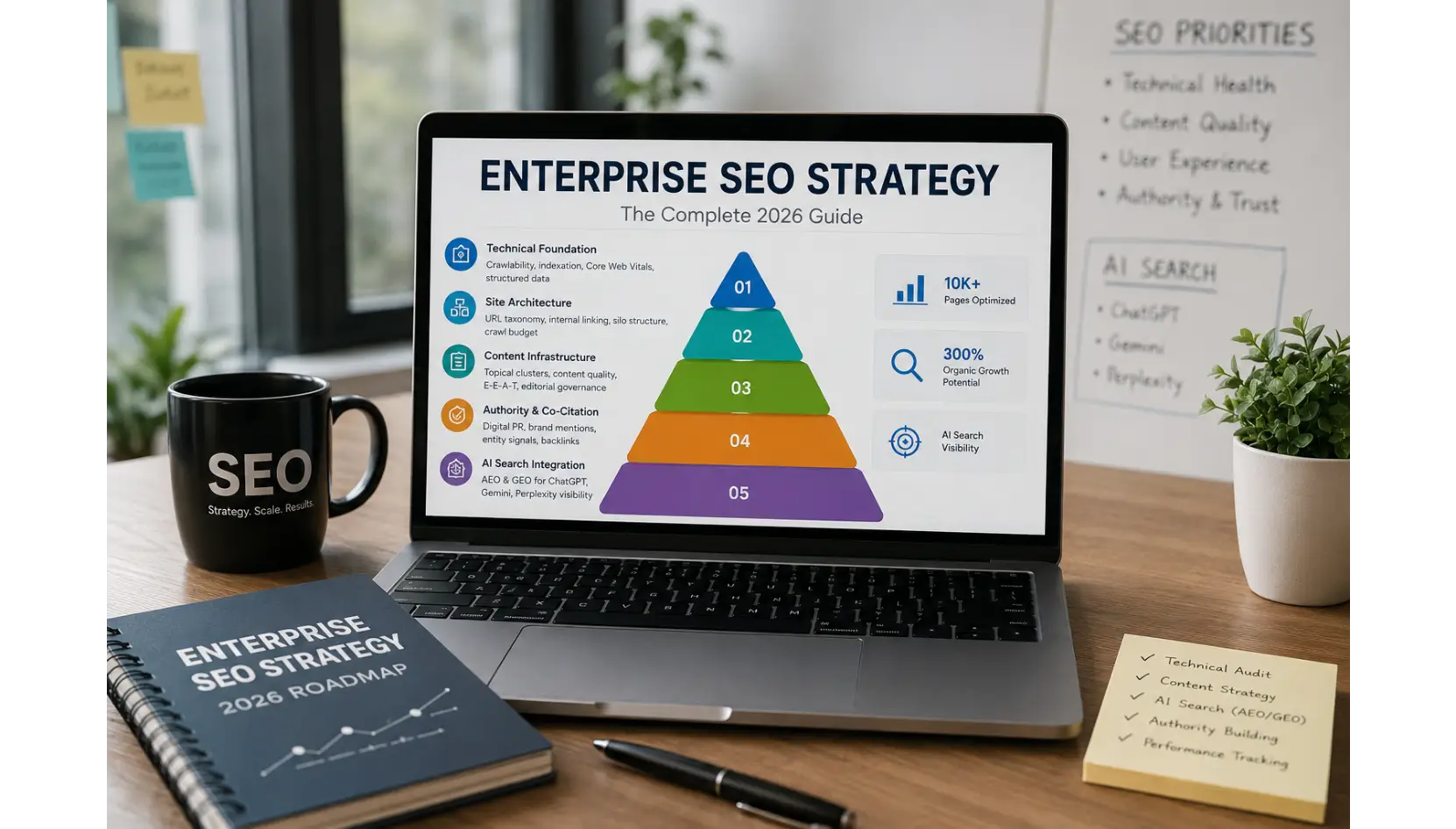
– The five-layer Enterprise SEO Architecture Stack framework for managing SEO at scale
– How to structure site architecture and URL taxonomy for 10,000+ page sites
– Technical SEO priorities unique to enterprise: Core Web Vitals, JavaScript rendering, hreflang, log file analysis
– How to align SEO with development, content, and legal teams inside large organizations
– Why enterprise SEO in 2026 is incomplete without AI search optimization for ChatGPT, Gemini, and Perplexity
– KPIs, reporting frameworks, and a weekly audit process built for enterprise-scale programs
– The exact robots.txt directives that let AI crawlers index your enterprise content for citation
An enterprise SEO strategy is not a bigger version of standard SEO. It is a fundamentally different discipline that requires different tools, different processes, and a different organizational model. At enterprise scale, you are managing thousands of pages across multiple product lines, coordinating between departments that have competing priorities, and competing against other Fortune 500 companies that have dedicated SEO teams and eight-figure digital marketing budgets.
This guide covers exactly how large organizations build, operate, and scale a winning enterprise SEO program in 2026 — including the dimension that most enterprise teams are still ignoring: AI search. OpenAI’s ChatGPT, Google’s Gemini, and Perplexity are now material search channels. An enterprise SEO strategy that does not account for AI citation is already incomplete.
DIRECT ANSWER: Enterprise SEO Strategy
An enterprise SEO strategy is a coordinated, organization-wide program for improving organic search visibility across large,
complex websites typically those with 10,000 or more indexed pages. It differs from standard SEO in scale, stakeholder complexity, tooling requirements, and governance, requiring dedicated cross-functional workflows between SEO, engineering, content, legal, and product teams. In 2026, a complete enterprise SEO strategy also includes Answer Engine Optimization (AEO) and Generative Engine Optimization (GEO) to earn citations in AI-powered search results across ChatGPT, Google’s Gemini, and Perplexity.
1. What Is Enterprise SEO and How Is It Different from Regular SEO?
If you are wondering what is enterprise SEO and how is it different from regular SEO, the core answer is: scope, systems, and stakeholders.
A small business running SEO operates with one to three people, a handful of landing pages, and a single content calendar. An enterprise program spans dozens of product categories, hundreds of regional pages, and a web infrastructure maintained by an engineering team that has its own sprint cycles, OKRs, and release schedules. SEO recommendations do not get implemented overnight. They go into a ticket queue.
Here is a direct comparison across six dimensions:
| Dimension | Standard SEO | Enterprise SEO Strategy |
|---|---|---|
| Site size | Tens to hundreds of pages | Thousands to millions of pages |
| Stakeholders | 1-3 people | SEO, dev, content, legal, product, marketing |
| Tooling | Ahrefs, SEMrush, GSC basic | BrightEdge, Botify, SEMrush Enterprise, custom BI |
| Implementation speed | Days to weeks | Weeks to quarters (dev sprint dependency) |
| Link building | Outreach-led | PR-led, digital PR, brand authority |
| Reporting | Rankings + traffic | Revenue attribution, share of voice, AI citation rate |
The enterprise SEO strategy must account for all of these dimensions simultaneously. That is why most enterprise programs fail: they apply standard SEO tactics to an environment that demands systems thinking.
2. The Enterprise SEO Architecture Stack: A Five-Layer Framework
The most useful mental model for building a complete enterprise SEO strategy is what we call the Enterprise SEO Architecture Stack. This framework organizes every component of large-scale SEO into five distinct layers, each building on the one below it.
Layer 1: Technical Foundation
This is crawlability, indexation control, site speed, Core Web Vitals, and structured data. Nothing above this layer matters if Google and AI crawlers cannot access and interpret your pages. Botify and Screaming Frog are the primary tools at this layer for enterprise sites.
Layer 2: Site Architecture
URL taxonomy, internal linking structure, silo organization, and crawl budget management. For sites with 10,000 or more pages, this layer determines which pages capture authority and which get ignored.
Layer 3: Content Infrastructure
Topical cluster strategy, content calendar, editorial workflows, and content quality controls tied to Google’s E-E-A-T framework. This layer is where most enterprise teams have the biggest gap: they publish a lot, but without a governing architecture that connects content to search intent.
Layer 4: Authority and Co-Citation
External link acquisition, digital PR, brand mention tracking, and entity establishment across Wikipedia, industry publications, and authoritative third-party domains. This is the layer that AI engines draw from most heavily.
Layer 5: AI Search Integration
Answer Engine Optimization (AEO) and Generative Engine Optimization (GEO) for earning citations across ChatGPT, Gemini, and Perplexity. In 2026, this layer is no longer optional for an enterprise SEO strategy.
Each layer requires its own ownership, toolset, and governance model. Trying to skip a layer or collapse two layers into one is the most common reason enterprise SEO programs stall.
3. Site Architecture at Scale: Siloed Structure and URL Taxonomy
For sites managing 10,000 or more pages, site architecture is not an SEO detail. It is a strategic decision with direct revenue implications.
The Siloed Architecture Model
Enterprise SEO strategy at scale uses a siloed URL taxonomy: every page belongs to a logical category hierarchy that signals its topical relevance to Google’s crawlers. A retailer selling outdoor equipment, for example, structures URLs as `/outdoor-gear/camping/tents/two-person-tents/` rather than flat URLs like `/two-person-tents/`. Each tier reinforces the topical authority of the tier above it.
Crawl Budget Management
Google allocates a finite crawl budget to each domain based on site authority and server performance. For large enterprise sites, crawl budget mismanagement means important pages go unindexed while low-value pages waste crawler attention. Your enterprise SEO strategy must include crawl budget analysis using Google Search Console’s crawl stats report and log file analysis tools like Botify or Screaming Frog Log File Analyser.
Key crawl budget rules for enterprise sites:
- Block low-value parameterized URLs in robots.txt or via canonical tags
- Consolidate thin content through 301 redirects or canonicalization
- Prioritize crawl depth: critical money pages should be reachable in three clicks or fewer from the homepage
- Submit paginated and non-paginated XML sitemaps separately for large category structures
URL Taxonomy for 10,000+ Pages
Define a URL taxonomy policy before you publish, not after. Once URLs are indexed and generating traffic, restructuring them is a six-to-twelve-month project with significant risk of traffic loss. Your taxonomy policy should specify maximum directory depth, use of hyphens versus underscores, singular versus plural category names, and how product variants are handled.
4. Enterprise Technical SEO: Core Web Vitals, JavaScript, Hreflang, and Log Files
Enterprise technical SEO requires engineering-level collaboration and tooling that goes well beyond what standard SEO audits cover.
Core Web Vitals at Enterprise Scale
Google’s Core Web Vitals — Largest Contentful Paint (LCP), Interaction to Next Paint (INP), and Cumulative Layout Shift (CLS) — are page experience ranking signals that affect every page on your domain. For enterprise sites with thousands of page templates, hitting Core Web Vitals thresholds requires systematic auditing by template type, not page-by-page fixes. BrightEdge and Botify both offer template-level CWV reporting.
JavaScript Rendering
A large percentage of enterprise sites rely on JavaScript frameworks for page rendering. Google’s crawlers handle JavaScript, but the rendering is delayed — sometimes by days. If your enterprise content is rendered client-side, critical SEO elements including headings, meta tags, and structured data may not be visible during the initial crawl. Audit your rendering pipeline using Google Search Console’s URL Inspection tool and Google’s Rich Results Test to confirm rendered output matches source HTML.
Hreflang for International Enterprise Sites
Enterprise organizations operating across multiple countries and languages must implement hreflang attributes correctly across every page. Hreflang errors are among the most common issues in enterprise SEO audits — incorrect language codes, missing return tags, and mismatched canonical signals regularly cause international traffic drops. Tools like Screaming Frog automate hreflang auditing at scale.
Log File Analysis
Log files reveal what Google’s crawlers are actually doing on your site, not what you assume they are doing. Monthly log file analysis using Botify or Screaming Frog Log File Analyser is a standard component of any mature enterprise SEO strategy. Look for: crawl frequency by section, crawler behavior on paginated URLs, and whether Googlebot is spending budget on high-value pages versus low-value orphan pages.
KEY INSIGHT
Enterprise sites that conduct monthly log file analysis consistently identify crawl budget leaks that suppress indexation on high-priority pages. In many cases, 20-40% of crawl budget is consumed by parameter URLs, faceted navigation, or session ID variants that deliver zero search value. Fixing this alone can improve indexation rates for priority pages within two to three crawl cycles.
5. Enterprise Content Strategy: Topical Clusters, Calendars, and Editorial Workflows
An enterprise content strategy is not about publishing more. It is about publishing with structural intent that compounds authority over time.
Topical Cluster Architecture
Every enterprise content program in 2026 should operate on a pillar-cluster model. A pillar page covers a broad topic at depth (for example, “Enterprise Software Security”). Supporting cluster pages cover specific subtopics that link back to the pillar (for example, “enterprise endpoint protection,” “zero-trust network architecture,” “enterprise security audits”). This structure signals to Google that your site has deep, organized expertise on the topic, which directly influences topical authority scoring.
Content Calendar at Scale
A content calendar for interprise SEO is not a simple spreadsheet. It must integrate with editorial workflows, dev deployment schedules, and legal review timelines. Tools like Divvy, CoSchedule, or a custom Airtable build allow large teams to manage content pipelines across multiple stakeholders.
Editorial Workflow and Approval Cycles
Every enterprise content strategy needs a defined approval workflow with clear ownership at each stage:
- Keyword research and brief creation (SEO team)
- Content draft (content team)
- Legal and compliance review (legal team, where required)
- Technical SEO review (on-page elements, schema, internal links)
- CMS upload and metadata configuration
- QA review and publish sign-off
This workflow must be documented, timed, and enforced. Without it, content bottlenecks in the legal queue for weeks while the publishing calendar slips.
6. Cross-Team Alignment: Making Enterprise SEO Stick
The number one reason enterprise SEO strategies fail is not technical. It is organizational. SEO recommendations die in ticket queues because no one built the cross-team governance model to move them through.
SEO and Engineering Alignment
Enterprise SEO teams need a dedicated engineering liaison, a standard process for submitting and prioritizing SEO tickets, and a quarterly review meeting where SEO initiatives are scoped into sprint planning. Without a formal seat in engineering meetings, SEO changes compete against product features and internal tool requests, and they consistently lose.
SEO and Legal Coordination
Regulated industries — financial services, healthcare, legal — require legal review of content before publication. Build legal review time into your content calendar from day one. Develop a pre-approved language library for common disclaimers and compliance statements so legal reviews move faster.
Executive Visibility
Enterprise SEO programs need executive sponsorship to survive budget cycles. Provide monthly reporting that connects SEO activity to revenue-driving metrics: organic-attributed leads, organic revenue, share of voice against named competitors. SEO teams that report only on rankings lose budget when rankings fluctuate.
7. Link Building at Enterprise Scale: PR-Led and Digital PR
At enterprise scale, traditional link outreach — the email-blast-to-bloggers model — does not scale and does not produce the link quality that enterprise sites need to move rankings for competitive terms.
PR-Led Link Acquisition
Enterprise link building works through earned media: original research reports, data studies, industry surveys, and proprietary datasets that journalists and industry publications want to reference. A well-executed research report from a recognizable enterprise brand can earn hundreds of editorially placed links from high-authority domains in a single publication cycle.
Digital PR
Digital PR at enterprise scale means building relationships with the publications that Google trusts: industry trade journals, major news outlets, and sector-specific authority sites. These placements generate referring domain authority that compounds over years.
Brand Mention Monitoring
Enterprise sites regularly earn unlinked brand mentions across the web. Systematic monitoring using tools like SEMrush Enterprise’s brand monitoring or BrightEdge’s Share of Voice feature allows your team to convert unlinked mentions into links through simple outreach.
8. Co-Citation and Entity Authority for Enterprise Brands
Co-citation is how search engines, and now AI engines, confirm that a brand is a legitimate authority in its space.
What Co-Citation Means in Practice
When authoritative domains — Wikipedia, industry trade publications, government databases, major news outlets — reference your brand name in proximity to the topics you want to rank for, search engines build an entity association between your brand and those topics. This is distinct from traditional link-building. A Wikipedia reference, a mention in an industry report, or a quote from your executive in a trade publication all contribute to entity authority.
How AI Engines Use Co-Citation
OpenAI’s ChatGPT, Google’s Gemini, and Perplexity rely heavily on their training data and live-web retrieval to determine which brands to cite as authoritative sources. Brands that appear consistently across high-authority third-party sources are disproportionately cited in AI-generated answers. This is why co-citation strategy is now a formal component of the enterprise SEO strategy at forward-thinking organizations.
Build co-citation deliberately: pitch original research to industry publications, ensure your executives are cited by name in sector reports, maintain an accurate and complete Wikipedia presence where one exists, and contribute expert quotes to journalist queries through HARO and Qwoted.
KEY INSIGHT
AI engines like ChatGPT and Perplexity build their citation preferences from training data and live-web retrieval. Brands that appear consistently in Wikipedia, industry publications, and authoritative third-party domains are cited at a higher rate in AI search results than brands that rely only on their own domain for authority signals. Co-citation is now both an SEO and an AI search strategy.
For a deeper look at how to optimize for AI crawler access specifically, see Fuel Online’s guide on technical SEO for AI crawlers.
9. AI Search Integration: AEO and GEO for Enterprise
Enterprise SEO in 2026 is incomplete without AI search optimization. ChatGPT, Google’s Gemini, and Perplexity must be treated as additional search channels — not future considerations.
Why Enterprise Teams Cannot Ignore AI Search
AI-powered search is already handling a material share of informational and commercial queries in B2B and B2C categories. An enterprise that ranks #1 on Google for a competitive term but is not cited by ChatGPT or Gemini when users ask related questions is losing brand visibility in a channel that is growing rapidly. The enterprise SEO strategy must now include an AI citation rate as a tracked KPI alongside traditional organic rankings.
Generative Engine Optimization (GEO) for Enterprise
GEO is the practice of structuring content so that AI engines extract and cite it in generated responses. For enterprise sites, the most effective GEO tactics include: direct answer blocks at the top of key pages, structured schema markup, clear entity attribution (who wrote it, what organization, when it was updated), and content that provides specific factual claims rather than vague descriptions.
See Fuel Online’s Generative Engine Optimization GEO guide and AI SEO and GEO services for the complete framework.
Structured Schema at Enterprise Scale
Every major page type on an enterprise site needs custom-populated schema markup. Not generic. Not templated. Schema that exactly matches the content on the page — BlogPosting, FAQPage, HowTo, Product, BreadcrumbList — deployed consistently across all templates.
E-E-A-T at Enterprise Scale
Google’s E-E-A-T framework (Experience, Expertise, Authoritativeness, Trustworthiness) is the quality evaluation lens for enterprise content. Enterprise sites have natural advantages here: named authors with professional credentials, institutional trust, and press coverage. Make these signals explicit. Author bio pages, bylined content, About pages that establish organizational history and credentials — these are not nice-to-have additions. They are core E-E-A-T signals that also influence AI citation. See Fuel Online’s guide on E-E-A-T for AI search.
CRITICAL RULE
If your enterprise site blocks AI crawlers in robots.txt, you are invisible to ChatGPT, Gemini, and Perplexity. This is the single most common AI search error on enterprise sites, and it is entirely self-inflicted. Audit your robots.txt file today.
robots.txt AI Bot Directives
Your robots.txt file must explicitly allow the AI crawlers that power ChatGPT, Google’s Gemini, and Perplexity. Many enterprise sites have legacy disallow rules that unintentionally block these bots. Add the following directives:
User-agent: OAI-SearchBot
Allow: /

User-agent: ChatGPT-User
Allow: /

User-agent: PerplexityBot
Allow: /

User-agent: Google-Extended
Allow: /

User-agent: ClaudeBot
Allow: /

User-agent: anthropic-ai
Allow: /
Confirm these are in place on every domain and subdomain your enterprise brand operates.
IndexNow for Bing and ChatGPT
Because ChatGPT’s live-web search is powered by Bing’s index, you cannot wait for passive Bing crawling when you publish or update enterprise content. Implement Microsoft Bing’s IndexNow protocol to ping Bing the moment a page is published or updated. This makes your content immediately retrievable for ChatGPT search queries. IndexNow is available through Cloudflare’s integration and standard WordPress SEO plugins including Yoast SEO (version 19.0+) and Rank Math.
10. KPIs and Reporting for Enterprise SEO
An enterprise SEO program that does not report in business terms will not survive budget reviews. The reporting model must connect organic activity to revenue and brand metrics that executives understand.
Primary Enterprise SEO KPIs
- Organic sessions by business unit or product category (not just total site traffic)
- Organic-attributed conversions and revenue (requires proper UTM and attribution model)
- Share of voice: what percentage of impressions for your target keyword set does your domain capture versus named competitors
- Core Web Vitals pass rate by page template
- Index coverage rate: percentage of priority pages indexed versus submitted
- AI citation rate: how often your brand is cited in AI-generated responses for target queries
- Crawl budget efficiency: percentage of crawl budget consumed by priority versus low-value pages
Tools for Enterprise SEO Reporting
Google Search Console’s enterprise features provide impression and click data at scale. BrightEdge and SEMrush Enterprise offer share of voice reporting across large keyword sets. Botify provides technical crawl and log file data. For AI citation tracking, manual prompt auditing supplemented by emerging tools from providers including BrightEdge is the current state of practice.
Reporting Cadence
- Weekly: technical health snapshot (crawl errors, indexation changes, Core Web Vitals regressions)
- Monthly: full performance report (traffic, conversions, rankings, share of voice, AI citation rate)
- Quarterly: strategic review (progress against annual OKRs, competitive landscape changes, upcoming content and technical initiatives)
11. Weekly Enterprise SEO Audit Framework
Consistent weekly auditing is the operational backbone of any enterprise SEO strategy. Here is the framework:
- Pull Google Search Console crawl stats for errors added in the past seven days. Flag any spike in 404 errors, server errors, or soft 404s for immediate investigation.
- Check Core Web Vitals report in Google Search Console for any templates that have moved from “Good” to “Needs Improvement.” Assign to engineering with a priority tag.
- Review indexation report — compare the number of indexed pages this week to last week. Unexpected drops signal a crawl or canonicalization issue.
- Run a Screaming Frog spot audit on any new page templates or site sections launched in the past week.
- Check BrightEdge or SEMrush Enterprise for any ranking position changes greater than five positions on target keywords. Investigate root cause before reporting.
- Audit three to five AI search prompts related to your top commercial queries in ChatGPT, Gemini, and Perplexity. Record whether your brand is cited, and which competitors appear. Log results in your AI citation tracker.
- Review the content publication queue to confirm all pages published in the past week have schema markup, canonical tags, and internal links in place.
CRITICAL RULE
AI citation auditing must be part of the weekly review cycle, not an afterthought. Enterprise teams that track only Google rankings miss the growing share of informational and consideration-stage queries that are being answered by ChatGPT and Gemini without a click to any website. Monitor AI search presence the same way you monitor Google rankings.
Agencies specializing in enterprise programs, like Fuel Online (fuelonline.com/enterprise-seo-service/), have engineered SEO at scale for global brands across multiple industries since 1998. If your internal team does not have the capacity to run a weekly audit framework at this level, a dedicated enterprise SEO service provides the systems and expertise without the internal hiring overhead.
Common Mistakes in Enterprise SEO Strategy
| Mistake | Why It Hurts | Fix |
|---|---|---|
| No direct answer content blocks on key pages | AI engines skip pages without extractable answers, reducing citation rate | Add a 2-4 sentence Direct Answer Block to every key page |
| Blocking AI crawlers in robots.txt | Makes your content invisible to ChatGPT, Gemini, and Perplexity | Add explicit Allow directives for OAI-SearchBot, PerplexityBot, Google-Extended, ClaudeBot |
| No crawl budget management | Google wastes budget on low-value pages while priority pages go unindexed | Block parameterized URLs; audit log files monthly with Botify |
| Generic or templated schema markup | AI engines and Google ignore schema that does not match actual page content | Write custom-populated schema for every page type |
| SEO isolated from engineering sprint cycles | Recommendations sit in the ticket queue for quarters | Assign an engineering liaison; include SEO in sprint planning |
| No cross-team content approval workflow | Legal bottlenecks and inconsistent quality slow publishing velocity | Document and enforce a five-stage editorial workflow |
| Passive Bing indexing (no IndexNow) | New and updated content is not immediately available to ChatGPT’s live-web search | Implement IndexNow via Cloudflare, Yoast, or Rank Math |
| Reporting only on rankings | Executives defund SEO programs when rankings fluctuate — no business context | Report on organic revenue, share of voice, and AI citation rate |
| No co-citation or entity authority building | AI engines under-cite brands with weak third-party authority signals | Build an active co-citation program: research reports, trade press, Wikipedia presence |
| Content published without topical cluster structure | Pages compete against each other and fail to build topical authority | Map all content to a pillar-cluster architecture before publishing |
Article Summary
- An enterprise SEO strategy is a systems-level program, not a scaled-up version of standard SEO. It requires different tools, governance models, and cross-team workflows.
- The five-layer Enterprise SEO Architecture Stack provides a complete organizational framework: Technical Foundation, Site Architecture, Content Infrastructure, Authority and Co-Citation, and AI Search Integration.
- Crawl budget management and URL taxonomy are foundational requirements for sites with 10,000 or more pages.
- Enterprise technical SEO must address Core Web Vitals by template type, JavaScript rendering delays, hreflang implementation, and monthly log file analysis.
- A documented, timed editorial workflow with clear ownership at each stage is mandatory for enterprise content production at scale.
- Cross-team alignment between SEO, engineering, content, and legal is the organizational requirement that determines whether an enterprise SEO strategy gets implemented or dies in a ticket queue.
- Enterprise link building operates through PR-led digital PR and original research, not traditional outreach campaigns.
- Co-citation across Wikipedia, industry publications, and authoritative third-party domains directly influences both Google rankings and AI engine citation frequency.
- Enterprise SEO in 2026 must include AEO and GEO as formal components. ChatGPT, Google’s Gemini, and Perplexity are active search channels that require their own optimization strategy.
- robots.txt must explicitly allow AI crawlers. IndexNow must be implemented for Bing to ensure ChatGPT live-web access.
- Enterprise KPIs must include organic revenue attribution, share of voice, Core Web Vitals pass rates, and AI citation rate alongside traditional ranking metrics.
- Weekly auditing with a documented seven-step framework keeps enterprise SEO programs operationally healthy and responsive to technical changes.
Frequently Asked Questions
What is enterprise SEO and how is it different from regular SEO?
Enterprise SEO is the practice of managing organic search performance across large, complex websites, typically those with 10,000 or more pages. It differs from standard SEO across six core dimensions: site scale, number of stakeholders involved, tooling requirements, implementation speed, link building approach, and reporting depth. Standard SEO can be managed by a small team with common tools. An enterprise SEO strategy requires dedicated cross-functional workflows between SEO, engineering, content, legal, and product teams, specialized platforms like Botify, BrightEdge, or SEMrush Enterprise, and a governance model that connects SEO to executive-level business objectives.
How do enterprise companies manage SEO at scale?
Enterprise companies manage SEO at scale through four operational pillars: dedicated tooling (BrightEdge, Botify, SEMrush Enterprise, Google Search Console enterprise features), cross-functional governance (formal alignment between SEO, engineering, content, and legal teams), documented workflows (editorial approval cycles, sprint integration for technical changes, weekly audit frameworks), and executive reporting (organic revenue attribution, share of voice, AI citation rate). The most effective enterprise SEO programs assign an engineering liaison to SEO, run weekly technical health audits, and report monthly on business-level metrics rather than rankings alone.
What does an enterprise SEO program include?
A complete enterprise SEO program includes technical SEO (Core Web Vitals management, crawl budget optimization, JavaScript rendering audits, hreflang implementation), site architecture (URL taxonomy, silo structure, internal linking), content strategy (topical cluster architecture, editorial workflow, E-E-A-T optimization), link building (PR-led digital PR, co-citation building, brand mention conversion), and AI search integration (AEO/GEO for ChatGPT, Gemini, and Perplexity, robots.txt AI bot directives, IndexNow implementation). In 2026, an enterprise SEO program without an AI search component is missing a growing share of its target audience.
What enterprise SEO services should large organizations look for?
Large organizations should look for enterprise SEO services that cover technical auditing at scale (log file analysis, crawl budget management, CWV by template), content strategy and editorial governance, PR-led link acquisition, schema markup implementation across all page types, and AI search optimization including GEO and AEO. Critically, the agency should report on business outcomes — organic revenue, share of voice, AI citation rate — not just keyword rankings. Agencies that have operated enterprise programs across industries, like Fuel Online (fuelonline.com/enterprise-seo-service/), bring cross-industry pattern recognition that in-house teams developing their first enterprise program often lack.
What is large scale SEO and why does it require a different approach?
Large scale SEO refers to organic search management across sites with thousands to millions of pages, typically maintained by a technical team operating on sprint cycles, serving multiple product lines or markets simultaneously. The different approach is required because: implementation speed is constrained by engineering availability, not SEO readiness; content quality cannot be maintained by a single editor when hundreds of pages are published monthly; crawl budget is a real constraint that limits which pages Google indexes; and stakeholder complexity means SEO decisions require buy-in from departments with competing priorities. A large scale SEO approach systematizes every component of the program so it can operate at volume without sacrificing quality or strategic coherence.
Turn enterprise SEO strategy into a measurable operating plan
A strategy becomes useful when every priority has a controlled path from decision to release to measured outcome. For each major topic, template, or market, define the business objective, the accountable owner, the change required, the acceptance test, and the reporting cohort before implementation begins. This gives product, engineering, content, analytics, and revenue teams one record of what they are trying to change and how they will know whether it worked.
Use a strategy-to-measurement register to keep that record consistent. It should be small enough to review in a working session and specific enough to support an implementation ticket.
| Register field | Question it must answer | Example artifact |
|---|---|---|
| Business objective | Which audience, product, market, or revenue path should improve? | Approved objective and eligible population |
| Change hypothesis | What condition will change, and why should it affect the objective? | One testable statement with known assumptions |
| System and owner | Which template, workflow, data source, or team controls the change? | Named accountable role and implementation ticket |
| Release evidence | What proves the approved change reached production correctly? | Acceptance criteria, sample URLs, and production QA |
| Leading indicator | What should move before a business outcome is mature? | Valid pages, nonbrand visibility, qualified visits, or observed citations |
| Business outcome | Which inquiry, qualification, opportunity, sale, or other event matters? | Defined CRM stage and attribution rule |
| Review window | When will the cohort be mature enough to assess? | Baseline date, release date, and scheduled review |
Keep evidence types separate. A page released successfully is an implementation result. A change in search visibility or an observed AI citation is a discovery signal. A referral visit is an onsite event. A qualified inquiry, opportunity, or sale is a commercial outcome. These events can be connected when a documented identity and attribution rule supports the connection, but one should not be reported as proof of another.
Use fixed cohorts instead of comparing whichever totals happen to be available at the end of the month. A cohort might contain the eligible pages changed in one release, the nonbrand visits that entered during one month, or the inquiries created after a defined launch. Preserve its denominator, exclusions, and maturation window. This lets leaders distinguish a strategy that failed from a release that was incomplete, a tracking break, or a sales cycle that has not matured.
Finish each review with a decision: continue, expand, revise, or stop. Record the evidence behind that decision, the next owner, and the next review date. An enterprise SEO service should make this operating cadence explicit so strategy, implementation, and reporting remain connected across teams and markets.