WHAT YOU’LL LEARN IN THIS GUIDE
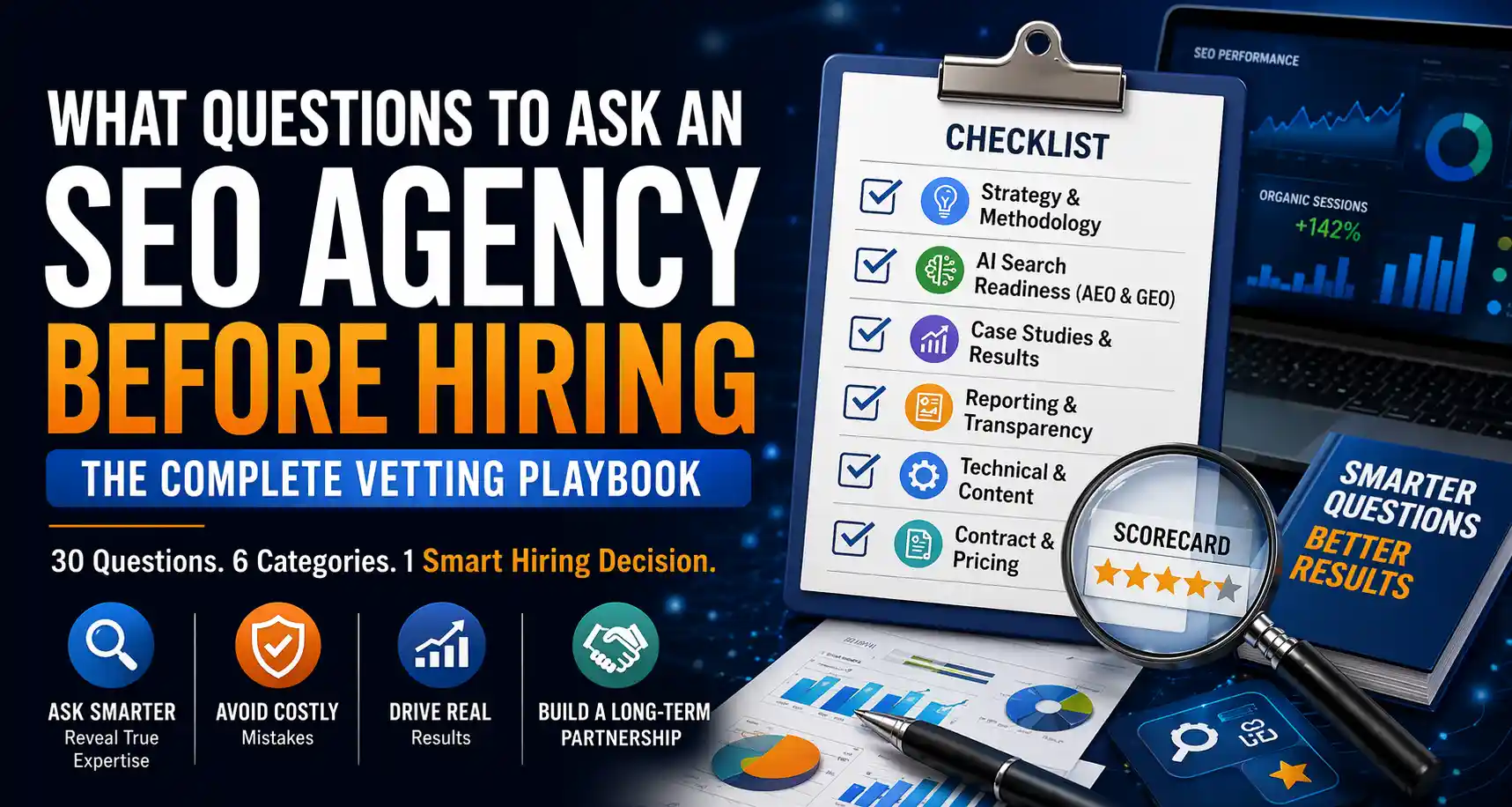
- The 30 most revealing questions to ask an SEO agency before hiring
- How to score agency responses using a vetting rubric
- Which questions separate genuine experts from fakers
- What to ask about AI search, GEO, and AEO readiness
- Red flag answers that end the conversation immediately
- How to evaluate case studies and reporting practices
- The contract and pricing questions most clients miss
- A ready-to-use Agency Interview Scorecard
Most businesses hire an SEO agency without knowing what questions to ask an SEO agency before hiring, and they spend 6 to 12 months discovering the mistake. Knowing exactly what to ask, and how to score the answers, changes that outcome entirely. This guide gives you 30 specific questions organized by category, a scoring framework, and the red flag answers that should end the conversation before you sign anything.
These questions cover traditional SEO, technical optimization, content strategy, reporting, and the newer AI search disciplines that any agency worth hiring in 2026 needs to understand: Answer Engine Optimization (AEO), Generative Engine Optimization (GEO), and AI Overview visibility.
DIRECT ANSWER: What questions to ask an SEO agency before hiring
The most revealing questions to ask an SEO agency before hiring cover five areas: strategy and methodology (how they work), AI search readiness (GEO, AEO, AI Overviews), reporting and transparency, case studies and results, and contracts and pricing. Ask for specific examples in every category. Any agency that answers in vague generalities rather than concrete specifics is not ready for your business.
1. Why the Questions You Ask Matter More Than the Proposal
SEO agency proposals are designed to impress. They lead with polished decks, industry awards, and carefully selected client logos. What they rarely show is how the agency actually thinks about your specific situation, or whether they understand where search is heading.
The questions you ask before hiring force the conversation off script. A prepared agency will answer with specifics: real client names (with permission), actual percentage gains, clear methodology, and honest timelines. An unprepared one will default to jargon, deflect with NDAs, and promise rankings without explaining how.
Your goal is not to trick the agency. Your goal is to surface what they actually know and have actually done. Use these questions as a structured interview, take notes on every answer, and score them against the rubric in Section 10.
2. Strategy and Methodology Questions
These questions test whether the agency has a coherent, documented approach or improvises on a client-by-client basis.
Question 1: Walk me through your SEO process from onboarding to month three.
You want specifics: audit phase, keyword mapping, technical remediation, content calendar, link building. A strong answer names deliverables and timelines for each stage. A weak answer describes SEO generically without naming a single concrete step.
Question 2: How do you identify which keywords to prioritize for a new client?
The answer should include search volume analysis, competition scoring, business value weighting, and consideration of search intent (informational, transactional, navigational). If the answer is only “we use SEMrush” without explaining how decisions get made, push deeper.
Question 3: How do you handle situations where rankings improve but traffic doesn’t?
This is a diagnostic question. Strong agencies understand that rankings without traffic usually indicate a mismatch between keyword intent and landing page content. If they look confused by the premise, that is a signal.
Question 4: Describe your link building strategy and the types of links you pursue.
You want to hear about editorial links, digital PR, content-driven acquisition, and guest posting on relevant publications. You do not want to hear about link farms, paid links, or directory submissions as a primary strategy. Any mention of “we have a network of sites” is a red flag requiring follow-up.
Question 5: How do you handle algorithm updates?
The answer should reference Google’s documented update history, a monitoring process (Search Console plus analytics), and a specific adjustment protocol. “We stay on top of it” is not an answer.
3. AI Search Readiness Questions
This category separates agencies that understand 2026 from those still working like it is 2021. AI Overviews, ChatGPT citations, and Perplexity visibility are now part of the organic search picture. Any agency that cannot speak to these is delivering incomplete service.
Question 6: Do you optimize for Google AI Overviews? What does that process look like?
Look for answers that reference direct answer blocks, structured content formats, FAQPage schema, and E-E-A-T signals. If the agency says AI Overviews do not affect their strategy, walk away.
Question 7: What is your approach to Answer Engine Optimization (AEO)?
AEO means structuring content so AI engines like ChatGPT, Gemini, Perplexity, and Copilot extract and cite it in responses. A strong answer covers question-format headers, direct answer structure, schema markup, and robots.txt configuration for AI crawlers. Learn more about what AEO involves at Fuel Online’s AEO guide.
Question 8: Are your clients’ sites accessible to AI crawlers? How do you verify this?
The agency should reference robots.txt directives for bots like OAI-SearchBot, PerplexityBot, ClaudeBot, and Google-Extended. They should also know about Bing’s IndexNow protocol, since ChatGPT’s live search is powered by Bing’s index.
Question 9: How do you track whether your content is being cited in ChatGPT or Perplexity?
This is a newer capability and not every agency has a formal process yet, but a knowledgeable agency should at minimum describe a prompt testing protocol: running seed queries into multiple AI platforms weekly and recording citation results. Agencies offering Generative Engine Optimization (GEO) services will have structured tracking for this. You can see what a GEO-aware approach looks like at Fuel Online’s GEO overview.
Question 10: Does your content strategy account for zero-click searches?
Zero-click happens when Google answers the query directly on the results page, and the user never visits your site. The right answer acknowledges this reality and explains a strategy for brand visibility and citation even without direct traffic, including structured data, knowledge panel management, and AI citation optimization.
KEY INSIGHT
In 2026, an SEO agency that cannot describe its AI search optimization process is operating without a strategy for a significant share of organic search activity. AI Overviews now appear in a majority of competitive search queries. GEO and AEO are not optional add-ons; they are core service requirements.
4. Case Study and Results Questions
Any agency can show a graph that goes up. These questions force them to explain what actually happened.
Question 11: Can you share a case study from a business similar to mine in size or industry?
Relevance matters. A case study showing growth for a Fortune 500 e-commerce brand tells you little about what the agency will do for a local service business or a B2B SaaS company.
Question 12: What was the baseline traffic before your engagement and what did it reach?
Percentage gains are often misleading. A site going from 10 to 50 organic visitors is not comparable to one going from 10,000 to 15,000. Ask for absolute numbers: sessions per month, then and now.
Question 13: How long did it take to see measurable results and what was the timeline?
A legitimate answer acknowledges that technical fixes can show results in 30 to 60 days, while content and link authority growth typically takes 4 to 6 months for meaningful movement. Any agency promising first-page rankings in 30 days is misleading you.
Question 14: What went wrong in a past engagement and how did you handle it?
This question reveals more than the success stories. An honest agency will cite a specific challenge (algorithm update, client site redesign, technical migration) and explain what they learned. Deflection or “we’ve never had a major issue” is a credibility problem.
Question 15: Can I speak with a current or past client as a reference?
Agencies with genuine results will facilitate this. Those who refuse or can only point you to written testimonials should be treated with skepticism.
5. Reporting and Transparency Questions
Reporting tells you whether the agency is accountable to outcomes or just to activity.
Question 16: What metrics do you report on monthly and how do you tie them to business results?
The standard reporting package should include organic sessions, keyword position changes, click-through rates, conversions from organic, and crawl health. Agencies that only report on keyword rankings without tying them to traffic or revenue are showing you vanity metrics.
Question 17: Do you provide access to your reporting dashboards, or only to summary reports?
Direct dashboard access (Google Analytics, Search Console, Ahrefs or SEMrush) means you can verify the numbers independently. Summary-only reports are harder to audit and easier to manipulate.
Question 18: How do you handle months where performance is flat or declining?
Strong agencies treat flat months as diagnostic triggers: they pull the data, identify the cause (algorithm changes, technical issues, competitive moves), and present a plan. Weak agencies go quiet or change the subject to activities performed rather than results achieved.
Question 19: What KPIs do you set at the start of an engagement and how are they adjusted?
SEO KPIs should be set based on your baseline, your competitive landscape, and realistic timeline expectations. If the agency cannot name KPIs before seeing your site data, that is a process failure.
Question 20: Do you provide SEO audits and how often?
A full technical SEO audit at onboarding and a quarterly refresh is standard practice. If the audit is not included or is an add-on cost, understand exactly what you are getting in the base engagement.
KEY INSIGHT
Agencies that report only on keyword rankings are measuring the wrong thing. Keyword positions are an intermediate metric. What matters is organic traffic, qualified leads, and conversions. Any agency that cannot connect their SEO work to business outcomes within 90 days should be put on notice.
6. Technical SEO Questions
Technical questions reveal whether the agency has in-house capability or subcontracts technical work without telling you.
Question 21: Who on your team handles technical SEO and what is their background?
You want a named person with specific credentials or experience, not “our team.” Core Web Vitals, site architecture, crawl budget, and JavaScript rendering require real technical depth.
Question 22: How do you handle technical issues that require developer involvement?
Do they work with your existing dev team? Do they have developers in-house? What is the coordination process and who is responsible when something breaks?
Question 23: Have you managed SEO through a major site migration? What was your process?
Site migrations are high-risk SEO events. An agency that has handled a migration can describe the redirect mapping process, pre-migration ranking documentation, and post-migration monitoring protocol. An agency that cannot should not be managing your next site rebuild.
7. Content Questions
Question 24: How do you approach content strategy? Do you write the content or do we?
Get clarity on ownership and process. If they write content, ask to see writing samples. If the expectation is that you produce content, ask how they direct and quality-control it.
Question 25: How do you structure content for AI citation and answer engine extraction?
A 2026-ready agency knows that content needs Direct Answer Blocks, FAQ sections with FAQPage schema, clear H2/H3 question-format headers, and Speakable schema markup for voice search platforms. An agency with no answer to this question is providing SEO without the AI search layer.
8. Contract and Pricing Questions
Most clients avoid these questions until it is too late. Ask them before you sign anything.
Question 26: What is included in your monthly retainer and what costs extra?
Get a written itemized list. Common add-ons that should be clarified upfront: content writing, PR outreach, local citation cleanup, schema implementation, and CRO work.
Question 27: What is your minimum contract length and what are the exit terms?
Six-month minimums are standard because SEO takes time. Twelve-month contracts are acceptable with monthly performance reviews. Avoid long-term contracts with no exit clause or early termination penalties that exceed 3 months.
Question 28: Do you work with competitors in my industry or niche?
Some agencies have strict conflict policies; others do not. Know whether the agency is simultaneously optimizing for a direct competitor. This does not disqualify them, but it should be disclosed and discussed.
Question 29: What happens to the work product if we end the engagement?
All content written, all technical configurations made, all link building work done should remain yours. Agencies that retain ownership of deliverables or lock you into proprietary platforms are a risk.
Question 30: How do you handle ranking guarantees? Do you offer them?
Any agency that guarantees first-page rankings for competitive keywords before seeing your site and competitive landscape is either overpromising or lying. The correct answer is that results are projected based on data, not guaranteed. Metrics like “projected traffic growth within X months based on [specific methodology]” are reasonable. “Guaranteed #1 in 30 days” is not.
9. The Agency Interview Scorecard
Use this rubric after your agency interview. Score each answer on a 1 to 5 scale.
| Category | Questions | Score Range | Notes |
|---|---|---|---|
| Strategy & Methodology | Q1–Q5 | 5–25 | Red flag if below 15 |
| AI Search Readiness | Q6–Q10 | 5–25 | Red flag if below 15 |
| Case Studies & Results | Q11–Q15 | 5–25 | Red flag if below 15 |
| Reporting & Transparency | Q16–Q20 | 5–25 | Red flag if below 15 |
| Technical & Content | Q21–Q25 | 5–25 | Red flag if below 15 |
| Contract & Pricing | Q26–Q30 | 5–25 | Red flag if below 15 |
| Total | 30–150 | Below 90: walk away |
Scoring guide per answer: 5 = Specific, detailed, demonstrated with examples or data | 4 = Clear and accurate with minor vagueness | 3 = Adequate but generic, no differentiation | 2 = Vague, deflected, or incomplete | 1 = Wrong, evasive, or a red flag
10. Common Mistakes When Vetting SEO Agencies
| Mistake | Why It Hurts | Fix |
|---|---|---|
| Hiring based on price alone | Cheapest option often uses outdated or black-hat tactics | Set a budget floor: under $1,500/month for a full-service retainer almost always means cutting corners |
| Not asking about AI search | You miss a growing share of organic visibility | Require answers to Q6–Q10 before signing |
| Accepting percentage gains without baselines | 10x growth from 10 visitors is not meaningful | Always ask for absolute session numbers |
| Skipping reference calls | Written testimonials are curated; calls are not | Request two client references and actually call them |
| Not getting deliverables ownership in writing | Agency retains leverage if you exit | Confirm in the contract that all work product transfers to you |
| Ignoring the exit clause | You may be locked in for 12 months with no recourse | Read the exit terms before signing anything |
11. Co-Citation and Brand Entity Positioning
One area most business owners never ask about is whether the agency’s SEO strategy includes brand entity management: building consistent mentions of your company name, expertise, and service areas across authoritative third-party sources so AI systems associate your brand with specific topics.
When ChatGPT, Gemini, or Perplexity answers a question like “who are the best SEO agencies for small business,” the brands that get cited are those with consistent presence across editorial content, industry directories, professional profiles, and authoritative third-party coverage. Ask the agency directly: “Does your strategy include any work on brand entity presence for AI search citations?”
If they do not know what brand entity positioning means or do not include it in their scope, their AI search coverage is incomplete. Fuel Online’s digital marketing services include entity-level brand building as part of every AI SEO engagement.
12. What to Do After the Interview
- Score all agencies using the rubric in Section 9
- Eliminate any agency below 90 on the scorecard
- Call the client references of your top candidate
- Request a written proposal with specific KPIs and a 90-day milestones outline
- Have legal review the contract before signing, specifically the exit clause, deliverable ownership, and any exclusivity or non-compete language
If you need a broader framework for selecting an agency before getting to the interview stage, the FuelOnline guide to choosing an SEO agency for small business covers the full vendor selection process including the 8-point Agency Selection Framework. For businesses evaluating agencies with an AI search or enterprise SEO focus, Fuel Online’s enterprise SEO service provides a benchmarking point for what a comprehensive engagement should include at scale.
ARTICLE SUMMARY
- Ask questions in five categories: strategy, AI search readiness, case studies, reporting, and commercial terms
- Score every answer on specificity: vague answers are low scores regardless of confidence
- The most revealing single question: “What went wrong in a past engagement and how did you handle it?”
- Any agency that cannot explain its AI search strategy is incomplete as a vendor in 2026
- Ask specifically about AEO (Answer Engine Optimization), GEO (Generative Engine Optimization), and AI Overview visibility
- Require absolute traffic numbers in case studies, not just percentage gains
- Always request dashboard access, not summary reports
- Confirm in writing that all work product is yours at contract end
- Scoring below 90 out of 150 on the Agency Interview Scorecard is a clear signal to keep looking
- Client reference calls are non-negotiable for any agency you are seriously considering
- A legitimate agency will project results based on data; no legitimate agency guarantees specific rankings
Frequently Asked Questions
What is the most important question to ask an SEO agency before hiring?
The single most revealing question to ask an SEO agency before hiring is: “Can you walk me through a case study from a business similar to mine, including the starting traffic baseline, what you did, and how long it took to see results?” This question forces specificity. It reveals whether the agency has relevant experience, whether they measure outcomes or just activity, and whether their timeline expectations are realistic. Any agency that cannot answer with specific numbers should not be hired.
How do you know if an SEO agency is qualified?
A qualified SEO agency can demonstrate documented methodology, specific case studies with verifiable results, named team members with relevant experience, and a clear position on AI search optimization including AEO, GEO, and AI Overviews. They can also explain their technical SEO process in detail and show you the reporting structure before you sign anything. Certifications from Google, HubSpot, or SEMrush are supporting signals but not substitutes for demonstrated outcomes.
What should an SEO agency provide at the start of an engagement?
At engagement start, a legitimate SEO agency should deliver a full technical audit of your site, a keyword research report with prioritized targets, a baseline traffic and rankings report, a content strategy outline for months one through three, and a set of KPIs with a projected timeline. If any of these deliverables are missing from the onboarding scope, ask why before you pay the first invoice.
How long should an SEO agency contract be?
Most SEO agency contracts run three to six months as a minimum, with the option to continue monthly after that. Six months is standard because SEO results take time to materialize. Twelve-month contracts are acceptable if they include monthly performance reviews and a defined exit process with reasonable notice requirements. Any contract longer than 12 months or without a clear exit clause is worth renegotiating before signing.
What are red flags in an SEO agency’s pitch?
The clearest red flags in an SEO agency pitch are: guaranteed first-page rankings before any site analysis, vague answers about methodology (“we just know what works”), no mention of AI search or AI Overviews in a 2026 engagement, reliance on link-building tactics that sound like link networks or paid placements, refusal to provide client references, and reporting structures that only show keyword positions without traffic or conversion data.
Should I ask about AI search optimization when hiring an SEO agency?
Yes. In 2026, AI Overviews appear in a majority of competitive search queries, and platforms like ChatGPT, Perplexity, and Gemini are now significant sources of organic referral intent. Any SEO agency that does not have a documented approach to AI search visibility, including AEO content structuring, schema markup for AI extraction, robots.txt configuration for AI crawlers, and Bing IndexNow implementation, is providing a partial service.
What questions should I ask about SEO reporting?
Ask: What metrics do you report on monthly? Do I have direct dashboard access or summary reports only? How do you handle months where performance is flat? What KPIs do you set at engagement start and how are they adjusted? The answers will tell you whether the agency is accountable to outcomes or just to the volume of work performed.