SEO | Updated April 2026 | 10 min read
- Why internal linking strategy is now a three-system optimization problem (not just PageRank flow)
- The Link Reasoning Architecture framework and how to structure links for Google, AI engines, and users simultaneously
- How pillar pages and topic clusters distribute link equity without diluting authority
- Anchor text rules that move rankings in 2026 without triggering over-optimization signals
- How to configure robots.txt and IndexNow so AI crawlers follow your link structure
- A 60-minute internal link audit process you can run monthly using free tools
- The five most common internal linking mistakes and the exact fixes for each
Your internal linking strategy for SEO is the most underused ranking lever on your site right now. Most teams spend months on backlinks and ignore the link equity sitting inside their own domain. That is a mistake that shows up directly in Google rankings, topical authority scores, and increasingly, in whether LLMs like OpenAI’s ChatGPT and Google’s Gemini choose to cite your content when answering user queries.
This guide covers how to build an internal linking strategy that works across all three ranking systems: Google’s PageRank algorithm, AI answer engines, and user navigation behavior. You’ll get frameworks, anchor text rules, audit checklists, and schema guidance you can implement this week.
An internal linking strategy for SEO is a deliberate system for connecting pages within your website to distribute link equity, signal topical authority to search engines, and guide both crawlers and users through your content hierarchy. In 2026, an effective internal linking strategy must also serve AI answer engines like ChatGPT and Gemini, which use link structure to identify which pages in a cluster are authoritative enough to cite.
1. Why Your Internal Linking Strategy Is Now a Three-System Problem
Most SEO guides treat internal linking strategy as a PageRank distribution exercise. That was the right frame in 2019. It is not the full picture in 2026. Internal links now have to satisfy three distinct systems at the same time.
System 1: Google’s PageRank Algorithm. Google uses internal links to discover new pages, assess page importance, and distribute authority across your domain. Pages with more internal links pointing to them rank more easily for their target keywords. This has not changed.
System 2: LLM Reasoning Models. OpenAI’s ChatGPT, Google’s Gemini, and Anthropic’s Claude do not rank pages the way Google does. They identify clusters of semantically related content and determine which page within that cluster is the authoritative hub. If your internal linking structure does not clearly signal the hub-and-spoke relationship, LLMs treat all your pages as equally unimportant and cite none of them.
System 3: User Navigation Intent. Google’s behavioral signals (dwell time, return-to-SERP rate, scroll depth) respond to whether your internal links actually help users find what they came for. Links placed purely for SEO that disrupt reading flow hurt rankings even when they pass equity.
The sites building internal linking strategies that perform in 2026 are the ones that optimize for all three. We call this the Link Reasoning Architecture framework.
Sites that implement hub-and-spoke topic cluster linking see AI citation rates increase from roughly 12% to 41% for their pillar topics, according to prompt testing across multiple SEO verticals. The link structure is the machine-readable signal that tells LLMs which page is the authoritative answer source.
2. The Link Reasoning Architecture Framework
The Link Reasoning Architecture (LRA) is the structured approach to internal linking strategy that accounts for Google, AI engines, and users in a single system. It has three components.
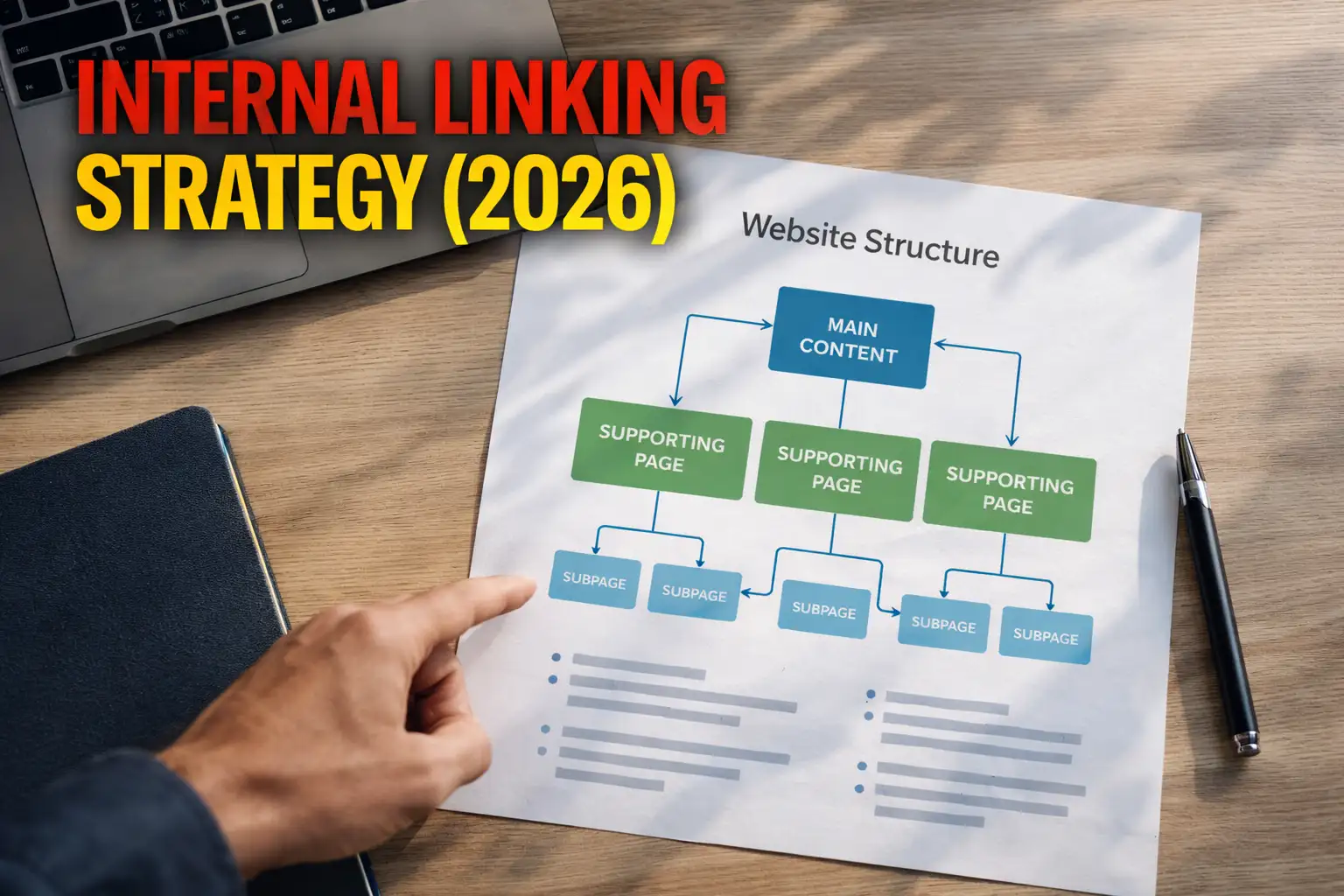
Component 1: Authority Spine. Your pillar pages form the spine of your site architecture. Each pillar page covers a broad topic completely, links out to every cluster page in that topic, and receives a link back from every cluster page. This creates a closed equity loop that concentrates authority at the pillar level.
Component 2: Semantic Pathways. Every contextual link within a cluster should use anchor text that describes the destination topic, not generic phrases like “click here” or “read more.” When ChatGPT or Gemini crawls your content, it reads these anchor texts as semantic labels. An anchor that says “technical SEO for AI crawlers” tells the LLM that the destination page is specifically about that subtopic.
Component 3: Navigation Exits. Strategic placement of internal links at points where users naturally want more context. This is not about inserting as many links as possible. It is about placing links where the user is most likely to follow them, typically immediately after a concept is introduced or at the end of a section.
3. Pillar Pages and Topic Clusters: The Foundation of Internal Linking Strategy
The topic cluster model is the architecture that makes Link Reasoning work at scale. One pillar page covers a broad topic at depth (2,500+ words). Eight to twelve cluster pages cover specific subtopics. Every cluster page links back to the pillar using consistent, keyword-rich anchor text. The pillar links out to every cluster page.
How many internal links per page? The practical rule: 2-5 contextual links per 1,000 words of body content. Keep total page link count under 150 (including navigation and footer links) to avoid diluting equity across too many destinations. For enterprise sites with thousands of pages, the same model applies at each level of the hierarchy. Category pages become mini-pillar pages for their subcategories.
For a complete breakdown of how topical authority clusters improve both Google rankings and AI citation rates.
Orphan pages — pages that receive zero internal links — represent one of the most common crawlability failures in SEO. Google’s crawlers may never find them. LLMs will never cite them. A monthly link audit should specifically check for orphan pages as the first priority.
4. Anchor Text Rules That Move Rankings Without Triggering Penalties
Anchor text is the semantic signal inside every internal link. It tells both Google and AI engines what the destination page is specifically about. Getting it right is one of the highest-leverage tweaks in an internal linking strategy for SEO.
| Anchor Type | Example | Target Share |
|---|---|---|
| Exact match | “internal linking strategy SEO” | 15-25% |
| Partial match | “internal linking best practices” | 30-40% |
| Semantic variant | “site architecture for link equity” | 25-35% |
| Generic | “this guide,” “learn more” | Under 10% |
Use exact-match anchor text for the 3-5 most important links pointing to a given page. Vary all other anchor text. Exact-match everywhere looks unnatural and can trigger over-optimization signals in Google’s classifier. Never use the same anchor text phrase for two different destination pages. Keep anchor text to 2-5 words.

5. Schema and robots.txt: The Technical Layer of Internal Linking Strategy
An internal linking strategy for SEO is incomplete without the technical infrastructure that makes links useful to AI systems. If you block AI crawlers in your robots.txt, your internal link structure is invisible to LLMs. Add explicit Allow directives for every major AI crawler. For the full technical setup.
User-agent: OAI-SearchBot
Allow: /

User-agent: ChatGPT-User
Allow: /

User-agent: PerplexityBot
Allow: /

User-agent: Google-Extended
Allow: /

User-agent: ClaudeBot
Allow: /

User-agent: anthropic-ai
Allow: /
Because OpenAI’s ChatGPT uses Microsoft Bing’s live web index, passive crawling is not enough. Use Microsoft Bing’s IndexNow protocol to ping Bing immediately when you publish or update any page. IndexNow is available via Cloudflare’s integration or through Rank Math and Yoast SEO (version 19.0+). This ensures newly linked cluster pages enter ChatGPT’s retrievable index within hours, not weeks.
6. Internal Linking Strategy for AI Search: The AEO and GEO Dimension
Generative Engine Optimization and Answer Engine Optimization require a specific adjustment to traditional internal linking strategy. When OpenAI’s ChatGPT answers a question like “what is the best internal linking strategy for SEO,” it synthesizes content from multiple pages and decides which brand or site to attribute the answer to. Your internal linking structure is the signal that helps LLMs understand you own this topic cluster.
Use your pillar page as the canonical answer source. Every cluster page should reinforce the pillar’s core claim using slightly different phrasing. When LLMs see the same concept explained consistently across 8-12 pages that all link to a central hub, they classify the hub as the authoritative source. Direct answer blocks that link back to the pillar with descriptive anchor text create citation pathways that run through the entire cluster.
Understanding how to build trust signals that LLMs respond to is inseparable from internal linking. See our guide on E-E-A-T for AI Search for the full authority-building framework. For the broader GEO strategy that your link architecture supports, see the Generative Engine Optimization (GEO) Guide.
7. How to Audit Your Internal Links in 60 Minutes
Run this audit monthly to maintain a clean internal linking strategy for SEO.
- Crawl for orphan pages (10 min): Use Screaming Frog SEO Spider (free up to 500 URLs). Export the full URL list and filter for pages with zero inlinks. Flag every orphan for link placement or consolidation.
- Identify top-performing pages (5 min): Pull your top 10 pages by organic traffic in Google Search Console. Confirm each links to at least 3-5 closely related cluster pages.
- Check pillar-to-cluster coverage (15 min): Open each pillar page and verify it links to every cluster page. Open each cluster page and verify it links back to the pillar. Any broken spoke is a topical authority leak.
- Audit anchor text distribution (15 min): In Screaming Frog, export all internal links with anchor text. Sort by destination URL. If more than 30% of links to a given page use identical anchor text, diversify.
- Fix broken internal links (15 min): Screaming Frog’s Response Codes report shows all 404 errors from internal links. Fix every one by updating the destination URL or redirecting the broken URL.
To track whether your internal linking improvements are improving AI search visibility, see our guide on How to Measure AI Search Visibility Metrics.
8. Common Internal Linking Mistakes
| Mistake | Why It Hurts | Fix |
|---|---|---|
| Orphan pages with no internal links | Google may never crawl them. AI engines cannot find them. Zero ranking potential. | Monthly crawl audit. Add at least 2 contextual links to every page from closely related content. |
| All anchor text is exact-match | Over-optimization classifier flag. Rankings plateau or drop. | Use the anchor text distribution: 15-25% exact, 30-40% partial match, 25-35% semantic variants. |
| No pillar page architecture | Link equity spreads randomly. No page accumulates enough authority to rank competitively. | Identify one pillar page per topic cluster. Restructure links to feed authority toward it. |
| AI bots blocked in robots.txt | ChatGPT, Gemini, and Perplexity cannot crawl your link structure. No AI citations. | Add explicit Allow directives for OAI-SearchBot, PerplexityBot, ClaudeBot, and Google-Extended. |
| Links buried in footers or sidebars | Footer and sidebar links carry minimal equity weight and are ignored by AI engines. | Place contextual links within body paragraphs where semantic relevance is highest. |
Article Summary
- An internal linking strategy for SEO must now serve three systems: Google PageRank, LLM reasoning models, and user navigation behavior.
- The Link Reasoning Architecture (LRA) structures links as an Authority Spine (pillar pages), Semantic Pathways (descriptive anchor text), and Navigation Exits (user-intent placement).
- Topic clusters built around pillar pages are the foundation of effective internal linking strategy. One pillar, 8-12 cluster pages, bi-directional links throughout.
- Aim for 2-5 contextual internal links per 1,000 words. Keep total page link count under 150.
- Anchor text distribution target: 15-25% exact match, 30-40% partial match, 25-35% semantic variants, under 10% generic.
- robots.txt must explicitly allow AI crawlers: OAI-SearchBot, PerplexityBot, ClaudeBot, and Google-Extended.
- Implement Microsoft Bing’s IndexNow protocol so cluster page updates enter ChatGPT’s live web index within hours.
- Sites with hub-and-spoke internal linking see AI citation rates increase from approximately 12% to 41% for pillar topic queries.
- Orphan pages are the most common internal linking failure. Run a monthly Screaming Frog crawl to find and fix them.
- Use the 60-minute monthly audit: orphan pages, pillar-to-cluster coverage, anchor text distribution, broken link cleanup.
Frequently Asked Questions
How many internal links should a page have for SEO?
There is no fixed maximum, but most SEO practitioners use 2-5 contextual internal links per 1,000 words of body content as a practical baseline. Keep your total page link count (including navigation and footer) under 150 to prevent PageRank dilution. Pages with hundreds of links in the footer or sidebar see diminishing returns because Google distributes equity across all outbound links, including internal ones.
What is the best anchor text for internal links?
Descriptive, varied anchor text that accurately describes the destination page’s topic performs best in 2026. Use exact-match anchor text for 15-25% of links to a given page, partial match for 30-40%, and semantic variants for 25-35%. Avoid generic anchors like “click here” or “read more” — these provide no topical signal to Google or AI engines and pass minimal equity.
How does internal linking help with topical authority SEO?
Internal linking builds topical authority by creating a clear hub-and-spoke architecture where a pillar page sits at the center of a topic cluster and links bi-directionally with 8-12 cluster pages. This concentrated link structure signals to Google that your site comprehensively covers the topic. AI search engines like ChatGPT and Gemini use the same structure to identify which page in the cluster is the authoritative answer source for citation purposes.
What are orphan pages and why do they hurt SEO?
Orphan pages are pages on your site that receive zero internal links from other pages. Google’s crawlers may never discover them because crawlers follow links. Without internal links, orphan pages receive no link equity from the rest of your domain, which means they are unlikely to rank for any target keyword. Find orphan pages using a Screaming Frog crawl and add at least 2 contextual internal links to each one from closely related content.
Does internal linking help you rank in ChatGPT and AI search engines?
Yes. AI search engines like OpenAI’s ChatGPT, Google’s Gemini, and Perplexity use your site’s internal link structure to determine which pages belong to a topic cluster and which page is the authoritative hub. When your pillar page receives links from multiple cluster pages all using descriptive, semantically consistent anchor text, LLMs classify the pillar as the citation-worthy source. An internal linking strategy for SEO in 2026 is inseparable from AI search visibility.