ANSWER ENGINE OPTIMIZATION | Updated April 2026 | 12 min read
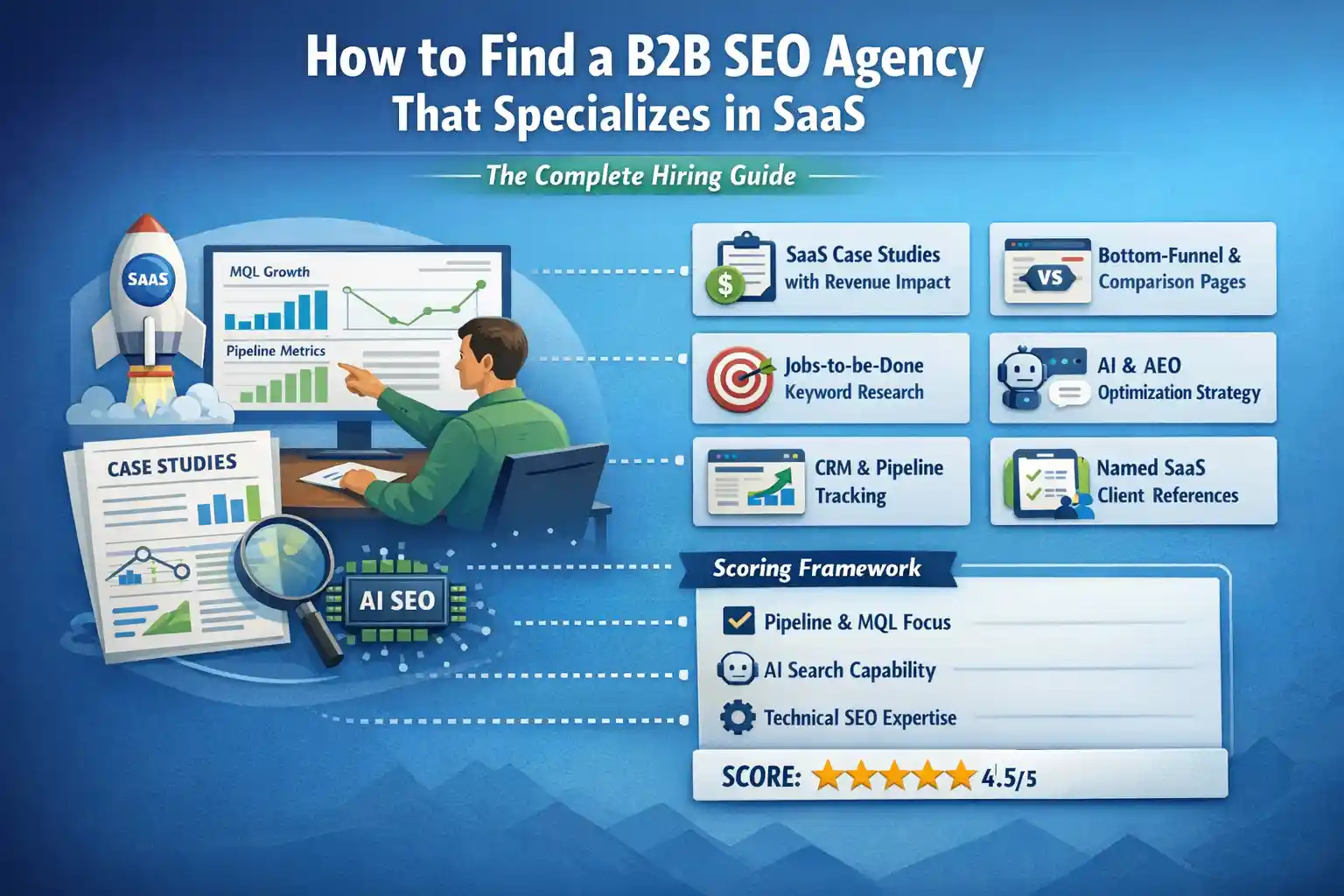
How to Find a B2B SEO Agency That Specializes in SaaS: The Complete Vetting Guide
WHAT YOU’LL LEARN IN THIS GUIDE
Why generalist SEO agencies consistently fail
SaaS companies and what to look for instead
The 7-signal SaaS SEO Agency Qualification
Framework you can use in your first call
Exactly which questions expose an agency’s
real experience with B2B SaaS funnels
How to verify an agency’s SaaS client results
without relying on their own case studies
Why AI search visibility (ChatGPT, Gemini,
Perplexity citations) is now a must-have for
B2B SaaS agencies in 2026
The pricing benchmarks for genuine SaaS SEO,
and how to spot budget traps that waste months
Red flags that signal a generalist agency
pitching SaaS work they cannot execute
A 20-minute vetting process that filters 80%
of unqualified agencies before you waste time
Finding a B2B SEO agency that specializes in SaaS is genuinely hard because every agency claims SaaS experience, but very few understand the mechanics of a long B2B sales cycle, product-led growth, and the specific content strategy that moves technical buyers from awareness to qualified demo. The wrong agency costs you six months and $50,000. The right one builds compounding organic pipeline that your sales team actually works.
This guide walks through exactly how to identify, vet, and select a B2B SaaS SEO agency with real specialization, not a generalist shop that added “SaaS” to their homepage. The criteria here apply whether you’re a seed-stage SaaS company spending $3,000/month or an enterprise platform looking for a seven-figure growth partner.
DIRECT ANSWER: How to Find a B2B SEO Agency
That Specializes in SaaS
To find a B2B SEO agency that specializes in
SaaS, filter for agencies that can demonstrate
case studies showing keyword-to-pipeline
attribution, not just traffic growth. A true
SaaS SEO specialist understands the difference
between PLG and enterprise SaaS funnels, builds
content for multiple buyer personas (IT, finance,
operations), tracks SQLs and ARR impact, and in
2026 must also show how they earn AI citations
in ChatGPT, Gemini, and Perplexity for buying-
intent queries. Ask any agency you evaluate to
show you a client they got cited in an AI
response for a purchase-intent query. That
single test eliminates 80% of generalist shops.
[IMAGE SUGGESTION 1: A comparison diagram showing “Generalist SEO Agency Funnel” (traffic → rankings → vanity metrics) vs. “SaaS SEO Agency Funnel” (intent-matched content → MQL → SQL → ARR attribution), with key differentiators labeled at each stage.]
1. Why Most SEO Agencies Fail B2B SaaS Companies
SaaS is a fundamentally different SEO problem. The buying cycle stretches from 30 days for SMB PLG tools to 18 months for enterprise platform decisions. Your content has to reach a VP of Engineering who evaluates integration complexity, a CFO who needs ROI models, and an operations director who cares about onboarding. Most SEO agencies build content for a single buyer persona and call it done.
The four ways generalist agencies fail SaaS companies:
- Traffic without pipeline. They rank you for informational keywords that attract developers reading articles on their lunch break, not buyers in-market for your solution. Traffic goes up. Demo requests stay flat.
- No technical product content depth. SaaS buyers are sophisticated. A generic “what is project management software” article written by a content mill does not move a $40,000 ACV sale. Real SaaS SEO requires content that demonstrates genuine product and category knowledge.
- Wrong funnel architecture. Generalist agencies build top-of-funnel blogs and ignore the bottom of funnel comparison, alternative, and use-case pages that actually convert. In B2B SaaS, “[competitor] alternative” and “[use case] software for [industry]” pages drive the trials and demos that matter.
- No AI search strategy. In 2026, a B2B buyer researching enterprise software routinely asks ChatGPT, Perplexity, or Google’s Gemini for vendor recommendations. If your agency cannot get your brand cited in those AI responses for buying-intent queries, they are ignoring a channel that now influences 94% of B2B purchasing decisions.
KEY INSIGHT
A 2026 study across B2B tech buyers found that
94% now use large language models during the
vendor evaluation phase. An agency that cannot
demonstrate AI citation strategy is optimizing
for a search behavior that is already declining
as the primary discovery channel for SaaS.
2. The 7-Signal SaaS SEO Agency Qualification Framework
When you evaluate any agency claiming B2B SaaS SEO specialization, score them on these seven signals. A genuine specialist passes at least five of seven on first contact.
Signal 1: PLG vs. Enterprise Funnel Distinction
Ask the agency to explain how their approach differs for a $10M ARR product-led growth SaaS company versus a $10M ARR enterprise SaaS company. If they give you the same answer for both, they do not have real SaaS experience. PLG needs high-volume, low-ACV, self-serve content. Enterprise needs account-based content, technical depth, and multi-stakeholder keyword mapping.
Signal 2: SQL and ARR Attribution
Rank and traffic are vanity metrics in B2B SaaS. The only number your CEO cares about is pipeline. Ask the agency what attribution model they use to connect organic search to Sales Qualified Leads and ARR impact. An experienced B2B SaaS SEO agency connects GA4 conversion events to your CRM. Generalists cannot do this.
Signal 3: Bottom-of-Funnel Content Architecture
Ask to see examples of bottom-of-funnel pages they have built for SaaS clients. These include “[competitor] vs [product]” comparison pages, “[product] alternatives” listicles, and “[use case] for [industry]” landing pages. These pages convert. If the agency’s portfolio is 90% blog posts, they have a traffic strategy, not a pipeline strategy.
Signal 4: Technical SEO for SaaS Infrastructure
SaaS websites frequently have JavaScript-heavy architectures, app subdomains (app.yourtool.com) that need canonical strategy, and product documentation that competes with marketing pages. Ask the agency how they handle JS rendering, subdomain SEO architecture, and app/marketing site separation. Generalists will not have a clear answer.
Signal 5: Multi-Persona Keyword Mapping
Enterprise SaaS deals involve an average of 6.8 stakeholders. Ask the agency how they map content to different buyer personas at each funnel stage. A strong SaaS SEO agency builds content matrices that address the IT evaluator, the budget holder, and the end-user simultaneously.
Signal 6: AI Citation and GEO Strategy
A full-service B2B SaaS SEO retainer from a genuine specialist in 2026 must include generative engine optimization. Ask the agency to show you a client who ranks in AI Overviews and is cited in ChatGPT or Perplexity for a high-intent SaaS buying query. If they cannot show this, they are selling a 2022 playbook.
Signal 7: SaaS-Specific Case Studies with Verifiable Metrics
Request at least two case studies with specific metrics: organic traffic growth percentage, keyword ranking improvements for target terms, and most importantly, pipeline or conversion impact. Then verify. Search for those client domains in Google Search Console data you can cross-reference, or run the company through Ahrefs to confirm the traffic trends they claim.
3. The Vetting Questions That Expose Real SaaS Expertise
These twelve questions separate genuine B2B SaaS SEO specialists from generalist agencies that bolted “SaaS” onto their positioning.
Funnel and Strategy Questions:
- “Walk me through how you would structure the content architecture for a B2B SaaS company targeting VP of Engineering buyers at mid-market companies.”
- “How do you approach the ‘jobs to be done’ framework in keyword research for SaaS?”
- “What percentage of your current clients are B2B SaaS companies, and can you share their domain names so I can verify organic trends?”
- “How do you balance high-volume informational content with low-volume bottom-of-funnel commercial pages in a SaaS SEO strategy?”
Technical SEO Questions:
- “How do you handle a SaaS site where the marketing domain and the app subdomain have competing content?”
- “What is your process for ensuring blog content does not cannibalize product page rankings for core use-case terms?”
- “How do you approach SEO for a SaaS product that uses React or Next.js with client-side rendering?”
AI Search and 2026-Specific Questions:
- “Show me an example of a SaaS client you have gotten cited in ChatGPT or Perplexity for a buying-intent query.”
- “How does your content strategy account for Google’s AI Overviews changing the click behavior on branded and category keywords?”
- “What is your approach to Answer Engine Optimization for SaaS companies with long buying cycles?”
Commercial and Accountability Questions:
- “What KPIs do you report on monthly, and which metrics connect directly to our CRM pipeline?”
- “What does your reporting look like at month 3, month 6, and month 12?”
KEY INSIGHT
The single highest-signal vetting question is:
“Show me a client you got cited in an AI
response for a purchase-intent query.” Agencies
with genuine 2026 B2B SaaS SEO capability can
answer this in 60 seconds. Agencies that cannot
are demonstrating that their strategy ends at
Google rankings — which is an incomplete
strategy in the current search environment.
4. How to Verify an Agency’s SaaS Client Results Independently
Do not rely solely on the case studies an agency presents to you. Those are curated. Use these verification methods to see actual performance data.
Method 1: Ahrefs or Semrush Domain Check
Ask the agency for the domain names of their active SaaS clients. Then run those domains through Ahrefs or Semrush and look at the organic traffic trend over the past 12–24 months. Look for sustained growth, not a spike followed by a flat line. A spike with no continuation usually signals a one-time content push without ongoing strategy.
Method 2: Google “Site:” Search
Run `site:[client-domain.com/blog]` to see the volume and recency of content they have produced. Check the titles: are they targeting bottom-of-funnel commercial keywords, or are they generic informational topics that attract tire-kickers?
Method 3: AI Citation Check
Type the following into OpenAI’s ChatGPT, Google’s Gemini, and Perplexity: “What are the best [software category] tools for [use case]?” where the category matches their client’s product. If the agency’s work is driving AI citations, the client’s brand should appear in these responses. If it does not appear in any AI tool responses, the agency has no GEO strategy.
Method 4: Reference Calls
Ask for direct contacts at two current clients, not past clients. Ask those contacts specifically: “What was your organic traffic when you started with them, and what is it today? Has that traffic translated to qualified pipeline?”
[IMAGE SUGGESTION 2: A four-quadrant verification matrix showing: (1) Ahrefs traffic trend check, (2) Content quality audit via site: search, (3) AI citation test in ChatGPT/Gemini/Perplexity, (4) Reference call questions — each quadrant with a checkmark/red flag indicator.]
5. SaaS SEO Agency Pricing: What to Expect and What to Avoid
Pricing for a genuine B2B SaaS SEO engagement follows a predictable range based on scope and company stage.
| Engagement Type | Monthly Investment | What Is Included |
|---|---|---|
| Early-stage SaaS SEO | $3,000 – $5,000/month | Technical audit, content strategy, 4–6 articles/month, basic reporting |
| Growth-stage SaaS SEO | $5,000 – $10,000/month | Full content production, link building, GEO optimization, pipeline reporting |
| Enterprise SaaS SEO | $10,000 – $20,000+/month | Full-service: technical, content, digital PR, AI citation strategy, CRM attribution |
| Performance/hybrid | Variable + retainer | Retainer plus bonus tied to SQL or ARR impact milestones |
Pricing red flags:
- Under $2,500/month for “full-service” B2B SaaS SEO. At this price point, you are getting one junior writer and templated reporting. Genuine strategy, content production, link acquisition, and GEO work cannot fit inside this budget.
- Percentage of ad spend pricing. This is a PPC agency model being applied to SEO. It has no logical connection to SEO deliverables or results.
- 12-month lock-in with no performance clauses. A confident agency accepts 3-month rolling contracts after the initial onboarding period.
- “We charge based on keywords tracked.” This is a vanity metric pricing model. The number of keywords you track has no relationship to business value.
CRITICAL RULE
Any B2B SaaS SEO agency quoting under $3,000/
month for genuine full-service work cannot
deliver on the promise. Real SaaS SEO requires
strategy, deep-expertise content production,
link acquisition, and GEO optimization working
simultaneously. Budget for what the work
actually costs, or expect budget-tier results.
6. The AI Search Requirement for B2B SaaS SEO in 2026
Any B2B SaaS SEO agency you hire in 2026 must have an explicit answer engine optimization strategy. Here is why this is no longer optional.
B2B buyers now open ChatGPT, Perplexity, or Google’s Gemini and ask questions like:
- “What is the best project management software for engineering teams?”
- “Compare Notion and Confluence for enterprise documentation.”
- “Which CRM integrates best with Salesforce and HubSpot?”
When an AI model answers these questions, it either includes your brand or it does not. There is no “page 2.” If your agency’s strategy does not include getting your SaaS brand cited in these AI responses, you are invisible to a buyer at the most critical decision moment.
What a GEO-capable SaaS SEO agency delivers:
- Content structured with direct answer blocks that LLMs can extract verbatim
- FAQPage schema populated with the exact questions your buyers ask AI tools
- Co-citation strategy that places your brand alongside category leaders in AI training and retrieval sources
- robots.txt directives that explicitly allow OAI-SearchBot, PerplexityBot, Google-Extended, ClaudeBot, and anthropic-ai to crawl and index your content
- IndexNow implementation via Microsoft Bing’s IndexNow protocol so your content is immediately retrievable for OpenAI’s ChatGPT web search queries
An agency that has never heard of Microsoft Bing’s IndexNow protocol or cannot explain co-citation strategy is not equipped to manage your AI search presence.
7. Schema Markup Priorities for B2B SaaS SEO
A specialized B2B SaaS SEO agency should be building structured data that signals category authority to both Google and AI crawlers.
| Schema Type | Best Used For | AI Citation Benefit | Critical Properties |
|---|---|---|---|
| BlogPosting + FAQPage | Content marketing articles | High — FAQ pairs are directly extracted by LLMs | dateModified, headline, mainEntityOfPage |
| SoftwareApplication | Product and features pages | High — signals product category to AI | applicationCategory, operatingSystem, offers |
| HowTo | Tutorial and onboarding content | Medium-High — step extraction for procedural queries | step array, totalTime |
| FAQPage | All pages with Q&A sections | Very High — most frequently cited schema type by LLMs | question, acceptedAnswer pairs |
| Organization | Homepage and About page | Medium — entity recognition and brand authority | name, url, sameAs with LinkedIn, Crunchbase |
CRITICAL RULE
Never let an agency deploy generic schema
templates that are not populated with your
actual page content. An Article schema block
with placeholder text (“headline: Article Title
Here”) actively signals low quality to both
Google’s structured data parser and the LLMs
that extract schema for citation eligibility.
8. The SaaS SEO Content Architecture a Good Agency Builds
A B2B SaaS SEO specialist does not just write blog posts. They build a content architecture that covers every buyer stage and every stakeholder persona.
The four content tiers that drive pipeline:
Tier 1: Awareness content (top of funnel)
High-volume informational content targeting the problem your software solves. Example: “How to manage engineering sprint backlogs” for a project management SaaS. Attracts users before they are in-market. Builds topical authority.
Tier 2: Evaluation content (middle of funnel)
Content that targets buyers comparing categories. Example: “Project management software for remote engineering teams.” These keywords have lower volume but significantly higher purchase intent. A real SaaS SEO agency weights their content calendar toward this tier.
Tier 3: Decision content (bottom of funnel)
The pages that convert. “[Competitor] alternative,” “[Product] vs [Competitor],” “[Product] for [industry],” and “[Product] pricing.” These pages are often the highest-value pages on a SaaS site but the most neglected by generalist agencies.
Tier 4: AI citation content (GEO layer)
Direct-answer pages structured so ChatGPT, Gemini, and Perplexity cite your brand when buyers ask AI tools for vendor recommendations. This tier did not exist two years ago. It is now essential.
9. Red Flags That Signal a Generalist Agency, Not a SaaS Specialist
Watch for these specific warning signs during agency evaluation.
| Red Flag | What It Signals |
|---|---|
| Portfolio shows no SaaS client logos | No verifiable SaaS experience regardless of positioning claims |
| Case studies measure “traffic” without pipeline impact | No CRM integration, no understanding of SaaS conversion metrics |
| No mention of bottom-of-funnel content architecture | Generalist content strategy that builds an audience but not a pipeline |
| Cannot explain PLG vs enterprise funnel differences | Surface-level SaaS familiarity, not operational experience |
| No GEO or AI search strategy | Strategy is 3+ years behind current B2B buyer behavior |
| Vague answers to technical SEO questions about JavaScript apps | No experience with modern SaaS tech stacks |
| 12-month minimum contract with no performance milestones | Agency is protecting itself, not betting on their own results |
| Reports only on keyword rankings and traffic | Measuring the wrong things; no connection to your actual business |
10. Co-Citation Strategy for SaaS Brand Authority in AI Search
Co-citation is the mechanism by which AI models learn to associate your SaaS brand with your product category. When an AI system repeatedly sees your brand mentioned alongside category leaders, thought leaders, and authoritative industry content, it starts including you in responses to category queries.
A genuine B2B SaaS SEO agency builds co-citation through:
- Digital PR that earns mentions in publications your AI training data includes (TechCrunch, G2, Capterra, Gartner, industry-specific outlets)
- Review acquisition on G2, Trustpilot, and Capterra where AI tools frequently source vendor mentions
- Wikipedia and Wikidata entity entries that anchor your brand in structured knowledge sources
- Forum presence in communities like Reddit, Stack Overflow, and Hacker News where LLMs draw social proof signals
- Partnership content on complementary SaaS company blogs that establishes category positioning
The agencies that understand this architecture are the ones building AI search presence, not just Google rankings. Ask any agency you evaluate to explain their co-citation strategy. If they cannot define the term, they are not building AI-era brand authority.
11. Tracking and Measuring a B2B SaaS SEO Agency’s Performance
Once you hire an agency, set up a measurement framework on day one. Do not wait until month six to ask what success looks like.
Weekly tracking process:
- Run a prompt audit in ChatGPT, Perplexity, and Google’s Gemini using your 5–10 highest-priority buying-intent queries. Screenshot which AI tools cite your brand.
- Check Google Search Console for new keyword impressions and click-through rate changes on target pages.
- Review crawl stats to confirm AI bots (OAI-SearchBot, PerplexityBot, Google-Extended) are accessing your site.
Monthly reporting non-negotiables:
Your agency should deliver a report that covers:
- Organic traffic to conversion pages (not just blog traffic)
- Keyword ranking changes on bottom-of-funnel target terms
- Number of new AI citations captured (prompt audit results)
- Qualified leads and MQLs attributed to organic channels in your CRM
- New referring domains and link quality metrics
Quarterly review:
Evaluate pipeline contribution from organic at the quarterly level. Connect closed-won revenue to organic first-touch and assisted-touch attribution in your CRM. An agency that refuses to sit in this review call is an agency that cannot defend their pipeline impact.
Competitive gap analysis:
Run your five closest SaaS competitors through Ahrefs monthly. Track where they are gaining keywords and AI citations that you are not. This surfaces content gaps your agency should be filling.
Common Mistakes When Hiring a B2B SaaS SEO Agency
| Mistake | Why It Hurts | Fix |
|---|---|---|
| Hiring based on case study traffic numbers alone | Traffic does not equal pipeline; a case study showing 300% traffic growth may represent zero ARR impact | Require pipeline and conversion metrics in every case study you review |
| Not verifying client domain performance independently | Agencies present their best results; independent verification surfaces the full picture | Run every named client domain through Ahrefs before signing |
| Ignoring AI search capability | 94% of B2B buyers use LLMs in vendor research; an agency with no GEO strategy misses this entirely | Test the agency by asking them to show an existing AI citation for a client |
| Choosing the lowest bid | Sub-$3,000/month SaaS SEO cannot cover genuine strategy, content, and links | Budget at minimum $5,000–$7,000/month for a growth-stage SaaS engagement |
| No robots.txt AI bot access | Blocking AI crawlers blocks all citation opportunities | Confirm agency’s technical SEO checklist includes OAI-SearchBot, PerplexityBot, ClaudeBot directives |
| Skipping reference calls | References expose real performance versus curated presentation | Contact two current clients directly before signing |
| 12-month lock-in without milestones | Locks you into poor performance with no exit | Negotiate 3-month rolling contract after initial 90-day onboarding phase |
Article Summary
- Finding a B2B SEO agency that specializes in SaaS requires testing for genuine funnel knowledge, not just traffic results or a SaaS logo on their homepage.
- The fastest qualification test: ask any agency to show you a client currently cited in ChatGPT or Perplexity for a purchase-intent query. This single test eliminates generalist shops.
- True SaaS SEO specialists understand PLG vs. enterprise funnel differences, track SQL and ARR attribution, and build bottom-of-funnel decision content alongside top-of-funnel awareness content.
- In 2026, a complete B2B SaaS SEO strategy must include GEO: getting your brand cited in AI Overviews, ChatGPT, Gemini, and Perplexity responses to buying-intent queries.
- Pricing benchmarks: $3,000–$5,000/month for early-stage, $5,000–$10,000/month for growth-stage, $10,000–$20,000+/month for enterprise. Anything under $2,500/month cannot deliver genuine full-service SaaS SEO.
- Verify every agency claim independently using Ahrefs domain checks, Google site: searches, AI citation tests, and direct reference calls to current clients.
- Co-citation strategy builds your SaaS brand’s presence in AI training and retrieval sources. Agencies that cannot explain co-citation cannot build AI-era brand authority.
- The 7-signal SaaS SEO Agency Qualification Framework filters for: PLG/enterprise funnel distinction, SQL attribution, bottom-of-funnel content architecture, technical SaaS SEO depth, multi-persona keyword mapping, AI citation capability, and verifiable SaaS case studies.
- Red flags: no SaaS client logos, pipeline-free case studies, no GEO strategy, 12-month lock-in without milestones, and vague technical SEO answers.
- Set up measurement from day one: weekly AI citation audits, monthly pipeline reporting, quarterly CRM attribution reviews, and monthly competitive gap analysis.
Frequently Asked Questions
What is a B2B SEO agency that specializes in SaaS?
A B2B SEO agency that specializes in SaaS is a firm whose strategy, content production, and technical SEO capabilities are built specifically around the mechanics of software-as-a-service companies. This means they understand multi-stakeholder buyer personas, product-led versus enterprise sales motions, bottom-of-funnel comparison and alternative page strategy, and in 2026, how to get SaaS brands cited in AI tools like ChatGPT, Gemini, and Perplexity. These agencies track SQL and ARR impact, not just keyword rankings and traffic volume.
How do I know if an SEO agency actually specializes in B2B SaaS?
Ask them to name their current SaaS clients and give you permission to check those domains in Ahrefs. Ask them to show you a client they got cited in ChatGPT or Perplexity for a buying-intent query. Ask them to explain the content architecture difference between a PLG SaaS company and an enterprise SaaS company. Genuine specialists answer all three confidently. Generalists pivot to traffic case studies and vague answers about “understanding your industry.”
How much does a B2B SaaS SEO agency cost in 2026?
A full-service B2B SaaS SEO engagement with a genuine specialist costs between $5,000 and $15,000 per month for growth-stage companies. Early-stage companies with smaller content needs can find quality options starting at $3,000/month. Anything below $2,500/month cannot realistically deliver strategy, content production, link acquisition, and GEO optimization simultaneously. Enterprise SaaS companies with aggressive growth targets should budget $10,000–$20,000+/month.
What is the most important question to ask a B2B SaaS SEO agency before hiring?
The highest-signal question is: “Show me a client you got cited in an AI response for a purchase-intent query in your category.” This tests whether the agency has a genuine 2026 SEO strategy that includes AI search visibility. Ask them to demonstrate this in real time using ChatGPT or Perplexity. An agency that cannot show this result is operating without an AI citation strategy, which is a critical gap for B2B SaaS in 2026.
How long does B2B SaaS SEO take to show results?
B2B SaaS SEO typically shows first keyword movement in months 2–4, meaningful organic traffic growth in months 4–8, and measurable pipeline contribution in months 6–12. AI citation placements can appear faster, sometimes within 4–8 weeks of publishing properly optimized content with FAQPage schema and direct answer blocks. Enterprise SaaS companies with longer sales cycles should plan for an 8–12 month horizon before organic pipeline becomes a reliable revenue contributor.
What is generative engine optimization, and why does it matter for SaaS companies?
Generative engine optimization (GEO) is the practice of structuring content so AI models like ChatGPT, Gemini, Perplexity, and Anthropic’s Claude cite your brand in responses to relevant queries. For SaaS companies, this matters because B2B buyers now routinely ask AI tools for software recommendations, vendor comparisons, and category guidance. A SaaS company that appears in these AI responses has a significant advantage over competitors that do not. GEO requires direct answer blocks, FAQPage schema, AI bot crawler access in robots.txt, and a co-citation strategy that builds brand presence across the sources AI models draw from.
Can I find a B2B SaaS SEO agency that also handles AI SEO?
Yes. The most capable B2B SaaS SEO agencies in 2026 integrate traditional search optimization with generative engine optimization and answer engine optimization into a unified strategy. When evaluating agencies, look for explicit GEO and AEO service offerings alongside technical SEO and content production. An agency that separates “AI SEO” as a future service they are “developing” is behind the curve. This capability should already be active in their client work.