WHAT YOU’LL LEARN IN THIS GUIDE – Why Google AI Overviews reduce organic clicks even when your rankings stay the same – The 5-step AI Visibility Gap Diagnostic to pinpoint exactly what’s hurting you – How to recover traffic by getting cited in AI Overviews instead of losing clicks to them – The robots.txt directives that unblock you from ChatGPT, Gemini, and Perplexity crawlers – How IndexNow speeds up AI crawler indexing so your updated content gets cited faster – The schema markup changes that make AI systems extract your content directly – A weekly 30-minute audit process to track AI search visibility alongside GSC rankings – Which query types are most at risk and which are actually gaining in this shift
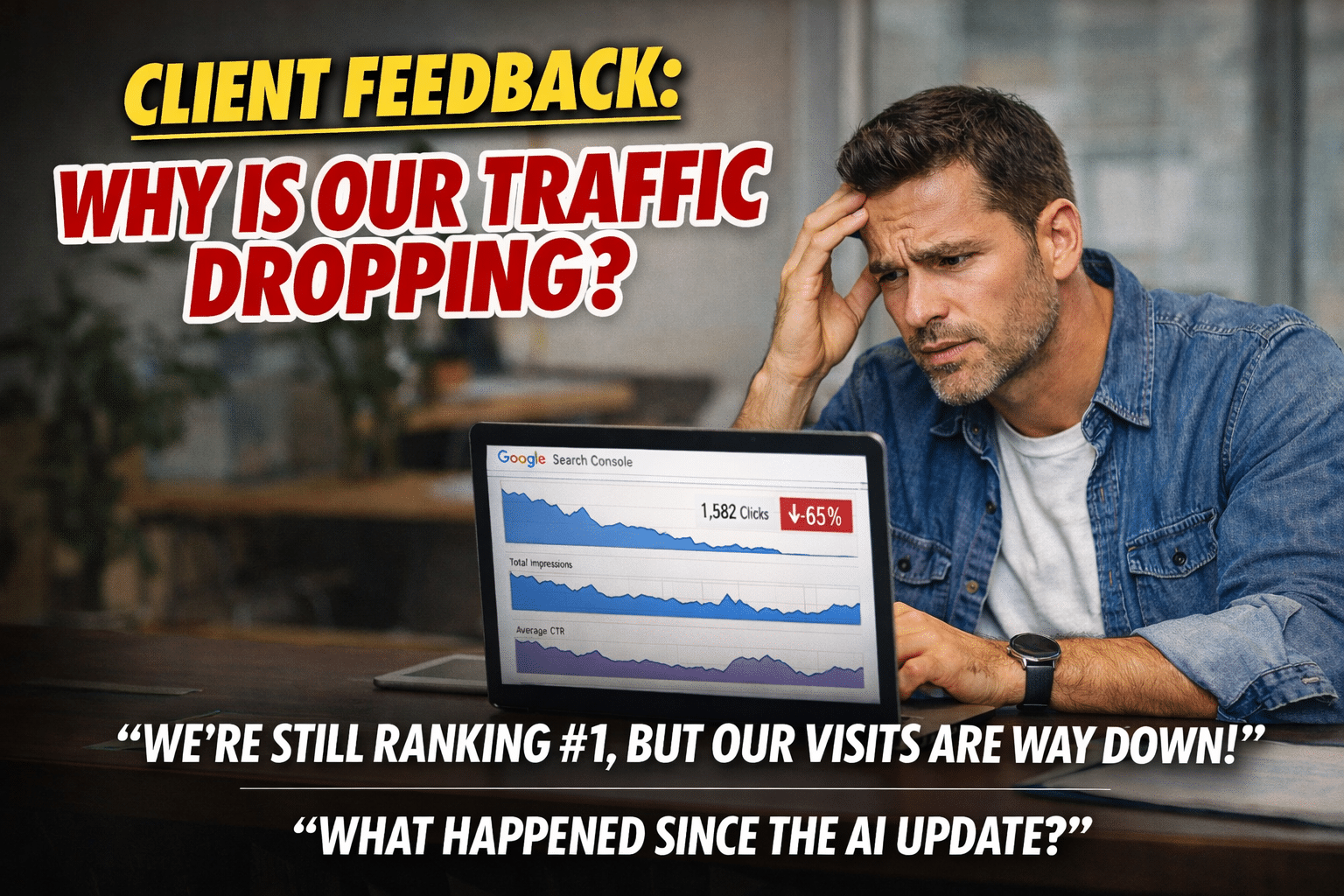
If your organic traffic is dropping after the AI Overviews update, you’re not imagining it — and the cause is almost certainly not a penalty. When Google AI Overviews appear on a search results page, click-through rates on informational queries drop by an average of 61%. Your rankings did not change. Your content did not get worse. Users simply got their answer without clicking. Understanding why organic traffic is dropping after AI Overviews is the first step. Building a recovery plan that turns the AI search shift into a citation opportunity is the second.
This guide covers both. You’ll get the diagnostic framework to identify exactly where your traffic went, and the technical and content changes to start earning AI citations instead of losing clicks to them. The strategies apply across Google AI Overviews, OpenAI’s ChatGPT, Google’s Gemini, Perplexity AI, and Microsoft Copilot. For foundational context, see our Generative Engine Optimization (GEO) Guide.
DIRECT ANSWER: Why Is My Organic Traffic Dropping After the AI Overviews Update? Organic traffic is dropping after the AI Overviews update because Google now answers informational queries directly on the search results page, removing the need for users to click through to your site. Google AI Overviews now appear on more than 40% of informational queries, reducing average CTR for those queries by 61%. Your rankings may be intact, but impressions no longer convert to clicks at the same rate. Recovery requires shifting from ranking optimization to AI citation optimization: structuring content so Google, ChatGPT, Gemini, and Perplexity cite your site as a source inside their generated answers.
1. What the AI Overviews Update Actually Changed
Most agencies tell clients their traffic is dropping because of “algorithm changes.” That’s incomplete. The actual mechanism is simpler and more structural.
When Google launched AI Overviews at scale in 2025, it fundamentally changed what the search results page does. Before AI Overviews, Google’s job was to route users to the best page. Now Google’s job is to answer the question directly, on the page, with linked sources below the generated summary.
The zero-click problem is real and accelerating. 60% of all Google searches now end without a single click to an external site. On mobile, that figure is 77%. In Google’s newer AI Mode experience, the zero-click rate reaches 93% for tested query sets.
The impact on CTR is query-type dependent. Here’s what the data shows:
| Query Type | AI Overview Frequency | CTR Impact |
|---|---|---|
| Informational (“what is X”, “how does Y work”) | Very high (60%+) | -55% to -70% CTR |
| Navigational (“brand name + service”) | Low | Minimal impact |
| Commercial comparison (“best X for Y”) | Moderate | -20% to -40% CTR |
| Transactional (“buy X”, “hire Y”) | Low | Minimal impact |
| Local (“X near me”) | Moderate | -15% to -30% CTR |
If most of your organic traffic was informational — how-to guides, explainer articles, FAQ content — you’re in the most affected segment. If your traffic was primarily transactional or navigational, the drop you’re seeing has a different cause and needs a different diagnosis.
KEY INSIGHT The overlap between top-10 Google rankings and AI Overview citations dropped from 75% in mid-2025 to between 17% and 38% by early 2026. High rankings no longer guarantee AI Overview inclusion. You now need a separate optimization layer on top of traditional SEO.
2. The 5-Step AI Visibility Gap Diagnostic
Before you change anything, run this diagnostic. It takes about 45 minutes and tells you whether your problem is an AI Overviews CTR issue, a penalty, a crawl block, or something else entirely.
Step 1: Separate impressions from clicks in Google Search Console.
Open Google Search Console and pull your Performance data for the last 90 days compared to the same 90-day period last year. Filter by “Queries” and sort by impressions. If impressions are stable or growing while clicks and CTR are falling for informational queries, AI Overviews are the cause. If impressions are also dropping, the problem is a ranking or indexation issue — not AI Overviews.
Step 2: Identify your most-affected query types.
Export your top 200 queries by impressions. Sort by CTR and flag any queries with CTR below 2% that had CTR above 5% previously. These are your AI Overview victims. Cross-reference them against Google’s query categories: informational, navigational, transactional, local.
Step 3: Check your robots.txt for AI crawler blocks.
This step catches a problem that 34% of sites have without knowing it. AI systems can only cite content they can crawl. Pull your robots.txt file and check for any rules blocking these crawlers:
User-agent: OAI-SearchBot
Allow: /

User-agent: ChatGPT-User
Allow: /

User-agent: PerplexityBot
Allow: /

User-agent: Google-Extended
Allow: /

User-agent: ClaudeBot
Allow: /

User-agent: anthropic-ai
Allow: /
If any of these bots are set to Disallow: / or are not explicitly allowed, you are invisible to those AI systems entirely.
Step 4: Check whether your key pages are JavaScript-rendered.
AI crawlers cannot execute JavaScript the way a browser does. If your top informational pages load content dynamically via React, Angular, or Vue without server-side rendering, AI systems may be crawling an empty shell. Test each key URL using Google Search Console’s URL Inspection tool and select “View Crawled Page” to see what Googlebot actually received.
Step 5: Run a citation check across AI platforms.
Open ChatGPT, Perplexity, Google AI Overviews, and Gemini. Manually search your top 10 informational queries. Note which answers appear and which sites get cited. If competitors are cited and you are not, the gap is either a crawl block, a content structure problem, or an authority deficit. The diagnostic steps above cover the first two. The sections below cover the third.
3. Why Rankings Are Not Enough Anymore
If you have been running an SEO program and maintaining strong Google rankings, the AI Overviews update may feel like a penalty you did not deserve. The frustrating truth is that traditional rankings and AI Overview citations are now separate optimization problems.
In 2024, roughly 75% of AI Overview citations came from pages ranking in the top 10. By early 2026, that number dropped to somewhere between 17% and 38% depending on the query category. This happened because Google’s AI Overview system now draws on a broader source pool, including Reddit threads, YouTube transcripts, specific passages from lower-ranking pages, and authority sites that may not rank on page one.
What Google AI Overviews actually look for:
- Direct, clearly structured answers in the first 150 words of a section
- Content that answers the exact query as stated (semantic completeness)
- E-E-A-T signals: author credentials, original data, first-person experience
- Schema markup that tells Google what the content is about
- Pages that load quickly and are accessible to Google-Extended bot
None of these are traditional ranking factors. Some overlap — E-E-A-T for AI Search helps rankings and citations — but the specific optimization actions required are different.
KEY INSIGHT Brands cited in Google AI Overviews earn 35% more organic clicks and 91% more paid ad clicks than uncited competitors for the same queries. The goal is not to stop losing clicks to AI Overviews — it is to become the source those AI Overviews cite.
4. How to Optimize Content for AI Overview Citations
Getting cited in Google AI Overviews requires a specific content structure that is different from standard SEO optimization. Here is the framework that produces citations.
Write direct answers at the start of every section. Google’s AI extracts passages, not pages. Each section of your content should open with a 2–4 sentence answer to the implied question in that section’s heading. Do not bury the answer in paragraph three.
Use the 134–167 word passage format. Based on multiple analysis studies of AI Overview citations, the most frequently extracted passages are self-contained units of 134–167 words that answer a specific question completely. Structure your content around these extraction targets. Each one should make sense as a standalone answer even without the paragraphs around it.
Add FAQPage schema to every article. FAQPage schema is the most direct signal you can send to Google that your content contains question-and-answer pairs worth extracting. Every article you publish should include FAQPage JSON-LD with 5–7 questions matched to actual search queries.
Update dateModified on every content refresh. Freshness matters. AI systems weight recently updated content more heavily for time-sensitive queries. Every time you edit a page, update the dateModified field in your Article or BlogPosting schema.
Demonstrate E-E-A-T explicitly, not implicitly. Include author bylines with credentials, link to primary sources, and add first-person examples that demonstrate experience. Google’s E-E-A-T framework rewards content that signals real human expertise. Generic, informational-only articles score lower.
5. The Technical SEO Fixes That Restore AI Visibility
Content structure gets you cited. Technical access gets you crawled. If the technical layer is broken, even perfect content will not appear in AI Overviews.
Fix 1: Unblock AI crawlers in robots.txt.
Add explicit Allow: / directives for all major AI crawlers (see Step 3 of the diagnostic above). This is the single highest-impact technical change you can make. It takes five minutes and unlocks your site to ChatGPT, Gemini, Perplexity, and Anthropic’s Claude. Full crawler directive setup is covered in our Technical SEO for AI Crawlers guide.
Fix 2: Implement IndexNow for faster Bing crawling.
Because OpenAI’s ChatGPT live-web browsing runs on Bing’s index, passive crawling is not fast enough. When you publish or update a page, you need to ping Bing immediately using the IndexNow protocol. IndexNow is available natively in Rank Math (enabled in Settings > General > Others) and in Yoast SEO (version 19.0+). For manual implementation, submit a POST request to https://api.indexnow.org/indexnow with your page URL and API key.
Fix 3: Switch high-value pages from client-side to server-side rendering.
If your informational content pages use JavaScript frameworks with client-side rendering, AI crawlers may be receiving blank HTML. Implement SSR (server-side rendering) or pre-rendering for your top traffic pages. Next.js, Nuxt.js, and Gatsby all support this natively.
Fix 4: Improve page speed for AI crawler compatibility.
Google’s AI Overview selection process appears to penalize pages with poor Core Web Vitals. Run Google’s PageSpeed Insights on your top informational pages and address any LCP (Largest Contentful Paint) values above 2.5 seconds.
Fix 5: Add Speakable schema to summary sections.
Speakable schema marks specific HTML sections as ideal for AI extraction. Add the cssSelector property pointing to your direct answer blocks and article summaries. This is a direct signal to Google’s AI extraction layer.
6. Schema Markup That Gets You Cited
Schema markup for AI citation optimization differs from schema for traditional SEO. Here is what actually matters.
| Schema Type | Best Used For | AI Citation Benefit | Critical Properties |
|---|---|---|---|
| BlogPosting / Article | All blog posts and guides | Establishes content type, authorship, freshness | dateModified, headline, author, keywords |
| FAQPage | Any page with Q&A sections | Direct extraction target for AI question-answering | Question.name must match exact search queries |
| HowTo | Step-by-step processes | Cited in procedural AI answers | step[].text must be self-contained instructions |
| Speakable | Summary and answer sections | Marks extraction targets for AI voice/text | cssSelector pointing to direct answer divs |
| WebPage + speakable | Landing pages with summaries | AI reading mode signal | speakable.cssSelector |
CRITICAL RULE Never use a generic schema template copied from another site. Every property in your schema must match the actual content on the page. A headline that differs from your H1, or FAQ questions that don’t match real search queries, are ignored or penalized by AI extraction systems. Custom-populate every field.
7. Co-Citation: Building Brand Authority Across the AI Source Pool
AI systems do not cite brands they have never encountered. If ChatGPT, Gemini, and Perplexity have not seen your brand mentioned across multiple credible sources, they will default to established players even if your on-site content is superior.
Co-citation is the practice of getting your brand, website URL, and specific claims mentioned across the sources that AI systems pull from. For a deep-dive into how ChatGPT decides what to cite, see our ChatGPT Ranking Factors guide. These sources include Wikipedia, Reddit, Quora, industry publications, YouTube transcripts, podcast mentions, press coverage, and your existing citation base.
The co-citation strategy for AI Overview recovery:
- Identify the competitors being cited for your target queries by running manual AI searches.
- Find where those competitors are mentioned off their own site. Use Ahrefs or SEMrush backlink data to identify their highest-authority referring domains.
- Get your brand mentioned on those same domains. Guest posts, podcast appearances, digital PR campaigns, and expert commentary all create co-citation signals.
- Build a Reddit presence on relevant subreddits. Reddit content is heavily cited by AI systems. Answering questions with links back to your detailed articles creates the co-citation layer that AI systems recognize.
- Get consistent NAP (Name, Address, Phone) and brand description across all directory listings. Inconsistent brand entity data confuses AI systems when they try to associate your mentions with a single entity.
8. Shifting Your KPIs: What to Measure When Clicks Are Declining
If your organic traffic is dropping after the AI Overviews update and you keep reporting on clicks and rankings alone, your data will tell an incomplete story. You need new KPIs.
Traditional SEO KPIs (still relevant, but not the whole picture):
- Organic clicks (from Google Search Console)
- Keyword rankings (position tracking via Ahrefs, SEMrush, or similar)
- Organic CTR by query type
AI search visibility KPIs (new, required):
- AI Overview citation frequency: how often your site appears as a cited source in Google AI Overviews for target queries
- LLM citation rate: how often ChatGPT, Perplexity, Gemini, and Copilot mention your brand or URL in response to target prompts
- AI-referred traffic: track referrer data in GA4 for visits from ChatGPT, Perplexity.ai, and Gemini as separate channels
- Share of AI Voice: for each target query, what percentage of AI-generated answers cite your brand versus competitors
How to track AI citations manually:
Run a weekly prompt audit. Take your top 20 target queries and submit them to ChatGPT, Perplexity, Gemini, and Copilot. Record which domains get cited for each query. Track this in a spreadsheet over time. Citation rates shift every 2–4 weeks as AI systems update their training and retrieval indexes. For the full KPI framework, see our guide on How to Measure AI Search Visibility Metrics.
KEY INSIGHT AI-referred traffic converts 4.4x better than standard organic search because visitors arrive already informed and further along in their buying decision. Even though raw click volume drops, the quality of traffic from AI citations is significantly higher. Focus on citation rate as a leading indicator of revenue impact.
9. The Weekly AI Traffic Recovery Audit (30 Minutes)
Run this process every Monday morning to track your recovery progress and catch new drops before they compound.
- Pull GSC data (5 min): Check clicks, impressions, and CTR for your top 50 queries. Flag any new drops in CTR on previously stable queries.
- Run AI citation checks (10 min): Search your top 10 informational queries in ChatGPT, Perplexity, and Google AI Overviews. Log which sites are cited. Note any new competitor citations or instances where your site appears.
- Verify robots.txt (2 min): Confirm AI bot directives are intact. A plugin update or deployment can accidentally overwrite your robots.txt. Check that
OAI-SearchBot,PerplexityBot,Google-Extended, andClaudeBotare still set toAllow: /. - Check IndexNow submission log (3 min): If you are using Rank Math or Yoast, check the IndexNow log to confirm recent page updates were submitted to Bing. If not, trigger manual submissions.
- Update content freshness (5 min): Pick 2–3 of your most-cited or target pages and update the
dateModifiedschema field. Add a minor content update (a new data point, an updated example) to justify the refresh date. - Review AI-referred traffic in GA4 (5 min): Check sessions attributed to
chatgpt.com,perplexity.ai, andgemini.google.comas referring domains. Trends here tell you whether your citation strategy is gaining traction.
Common Mistakes That Make the Traffic Drop Worse
| Mistake | Why It Hurts | Fix |
|---|---|---|
| Blocking AI crawlers in robots.txt | Completely prevents citations in ChatGPT, Perplexity, and Claude — you can’t be cited if you can’t be crawled | Add Allow: / for OAI-SearchBot, PerplexityBot, Google-Extended, ClaudeBot, anthropic-ai |
| Burying answers in paragraph 3 or 4 | AI extraction looks for the first clear answer in a section; buried answers are skipped | Lead every section with a 2–4 sentence direct answer, then expand |
| Treating rankings as the only KPI | Stable rankings with dropping CTR means AI Overviews are the cause; tracking only rankings misses the real problem | Add AI citation rate and AI-referred traffic to your monthly reporting |
| Using generic schema copied from another site | Schema with mismatched headline, dateModified, or fake FAQ questions is filtered by AI extraction systems | Custom-populate every schema property to match actual page content |
| Waiting for passive Bing crawling | ChatGPT’s search function runs on Bing’s index; if Bing hasn’t crawled your updated content, ChatGPT won’t cite it | Implement IndexNow via Rank Math or Yoast to ping Bing on every publish |
| Ignoring co-citation | AI systems cite brands with cross-platform mention density; on-site optimization alone is insufficient | Build brand mentions on Reddit, industry publications, YouTube, and podcast transcripts |
| Publishing only for Google’s ranking algorithm | Transactional content behaves differently from informational; applying the same strategy to both wastes resources | Segment your content by query type and apply AI citation optimization only to informational and commercial content |
Article Summary
- Organic traffic is dropping after the AI Overviews update because Google now answers informational queries directly on the SERP, reducing user clicks by an average of 61% for affected query types.
- Your rankings have not changed. The problem is that ranking no longer guarantees clicks for informational queries. Citations inside AI Overviews are the new metric that matters.
- The AI Visibility Gap Diagnostic (GSC impression vs. click split, query type segmentation, robots.txt check, JS rendering audit, manual citation check) identifies the specific cause in under 45 minutes.
- The overlap between top-10 rankings and AI Overview citations dropped from 75% to between 17% and 38% between mid-2025 and early 2026. Rankings and citations are now separate optimization problems.
- Unblocking AI crawlers in robots.txt is the highest-impact technical change you can make. 34% of sites are blocking at least one major AI crawler without knowing it.
- Implementing IndexNow is essential for ChatGPT citation because ChatGPT’s live search runs on Bing’s index, not Google’s.
- Direct answer blocks (2–4 sentences answering the query at the start of each section) are the most frequently cited content structure across Google AI Overviews, ChatGPT, and Perplexity.
- FAQPage schema, custom-populated with exact search query phrasing, is the most direct schema signal for AI extraction.
- AI-referred traffic converts 4.4x better than standard organic traffic. Fewer clicks with higher conversion rate means AI citation optimization directly impacts revenue.
- Run a 30-minute weekly audit covering GSC data, AI citation checks, robots.txt verification, IndexNow logs, and GA4 AI-referred traffic tracking.
- Co-citation across Reddit, industry publications, YouTube transcripts, and press coverage is the off-site layer that AI systems use to trust and cite your brand.
Frequently Asked Questions
Why is my organic traffic dropping but my rankings are the same?
If your rankings are stable but your organic clicks and CTR are falling, Google AI Overviews are almost certainly the cause. When a Google AI Overview appears at the top of the search results, it answers the user’s question directly on the page. Users get their answer without clicking through to your site. This is most pronounced on informational queries — how-to articles, definitions, explainer content — where AI Overview appearance rates exceed 60%.
How do I know if Google AI Overviews are responsible for my traffic drop?
Open Google Search Console and compare your Performance data for the last 90 days against the previous year. Filter by Queries and look for queries where impressions are stable or growing but clicks and CTR have fallen. Informational queries (those beginning with “what is”, “how to”, “why does”) showing this pattern are your AI Overview victims. You can also manually search those queries in Google and check whether an AI Overview appears.
Can I stop Google from showing AI Overviews for my content?
No. You cannot opt out of Google AI Overviews appearing on search results pages for queries related to your content. However, you can use the nosnippet or data-nosnippet meta tag to prevent Google from extracting specific passages from your pages. This prevents your content from being cited inside an AI Overview but does not stop AI Overviews from appearing for the query at all. The more effective strategy is to get cited as the source inside the AI Overview rather than trying to block it.
What is the fastest way to recover traffic after the AI Overviews update?
The fastest recovery tactic is unblocking AI crawlers in your robots.txt file. If Google-Extended, OAI-SearchBot, PerplexityBot, or ClaudeBot are disallowed, your content cannot be cited by those systems. After fixing robots.txt, implement IndexNow to push your pages into Bing’s index immediately, then restructure your top informational articles to lead each section with a direct 2–4 sentence answer. These three changes together typically show citation improvements within 2–4 weeks.
Does optimizing for AI Overviews hurt my traditional SEO rankings?
No. The content structure changes that improve AI Overview citations — direct answer formatting, comprehensive FAQ sections, clear section structure, E-E-A-T signals — also improve traditional Google rankings. There is no conflict between the two optimization approaches. FAQPage schema, improved heading structure, and faster page speeds benefit both Google ranking and AI Overview inclusion.
How long does it take to see traffic recover after optimizing for AI Overviews?
Content and schema changes typically take 2–6 weeks to show up in AI citation data, depending on how frequently the AI system updates its index. Robots.txt fixes have the fastest impact — AI crawlers re-crawl sites within days of gaining access. IndexNow submissions push content into Bing’s index within hours. Recovering lost Google ranking traffic (from algorithm updates unrelated to AI Overviews) follows the standard 3–6 month SEO timeline.