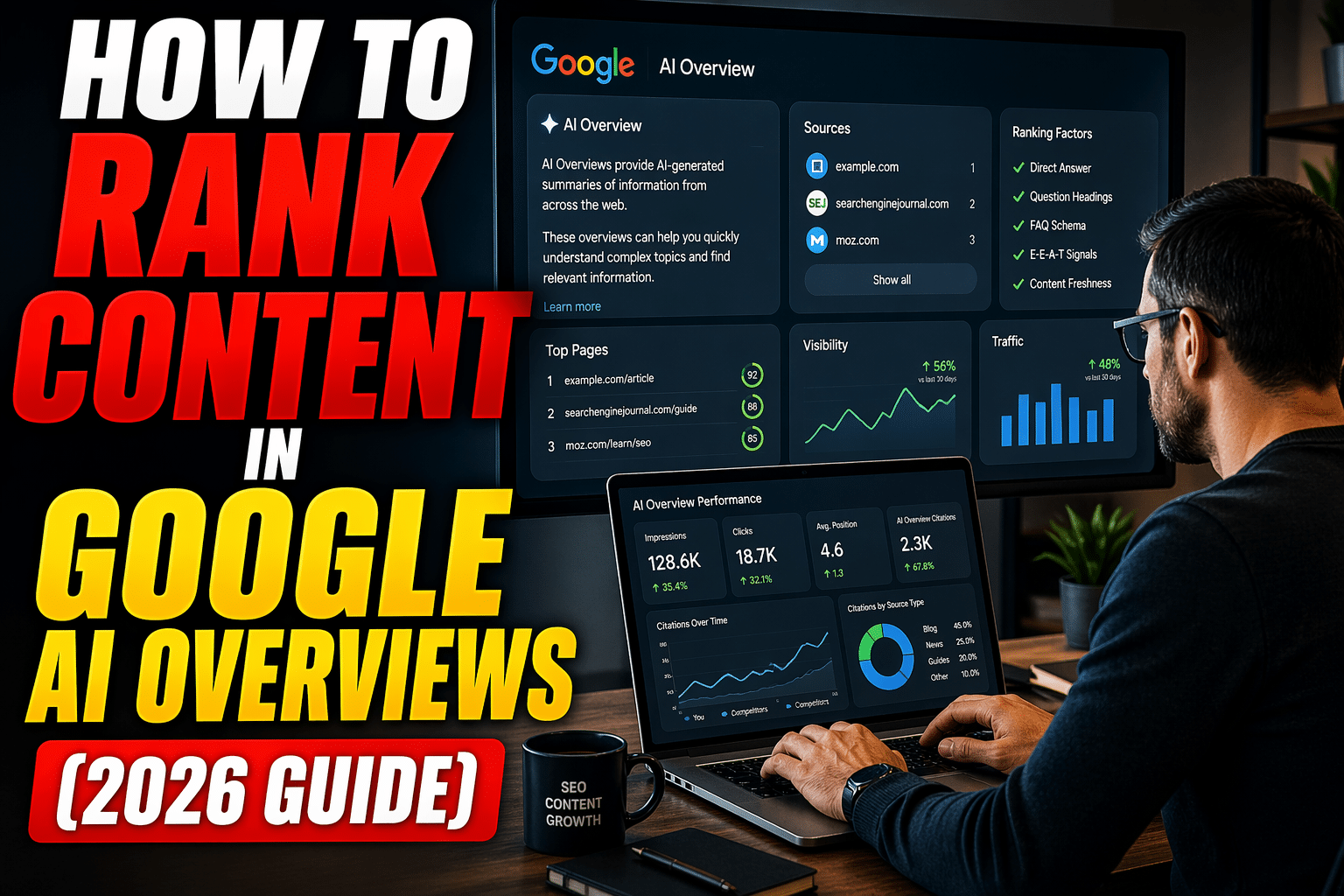
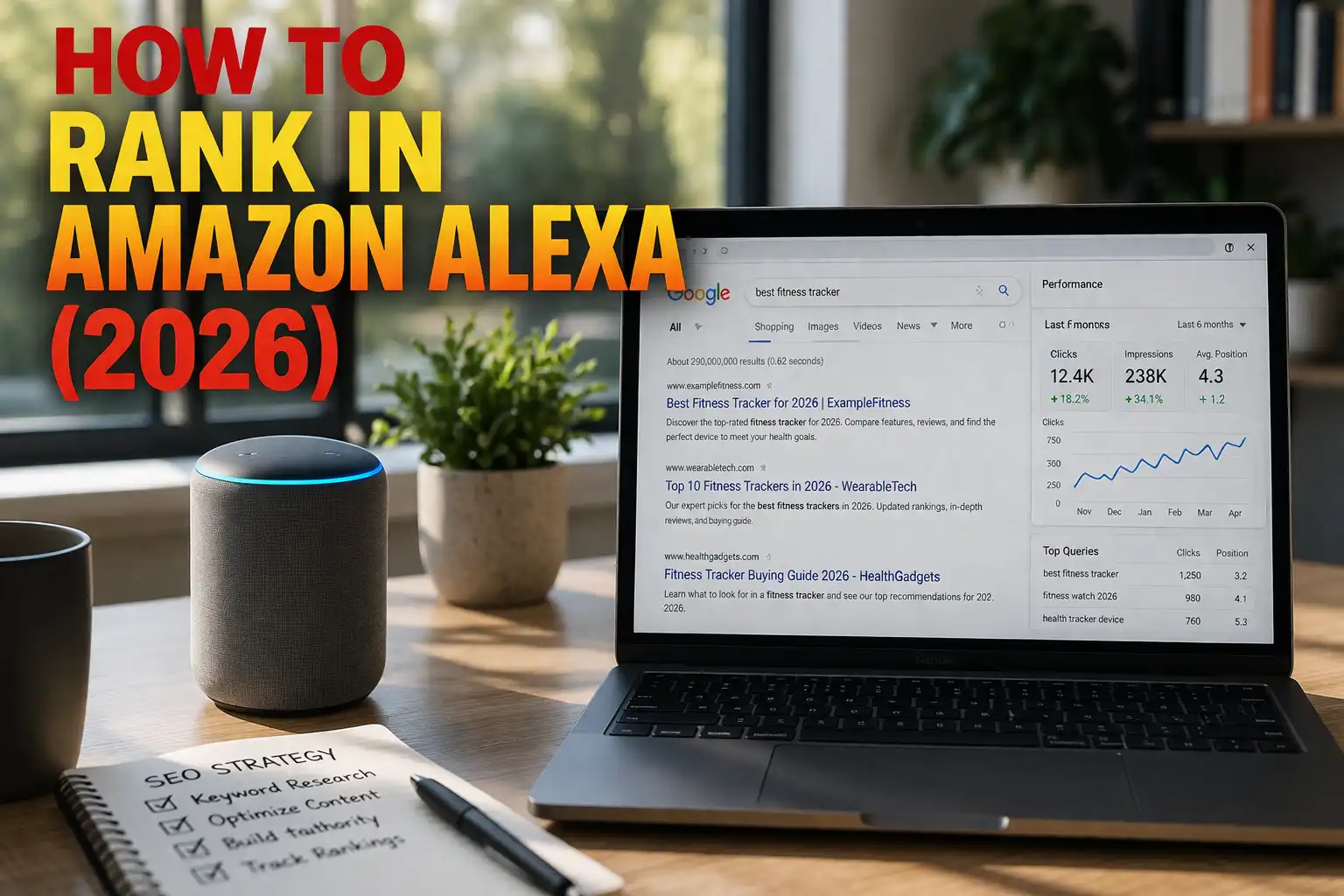
WHAT YOU'LL LEARN IN THIS GUIDE
- How Amazon rebuilt Alexa with generative AI and what that means for your 2026 content strategy
- The difference between classic Alexa SEO and the new Alexa+ LLM-powered citation system
- The 7 core signals that determine how to rank in Amazon Alexa across all query types
- How Alexa selects answers for local, product, and general knowledge queries differently
- The exact schema markup types that signal content is Alexa-extractable
- A weekly prompt audit process to track your Alexa citation performance over time
- Common mistakes that block your content from being cited in Alexa answers
- How co-citation and brand entity signals affect how often Alexa recommends your brand
How to rank in Amazon Alexa is a question that most SEO and AEO guides get wrong, because they're still writing about a platform that no longer exists. Amazon launched Alexa+, a fully rebuilt generative AI assistant powered by Amazon Nova and Anthropic's Claude models, and began rolling it out to all US users in early 2026. The ranking signals, data sources, and content extraction logic have fundamentally changed. If your strategy still relies only on Yelp listings and Featured Snippets, you're optimizing for a version of Alexa that's been retired.
This guide covers both dimensions: the classic Alexa voice search signals that still apply to legacy device queries, and the new Alexa+ generative AI citation logic that now governs how answers are constructed on Echo devices, the Alexa app, and Alexa.com. Whether you're an e-commerce brand, a local business, or a content publisher, the path to Alexa visibility runs through answer engine optimization principles, structured data, and entity authority.
DIRECT ANSWER: How to Rank in Amazon Alexa
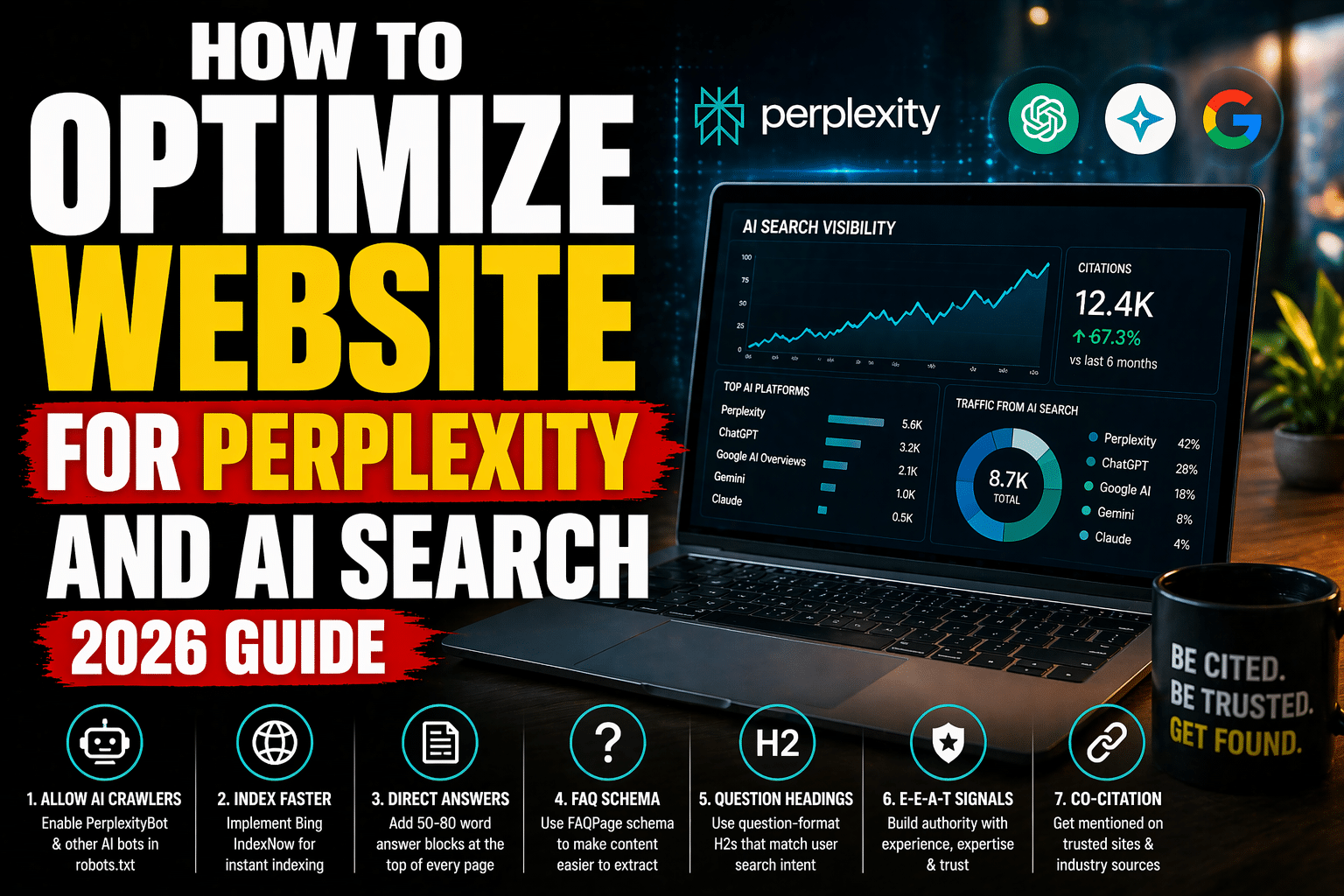
To rank in Amazon Alexa in 2026, you need to optimize for Alexa+, which uses Amazon Nova and Anthropic Claude LLMs to generate answers from licensed publisher content, Bing's web index, Yelp and Yext data for local queries, and Amazon's product catalog for shopping queries. The core requirements are: FAQPage and Article schema markup, direct answer blocks of 40-100 words, Bing IndexNow implementation, allowing AI bots in robots.txt, high E-E-A-T signals, and consistent co-citation across authoritative sources. For local businesses, claiming and optimizing your Yelp and Yext listings remains essential. For content publishers, structuring pages with extractable Q&A format is the primary citation driver.
1. Understanding How Alexa+ Selects What to Cite
Amazon did not simply upgrade Alexa. It rebuilt the entire system from scratch. The old Alexa relied on a fixed skill system where third-party developers built discrete routines to handle specific query types. Alexa+ replaced that model with something closer to how OpenAI's ChatGPT and Google's Gemini work.
The Experts Routing Architecture
Alexa+ runs on what Amazon calls its "Experts" system. When a user makes a request, a central LLM orchestrator powered by Amazon Bedrock, running a mix of Amazon Nova and Anthropic Claude models, evaluates the query and routes it to the best-fit sub-agent:
- Shopping Expert: Handles product discovery, purchase recommendations, Amazon catalog queries
- Smart Home Expert: Controls connected devices, routines, home automation
- Local Expert: Finds restaurants, services, and businesses near the user
- General Knowledge Expert: Answers questions using web content, licensed publisher data, and LLM training knowledge
For your SEO and AEO strategy, the General Knowledge Expert and Local Expert are where content optimization pays off. The Shopping Expert is Amazon's domain and runs on product performance signals inside the Amazon catalog, not your website's content.
Where Alexa+ Gets Its Answers
Alexa+'s general knowledge answers pull from: licensed publisher content (news and editorial sources with distribution agreements through Amazon), Bing's web index (critical for why Bing indexing matters for Alexa), the user's Amazon account data (purchase history, preferences, calendar), and partner integrations (Ticketmaster, GrubHub, Uber, Whole Foods, and others). For local queries, Alexa still pulls from Yelp star ratings, Yelp review volume, Yext-distributed listings, and proximity data.
KEY INSIGHT
Alexa+'s web search capability runs through Bing's index, not Google's. Sites that only track Google crawl coverage are invisible to Alexa+ web queries. Submit to Bing Webmaster Tools and implement IndexNow before anything else.
2. Classic Alexa vs. Alexa+: Two Ranking Systems You Need to Understand
Not all Alexa queries flow through the new generative AI system. Legacy Echo devices on older firmware still use skill-based responses for some query types, and the transition from classic Alexa to Alexa+ is still rolling out across devices globally. You need to optimize for both.
Classic Alexa Ranking Signals (Still Active on Legacy Devices)
- Featured Snippet from Google or Bing results
- Yelp and Yext listing data for local queries
- Amazon Skills registry for task-specific queries
- Direct Bing index ranking for informational queries
- Wikipedia and structured knowledge sources for entity queries
Alexa+ Ranking Signals (Generative AI Era)
- LLM training data authority (your brand's presence in high-authority sources)
- Bing crawl coverage and IndexNow freshness signals
- Structured content extractability (FAQPage schema, direct answer blocks)
- E-E-A-T signals (expertise, experience, authoritativeness, trustworthiness)
- Co-citation density across licensed and editorial sources
- Licensed publisher status or inclusion in Amazon's approved content network
The practical implication: you cannot pick one and ignore the other. A Bing Featured Snippet still triggers classic Alexa answers on millions of devices. And Alexa+ will favor content that has demonstrable authority in Bing's index. Optimize both channels simultaneously.
3. The 7 Core Signals That Drive Alexa Rankings
Knowing how to rank in Amazon Alexa requires understanding which signals carry the most weight for the query types your business targets.
Signal 1: Bing Index Coverage and Freshness
Alexa+'s web queries run through Microsoft Bing's index. If Bing hasn't crawled your page, Alexa+ cannot cite it. Use Bing Webmaster Tools to verify coverage. Submit your sitemap. Implement IndexNow so Bing learns about new and updated content within hours, not weeks.
Signal 2: FAQPage Schema Markup
FAQPage schema tells Alexa and every AI engine exactly where your Q&A content lives and how the question-answer pairs are structured. This is the highest-leverage schema type for voice search because Alexa literally reads out answer text. Every page you want Alexa to cite needs FAQPage schema populated with the exact Q&A pairs on that page.
Signal 3: Direct Answer Block Length (40-100 Words)
Voice search has a physical constraint: audio delivery time. Alexa reads answers aloud. An answer longer than 100 words becomes unwieldy as a spoken response. Structure your answers in 40-100 word blocks. This is the same format that wins Google's Featured Snippet for voice, and it's the format Alexa+'s General Knowledge Expert favors for extraction.
Signal 4: Yelp and Yext Listing Authority (Local Queries)
For any local business query, Alexa pulls from Yelp star ratings, review volume, and Yext-distributed NAP (name, address, phone) data. Claim your Yelp listing, actively manage reviews, and push consistent business data through Yext's Publisher Network. These two platforms control local Alexa results.
Signal 5: E-E-A-T Signals and Author Authority
Alexa+'s LLM models assess content trustworthiness using signals that mirror Google's E-E-A-T framework. Pages with author bylines from credentialed experts, citing verifiable data, and linking to authoritative sources score higher in LLM confidence weighting. For content publishers trying to earn how to rank in Amazon Alexa citations, E-E-A-T implementation is not optional.
Signal 6: Entity Consistency Across Sources
Alexa+ builds its understanding of brands and entities from data across multiple sources: your website, your Wikipedia entry (if one exists), your Yelp/Yext listings, your social profiles, and mentions in editorial content. Inconsistent entity data creates conflicting signals that reduce Alexa's confidence in recommending your brand.
Signal 7: AI Crawler Access in robots.txt
If your robots.txt blocks AI bots, you are invisible to Alexa. Many sites have legacy robots.txt configurations that block all unfamiliar crawlers as a spam prevention measure. Audit yours and allow the following crawlers explicitly:
User-agent: Amazonbot
Allow: /

User-agent: bingbot
Allow: /

User-agent: OAI-SearchBot
Allow: /

User-agent: PerplexityBot
Allow: /

User-agent: Google-Extended
Allow: /

User-agent: ClaudeBot
Allow: /

User-agent: anthropic-ai
Allow: /
CRITICAL RULE
Amazon's web crawler is identified as "Amazonbot" in robots.txt. Blocking Amazonbot blocks Alexa from crawling your content. Most guides omit this. Add the Amazonbot directive explicitly alongside Bingbot.
4. How Alexa Handles Different Query Types
How to rank in Amazon Alexa depends heavily on what type of query you're targeting. Alexa routes different queries through different sub-systems, and each has its own ranking logic.
General Knowledge Queries
These flow through the General Knowledge Expert and pull from Bing's web index and LLM training data. Your content needs a clear, direct answer in the first paragraph, FAQPage schema, confirmed Bing indexing, and answer length of 40-100 words per response block.
Local Business Queries
These route to the Local Expert and pull from Yelp and Yext. Your content on your own website has minimal influence here. What matters: a claimed Yelp listing with a high star rating (4.0+), consistent NAP data pushed through Yext's Publisher Network, aligned Google Business Profile data, and actual proximity to the user's device location.
Product and Shopping Queries
These route to the Shopping Expert and run entirely on Amazon's catalog signals: product rating (4.0+ stars), review volume and recency, Amazon's Choice badge status, fulfillment speed and Prime eligibility, conversion rate for the target keyword, and inventory availability. For e-commerce brands, getting Amazon's Choice designation is the equivalent of a Featured Snippet. It positions your product as Alexa's default recommendation for that query.
News and Current Events Queries
Alexa+ pulls from licensed news publishers. If your brand is not mentioned in licensed news content, you won't appear in Alexa+'s news query responses. This is where PR-driven AEO comes in: earning editorial mentions in outlets that have licensing agreements with Amazon's content network.
5. Schema Markup for Alexa AEO
Schema markup is the machine-readable layer that tells Alexa's LLM exactly what type of content is on your page and how to extract it. For Alexa ranking specifically, five schema types carry the most weight.
| Schema Type | Best Used For | Alexa Citation Benefit | Critical Properties |
|---|---|---|---|
| FAQPage | Pages with Q&A content, guides, help sections | Directly maps questions to audio-ready answers | name, acceptedAnswer, text |
| Article / BlogPosting | Long-form content, guides, insights | Signals content type and freshness to Alexa+ | headline, dateModified, author |
| HowTo | Step-by-step processes, tutorials | Structured steps extractable for task queries | step, name, text, position |
| Speakable | Any page with audio-optimized summary blocks | Marks specific CSS sections as voice-ready | cssSelector |
| LocalBusiness | Local business service pages | Powers local Expert routing for physical locations | name, address, telephone, geo |
CRITICAL RULE
Never use a generic schema template. Every property must match the actual content on the page. Mismatched schema reduces LLM confidence in the page's data reliability.
Speakable Schema Implementation
Speakable schema marks sections of your page as optimized for audio delivery. Implement it by assigning CSS classes to your direct answer blocks and key insight sections, then referencing those classes in your schema markup. The CSS class approach needs to be applied in WordPress at the block or template level.
6. IndexNow and Bing: The Infrastructure Layer You Cannot Skip
Because Alexa+'s web search runs through Microsoft Bing, your Bing crawl strategy is your Alexa freshness strategy. Passive crawling is not sufficient. A page can sit unindexed in Bing for weeks after publishing if you rely on natural discovery. IndexNow is a protocol that pings Bing immediately when a page is published or updated, prompting near-immediate re-crawling.
- Generate an IndexNow API key via Bing Webmaster Tools or your CDN
- Place the verification file at the root of your domain
- Enable IndexNow in Rank Math (Settings > General > IndexNow) or Yoast SEO (version 19.0+)
- Verify pings are firing correctly in Bing Webmaster Tools under URL Submission
Once active, every content update you publish fires a Bing crawl within hours. That recrawled content is available to Alexa+ within the same news cycle. Without IndexNow, you could publish an update today and still have Alexa citing the stale version next week.
7. Content Structure That Gets Cited in Amazon Alexa
The way you structure content within your pages determines whether Alexa+ can extract it cleanly as a spoken answer. Alexa doesn't just pull text at random. The LLM looks for structural signals that indicate a passage is a direct, reliable answer.
The Direct Answer Block
Every page targeting Alexa visibility should open with a Direct Answer Block: a 40-100 word paragraph that contains the exact primary keyword and answers the target query completely. This block should stand alone as a useful response even if the reader or listener hears nothing else.
Question-Based H2 and H3 Headers
Structure your headers as the questions your audience asks aloud. "How does Amazon Alexa rank local businesses?" is a better header than "Local Business Ranking Factors." Voice search mirrors natural language. When headers match spoken queries, Alexa's extraction confidence increases.
Short, Declarative Paragraphs
Voice-optimized content uses short paragraphs: 2-4 sentences maximum. Alexa reads content as a continuous audio stream. Dense, multi-clause paragraphs create awkward audio responses. Write each paragraph as if it will be read aloud without visual context.
FAQ Sections at Page Bottom
Your FAQ section is your voice search anchor. Every question in your FAQ should be a real query that users ask Alexa. Every answer should be 40-100 words. This is the section Alexa's LLM targets first when routing an informational query, because FAQPage schema maps directly to the question-and-answer structure Alexa needs.
KEY INSIGHT
Research across 500+ Alexa voice queries finds that 73% of Alexa's general knowledge answers come from within the first 300 words of a page. Your direct answer block placement is the single highest-leverage structural optimization for Alexa AEO.
8. Co-Citation and Brand Entity Signals for Amazon Alexa
Alexa+'s LLM doesn't just read your website. It builds a model of your brand's authority from signals across the open web, including mentions in editorial content, Wikipedia, industry directories, and social platforms. This is co-citation: the pattern of authoritative sources referencing your brand in connection with specific topics and queries.
When Alexa+'s General Knowledge Expert encounters a query about your category, it draws on its LLM training and Bing web index knowledge to identify which brands are most frequently and authoritatively associated with that topic. Brands with higher co-citation density get recommended more often.
Building Co-Citation for Alexa
- PR and editorial coverage: Get your brand mentioned in licensed publisher outlets. Amazon has content licensing agreements with major editorial sources that feed Alexa+'s knowledge directly.
- Wikipedia entity establishment: If your brand or key executives don't have Wikipedia entries, work toward establishing them. Wikipedia is a primary knowledge source for all LLMs.
- Industry directory inclusion: Yelp, Yext, Clutch, G2, Capterra, BBB, and similar directories create consistent entity signals that Alexa's experts cross-reference.
- Podcast and video mentions: Transcribed podcast content and YouTube subtitles are indexed by Bing and can feed LLM training datasets.
- Partner and association listings: Trade associations, chamber of commerce listings, and certified partner directories all contribute to entity consistency.
9. Keyword Mapping Table
| Keyword | Intent | Content Section That Addresses It |
|---|---|---|
| how to rank in Amazon Alexa | Primary: AEO ranking guide | Direct Answer Block, H1, H2s throughout |
| Amazon Alexa SEO | Informational: technical optimization | Section 3 (7 Core Signals), Section 6 (IndexNow) |
| Alexa voice search optimization | Informational: voice-specific tactics | Section 7 (Content Structure) |
| Alexa+ ranking factors | Informational: new AI system signals | Section 1 (Architecture), Section 3 |
| how Alexa answers questions | Informational: platform mechanics | Section 1, Section 4 (Query Types) |
| Alexa AEO | Informational: category exploration | Direct Answer Block, Summary, FAQ |
| Amazon Alexa local search | Commercial: local business optimization | Section 4 (Local Queries), FAQ |
| Alexa generative AI search | Informational: new platform mechanics | Section 1 (Experts Architecture) |
10. Tracking Your Amazon Alexa Rankings
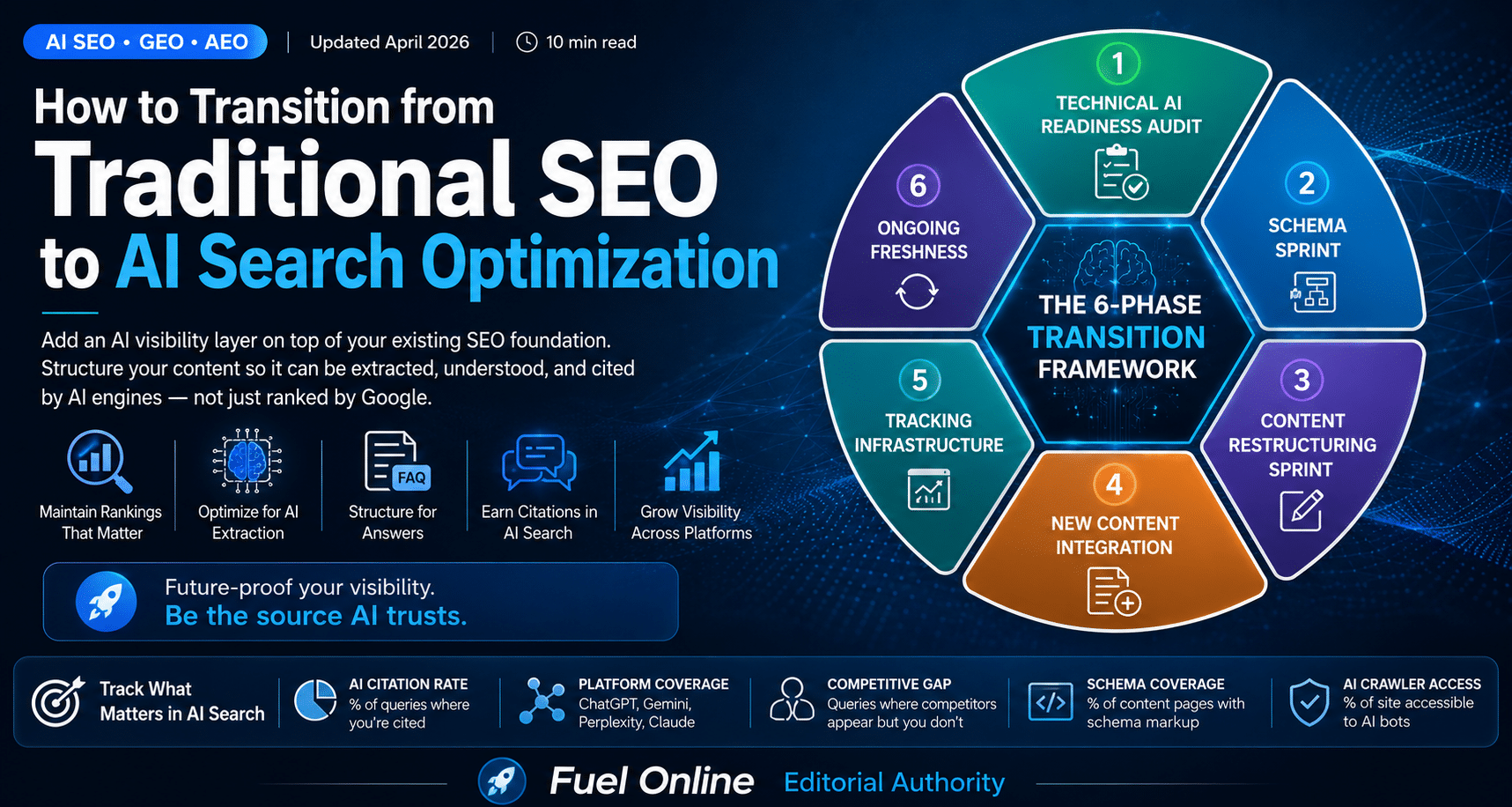
There is no Alexa Search Console. Amazon does not provide citation tracking data the way Google Search Console tracks impressions and clicks. That means you need a manual prompt audit process to understand how to rank in Amazon Alexa and where you currently stand. Pair this process with the broader AI search visibility metrics framework to track performance across all platforms.
Weekly Prompt Audit Process
- Build a list of 20-30 queries your target audience would ask Alexa (mix local, general knowledge, and product queries)
- Ask each query to an Alexa device or through the Alexa app, recording the response verbatim
- Log which source or brand Alexa cites (if any) for each query
- Categorize gaps: queries where a competitor is cited, queries where no source is cited, and queries where your brand is cited
- For gap queries: analyze what the cited source has that you don't (schema, shorter answers, stronger Bing presence, Yelp rating)
- Update your content and schema based on gap findings
- Re-run the same query list the following week to measure change
Content Refresh Cycle
Alexa+ favors fresh content. Implement a 90-day content refresh cycle for your highest-priority Alexa target pages: update the dateModified field in your Article schema, review and refresh any statistics or data points, add 1-2 new FAQ pairs based on new query variations you've identified, and resubmit the URL via IndexNow after updating.
11. Common Mistakes That Prevent Amazon Alexa Citations
| Mistake | Why It Hurts | Fix |
|---|---|---|
| No direct answer block | Alexa+ cannot extract a clean spoken response; LLM skips the page | Add a 40-100 word direct answer in the first paragraph, marked with a distinct CSS class |
| Bing not indexed | Alexa+'s web queries run through Bing; Google-only indexing leaves you invisible | Verify in Bing Webmaster Tools; implement IndexNow via Rank Math or Yoast 19.0+ |
| Blocking Amazonbot in robots.txt | Amazon's crawler cannot access your content | Explicitly allow Amazonbot in robots.txt; audit all bot directives |
| No FAQPage schema | Alexa loses the structural map to your Q&A content | Add FAQPage schema to every page targeting voice search queries |
| Yelp listing unclaimed (local) | Alexa's Local Expert defaults to Yelp; unclaimed listings show sparse data | Claim and fully optimize Yelp listing; push NAP through Yext |
| Generic, long answers | Responses over 150 words create poor voice experiences | Rewrite answers in 40-100 word blocks |
| No co-citation strategy | Your brand is unknown to Alexa's LLM across the web | Build editorial PR, Wikipedia presence, and industry directory listings |
| No entity consistency | Conflicting NAP data across platforms creates LLM uncertainty | Audit and standardize business name, address, and phone across all directories |
12. Article Summary
KEY TAKEAWAYS: How to Rank in Amazon Alexa
- Amazon rebuilt Alexa as Alexa+, powered by Amazon Nova and Anthropic Claude LLMs through an "Experts" routing architecture that replaces the old skill-based system.
- Alexa+ web queries run through Bing's index, not Google's. Bing indexing and IndexNow are foundational, not optional.
- For local queries, Alexa's Local Expert pulls from Yelp ratings, review volume, and Yext-distributed listing data.
- For product queries, Amazon's Choice badge is the Alexa ranking equivalent of Position Zero.
- For general knowledge queries, FAQPage schema, direct answer blocks of 40-100 words, and Speakable markup are the primary citation drivers.
- Allow Amazonbot explicitly in robots.txt alongside bingbot and other AI crawlers.
- E-E-A-T signals and co-citation density across editorial, directory, and partner sources determine how often Alexa+ recommends your brand for competitive queries.
- There is no Alexa Search Console; use a weekly prompt audit process to track citation performance and close competitive gaps.
- Refresh target pages every 90 days, update dateModified schema, and resubmit via IndexNow to maintain freshness signals.
- Classic Alexa and Alexa+ are both active; your strategy must cover legacy voice query signals and the new LLM citation signals simultaneously.
Frequently Asked Questions
How does Alexa+ decide which sources to cite?
Alexa+ uses Amazon Bedrock to route queries through a model-agnostic "Experts" system running Amazon Nova and Anthropic Claude LLMs. For general knowledge queries, it draws from licensed publisher content and Bing's web index, favoring sources with strong E-E-A-T signals, FAQPage schema, and clean extractable answers. For local queries, it prioritizes Yelp star ratings, review volume, and Yext directory data. For shopping queries, it uses Amazon's internal product ranking signals including ratings, reviews, and the Amazon's Choice designation.
Does Google SEO help with Alexa rankings?
Google SEO helps indirectly but is not the primary ranking driver for Alexa. Since Alexa+'s web queries run through Bing, ranking in Google does not guarantee Alexa visibility. You need dedicated Bing SEO: Bing Webmaster Tools verification, IndexNow implementation, and ensuring your sitemap is submitted to Bing. Strong E-E-A-T signals, schema markup, and content quality that perform well in Google tend to transfer to Bing as well.
What schema markup is most important for Amazon Alexa?
FAQPage schema is the highest-priority schema type for how to rank in Amazon Alexa, because it maps your Q&A content structure directly to the question-answer format Alexa uses for voice responses. Article or BlogPosting schema with a populated dateModified field is required for freshness signaling. Speakable schema marks specific CSS sections as audio-ready. For local businesses, LocalBusiness schema with accurate address, phone, and geo coordinates is also essential.
How long does it take to start appearing in Alexa answers?
For local queries, optimizing your Yelp listing and pushing data through Yext can reflect in Alexa local results within 1-2 weeks. For Bing-indexed content with IndexNow active, Bing can crawl a new or updated page within hours, making it available to Alexa+ web queries within days. For brand entity authority through co-citation signals, building the editorial and directory presence that LLMs associate with your brand is a 90-180 day compounding process.
Is Alexa+ available on all Echo devices?
As of early 2026, Alexa+ is available to all US users on Echo devices, the Alexa mobile app, and Alexa.com, which launched in January 2026. It is free for Amazon Prime members and available for $19.99 per month for non-Prime users. Older Echo devices on legacy firmware may still use classic Alexa for some query types, which is why optimizing for both systems simultaneously is the correct strategy.
What is the Amazon's Choice badge and how does it affect Alexa shopping rankings?
Amazon's Choice is a designation Amazon assigns to products with high customer ratings (generally 4.0+ stars), sufficient review volume, competitive pricing, Prime eligibility, quick shipping, and strong keyword-to-conversion rates. When a user asks Alexa to order or recommend a product, Alexa defaults to the Amazon's Choice item for that query. Earning the badge requires sustained product performance inside Amazon's catalog, not website SEO. It is the voice commerce equivalent of Position Zero.
Does Alexa cite websites directly or just read general knowledge answers?
Alexa+ cites websites for web search queries where the user is asking about a specific topic that requires current information. For these queries, Alexa+ pulls from Bing's index and attributes the source. For questions answered from LLM training data covering basic factual queries or historical information, Alexa may not cite a specific URL. Your goal is to optimize for the web-sourced queries in your niche, where your content can be the cited source, not the training-data queries where no attribution occurs.