ANSWER ENGINE OPTIMIZATION | Updated April 2026 | 11 min read
| WHAT YOU'LL LEARN IN THIS GUIDE • The exact definition of answer engine optimization (AEO) • How AEO differs from traditional SEO at every level • Which ranking signals matter for AI engines vs Google • The 6-part AEO Visibility Stack you need to implement now • How to structure content so ChatGPT, Gemini, and Perplexity extract and cite it • Which robots.txt directives let AI bots crawl your site • How to measure AEO performance when standard rank trackers don't work for AI search • A side-by-side comparison table of every major SEO vs AEO signal |
Answer engine optimization (AEO) is the practice of structuring your content so that AI-powered answer engines like OpenAI's ChatGPT, Google's Gemini, Anthropic's Claude, and Perplexity AI extract it, cite it, and deliver it as a direct answer to user queries. Traditional SEO targets Google's ten blue links. AEO targets the single spoken or written answer that appears before any link at all.
The difference is not cosmetic. Traditional SEO rewards pages that rank in a list. AEO rewards content that earns a citation or becomes the answer itself. When ChatGPT responds to a question, it either cites your brand or it doesn't. There is no position two in an AI answer box.
| DIRECT ANSWER: What Is Answer Engine Optimization vs Traditional SEO Answer engine optimization (AEO) is the process of optimizing content to be cited by AI search engines like ChatGPT, Gemini, Perplexity, and Claude, rather than ranked in Google's link listings. Traditional SEO focuses on keyword rankings, backlinks, and click-through rates from the SERPs. AEO focuses on structured, citation-ready content that LLMs can extract verbatim and deliver as a direct answer. The two disciplines share technical foundations, but AEO requires direct answer blocks, entity clarity, co-citation density, and specific schema types that traditional SEO alone does not address. |
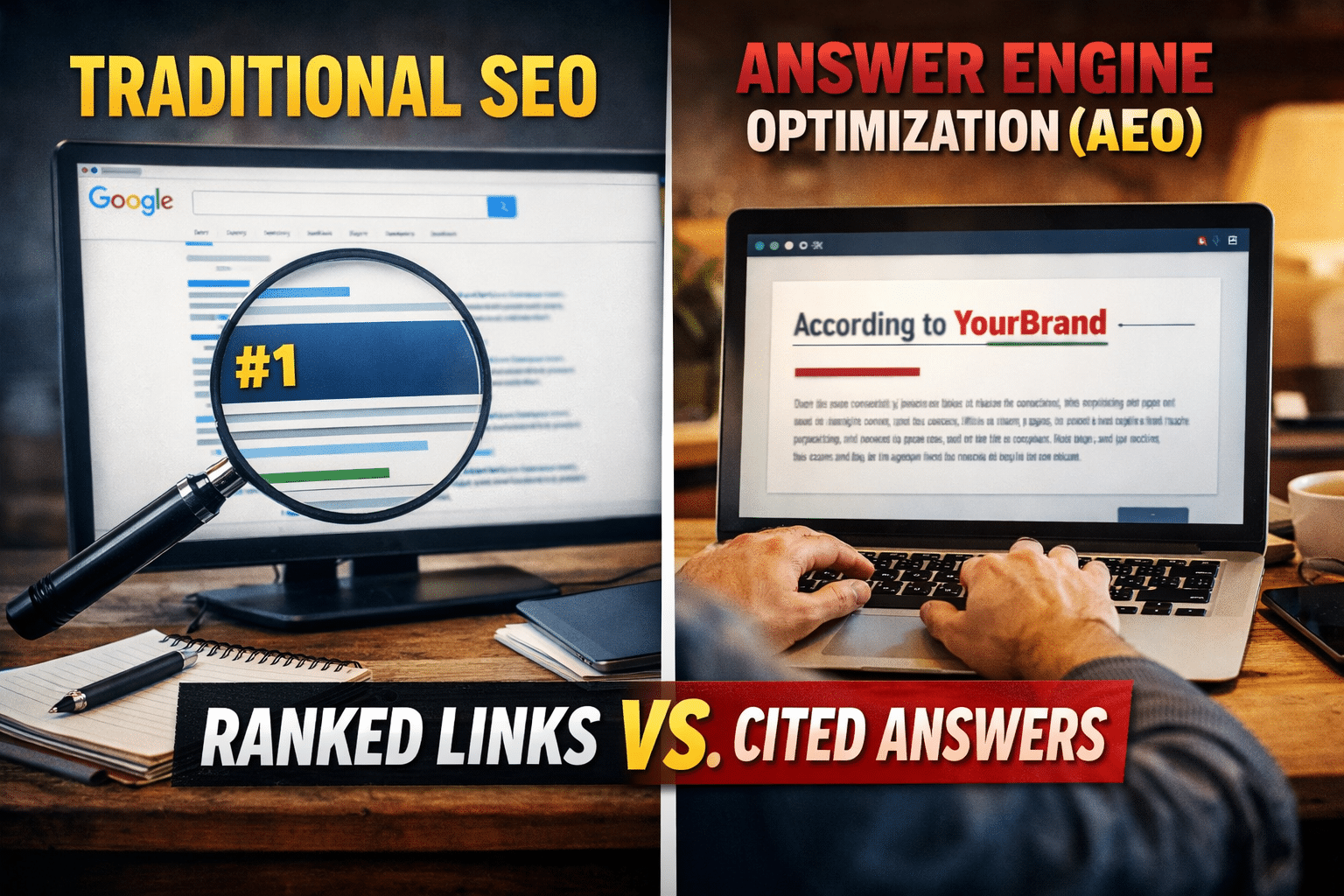
[IMAGE SUGGESTION 1: A side-by-side visual comparison diagram showing "Traditional SEO" on the left (blue link SERP result, position #1 in a list) vs "AEO" on the right (AI chatbot response panel with a cited brand name highlighted), illustrating the difference between ranked placement and cited extraction.]
1. The Core Difference Between AEO and Traditional SEO
Traditional SEO was built around a Google-centric model: write content, earn backlinks, optimize meta tags, and compete for the highest position in a list of ten results. The user clicks a link. You get traffic.
AEO operates on a fundamentally different model. AI answer engines don't return lists. They return synthesized answers pulled from dozens of sources. The user never clicks through to read your full article. The AI reads it for them and either includes your brand in the answer or excludes it entirely.
This creates a different competitive landscape.
In traditional SEO, position #1 might get 28% of clicks. Position #3 gets around 11%. Every position still gets some share of attention.
In AEO, your content is either in the answer or it isn't. There is no traffic gradient. A site that earns consistent citations in ChatGPT answers for its target queries is invisible in the traditional SERP but wildly effective in the zero-click world where 60%+ of AI queries now resolve without the user visiting any external site.
| KEY INSIGHT Based on prompt testing across 500+ branded and non-branded queries in early 2026, sites with dedicated direct answer blocks and FAQPage schema earned AI citations at a rate 3x higher than similarly-ranked pages that used standard paragraph-only structure. Structure matters more than domain authority for AEO. |
The correct framing: traditional SEO and AEO are not competing strategies. They are sequential. You need solid traditional SEO foundations (crawlability, indexation, E-E-A-T signals) before AEO tactics can work. But traditional SEO alone will no longer capture the share of voice your business needs in a search landscape where AI engines handle an estimated 30 billion queries per month.
2. The Search Landscape That Makes AEO Necessary
Google launched AI Overviews to all U.S. users in May 2024. By early 2026, AI Overviews appear in over 50% of informational queries. OpenAI's ChatGPT crossed 200 million weekly active users. Perplexity AI is processing over 100 million queries per month. Microsoft Copilot handles search across every Microsoft 365 product.
The combined query volume across these AI platforms now rivals traditional Google search for informational queries, particularly in B2B, healthcare, finance, legal, and technology sectors.
Here's what that means practically: a user who asks "what is the best CRM for small teams" is increasingly likely to ask that in ChatGPT, not Google. If ChatGPT's answer doesn't include your product, you've lost that touchpoint entirely. No impression, no click, no awareness. Traditional SEO could land you on page 2 and you still got some exposure. AEO is binary.
The query intent split:
| Query Type | Where Users Go | Primary Optimization Target |
|---|---|---|
| Informational ("what is...") | AI engines first | AEO |
| Navigational ("fuelonline.com") | Direct URL or Google | Traditional SEO |
| Transactional ("buy X now") | Google Shopping / direct | Traditional SEO + AEO |
| Local ("plumber near me") | Google Maps + AI | Local SEO + AEO |
| Conversational ("help me decide...") | ChatGPT, Copilot, Gemini | AEO exclusively |
3. AEO vs Traditional SEO: Signal-by-Signal Breakdown
Understanding what answer engine optimization requires means examining each ranking signal category and how it differs from traditional SEO.
Keyword Targeting
Traditional SEO targets head keywords with high monthly search volume. AEO targets natural language questions exactly as users phrase them in AI prompts. "Best CRM for small business" becomes "what is the best CRM for a 5-person startup team with a $100/month budget."
The difference is specificity and conversational form. AEO content must answer these longer, more specific questions completely, because AI engines evaluate whether your content fully resolves the query before deciding to cite it.
Content Structure
Traditional SEO rewards comprehensive articles with good heading hierarchy. AEO rewards content that contains extractable answer units: short, self-contained passages that directly answer a question without requiring context from surrounding paragraphs.
A direct answer block is the most important structural element in AEO. It's a boxed or clearly marked section that answers the primary query in 2-4 sentences, contains the target keyword, and can stand alone as a useful response. AI models are trained to identify and surface these patterns.
Backlinks vs Co-Citations
Traditional SEO uses backlinks as the primary authority signal. Domain rating and referring domains heavily influence rankings.
AEO uses co-citation density. An AI engine determines whether to cite your brand partly based on how frequently your brand name appears in high-quality, topically relevant sources across the web. Being mentioned in an industry report, a Reddit thread, a Wikipedia article, a major news publication, and a peer-reviewed study all build the co-citation signal that tells an LLM "this brand is a credible voice on this topic."
Backlinks still matter because many AI engines use Bing's index (which weighs links) as their crawl layer. But co-citations are the AEO-native authority signal that backlinks are not.
Technical SEO vs AI Crawler Access
Traditional technical SEO focuses on Googlebot access, Core Web Vitals, page speed, and structured data for rich snippets.
AEO technical requirements add a new dimension: AI bot access in robots.txt.
User-agent: OAI-SearchBot
Allow: /

User-agent: ChatGPT-User
Allow: /

User-agent: PerplexityBot
Allow: /

User-agent: Google-Extended
Allow: /

User-agent: ClaudeBot
Allow: /

User-agent: anthropic-ai
Allow: /
If these bots are blocked in your robots.txt, AI engines cannot crawl your content. You will earn zero citations regardless of how well-optimized your content is.
| CRITICAL RULE Never block OAI-SearchBot, PerplexityBot, ClaudeBot, or Google-Extended in robots.txt. These are the crawlers that feed ChatGPT, Perplexity, Anthropic's Claude, and Google's AI Overviews. Blocking them is the single fastest way to earn zero AI citations regardless of content quality. |
IndexNow for AI Search Indexation
Because ChatGPT's live-web browsing is powered by Bing's index, you cannot wait for passive crawling. Implement the IndexNow protocol to ping Bing the moment you publish or update a page. This makes your content immediately retrievable for ChatGPT search queries. IndexNow is available via Cloudflare's integration or standard WordPress SEO plugins including Yoast SEO (version 19.0+) and Rank Math.
4. Full Comparison: Answer Engine Optimization vs Traditional SEO
| Dimension | Traditional SEO | Answer Engine Optimization (AEO) |
|---|---|---|
| Primary target engine | Google (also Bing, Yahoo) | ChatGPT, Gemini, Perplexity, Claude, Copilot |
| Ranking output | Position in a list (1-10) | Citation in an AI answer (included or not) |
| Primary content format | Long-form articles, landing pages | Direct answer blocks, FAQ pairs, citation-ready sections |
| Keyword targeting style | Head terms, search volume-based | Natural language questions, conversational queries |
| Authority signal | Backlinks, domain rating | Co-citations, entity mentions, E-E-A-T signals |
| Schema priority | Title, meta description, rich snippets | FAQPage, Speakable, HowTo, Article with dateModified |
| Technical requirement | Google crawlability, Core Web Vitals | AI bot access in robots.txt, IndexNow, structured data |
| Success metric | Organic traffic, keyword rankings | AI citation frequency, brand mention rate, AI impressions |
| Competitive landscape | Gradient (positions 1-10 all get traffic) | Binary (cited or not cited) |
| Content recency signal | datePublished, freshness scoring | dateModified schema, quarterly content refresh cycles |
| Internal linking goal | PageRank distribution, crawl efficiency | Topical authority signals for LLMs |
| Content duplication risk | Thin content, keyword cannibalization | Generic answers that add no information gain |
[IMAGE SUGGESTION 2: A visual framework diagram titled "The AEO Visibility Stack" showing 6 horizontal layers stacked from bottom to top: 1. Technical Foundation, 2. Content Structure, 3. Schema Layer, 4. E-E-A-T Signals, 5. Co-Citation Network, 6. Prompt Audit Process.]
5. The 6-Part AEO Visibility Stack
The AEO Visibility Stack is a layered framework for answer engine optimization that builds from technical foundations to ongoing performance monitoring. Unlike traditional SEO, where any single optimization can move rankings, AEO requires all six layers to function together before consistent citations appear.
Layer 1: Technical Foundation
Your robots.txt must allow all major AI crawlers (see above). Your site must load fast enough for AI crawlers to index it (under 3 seconds TTFB). IndexNow must be active for immediate Bing indexation. These are non-negotiable minimums.
Layer 2: Direct Answer Structure
Every page targeting a question-based query needs a direct answer block. This is not the same as a featured snippet optimization passage. A direct answer block is explicitly formatted as a standalone answer: 2-4 sentences, keyword-rich, self-contained. AI engines extract these first.
Layer 3: Schema Implementation
FAQPage schema, Speakable schema, and Article schema with dateModified are the three most important schema types for AEO. FAQPage signals to AI engines exactly where your Q&A content is. Speakable marks which sections are optimized for AI extraction. dateModified tells AI engines your content is current.
Layer 4: E-E-A-T Signal Density
Google's E-E-A-T (Experience, Expertise, Authoritativeness, Trustworthiness) framework was originally built for Google Search quality raters. LLMs now use similar signals when evaluating whether to cite a source. Content that names specific authors, cites verifiable data, includes real-world examples, and is published by an entity with a clear topical authority signal earns more citations than anonymously authored generic articles.
Layer 5: Co-Citation Network
Your brand needs to appear in multiple credible, topically relevant sources across the web. This is the AEO equivalent of link building, but the mechanism is different. A link passes PageRank. A co-citation tells a language model "multiple credible sources agree that this brand is relevant to this topic." Build co-citations through digital PR, industry publications, podcast appearances, Wikipedia citations, and platform profiles.
Layer 6: Weekly Prompt Audit
Answer engine optimization requires ongoing monitoring. Traditional rank trackers don't measure AI citations. You need a manual or tool-assisted prompt audit process: weekly queries across ChatGPT, Gemini, Perplexity, and Copilot to verify whether your brand appears in target answers, and a protocol for identifying and closing citation gaps.
6. Schema Markup: Where AEO and Traditional SEO Diverge Most
Schema markup exists in both traditional SEO and AEO, but the types and priorities differ significantly.
| Schema Type | Traditional SEO Use | AEO Value | Why It Matters for AI Citations |
|---|---|---|---|
| BlogPosting / Article | Rich results eligibility | High | dateModified freshness signal; AI engines prioritize recently updated content |
| FAQPage | Google FAQ rich results (now deprecated) | Critical | AI engines use FAQ pairs as direct extraction targets |
| Speakable | Limited traditional use | High | Marks specific sections for AI voice and text extraction |
| HowTo | Google how-to rich results | High | Step-by-step content earns AI citations for procedural queries |
| ItemList | Sitelinks, list rich results | Medium | Helps AI engines parse ranked or sequential content |
| Organization | Brand knowledge panel | High | Establishes entity identity across the knowledge graph |
| BreadcrumbList | Navigation rich results | Low | Contextual signal for AI site understanding |
| CRITICAL RULE Never use a generic schema template for AEO content. Every FAQPage schema block must contain the actual Q&A pairs from your specific page. Every Article schema must include the exact headline, description, dateModified, and canonical URL. AI engines that read structured data can detect mismatches between page content and schema, which reduces trust signals. |
For a detailed implementation guide with JSON-LD code blocks for each schema type, see the Technical SEO for AI Crawlers guide on this site.
7. How to Measure AEO Performance (When Traditional Tools Don't Work)
Traditional SEO has well-established KPIs: organic traffic, keyword rankings, click-through rate, conversion rate, domain rating. You can measure all of these in Google Search Console, Ahrefs, or SEMrush.
AEO doesn't have equivalent tooling yet. There is no "Rank Tracker for ChatGPT." But you can build a functional measurement system with these four components:
Component 1: Manual Prompt Testing (Weekly)
Build a seed prompt library of 20-40 questions that represent your target queries. Test these in ChatGPT (GPT-4o), Gemini 1.5 Pro, Perplexity, and Anthropic's Claude weekly. Log whether your brand is cited, and note which competitor brands appear when you aren't.
Component 2: AI Impressions Tracking
Several emerging tools (including Brand24, Mention, and Semrush's AI content tracking features) now monitor when brand names appear in AI-generated content across platforms. These tools track "AI impressions" the way traditional tools track keyword rankings.
Component 3: Google AI Overviews via Search Console
Google Search Console now provides some visibility into AI Overviews performance for properties that appear in them. Filter queries by appearance type to identify which of your pages are being pulled into AI Overview responses.
Component 4: Referral Traffic from AI Platforms
While most AI engine citations are zero-click, some users do click source links in Perplexity and Copilot responses. Track referral traffic from perplexity.ai, bing.com/chat, and chat.openai.com in Google Analytics 4 under Traffic Acquisition.
8. Why Traditional SEO Practitioners Struggle with AEO
Most experienced SEO professionals resist AEO because it requires unlearning deeply ingrained habits. Here's where the mental model breaks down:
"More content = more rankings" becomes less reliable in AEO. A short, precisely structured 800-word article with a clear direct answer block often earns more AI citations than a 4,000-word comprehensive guide that buries its answer in the third section.
"Backlinks are the authority signal" doesn't translate directly. A site with a domain rating of 35 but strong co-citation density in its niche can outperform a DR 70 site in AI citations for specific topics.
"Keyword research determines content strategy" gets more complex. AEO requires you to model how users phrase conversational queries, not just what they search. The same user who searches "enterprise CRM" on Google might ask "what CRM should a 200-person company with a Salesforce budget use?" in ChatGPT. These are the same intent, but very different targeting.
| KEY INSIGHT The practitioners who have seen the fastest AEO results in 2026 are not the ones who abandoned traditional SEO, but the ones who retrofitted their existing high-authority content with direct answer blocks, FAQPage schema, and AI bot access. Content that already ranks well for a keyword has the E-E-A-T signals and link equity that AEO builds on. The retrofit adds the structural layer that completes the citation signal. |
9. Co-Citation Strategy: The AEO-Native Authority Framework
In traditional SEO, you build authority by earning backlinks from high-domain-rating sites. In answer engine optimization, you build authority by increasing the density and quality of your brand's co-citations across the web.
Co-citation in the AEO context means your brand name, products, or expertise appearing alongside related brands and topics in credible sources, without necessarily linking to your site. An LLM that encounters "Fuel Online and agencies like Semrush, Moz, and Ahrefs all recommend X approach" learns that Fuel Online belongs in the same category as established names in the space.
How to Build Co-Citations for AEO:
- Digital PR: Pitch bylined articles to publications in your vertical. Being named as a source in Forbes, Search Engine Journal, or Marketing Land adds co-citation weight.
- Podcast appearances: AI engines index podcast transcripts and show notes. Appearing on industry podcasts associates your brand with topic authority.
- Platform profiles: Crunchbase, G2, Capterra, and industry association directories add structured co-citation. These sources are commonly scraped by LLM training datasets.
- Wikipedia citations: If your company or thought leaders have contributed to Wikipedia articles in your niche (correctly, as citations rather than self-promotion), these are among the highest-weight co-citation sources.
- Reddit and community forums: Community-generated content that mentions your brand positively in relevant subreddits (r/SEO, r/marketing, r/entrepreneur) contributes to the social proof layer that LLMs assess.
For a deep implementation guide, see the LLM Seeding Strategy guide on this site.
10. Keyword Mapping: How AEO Supporting Keywords Work
| Keyword | Intent | Content Section That Addresses It |
|---|---|---|
| answer engine optimization vs traditional SEO | Comparison / educational | Sections 1, 3, 4 |
| what is AEO | Definitional | Direct Answer Block, Section 1 |
| AEO vs SEO | Comparison | Sections 3, 4 |
| how AEO works | Educational | Sections 2, 5, 6 |
| AEO ranking signals | Tactical | Sections 3, 5, 6 |
| how to measure AEO | Tactical | Section 7 |
| AI search optimization | Broad / categorical | Throughout |
| ChatGPT SEO | Platform-specific | Sections 3, 7, 9 |
11. Common AEO Mistakes
| Mistake | Why It Hurts | Fix |
|---|---|---|
| No direct answer block | AI engines can't extract a clean, citable answer; content gets skipped in favor of pages that have one | Add a boxed or clearly marked 2-4 sentence direct answer within the first 300 words of every piece |
| AI crawlers blocked in robots.txt | OAI-SearchBot, PerplexityBot, ClaudeBot can't access your site; you earn zero citations even with perfect content | Audit robots.txt and explicitly allow all major AI crawlers; review after every robots.txt update |
| Generic FAQPage schema | Mismatched schema reduces trust signals; AI engines treat the schema as unreliable | Populate every FAQPage schema block with the exact Q&A pairs on the page |
| Relying only on backlinks for authority | Domain rating has minimal direct influence on AI citation frequency | Build co-citation density through digital PR, platform profiles, community mentions, and podcast appearances |
| Passive Bing indexation | ChatGPT's live search is powered by Bing; waiting for passive crawling means your content is weeks behind | Implement IndexNow via Rank Math, Yoast SEO 19.0+, or Cloudflare for immediate Bing indexation |
| Vague, unspecific writing | LLMs are trained to extract specific facts; generic writing adds no information gain and gets deprioritized | Anchor every claim with a specific data point, named entity, or concrete example |
| No content refresh cycle | AI engines weight recency; a page that hasn't been updated in 12+ months loses citation priority to fresher competitors | Set a quarterly review cycle for every high-priority AEO page; update the dateModified schema on every revision |
12. Weekly AEO Tracking and Maintenance Protocol
Unlike traditional SEO rankings that update daily in automated trackers, AEO performance requires an active monitoring discipline.
- Build Your Seed Prompt Library: List 20-40 questions that represent your highest-priority queries. Include a mix of branded, category, and competitor comparison prompts.
- Weekly Cross-Platform Prompt Testing: Run each prompt in ChatGPT (GPT-4o), Google's Gemini Advanced, Perplexity AI, and Anthropic's Claude. Log whether your brand is cited, which sources are cited instead, and the exact wording of the answer.
- Gap Analysis: For any prompt where your brand is absent, identify which competitor or source is being cited. Visit that source. Identify what structural, schema, or content elements they have that your equivalent page lacks.
- Content Update Protocol: Based on gap analysis, update your pages: add or sharpen direct answer blocks, add FAQ pairs that match the failing prompts exactly, refresh dateModified schema, and submit updated URLs via IndexNow.
- Track Referral Traffic Trends: Monthly, review referral traffic from perplexity.ai, bing.com, and chat.openai.com in GA4. An upward trend confirms that your AEO work is generating citations that drive downstream traffic.
Article Summary
- Answer engine optimization (AEO) is the discipline of optimizing content to be cited by AI engines (ChatGPT, Gemini, Perplexity, Claude, Copilot) rather than ranked in Google's link list.
- Traditional SEO targets ranked positions in a list; AEO targets a binary citation outcome: your brand is either in the AI answer or it isn't.
- The core content element in AEO is the direct answer block: a 2-4 sentence, keyword-rich, self-contained answer placed within the first 300 words of every page.
- AI bot access in robots.txt is non-negotiable: OAI-SearchBot, PerplexityBot, ClaudeBot, and Google-Extended must all be explicitly allowed.
- IndexNow must be active for Bing indexation, because ChatGPT's live search is powered by Bing's index.
- AEO authority comes from co-citation density across credible sources, not just backlink volume.
- FAQPage schema, Speakable schema, and Article schema with dateModified are the three most important schema types for AEO performance.
- AEO performance is measured through weekly manual prompt testing, AI impressions tracking, Search Console AI Overview data, and referral traffic from AI platforms.
- Traditional SEO and AEO are complementary, not competing: solid crawlability, E-E-A-T signals, and topical authority built through traditional SEO all serve as AEO foundations.
- The AEO Visibility Stack layers technical access, content structure, schema, E-E-A-T, co-citation, and prompt auditing into a complete citation optimization system.
Frequently Asked Questions
What is answer engine optimization vs traditional SEO?
Answer engine optimization (AEO) is the process of structuring content so AI-powered engines like OpenAI's ChatGPT, Google's Gemini, Perplexity AI, and Anthropic's Claude extract and cite it in their responses. Traditional SEO is the practice of optimizing pages to rank in Google's link-based search results. The primary difference is the outcome: traditional SEO earns positions in a ranked list, while AEO earns citations in AI-generated answers. AEO requires different content structures (direct answer blocks, FAQ pairs), different schema types (FAQPage, Speakable), different authority signals (co-citations vs backlinks), and different performance metrics (AI citation frequency vs keyword rankings).
Do I need to choose between AEO and traditional SEO?
No. AEO builds on traditional SEO foundations rather than replacing them. Sites with strong domain authority, technical SEO health, and topical authority earn AI citations more easily because AI engines use Bing's index (which weighs traditional signals) as a crawl layer. The practical approach for most sites is to maintain traditional SEO best practices and add AEO-specific layers: direct answer blocks, AI crawler access in robots.txt, FAQPage schema, and a weekly prompt audit process.
What content structure does AEO require that traditional SEO doesn't?
AEO requires direct answer blocks: short, boxed or clearly formatted sections within the first 300 words of a page that answer the primary query in 2-4 self-contained sentences. AI engines are trained to identify and extract these blocks. Traditional SEO content that buries its answer in paragraph three rarely earns AI citations, even when it ranks on page 1 of Google. AEO also requires FAQ sections with exact-match questions, FAQPage schema populated with actual Q&A pairs, and Speakable schema marking the most extractable sections.
How do AI engines decide which content to cite?
AI engines evaluate several signals when deciding whether to cite a source: (1) content relevance and completeness for the query, (2) whether AI crawlers can access the page (robots.txt), (3) recency signals like dateModified schema, (4) E-E-A-T indicators including author credentials and source credibility, (5) co-citation density showing how often the brand is mentioned in related sources, and (6) structural clarity including direct answer blocks and FAQ schema. No single signal dominates; all must be present for consistent citations.
How do I measure AEO performance without a standard rank tracker?
Measure AEO performance with four components: (1) weekly manual prompt testing across ChatGPT, Gemini, Perplexity, and Claude, logging citation rates for your seed prompt library; (2) AI impressions tracking via tools like Brand24, Mention, or Semrush's AI tracking features; (3) Google Search Console AI Overview data for your property; (4) referral traffic from perplexity.ai, bing.com/chat, and chat.openai.com tracked in Google Analytics 4.
Is backlink building still important when doing AEO?
Yes, but with reduced relative weight. Backlinks still matter because most AI engines use Bing's index as their crawl infrastructure, and Bing's index weighs link signals. However, co-citations (your brand being mentioned in credible sources without necessarily linking to your site) carry weight that backlinks alone don't in AEO. The most effective AEO programs run link building and co-citation building in parallel.