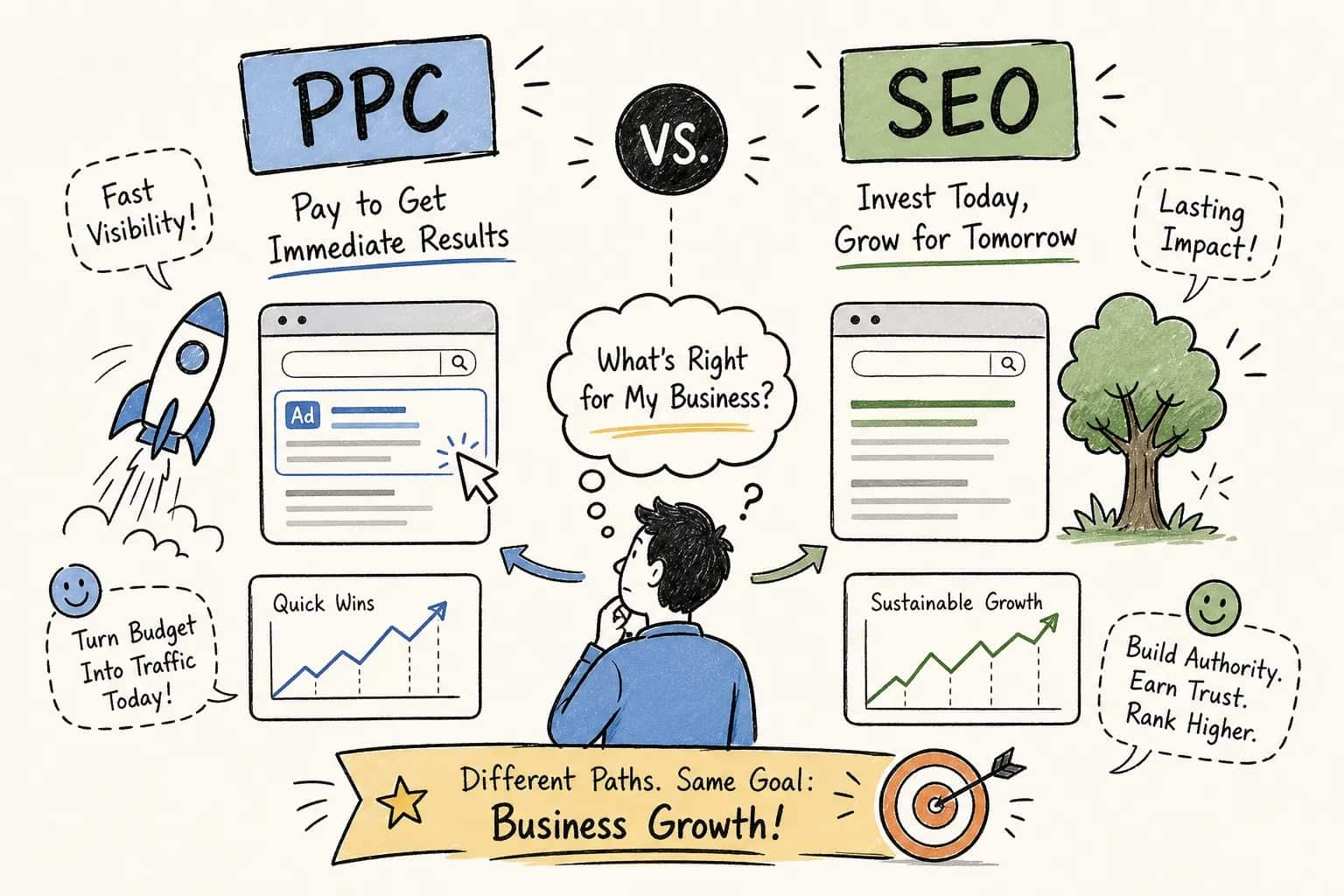
Every marketing director and founder eventually hits the same wall: you have a finite budget, two channels competing for it, and a leadership team that wants results yesterday. If you're asking whether you should invest in PPC or SEO for your business, the answer is rarely as simple as picking one. The way most businesses frame this question costs them real money, not because they chose the wrong channel, but because they treated it as a binary choice in the first place.
At Fuel Online, we've been running both channels for enterprise clients since 1998. Over more than 25 years, the answer to "should I invest in PPC or SEO for my business?" has almost never been one or the other. It almost always comes down to three things: where your business is right now, what your timeline to results needs to be, and what your competitive environment actually looks like. This article gives you a decision framework, not a generic comparison, so you can make the call with real numbers behind it.
How PPC and SEO actually deliver results differently
What paid search gives you (and takes away when you pause)
Google Ads operates on a cost-per-click model for search campaigns: you bid for placement, and you pay every time someone clicks. (Other bidding formats like target CPA and CPM exist, but CPC dominates standard search campaigns.) The upside is immediacy. Your campaign can go live today and generate traffic by this afternoon. The downside is structural: the moment you stop spending, the traffic stops. You're renting visibility, not building it. Across industries, Google Ads averages an 8.18% conversion rate, which is genuinely strong, but CPCs swing dramatically by vertical. Retail averages around $1.16 per click, while legal services run closer to $8.58. That difference determines how far your budget actually goes.
What organic search builds over time
SEO works by earning rankings through content quality, technical site health, and domain authority. Traffic doesn't arrive on day one, but once those rankings are established, they don't evaporate when you stop writing checks. A well-optimized page can generate qualified traffic and leads for months or years with minimal ongoing cost. That compounding dynamic is what makes organic search so powerful over a long enough timeline, and so frustrating for anyone who needs results in the next 30 days.
ROI at 6, 12, and 24 months: the timeline most marketers underestimate
Why paid search dominates early returns
At the six-month mark, PPC almost always produces the stronger ROI. You have data, you have leads, and your cost-per-acquisition is a known number. SEO is still ramping: local businesses typically see first meaningful movement in three to six months, ecommerce sites often wait five to ten months, and B2B companies frequently don't see significant organic traction until six to twelve months in. For any business with an urgent pipeline need, that gap is not theoretical. Betting on the wrong channel too early can mean an entire quarter of missed pipeline, and that's a costly mistake to unwind mid-year.
Should I invest in PPC or SEO for my business? What the 12- and 24-month numbers show
At the twelve-month mark, the equation flips. Organic leads cost roughly 61% less than paid leads, and SEO becomes five to ten times more cost-effective than paid search from this point forward. By twenty-four months, the total cost of ownership for equivalent organic traffic runs approximately 40% lower than paid search. Paid search, by contrast, maintains a flat or rising customer acquisition cost as competition for keywords increases. Every month of solid SEO work makes future traffic cheaper; every month of paid search just keeps the meter running.
What each channel actually costs to perform at a useful level
One of the most expensive mistakes small businesses make is splitting a thin budget 50/50 between PPC and SEO, then getting mediocre results from both. Both channels have minimums below which they simply don't work well enough to justify the spend.
The real minimum for Google Ads to generate usable data
To gather statistically meaningful conversion data from paid search, you need at least $1,500 to $3,000 per month in actual media spend, not total marketing budget. Most campaigns need twenty to thirty conversions per month for Smart Bidding to stabilize and for you to have enough signal to optimize. Below that threshold, you're making decisions based on noise. If your industry CPC is $8.58 (legal) versus $1.16 (retail), that same $1,500 buys you 175 clicks or 1,293 clicks respectively. Industry matters enormously for what your floor actually needs to be.
What a meaningful SEO investment looks like
Many agencies charge in the range of $1,000 to $2,500 per month for local or small business SEO campaigns, scaling significantly for enterprise or ecommerce work. For businesses with total budgets under $2,000 per month, allocating 60 to 80% toward SEO and 20 to 40% toward PPC is a sound approach, unless immediate leads are the primary constraint. Trying to run both channels on a budget that can't fund either of them properly produces underwhelming results across the board. Pick a lead channel and support it.
Should I invest in PPC or SEO for my business? A decision framework based on where you are right now
Stop asking which channel is better in general, and start asking which one fits your current situation. The right answer shifts based on four practical variables: your timeline, your budget, your domain history, and what it costs to buy clicks in your market.
Scenarios where PPC should come first
New businesses with little or no domain authority should start with paid search. There's no shortcut around the ramp-up period for SEO, and a brand-new site competing against established players in organic results is a slow race. PPC also makes more sense for businesses with a short selling season, a product launch deadline, or a specific revenue window that a six-month SEO build would miss entirely. If you're in a low-CPC category like retail or travel, paid search is affordable enough to sustain while organic builds in the background.
Scenarios where SEO is the smarter lead investment
Established businesses with some domain history, a track record of content, and a longer sales cycle are natural candidates for an SEO-first approach. B2B companies especially benefit here: organic content builds trust and educates buyers across a long consideration period, which paid ads alone can't replicate effectively. Any business operating in a high-CPC vertical (think legal, finance, or insurance), where a single click costs $8 to $10, also has a strong economic argument for organic. When the math on paid search is brutal, sustainable organic traffic becomes the only viable long-term path.
The hybrid approach: how running both channels makes each one stronger
Running PPC and SEO simultaneously isn't just a diversification strategy. It's a feedback loop where data from one channel accelerates performance in the other. When the two channels are siloed, you leave that advantage on the table.
How PPC data sharpens your SEO keyword strategy
Paid search campaigns generate conversion data fast. Within the first sixty to ninety days, you can identify which search terms are actually driving qualified traffic, which landing page copy is resonating, and which queries are converting at a cost that makes sense. That intelligence directly informs your SEO content roadmap: instead of guessing which topics to prioritize for organic, you build content around terms you already know convert. This cuts months of guesswork out of the organic strategy and focuses your publishing budget on pages that are likely to perform.
How Fuel Online structures integrated search campaigns for enterprise clients
For enterprise clients, Fuel Online runs PPC and SEO as a unified strategy, not two separate budget lines fighting for the same allocation. Competitive analysis informs both channel strategies simultaneously. Paid search fills the visibility gap while organic rankings are building, and shared conversion data drives both content strategy and ad creative. Our integrated model is built specifically for organizations where a misallocated search budget isn't just a missed opportunity, it's a measurable revenue problem. If your business is at the stage where getting this right matters, that integrated model is worth exploring before you set next quarter's budget.
Your 90-day starter plan: budget splits, KPIs, and attribution
Month-by-month priorities for your first quarter
If you're starting PPC-first, months one through three should focus on setting up conversion tracking correctly, establishing baseline CPCs and click-through rates by campaign, and identifying the top-converting keywords that will eventually anchor your SEO content plan. If you're going SEO-first, complete a technical site audit in month one, then move into publishing high-intent content pieces in month two (a typical early cadence might be four to six pieces depending on your team's capacity), and clean up or build out local citations and structured data by month three. For a hybrid start, launch paid campaigns in week one with a clean conversion tracking setup, and run keyword research and content planning in parallel so both channels are moving by day thirty.
How to measure which channel is actually working
Attribution is where most businesses get the PPC-vs-SEO comparison completely wrong. Last-click attribution systematically over-credits paid search and under-credits organic, because SEO typically influences the top of the funnel during discovery and consideration, while paid search captures the final click before conversion. Relying on last-click data to evaluate these two channels is like grading a relay race by only timing the last runner. The most reliable approach is data-driven attribution in GA4, which uses your actual conversion path data to assign fractional credit across touchpoints. If your conversion volume isn't high enough for data-driven attribution to stabilize, run position-based attribution alongside last-click as a comparison baseline, and track leads, customer acquisition cost, and cost-per-conversion separately by channel from day one.
Making the call: PPC, SEO, or both
Deciding whether to invest in PPC or SEO for your business isn't a permanent commitment, it's a current-stage decision, and the right answer evolves as your business grows, your domain authority builds, and your market conditions shift. The signals that point you toward PPC are urgency, a short competitive window, a new domain, or a high-converting offer in a low-CPC market. The signals that point you toward SEO are domain history, a long sales cycle, high CPCs in your vertical, and a goal of reducing long-term dependence on paid traffic.
The most effective long-term strategy is almost always an integrated one, where paid search and organic work together rather than compete for the same budget line. PPC gives you data and near-term revenue while SEO builds. SEO gives you compounding returns that lower your overall acquisition cost as the months stack up. Neither channel performs at its best in isolation.
If your business is ready to stop guessing and start running both channels with a data-backed plan, Fuel Online has the integrated search expertise to get you there. Reach out to see how a strategy built around your business stage, budget, and market conditions can change the numbers on your side of the ledger.