Search used to work like a library card catalog. You typed a query, got a list of pages, picked one, and read it. That model is eroding fast, and generative engine optimization is the discipline emerging to replace it. Google AI Overviews, Perplexity, ChatGPT, and Gemini now synthesize answers directly and hand them to users without requiring a click. The brands appearing in those answers aren’t necessarily the ones who ranked first for a head keyword. They’re the ones whose content was structured to be extracted, trusted, and quoted by machines.
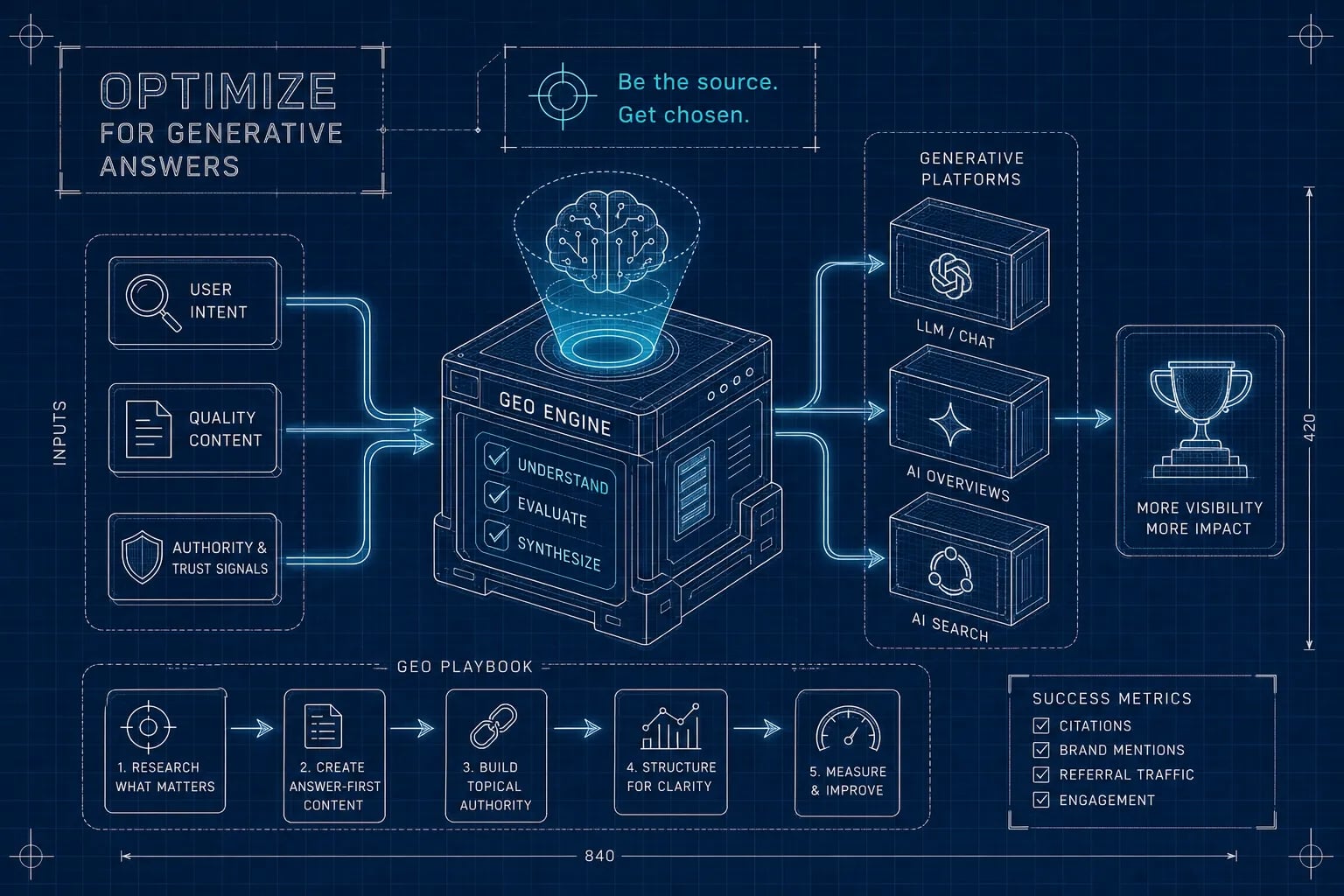
Generative engine optimization (GEO) is the practice of making your content readable and citable by AI-powered search systems. It’s not a rebrand of traditional SEO. It’s an additional layer of strategy that accounts for where a significant portion of search behavior is already landing. A small number of agencies, including Boston-based Fuel Online, began developing GEO methodologies before the term entered mainstream marketing vocabulary. Most brands and agencies are catching up right now, in 2026, which means the window for early-mover advantage is still open but closing.
This playbook covers what GEO actually requires, how AI systems decide which sources to cite, the content and technical changes that shift citation probability, and how to measure the results.
What generative engine optimization actually is (and what it isn’t)
Traditional search returned a ranked list of pages and let the user decide which one answered their question. Generative search doesn’t do that. It reads candidate pages, synthesizes a response, and occasionally links back to sources. The user gets an answer without necessarily visiting any site. Google AI Overviews, Perplexity, and ChatGPT with browsing are different products built on different retrieval stacks, but they all share this fundamental behavior: they compile, not just list.
Traditional SEO optimizes for ranking signals: backlinks, authority, keyword relevance, technical structure. GEO optimizes for extraction signals, specifically whether a machine can pull a clear, accurate, standalone answer from your page. The two disciplines overlap significantly on crawlability, topical relevance, and domain authority. Where GEO goes further is in answer-first page structure, entity clarity, and schema alignment that helps retrieval pipelines parse content accurately. Google’s own guidance frames it simply: standard SEO eligibility is the baseline, but it isn’t sufficient on its own for generative feature inclusion.
The platforms GEO applies to are worth mapping briefly. Google AI Overviews are embedded directly in search results. Perplexity uses retrieval-augmented generation, pulling live web content to ground its answers. ChatGPT with web browsing works similarly. Gemini operates across Google’s product suite. Each has a different retrieval architecture, but the on-page content signals that improve citation probability are consistent across all of them: clarity, structure, authority, and entity precision.
How AI systems decide which sources to cite
AI search systems don’t simply grab the top-ranked page and quote it. They expand a user’s query into multiple related sub-questions, retrieve candidate passages across those expanded searches, and then select sources that appear repeatedly as strong matches across the full query fan. A brand whose content clearly answers five related sub-queries is far more likely to be cited than one that ranks first for only the head term. That’s a meaningful shift from how SEO historically worked, and it’s central to understanding why optimizing for generative AI requires a different editorial mindset.
The on-page signals that shift citation likelihood break into four main categories. Query-to-passage relevance is the strongest single factor: does your page contain a passage that directly addresses the question? Topical depth across related sub-questions matters next, because comprehensive coverage increases the chance your page matches multiple retrieval paths simultaneously. Domain credibility signals function as a moderate influence, similar to traditional authority metrics. Structured data helps retrieval pipelines parse and extract your content accurately, especially when the schema matches the visible page structure.
E-E-A-T signals function indirectly here. They’re not a formal citation rule built into AI retrieval logic, but authoritative, credible content tends to surface more consistently across retrieval queries, which produces the same outcome. Think of it as E-E-A-T working through the ranking layer that feeds the retrieval pool, rather than as a direct citation trigger.
Entity clarity deserves its own emphasis. AI systems build internal maps of brands, people, concepts, and their relationships. If your brand name appears inconsistently across pages, your content lacks author attribution, or your topics bleed into each other without clear semantic structure, AI systems struggle to place you accurately in their retrieval outputs. Consistent entity signals across your site, reinforced by Organization schema and sameAs markup pointing to authoritative external profiles, help close that gap. This is one reason LLM optimization work so often starts with entity and brand consistency rather than content volume.
Content changes that increase your chances of being cited
The clearest single change you can make to a page: lead each section with a direct, concise answer to the question that section addresses, then develop the supporting detail below it. This answer-first structure maps directly to how AI systems generate responses. They look for the core claim, extract it, and then optionally include supporting context. Use H2 and H3 headings that mirror how users actually phrase prompts. “What is generative engine optimization?” works better as a heading than “Our GEO overview” because the former is how someone would actually ask the question in a search bar or AI chat window.
Every section of your content should contain at least one sentence that functions as a standalone, complete, quotable statement. AI systems pull individual passages, not full pages. If the core claim in a section is buried inside a long, clause-heavy sentence, it becomes harder to extract cleanly. Keep paragraphs short. Use bullets for genuinely list-type content, not as a way to pad word count. Write like you’re being quoted, not like you’re writing an essay.
A single well-structured page isn’t enough on its own. GEO rewards domains with comprehensive, connected coverage of a topic cluster. If you address the core topic but miss the adjacent questions users ask alongside it, AI systems find other sources that don’t miss them. Map your content against the related sub-questions your audience is actually asking, then build or update pages to close those gaps. Coverage breadth combined with passage-level precision: that’s topical authority in its most practical form.
Technical and schema foundations for AI extraction
FAQPage and HowTo schema
FAQPage schema is the most consistently high-impact type for AI-generated answers because its structure mirrors the Q&A format AI systems generate. According to a 2025 analysis by Semrush’s AI visibility research team, pages correctly implementing FAQPage schema appeared in Google AI Overviews at a substantially higher rate than comparable pages without it, though the exact lift varies by implementation quality. HowTo schema performs well for procedural content, structuring step-by-step instructions in a format retrieval systems can parse and excerpt cleanly.
Article and Organization schema
Article and BlogPosting schema add authorship, freshness, and content-type signals that matter for editorial pages. Organization schema at the site level establishes brand entity identity as a foundation for everything else. The non-negotiable rule across all schema implementation: schema must match the visible page structure. An FAQPage schema on a page that doesn’t actually read as a series of questions and answers is noise in the retrieval pipeline, not signal. AI systems that retrieve your content will encounter both the structured data and the rendered text. When those two things conflict, credibility suffers. Build the real content first, then implement schema that accurately describes it.
Semantic HTML and clean site structure matter for the same underlying reason: AI retrieval systems need to render and parse your pages accurately. Google’s guidance is explicit on this: pages must be indexed, eligible for snippets, and accessible to Googlebot. JavaScript-heavy pages that aren’t fully rendered by crawlers can’t be extracted regardless of content quality. Reduce duplicate content, use heading hierarchy correctly, and ensure metadata includes authorship and publication dates. These aren’t optional polish items; they’re baseline requirements for generative feature eligibility.
For entity consistency, apply Organization, Person, and sameAs markup across your site to anchor your brand identity in AI retrieval systems. Your brand name, product names, and author credentials should be described the same way across every page. Inconsistency creates ambiguity, and ambiguity causes AI systems to either omit your brand from answers or attribute content inaccurately. Linking your Organization schema to verified external profiles on Wikidata, LinkedIn, and Crunchbase gives AI systems multiple corroborating sources to confirm your identity.
Measuring GEO visibility and tracking citation performance
GEO measurement runs on three layers. Visibility metrics track how often your brand appears in AI answers for a defined prompt set. Citation metrics track how often AI answers explicitly link or attribute your pages as sources. Traffic metrics capture referral visits and conversions originating from AI platforms.
Share of voice, your citations versus competitors across the same prompt set, is the most actionable performance benchmark you have, because it contextualizes your results against the field rather than against an arbitrary absolute target. It’s also the clearest signal of where AI answer optimization efforts are gaining traction and where gaps remain.
The practical monitoring stack in 2026 combines several tools, because no single platform covers every AI engine. Dedicated AI visibility platforms like Profound, Peec AI, Goodie AI, and Semrush’s AI Visibility Toolkit handle prompt-level brand appearance tracking across multiple engines. Google Analytics 4 captures AI referral traffic when users do click through. Bot analytics tools give you visibility into crawler activity and how frequently AI systems are accessing your pages. Running all three gives you a full picture from retrieval to revenue.
A functional GEO reporting setup runs a fixed prompt set across your target AI engines on a consistent weekly or monthly schedule, records appearance rate, citation rate, and sentiment, and tracks changes over time. Roll these metrics into a dashboard that separates AI visibility from downstream referral traffic so you can distinguish brand awareness impact from business impact. Flag sudden drops in citation rate immediately. They’re often the first indicator of a content gap, a schema implementation issue, or a competitor who just published something that outperforms your pages on a key sub-query. Treat those drops as a diagnostic signal, not just an analytics footnote.
Start treating content as a retrieval asset, not just a ranking asset
GEO isn’t a replacement for traditional SEO. It’s the next layer of search strategy, built for where search behavior is already heading. The fundamentals covered here, answer-first structure, entity clarity, schema alignment, and citation tracking, are the practical starting point. They’re also not a one-time project. AI retrieval systems are updated continuously, new AI platforms emerge, and competitors are running the same playbook you are. The brands that maintain citation visibility are the ones that treat generative engine optimization as an ongoing discipline, not a single audit.
At Fuel Online, we’ve been building out GEO methodologies at the enterprise level since before most agencies knew what to call the practice. The technical infrastructure, content architecture, entity optimization, and measurement frameworks described in this article are what we implement for brands that need AI search visibility at scale. The gap between brands that appear in AI-generated answers and brands that don’t will widen considerably over the next 12 to 18 months.
When you’re ready to move from understanding generative engine optimization to actually executing it, reach out to our team at Fuel Online. We can walk you through exactly what this looks like for your specific brand, content footprint, and market position.