ANSWER ENGINE OPTIMIZATION | Updated April 2026 | 10 min read
WHAT YOU'LL LEARN IN THIS GUIDE
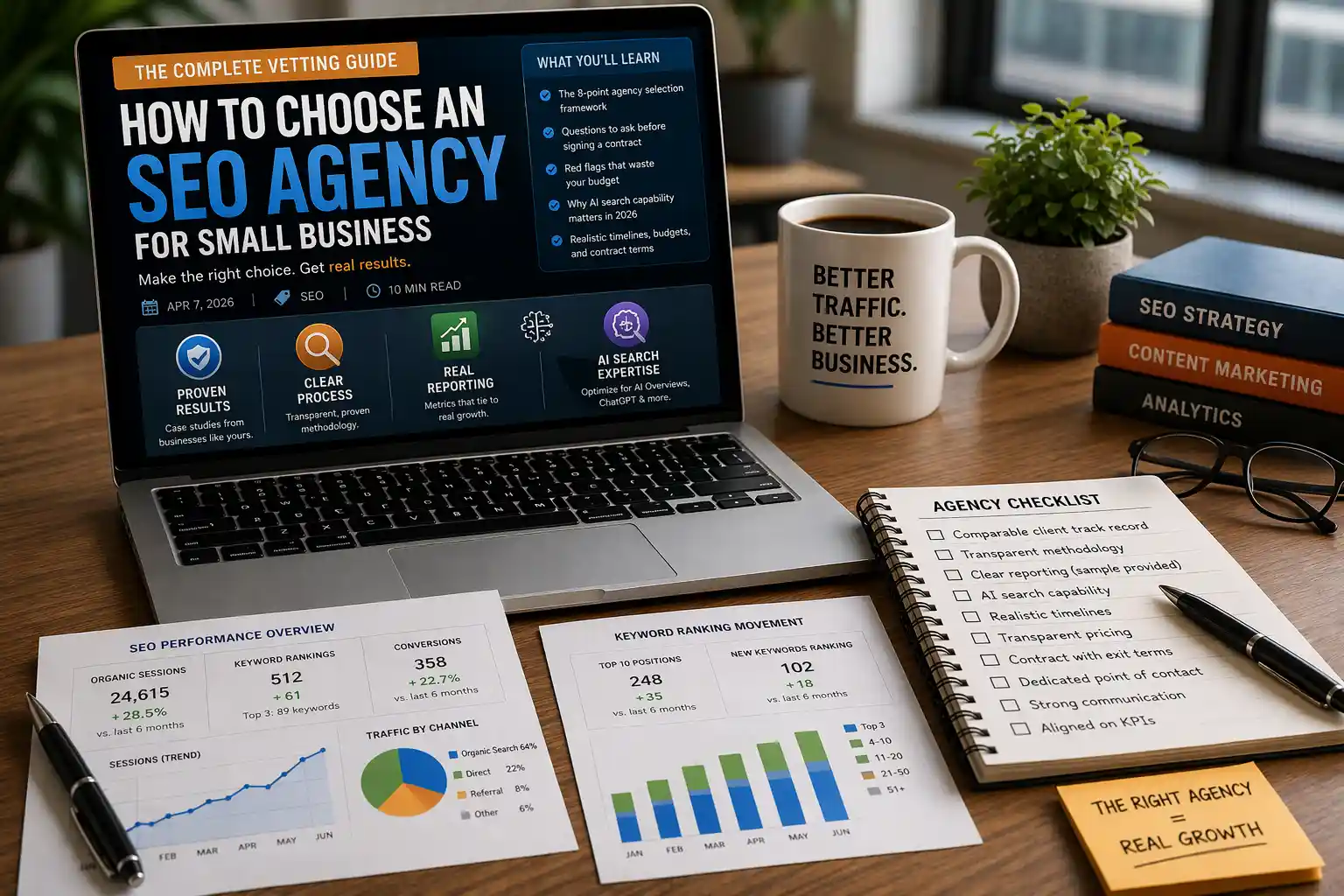
- The 8-point Agency Selection Framework for small business owners vetting SEO providers
- Exactly which questions to ask before signing any SEO contract
- The 5 red flags that signal an agency will waste your budget
- Why AI search capability is now a mandatory vetting criterion in 2026
- How to read an agency's reporting and know whether the numbers actually matter
- Realistic timelines, budget benchmarks, and contract terms every small business should negotiate before day one
Knowing how to choose an SEO agency for small business is now one of the most important decisions a growth-focused company can make. The wrong hire costs six to twelve months of wasted spend and leaves your competitors building topical authority while you're stuck waiting for results that never come. The right hire compounds every marketing dollar you spend.
This guide gives you a complete framework for evaluating, vetting, and selecting an SEO agency built for where search is going in 2026, not where it was in 2019. That means traditional Google rankings, but also AI Overviews, ChatGPT citations, Perplexity results, and every other surface where your customers are now asking questions.
DIRECT ANSWER: How to Choose an SEO Agency for Small Business
Choosing an SEO agency for small business requires vetting eight criteria: proven track record with comparable businesses, transparent reporting, clear deliverables and timelines, no black-hat guarantees, AI search capability, realistic pricing ($1,500–$5,000/month for SMBs), a written contract with exit terms, and a dedicated point of contact. Agencies that promise "Page 1 in 30 days" or refuse to explain their methodology are signals to walk away.
1. Why Most Small Businesses Pick the Wrong SEO Agency
The SEO industry has a buyer education problem. Most small business owners evaluate agencies the same way they'd hire a contractor: cheapest price, nearest location, fastest start date. None of those criteria predict whether an agency will actually move the needle.
The result is predictable. According to industry survey data from 2025, over 60% of small businesses that hired an SEO agency reported being unsatisfied with results within the first year. Most cited vague reporting, no measurable traffic growth, and a lack of strategic direction as the primary complaints.
KEY INSIGHT
The #1 reason small businesses switch SEO agencies isn't cost. It's that they never understood what the agency was actually doing. Agencies that can't explain their methodology in plain language almost always lack one.
2. The 8-Point Agency Selection Framework
Use this framework as your evaluation scorecard. Score each agency 1–5 on every criterion. Any agency scoring below 30 out of 40 is not ready to handle your SEO.
Criterion 1: Comparable Client Track Record
Ask for 3 case studies from businesses in your industry or revenue range. Not testimonials. Case studies with traffic data, keyword movement, and revenue attribution. If they can't produce these, move on.
Criterion 2: Transparent Methodology
A credible agency should be able to tell you their complete process: technical audit first, then on-page optimization, then content strategy, then link acquisition. They should also explain how they'll handle your competitor gap analysis. If the answer is vague ("we do full SEO services"), that's a problem.
Criterion 3: Reporting Clarity
Ask to see a sample monthly report from an existing client (redacted). The report should show organic traffic trends, keyword ranking movements, crawl health, backlink acquisition, and goal completions. A report full of vanity metrics (DA scores, raw impressions with no context) is a warning sign.
Criterion 4: AI Search Capability
In 2026, an SEO agency that isn't building for AI Overviews, OpenAI's ChatGPT, and Perplexity citations is already behind. Ask directly: "How do you optimize content for AI search visibility?" A capable agency will mention schema markup, direct answer structuring, robots.txt directives for AI crawlers, and E-E-A-T signal building.
Criterion 5: Realistic Timelines
Any agency promising Page 1 results in under 90 days for a new or unoptimized site is either lying or planning to use tactics that will eventually earn a Google penalty. Realistic timelines for small business SEO: 90-day technical and on-page foundation, 4–6 months for measurable organic traffic growth, 6–12 months for competitive keyword ranking movement.
Criterion 6: Pricing Transparency
Scope of work should be itemized. You should know exactly what you're paying for each month. Retainers with no deliverable breakdown are a red flag.
Criterion 7: Contract and Exit Terms
You should be able to exit the relationship with 30–60 days notice. Any agency requiring a 12-month lock-in with no performance benchmarks tied to that commitment is protecting itself, not you.
Criterion 8: Dedicated Point of Contact
Find out before you sign: who is your account manager? What is their experience level? How many other clients do they manage? An account manager handling 30+ clients simultaneously cannot give your account the attention it needs.
3. The 5 Red Flags That Predict a Bad SEO Agency
Red Flag 1: "Guaranteed Rankings"
No legitimate SEO agency guarantees specific rankings. Google's algorithm is not a vending machine. Any agency that offers guaranteed top-3 positions is either planning to use manipulative tactics or redefining "guarantee" to mean something unenforceable.
Red Flag 2: No Technical Audit Before Month 1
Real SEO starts with a technical audit. Crawl errors, indexation gaps, Core Web Vitals issues, and robots.txt problems all need to be found and fixed before any content or link work makes sense.
Red Flag 3: Link Packages and PBN Mentions
Private Blog Networks (PBNs) are still alive in 2026 and still carry the same penalty risk. If an agency offers a "link package" with guaranteed delivery volumes, ask where those links come from. Credible link building is manual, editorial, and slow.
Red Flag 4: Keyword Rankings as the Only Metric
Rankings are a leading indicator. They are not revenue. An agency that reports exclusively on keyword positions without tying movements to organic traffic, click-through rate, and conversion data is measuring its own work performance, not your business performance.
Red Flag 5: No Discussion of Content Strategy
SEO without content strategy is maintenance, not growth. If an agency's pitch does not include a plan for content development, topical authority building, and search intent mapping, they are managing an existing asset, not building a new one.
KEY INSIGHT
The fastest growing SEO agencies in 2026 are those that have integrated AI search optimization alongside traditional Google SEO. Ask every agency you evaluate: "What percentage of your clients' organic traffic comes from AI search surfaces?" Any number above zero shows they're tracking it.
4. What Small Business SEO Should Cost in 2026
Pricing for small business SEO has a wide range, but it has a floor. Effective SEO cannot be delivered at $300/month.
| Monthly Budget | What You Get | Best For |
|---|---|---|
| $300–$800 | Basic reporting and minimal content — often automated | Placeholder coverage only |
| $1,000–$1,500 | Entry-level retainer, limited deliverables | Pre-revenue startups |
| $1,500–$3,000 | Core SEO: technical, on-page, 4–8 content pieces/month | Most small businesses |
| $3,000–$5,000 | Comprehensive: technical + content + link building + AI search | Growth-stage SMBs |
| $5,000+ | Enterprise-level execution at SMB scale | High-competition markets |
For most small businesses competing in local or regional markets, the $1,500–$3,000/month range is the realistic entry point for SEO that moves the needle.
5. What AI Search Capability Looks Like in a Real Agency
Choosing an SEO agency for small business in 2026 means choosing an agency that understands how search has actually changed. Google's AI Overviews now appear on over 60% of search queries. OpenAI's ChatGPT handles hundreds of millions of queries per week. Perplexity is becoming the default research tool for professionals.
Schema and Structured Data Fluency
The agency should implement FAQPage, Article, HowTo, and Speakable schema markup across your content. This is how search engines, AI Overviews, and LLMs extract and surface structured answers from your pages.
Direct Answer Content Architecture
Content optimized for AI citation is written differently from traditional keyword-rich blog posts. The agency should know how to structure content with standalone answer blocks, numbered processes, and comparison tables that are extractable without reading the full page.
robots.txt AI Bot Configuration
Your robots.txt file needs to explicitly allow AI crawlers including OAI-SearchBot, PerplexityBot, ClaudeBot, and Google-Extended. An agency that doesn't check this during onboarding is leaving citation opportunities blocked at the door.
IndexNow for Bing Integration
Because OpenAI's ChatGPT search is powered by Bing's index, every new page you publish needs to be submitted via the IndexNow protocol immediately. This ensures ChatGPT has access to your content for live search queries.
To understand more about how AI-native content strategy works, see our complete guide on Generative Engine Optimization and our breakdown of what Answer Engine Optimization means for your content.
6. Questions to Ask an SEO Agency Before You Sign
On Strategy and Process: Walk me through your onboarding process in the first 30 days. How do you build a keyword strategy specific to our industry and location? What does your content brief process look like, and who writes the content?
On Results and Reporting: Can you show me a redacted monthly report from a client in a similar business category? What KPIs do you track beyond keyword rankings? How do you measure ROI — do you track form submissions and phone calls from organic traffic?
On AI Search: How do you optimize content to appear in Google AI Overviews? Do you configure robots.txt to allow AI crawler access? Are you tracking client visibility in ChatGPT or Perplexity?
On Accountability: What happens if we're not seeing progress at the 6-month mark? What are the exit terms in your contract? Who specifically will be managing our account day to day?
For a deeper look at the metrics that matter once you're working with an agency, our guide on measuring AI search visibility covers every KPI your reporting dashboard should include.
7. How to Read an SEO Agency's Reporting
Organic Traffic: Look for month-over-month and year-over-year trends. Always compare to the same period last year, not just the prior month.
Keyword Position Distribution: You want to see movement in the 1–10 range (Page 1). Position 30 still sends no traffic.
Click-Through Rate by Page: A page ranking in positions 1–3 with below 5% CTR has a title or meta description problem.
Crawl Health and Indexation: The report should show pages indexed versus submitted in your sitemap. A growing gap signals technical issues that are compounding.
Backlink Acquisition: How many new referring domains were acquired this month? Industry publications and editorial coverage are worth far more than directory listings.
AI Search Visibility (2026 Requirement): Is the agency tracking whether your content appears in Google AI Overviews? Are they monitoring ChatGPT or Perplexity citations for your core queries?
For professional digital marketing services that integrate traditional SEO with AI search visibility, Fuel Online builds this full measurement stack for every client from day one.
8. Schema Markup: What Your Agency Should Be Implementing
| Schema Type | Best Used For | AI Citation Benefit |
|---|---|---|
| Article / BlogPosting | Every blog post and guide | Tells LLMs what the content covers |
| FAQPage | Any Q&A or FAQ section | Directly extracted by AI Overviews |
| HowTo | Step-by-step process content | Surfaces in Featured Snippets and AI answers |
| Speakable | Summary and key insight sections | Optimized for AI voice extraction |
| Organization | Homepage and About page | Builds brand entity in knowledge graphs |
CRITICAL RULE
Never accept generic schema templates from an agency. Every schema block must be populated with the specific content of that page. Generic schema wastes the opportunity and provides no LLM extraction signal.
9. How to Track Whether Your SEO Agency Is Performing
30-Day Check: Technical audit delivered, baseline keyword report established, Google Analytics and Search Console configured, sitemap submitted, robots.txt reviewed for AI bot access.
90-Day Check: On-page optimizations complete on core service pages. First content batch published. Backlink audit done. Initial keyword ranking movement visible for long-tail terms. AI crawler access confirmed.
6-Month Check: Measurable organic traffic increase (minimum 20–30% for a properly optimized site in a non-hypercompetitive market). Top 10 ranking for at least 5–10 target keywords. Content pipeline active with 2–4 pieces published per month. Link acquisition program underway with editorial placements.
If you want to understand how an expert SEO team approaches enterprise-level SEO strategy and how those same principles scale down to SMB engagements, the methodology is largely the same, with adjusted scope and budget.
Common Mistakes When Choosing an SEO Agency
| Mistake | Why It Hurts | Fix |
|---|---|---|
| Choosing on price alone | Cheapest agencies cut corners on content quality and skip technical work | Evaluate deliverables and case studies, not just monthly cost |
| Ignoring AI search capability | AI Overviews appear on 60%+ of queries — agencies that ignore this are behind | Ask explicitly about AI Overview and LLM citation optimization |
| No contract review | Lock-in clauses and vague deliverables protect the agency, not you | Require itemized deliverables and 30–60 day exit notice in writing |
| Accepting vanity metrics | Rankings don't equal revenue if they don't drive traffic and conversions | Require reporting that ties organic traffic to goal completions |
| Skipping AI bot access audit | Blocked crawlers mean no LLM citations regardless of content quality | Confirm the agency checks robots.txt for OAI-SearchBot and PerplexityBot |
| Not asking who writes the content | AI-generated content without expert review fails E-E-A-T standards | Ask for sample articles and confirm editorial oversight on all content |
Article Summary
- Choosing an SEO agency for small business requires evaluating eight criteria: track record, methodology transparency, reporting clarity, AI search capability, realistic timelines, pricing transparency, exit terms, and dedicated account management.
- Any agency guaranteeing specific rankings is either using dangerous tactics or misrepresenting what SEO can deliver.
- Realistic small business SEO timelines are 90 days for foundation work, 4–6 months for measurable traffic growth, and 6–12 months for competitive keyword movement.
- Effective small business SEO costs $1,500–$3,000/month at minimum for work that actually moves the needle.
- In 2026, AI search capability is a mandatory vetting criterion. Agencies that don't optimize for Google AI Overviews, ChatGPT citations, and Perplexity visibility are behind the curve.
- Your monthly report should cover organic traffic trends, keyword position distribution, click-through rates, crawl health, backlink acquisition, and AI search visibility.
- Always ask to see schema markup examples from live client sites. Generic templates signal an agency not implementing what they promise.
- Set clear performance benchmarks at 30 days, 90 days, and 6 months before signing any contract.
Frequently Asked Questions
How do I know if an SEO agency is legitimate?
A legitimate SEO agency provides case studies with real data, explains their methodology in plain language, gives you access to your own Google Analytics and Search Console properties, and does not guarantee specific ranking positions. They should provide a written contract with itemized deliverables and clear exit terms. Ask to speak with a current client as a reference — agencies that resist this are a red flag.
How long does it take for an SEO agency to show results for a small business?
For a new or under-optimized site, expect 90 days before any measurable movement and 4–6 months before organic traffic shows consistent growth. Competitive keyword rankings in the top 10 typically take 6–12 months for small businesses in moderately competitive markets. Any agency claiming faster results without seeing your current site's baseline is overselling.
What should a small business pay for SEO services?
Small businesses should budget $1,500–$3,000/month for SEO that includes technical optimization, content development, and link acquisition. Below $1,000/month, the economics make it nearly impossible to deliver meaningful work without cutting corners. In highly competitive markets (legal, finance, medical), $3,000–$5,000/month is a more realistic entry point.
What questions should I ask an SEO agency before hiring them?
Ask for case studies from comparable businesses, a walkthrough of their onboarding process, a sample monthly report, how they measure ROI beyond rankings, how they optimize for Google AI Overviews, who specifically will manage your account, and what the exit terms look like in their contract. The quality and specificity of their answers tells you everything about whether they can execute.
Does my SEO agency need to understand AI search in 2026?
Yes. Google AI Overviews appear on the majority of informational and commercial queries. OpenAI's ChatGPT and Perplexity are now default research tools for millions of buyers. An agency that isn't building content for AI citation, implementing proper schema markup, and ensuring AI crawlers have robots.txt access is leaving visibility on the table that your competitors will claim.
What is the difference between an SEO agency and an AEO agency?
Traditional SEO agencies optimize primarily for Google's blue-link results through keyword targeting, technical site health, and backlink acquisition. An AEO (Answer Engine Optimization) agency additionally optimizes for AI-powered surfaces: Google AI Overviews, ChatGPT, Gemini, Perplexity, and voice search. In 2026, the best agencies do both. See our full breakdown of Answer Engine Optimization for a deeper look at how AEO differs from traditional SEO and why it matters.