WHAT YOU’LL LEARN IN THIS GUIDE
- What search everywhere optimization means and why it is replacing single-channel SEO
- The 5 discovery channels driving traffic in 2026 that your strategy must cover
- How to structure content so AI engines like ChatGPT, Perplexity, and Gemini cite it
- Social search tactics for TikTok, YouTube, and Reddit that most brands ignore
- The schema and technical setup that makes content findable across every platform
- How to build co-citation density across sources for LLM brand mention frequency
- A weekly tracking system for multi-platform search visibility
- The most common mistakes that kill multi-platform discovery
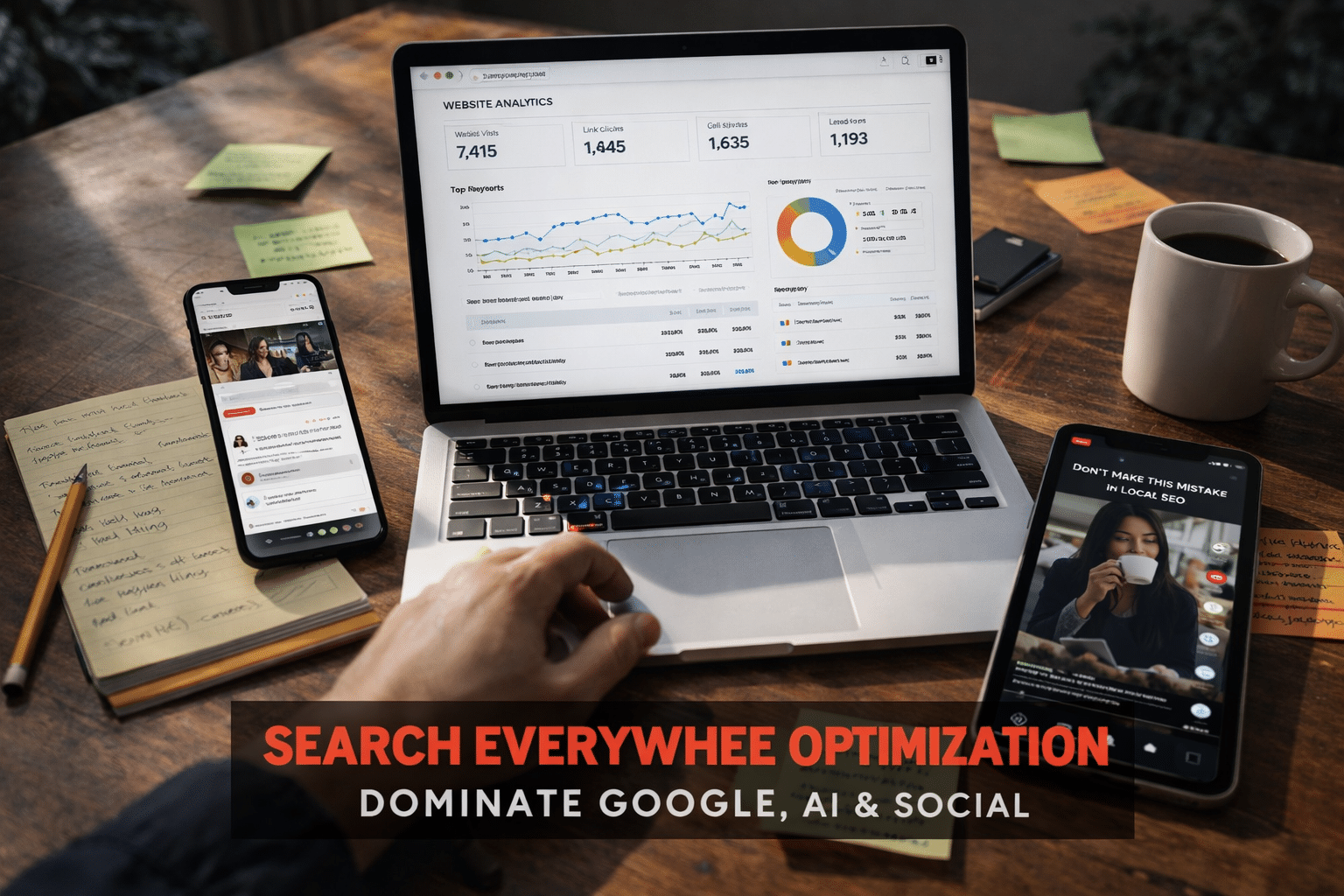
Search everywhere optimization is the practice of structuring your brand, content, and technical SEO so you get found across every discovery channel at once — Google, OpenAI’s ChatGPT, Perplexity, TikTok, YouTube, Reddit, and Google’s Gemini. Fifty-eight percent of users under 35 now use TikTok or YouTube as their first search stop for how-to queries, and 27% of all informational queries in the US are now answered by an AI engine before a user ever clicks a link. If your strategy only targets Google’s blue links, you are invisible to a growing majority of the searching public.
Search everywhere optimization replaces the old single-channel SEO playbook. This guide breaks down exactly how to build presence across AI search, social search, and traditional Google results simultaneously — with the technical setup, content structure, and tracking system to match. The strategies here apply whether you are an ecommerce brand, a B2B service provider, or a digital agency trying to dominate every surface your prospects use to research decisions.
DIRECT ANSWER: What Is Search Everywhere Optimization?
Search everywhere optimization is a multi-platform discoverability strategy where brands structure content, schema markup, and technical SEO to appear in AI search engines (ChatGPT, Perplexity, Gemini), social discovery platforms (TikTok, YouTube, Reddit), and traditional Google results simultaneously. It replaces single-channel SEO with a framework that treats every search-capable platform as an indexable surface, ensuring your brand gets cited and discovered regardless of where a user starts their query.
1. What Is Search Everywhere Optimization and Why It Matters Right Now
The phrase “search everywhere optimization” gained traction in the broader digital marketing community around 2024–2025, but the underlying problem predates that. Audiences have always searched in multiple places. What changed is scale and AI. TikTok now processes over 1 billion queries per day. OpenAI’s ChatGPT handles 100 million weekly active users, many of whom use it for informational queries that used to flow exclusively to Google. YouTube has been the second-largest search engine by query volume for over a decade.
A search everywhere optimization strategy acknowledges that the discovery funnel now has five or more active entry points. If you optimize for one, you are not just missing traffic — you are losing brand presence in the channels your competitors will soon own. The brands winning at search everywhere optimization in 2026 built a content and technical architecture that serves all channels simultaneously, not a separate strategy bolted onto each one.
The core insight behind search everywhere optimization is that the same underlying content asset can appear in Google’s featured snippet, a ChatGPT citation, a TikTok search result, and a Reddit discussion thread — if it is structured correctly. Most brands are not structured correctly. That gap is the opportunity.
2. The 5 Core Discovery Channels a Search Everywhere Optimization Strategy Must Cover
Google and Bing Traditional Search
Google processes 8.5 billion queries daily. Bing’s market share is growing because it now powers OpenAI’s ChatGPT live-web search. Traditional organic ranking still requires technical SEO, Google’s E-E-A-T signals, and on-page optimization — but the content format must also serve AI extraction, which changes how pages are written and structured.
AI Search Engines (ChatGPT, Perplexity, Gemini, Claude)
AI engines do not rank pages — they cite sources in generated responses. Your content needs a Direct Answer Block, FAQPage schema, and proper robots.txt directives to get extracted. This is the fastest-growing discovery channel and the hardest to measure, which is exactly why most brands are not yet treating it seriously. That gap is closing fast.
TikTok Search
TikTok’s in-app search processes over 1 billion daily queries, with users heavily favoring short-form video for “how-to”, “best”, and “near me” style queries. TikTok search everywhere optimization requires keyword placement in captions, spoken keywords in the first five seconds of a video, on-screen text reinforcement, and targeted hashtag strategy.
YouTube Search
YouTube processes 3 billion queries per day and earns placement in Google’s main SERP with increasing frequency. YouTube SEO requires keyword-optimized titles, descriptions, chapter timestamps, and closed captions. A video that appears in both YouTube search results and Google’s video carousel creates two citation points for one piece of content.
Reddit and UGC Platforms
Google’s Helpful Content updates heavily rewarded Reddit, Quora, and other user-generated content platforms. Reddit posts rank in Google’s top 5 for thousands of high-intent comparison and recommendation queries. Perplexity AI and OpenAI’s ChatGPT frequently cite Reddit threads as sources when answering “best X for Y” questions. A search everywhere optimization plan that excludes Reddit is missing one of the AI engines’ most-used reference sources.
3. AI Search Optimization: The Non-Negotiable Foundation Layer
AI search optimization is the anchor of any search everywhere optimization strategy. Without it, your content cannot be cited by ChatGPT, Perplexity, Google’s Gemini, or Anthropic’s Claude — AI engines that together serve hundreds of millions of informational queries per month.
1. Direct Answer Blocks
Every page targeting an informational query needs a 2–4 sentence, standalone answer placed near the top of the content. AI engines extract these verbatim. Structure them using clear HTML semantics or callout boxes with CSS class .direct-answer-block for Speakable schema targeting.
2. FAQPage Schema
Structured FAQ markup tells AI crawlers exactly which questions your page answers. Populate every page’s FAQPage schema with the actual Q&A pairs from your content — not generic questions, not hypothetical questions.
3. AI Crawler Access in robots.txt
Your robots.txt must explicitly allow OAI-SearchBot, ChatGPT-User, PerplexityBot, ClaudeBot, Google-Extended, and anthropic-ai. Blocking these bots is the single most common reason sites fail to earn AI citations despite publishing high-quality content.
User-agent: OAI-SearchBot
Allow: /

User-agent: ChatGPT-User
Allow: /

User-agent: PerplexityBot
Allow: /

User-agent: Google-Extended
Allow: /

User-agent: ClaudeBot
Allow: /

User-agent: anthropic-ai
Allow: /
4. IndexNow for Bing
Because OpenAI’s ChatGPT live-web search runs on Bing’s index — not Google’s — passive crawling is not fast enough. Implement Microsoft Bing’s IndexNow protocol via Rank Math or Yoast SEO (v19.0+) to ping Bing the moment you publish or update a page. Sites that implement IndexNow typically appear in ChatGPT search results within 24–48 hours of publishing versus 2–3 weeks for passive Bing crawling.
For the full technical setup covering AI crawler directives, IndexNow, and Speakable schema implementation, see Fuel Online’s Technical SEO for AI Crawlers guide.
4. Social Search: TikTok, YouTube, and Reddit as Discovery Engines
Most SEO teams treat social platforms as distribution channels — they share content after publishing it, not before. That framing is outdated for search everywhere optimization. TikTok, YouTube, and Reddit are structured search surfaces with their own ranking algorithms, keyword relevance systems, and quality signals.
TikTok SEO Tactics That Generate Search Visibility
TikTok keyword research starts inside TikTok’s own search bar. Type your target topic and review autocomplete suggestions — these are exact user queries. Then optimize your video content with:
- Target keyword in the first 150 characters of the caption
- Target keyword spoken clearly in the first five seconds of the video
- On-screen text with the keyword visible in the first frame
- Three to five niche hashtags (specific beats broad every time)
- A direct question format in the video opener to drive comment engagement — a TikTok ranking signal
YouTube SEO for Dual Search Visibility
YouTube videos earn a second point of visibility when they appear in Google’s video carousel and standard organic results for the same keyword. Optimize for both surfaces by placing the target keyword in the video title within the first 60 characters, in the first 100 words of the description, and in chapter timestamp names. YouTube’s chapter titles are indexed by Google separately from the video title — an underused keyword placement most brands miss.
Reddit for AI Source-Building
Reddit is not just a community platform in the context of search everywhere optimization — it is a citation source for AI engines. Perplexity AI regularly cites Reddit threads when answering recommendation queries. Building a credible, non-promotional brand presence in relevant subreddits makes your brand and content accessible to AI engines that use Reddit as a high-trust retrieval source.
For the framework that governs how AI engines decide what to recommend, see the Generative Engine Optimization (GEO) Guide.
5. Schema and Technical Setup for Multi-Platform Search Visibility
| Schema Type | Applicable Channel | What It Enables |
|---|---|---|
| BlogPosting + FAQPage | AI Search, Google | LLM extraction, featured snippets, People Also Ask |
| Speakable | AI voice assistants, Google Assistant | Voice answer extraction for Speakable-tagged sections |
| VideoObject | YouTube, Google | Video rich results in SERP for video content pages |
| ItemList | Google, AI Search | Ranked list rich results for listicle-format content |
| HowTo | AI Search, Google | Step-by-step rich result cards for process guides |
CRITICAL RULE
Never deploy generic schema templates. Every schema block must be populated with actual page content — real headline, real FAQ pairs, real step descriptions matching the article text. Generic schema fails validation and provides zero citation advantage over unstructured content.
Open Graph Tags for Social Previews
TikTok and Instagram use Open Graph tags to generate link previews. If your OG tags are missing or your page LCP exceeds 2.5 seconds, the preview collapses in-app and click-through drops sharply. Audit your OG tags with a social media link debugger quarterly, not annually.
Canonical URLs for Cross-Platform Content
When the same content appears in a LinkedIn newsletter and on your site, always set the canonical to the original page URL. This prevents duplicate indexing while concentrating all link authority on the source.
6. The Co-Citation Layer: How to Build Brand Presence Across Sources
Search everywhere optimization is not only about your own content. It is about how frequently your brand appears across the third-party sources that AI engines and search algorithms trust as authoritative.
OpenAI’s ChatGPT and Perplexity AI build responses by retrieving from multiple independent sources. When a brand is mentioned consistently across diverse, authoritative sources — press coverage, trade publications, Reddit communities, podcast transcripts, and industry directories — the frequency and context of those mentions increase the probability that an AI engine surfaces your brand in a relevant response. This is co-citation density, and it is one of the hardest things for competitors to replicate quickly.
KEY INSIGHT
Co-citation density — how often your brand appears alongside competing brands or related topics in independent third-party sources — is a strong predictor of LLM brand mention frequency. Sites consistently cited by ChatGPT and Perplexity are typically mentioned in 15+ distinct external source types, not just high-DA backlink profiles.
- Secure bylines and coverage in trade publications covering your topic area
- Publish contributed articles on Substack, Medium, and LinkedIn that link back to your canonical page
- Request inclusion in “best of” and “top agencies” roundups in your category
- Maintain consistent brand mentions in podcast show notes and YouTube video descriptions referencing your site
- Build a genuine Reddit presence in 2–3 relevant subreddits with a participation-first approach before any promotional intent
For the complete E-E-A-T and brand trust-building framework that supports co-citation, see Fuel Online’s E-E-A-T for AI Search guide.
7. How to Track Search Everywhere Optimization Performance
Traditional rank tracking only measures Google positions. A search everywhere optimization strategy requires a multi-signal tracking system covering all five discovery channels.
Weekly Tracking Protocol
- Google Search Console: Check impressions and clicks for target keywords. Monitor AI Overview appearances using the search type filter.
- Perplexity prompt audit: Run your top 5 keywords directly in Perplexity and log whether your site is cited in the response.
- ChatGPT prompt audit: Run the same 5 keywords in OpenAI’s ChatGPT with Bing web search enabled. Note citation frequency and the exact phrasing used.
- TikTok search audit: Search your target keyword phrases inside TikTok’s native search bar. Track your videos’ positions and view counts for those queries.
- YouTube Studio: Review search impression volume and click-through rate for your video content.
Monthly Tracking
- Run a full AI visibility audit using a minimum set of 20 prompt queries covering your core topics
- Review Reddit mentions using the Google search operator
site:reddit.com "[brand name]" - Flag any article more than 90 days old without a data refresh — content freshness is a direct AI citation signal
8. The Search Everywhere Optimization Rollout Sequence
Most marketing teams cannot execute a full search everywhere optimization strategy simultaneously. This is the recommended sequencing that delivers the fastest impact in the first 90 days:
- Weeks 1–2: Fix your robots.txt AI bot directives and deploy IndexNow via Rank Math or Yoast. These are zero-content changes with immediate impact on AI citation eligibility.
- Weeks 3–4: Retrofit your top 10 traffic pages with Direct Answer Blocks and FAQPage schema. Prioritize pages that answer informational queries where AI citation is likely.
- Month 2: Launch a TikTok or YouTube content series targeting your top 5 informational keywords in video format. Prioritize the platform where your target audience searches more.
- Month 3: Begin Reddit presence-building in 2–3 relevant subreddits with a genuine participation-first approach. Focus on helpful answers before any brand signal.
- Ongoing: Run the weekly AI prompt audit and monthly content refresh cycle to maintain citation eligibility across all channels.
For the full ranking guide to AI search, see How to Rank in ChatGPT.
9. Common Search Everywhere Optimization Mistakes
| Mistake | Why It Hurts | Fix |
|---|---|---|
| Blocking AI bots in robots.txt | ChatGPT, Perplexity, and Claude cannot crawl or cite your content regardless of quality | Add explicit Allow directives for all major AI user agents in robots.txt |
| Treating social as distribution only | Your brand is invisible in TikTok and YouTube search results for your target queries | Build a keyword-optimized video content plan for at least one social search platform |
| No Direct Answer Block on key pages | AI engines cannot extract a clean, citable answer from unstructured content | Add a 2–4 sentence Direct Answer Block to every page targeting an informational query |
| Ignoring Bing indexing for ChatGPT | ChatGPT live search runs on Bing’s index — Google indexing alone is not sufficient | Implement IndexNow via Rank Math or Yoast to ensure same-day Bing indexing |
| Single-source co-citation | AI engines distrust brands mentioned in only one source type | Build mentions across press, podcasts, industry directories, and UGC platforms |
| Generic schema deployment | Generic schema blocks fail validation and produce no rich result or citation advantage | Populate every schema property with actual, page-specific content |
Article Summary
- Search everywhere optimization is the practice of building brand discoverability across all major search surfaces — AI engines, social platforms, and traditional Google — simultaneously.
- The 5 core discovery channels in 2026 are: Google/Bing traditional search, AI search engines (ChatGPT, Perplexity, Gemini, Claude), TikTok, YouTube, and Reddit.
- AI citation eligibility requires four elements: a Direct Answer Block, FAQPage schema, robots.txt AI bot directives, and Bing IndexNow implementation.
- TikTok search everywhere optimization requires keyword placement in captions, spoken keywords in the first 5 seconds, and specific hashtag targeting.
- YouTube video content earns dual visibility: on YouTube’s native search and in Google’s video carousel and SERP.
- Reddit and UGC platforms function as AI citation sources — Perplexity regularly cites Reddit threads for comparison and recommendation queries.
- Co-citation density is a core predictor of LLM recommendation frequency — build mentions across 15+ distinct external source types.
- Deploy schema specifically for your content type: BlogPosting + FAQPage for articles, VideoObject for video content, HowTo for process guides.
- Track multi-platform performance weekly via Google Search Console, AI prompt audits, TikTok search position checks, and YouTube Studio analytics.
- Fastest 90-day path: fix robots.txt and IndexNow first, then retrofit key pages with Direct Answer Blocks, then build video content for social search channels.
Frequently Asked Questions
What is search everywhere optimization?
Search everywhere optimization is a multi-platform discoverability strategy that structures your brand’s content and technical SEO to appear across AI search engines (like OpenAI’s ChatGPT, Perplexity, and Google’s Gemini), social discovery platforms (like TikTok and YouTube), and traditional Google results simultaneously. It moves beyond single-channel SEO to treat every search-capable platform as an indexable surface your brand needs presence on.
How is search everywhere optimization different from traditional SEO?
Traditional SEO focuses on ranking in Google’s organic results. Search everywhere optimization recognizes that a large and growing share of informational queries is now answered by AI engines or discovered through social search platforms like TikTok and YouTube. A search everywhere optimization strategy adds AI citation optimization, social video keyword strategy, Reddit presence-building, and cross-platform schema markup to the traditional on-page and link-building foundation.
How do I get my content cited by ChatGPT and Perplexity?
To earn citations from OpenAI’s ChatGPT and Perplexity AI, your content needs four elements: a Direct Answer Block (2–4 sentence standalone answer to the primary query), FAQPage schema populated with your actual Q&A pairs, robots.txt directives explicitly allowing AI crawlers including OAI-SearchBot and PerplexityBot, and Microsoft Bing’s IndexNow protocol to ensure same-day indexing for ChatGPT’s live-web search function.
Which social search platform should I prioritize first for search everywhere optimization?
The right choice depends on your audience and content type. If your audience skews under 35 and your content is visual or tutorial in nature, TikTok delivers the fastest search everywhere optimization return. If you produce educational or process-focused content, YouTube provides dual visibility in both YouTube search and Google’s SERP. If your audience uses comparison and recommendation queries, Reddit is the highest-leverage platform because AI engines like Perplexity regularly cite Reddit threads as sources for those query types.
How do I measure search everywhere optimization performance?
Measure search everywhere optimization with five parallel signal streams: Google Search Console for organic impressions and clicks, weekly AI prompt audits in ChatGPT and Perplexity to track citation frequency, TikTok search position tracking for your target keywords, YouTube Studio search impression data, and Reddit mention monitoring via the Google search operator site:reddit.com "[brand name]". Review all five signals monthly for a complete multi-platform visibility picture.