AI SEO, GEO & AEO | Updated April 2026 | 10 min read
How to Transition from Traditional SEO to AI Search Optimization
Transitioning from traditional SEO to AI search optimization does not mean abandoning what works. Google ranking still matters. Backlinks still matter. Technical SEO still matters. The transition means adding an AI visibility layer on top of your existing foundation — and restructuring your content so it can be extracted and cited by AI engines, not just ranked by Google’s algorithm.
The shift from traditional SEO to AI search optimization is the most significant change in search strategy since the mobile-first update. Companies that treat it as optional are already losing visibility to competitors who are actively being cited in ChatGPT, Perplexity, and Google AI Overviews.
1. What Changes When You Add AI Search Optimization
Traditional SEO optimizes for ranking signals: keyword density, backlinks, page speed, Core Web Vitals. AI search optimization adds extraction signals: how well can an LLM pull a useful answer from your content? These are different requirements. A page can rank #1 on Google and never appear in an AI Overview. A page with modest traditional rankings can be cited repeatedly in Perplexity if its content is structured for extraction.
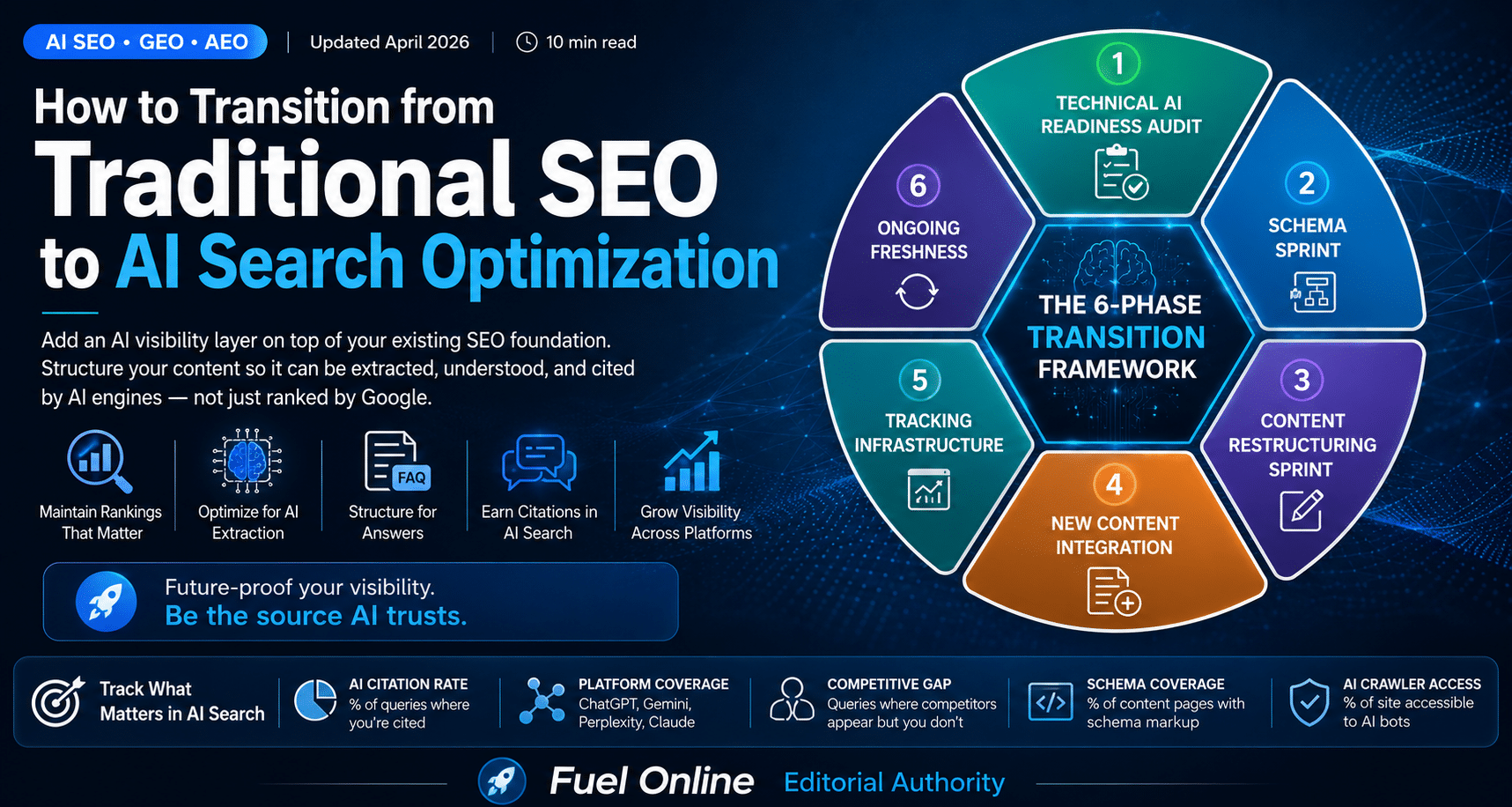
2. The 6-Phase Transition Framework
Phase 1: Technical AI Readiness Audit. Audit your robots.txt for AI crawler access. Confirm PerplexityBot, OAI-SearchBot, ChatGPT-User, Google-Extended, ClaudeBot, and anthropic-ai are all allowed. Check for Cloudflare or WAF rules that block unknown bots. Verify your sitemap is current and submitted to Bing Webmaster Tools.
Phase 2: Schema Sprint. Implement FAQPage schema on your 20 highest-traffic pages. Add Article/BlogPosting schema with dateModified to all content pages. Implement Speakable schema targeting your direct answer blocks. Add HowTo schema to any step-by-step content. This phase takes 2-3 weeks and produces the fastest AI visibility gains.
Phase 3: Content Restructuring Sprint. Identify your top 30 organic keywords. For each query that triggers an AI Overview or appears in Perplexity answers, audit the corresponding page. Add direct answer blocks to the top of pages that lack them. Rewrite H2 headings from declarative to question format. Add FAQ sections to pages that don’t have them.
Phase 4: New Content Integration. Going forward, every new piece of content is written to the AI-optimized standard from day one. Brief writers to include direct answer blocks, question H2s, and FAQ sections as standard requirements. Integrate schema generation into the publishing workflow.
Phase 5: Tracking Infrastructure. Set up a weekly prompt audit library. Build a spreadsheet tracking 30-50 target queries across ChatGPT, Gemini, Perplexity, and Claude. Record citation rates weekly. Track which pages are cited, which competitors appear, and where gaps exist. This replaces the traditional rank-tracking-only mindset with a multi-platform visibility view.
Phase 6: Ongoing Freshness. Update dateModified schema on pages as they are refreshed. Run quarterly content audits to identify pages losing AI citation frequency. Keep direct answer blocks and FAQ sections updated as industry knowledge evolves.
3. KPIs That Change in AI Search
Traditional SEO KPIs: keyword rankings, organic traffic, domain authority, backlink count. AI search KPIs to add: AI citation rate (% of target queries where your site is cited), AI citation platform coverage (ChatGPT, Gemini, Perplexity, Claude), competitive citation gap (queries where competitors are cited but you are not), schema coverage rate (% of content pages with FAQPage and Article schema), and AI crawler access rate (% of site accessible to AI bots).
4. What Stays the Same
Technical SEO fundamentals remain essential. A slow site is still penalized. Thin content still underperforms. Backlinks still influence authority. E-E-A-T signals still matter. The AI search layer does not replace these requirements — it sits on top of them. Sites with weak traditional SEO foundations will find AI optimization provides limited returns because AI systems still favor authoritative, well-structured sources.
5. Common Transition Mistakes
Mistake 1: Treating AI search optimization as a one-time project rather than an ongoing discipline. Mistake 2: Ignoring robots.txt AI bot access — the first step many teams skip. Mistake 3: Adding FAQPage schema without restructuring the actual content to match it. Mistake 4: Tracking only Google AI Overviews and ignoring Perplexity and ChatGPT Search. Mistake 5: Not setting up baseline AI citation tracking before making changes, making it impossible to measure progress.
Article Summary
- Transitioning to AI search optimization means adding an extraction layer on top of existing SEO — not replacing it
- The 6-phase framework: Technical AI Readiness Audit, Schema Sprint, Content Restructuring Sprint, New Content Integration, Tracking Infrastructure, Ongoing Freshness
- Phase 1 (robots.txt audit) and Phase 2 (schema sprint) produce the fastest initial AI visibility gains
- New KPIs to track: AI citation rate, platform coverage, competitive citation gap, schema coverage rate
- Traditional SEO fundamentals remain essential — AI optimization builds on top of them, not instead of them
- Set up baseline AI citation tracking before making changes so you can measure the impact
Frequently Asked Questions
How long does it take to transition from traditional SEO to AI search optimization?
The technical foundation (robots.txt, schema) can be implemented in 2-4 weeks. Content restructuring for top pages takes 4-8 weeks depending on site size. Seeing measurable AI citation improvements typically takes 6-12 weeks after implementation. Building a full AI search tracking infrastructure is an ongoing process, not a one-time project.
Do I need to rewrite all my existing content?
No. Focus on your top 20-30 pages by organic traffic first. Add direct answer blocks, convert H2s to question format, add FAQ sections, and implement FAQPage schema. New content should be written to the AI-optimized standard from creation. Older content can be updated incrementally based on AI citation audit findings.
What is the single most impactful change for AI search visibility?
Allowing AI crawlers in robots.txt combined with implementing FAQPage schema on high-traffic pages. These two changes have the broadest impact across ChatGPT, Perplexity, Google AI Overviews, and Claude. They are also the fastest to implement.
How is AI search optimization different from AEO and GEO?
AEO (Answer Engine Optimization) focuses on structuring content for AI answer extraction. GEO (Generative Engine Optimization) focuses on appearing in AI-generated responses across platforms. AI search optimization is the umbrella term covering both disciplines plus the technical implementation layer (robots.txt, IndexNow, schema).
Fuel Editorial Team
Fuel Online Strategist
Fuel Tech Lead
AI & Infrastructure Audit
Editorial Board
Data Integrity & Accuracy