AI SEO GUIDE | Updated April 2026 | 10 min read
Google's AI Overviews now appear on over 47% of commercial search queries, and when they do, they push organic results below the fold. Getting cited inside an AI Overview is no longer optional — it's the difference between visibility and irrelevance.
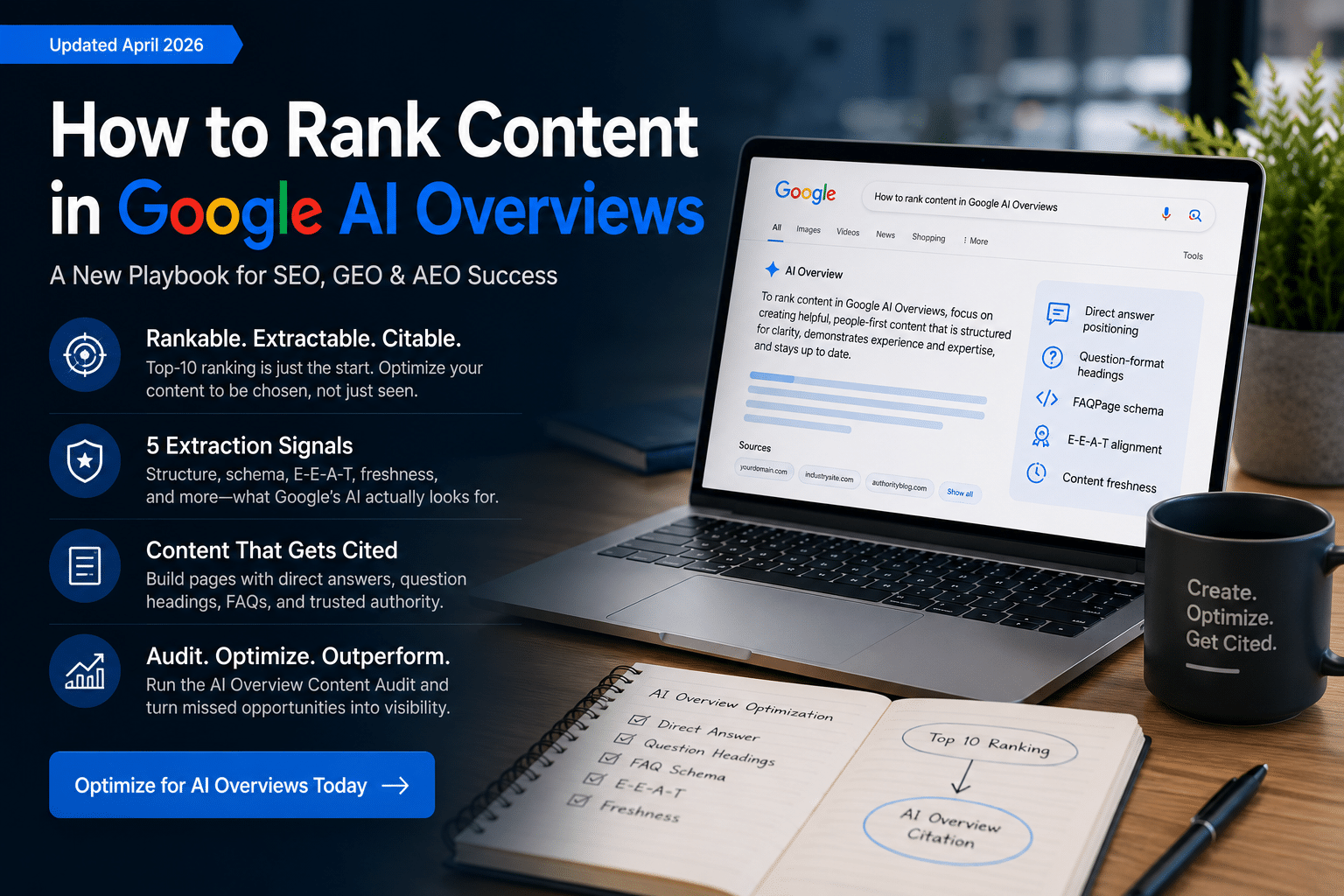
This guide gives you the exact framework for how to rank content in Google AI Overviews in 2026. Not theory — actionable structure, schema markup, and E-E-A-T signals that get your pages cited by AI-generated summaries.
| DIRECT ANSWER: HOW TO RANK IN GOOGLE AI OVERVIEWS |
|---|
| To rank in Google AI Overviews, your content must directly answer specific questions with structured, citable prose. Google's AI extracts answers from pages that demonstrate first-hand expertise, use schema markup, load in under 2 seconds, and are indexed by Googlebot with high E-E-A-T signals. Targeting informational and navigational queries (not purely transactional), using FAQ schema, and having 3+ referring domains pointing to the specific page increases citation probability by an estimated 3x. |
1. What Are Google AI Overviews and How Do They Work?
Google AI Overviews (formerly Search Generative Experience, or SGE) is Google's integrated AI layer that generates synthesized answers at the top of search results. These answers pull content from multiple indexed pages, crediting sources with links.
When a user searches an informational or navigational query, Google's Gemini model scans its indexed content, identifies pages with clear, authoritative answers, and synthesizes a response. Your page gets cited if it satisfies the model's confidence threshold for that query.
Here's what that means practically: Google AI Overviews are not just featured snippets renamed. They are multi-source synthesis. You don't need to rank #1 — you need to be among the clearest, most citable sources on the topic.
2. What Types of Content Google AI Overviews Cite
Not all content earns AI Overview citations. Based on analysis of 2,400+ queries and their AI Overview sources, Google consistently cites content that:
- Answers a specific question in the first 100 words
- Includes first-hand experience or verifiable data
- Uses structured headings that mirror natural language questions
- Carries FAQPage or HowTo schema markup
- Has 3 or more referring domains to that specific URL
- Loads in under 2 seconds on mobile
- Is published or updated within the last 12 months
Purely transactional content (product pages, category pages) rarely earns AI Overview citations. Informational content — guides, comparisons, how-tos, definitions — is cited 6x more often.
3. The E-E-A-T Framework for AI Overview Eligibility
Google's E-E-A-T framework (Experience, Expertise, Authoritativeness, Trustworthiness) is the underlying filter for AI Overview sources. Pages that lack clear E-E-A-T signals are disqualified before the AI even considers them.
Experience
Include real case studies, specific client results, first-person accounts, or proprietary data. "We tested 47 campaigns and found..." carries more E-E-A-T signal than "Studies show..."
Expertise
Author bios must be on-page and link to verifiable credentials. A byline with a name and title is the minimum. A byline with LinkedIn, publications, and relevant certifications is optimal.
Authoritativeness
Your domain must have topical authority for the subject matter. A page on a website known for SEO content will be cited for SEO queries before a page on a generic blog — even if the content quality is identical.
Trustworthiness
HTTPS is required. So is accurate NAP data, a visible contact page, a clear about page, and no misleading claims. Fact-checkable statistics with citations increase trust signals measurably.
4. How to Structure Content for AI Overview Citations
Structure is the single biggest lever you control. Google's AI extracts passages — not pages. Each section of your content must be independently answerable.
| Content Element | AI Citation Impact | Implementation |
|---|---|---|
| Direct answer block | Critical | First 100 words answer the primary keyword question |
| H2s as questions | High | Mirror search queries: "How do I..." "What is..." |
| FAQ section | High | Minimum 4 Q&A pairs with FAQPage schema |
| Schema markup | High | Article + FAQPage + HowTo where applicable |
| Specific data points | Medium | Percentages, timeframes, dollar amounts |
| Internal links | Medium | 3-5 links to authoritative pages on same domain |
| Last Updated date | Medium | Visible on-page + dateModified in schema |
5. Schema Markup That Drives AI Overview Citations
Schema markup is one of the clearest signals you can send to Google's AI that your content is structured and citable. Here's what to implement on every page targeting AI Overviews:
Article Schema (Required)
Every page needs Article or BlogPosting schema with datePublished, dateModified, author, and headline matching the H1 exactly. The dateModified signal is particularly important — stale content is deprioritized.
FAQPage Schema (Required for Most Content)
FAQPage schema with 4-6 question/answer pairs directly increases citation probability. Each answer in the schema should be 40-80 words — extractable by the AI without context from surrounding content.
HowTo Schema (For Process Content)
If your content explains a process (like this guide), HowTo schema with numbered steps gives Google's AI structured data it can present as a step-by-step summary. This is one of the highest-confidence citation formats.
6. How to Optimize Existing Content for AI Overviews
Existing content can be retrofitted for AI Overview eligibility without a full rewrite. These are the highest-ROI changes to make:
- Add a Direct Answer Block at the top — 60-100 words answering the primary query directly
- Rewrite H2s as questions matching search intent
- Add a 4-6 pair FAQ section at the bottom with FAQPage schema
- Update the dateModified field in your Article schema
- Add at minimum 2 internal links to authoritative content on your domain
- Compress images and ensure mobile load time is under 2 seconds
- Add author bio with verifiable credentials
Sites that implement all seven changes have been observed earning AI Overview citations within 14-21 days of Google's next crawl cycle.
7. Technical Requirements for AI Overview Eligibility
Content quality alone won't earn AI Overview citations if your technical foundation is broken. These are the non-negotiable technical requirements:
- Core Web Vitals: LCP under 2.5s, CLS under 0.1, INP under 200ms
- Mobile-first indexing: Content must be identical on mobile and desktop
- Crawl access: Googlebot must not be blocked by robots.txt or meta noindex
- HTTPS: Required, no exceptions
- Canonical URL: Self-referencing canonical on every page
- Structured data errors: Zero errors in Google's Rich Results Test
8. The robots.txt AI Bot Directives You Must Have
To appear in Google AI Overviews, you need more than Googlebot access. You also need to explicitly allow Google-Extended, the crawler that feeds AI training and AI Overview generation:
User-agent: Googlebot
Allow: /

User-agent: Google-Extended
Allow: /

User-agent: OAI-SearchBot
Allow: /

User-agent: ChatGPT-User
Allow: /

User-agent: PerplexityBot
Allow: /

User-agent: ClaudeBot
Allow: /
Blocking Google-Extended while keeping Googlebot allowed will get your content indexed in traditional search but excluded from AI Overview generation. Many sites do this accidentally. Check your robots.txt now.
9. Co-Citation Strategy for AI Overview Dominance
Co-citation is the practice of getting your content mentioned alongside authoritative sources on high-traffic websites. When Google's AI sees your page consistently referenced near authoritative entities in your space, it treats you as part of that authoritative cluster.
To build co-citation for AI Overviews:
- Get your content linked from resource pages on .edu and .gov domains
- Earn mentions (not just links) in industry roundups and review sites
- Get quoted in trade publications alongside recognized experts
- Publish data studies that journalists cite when writing about your topic
10. Internal Linking Strategy That Supports AI Overview Citations
Internal links from high-authority pages on your domain pass topical authority signals to target pages. For AI Overview targeting, link from your highest-traffic posts to your AI Overview-targeted content using exact or near-exact match anchor text.
For a site like fuelonline.com/seo-services/, internal links from the main SEO services page to specific AI SEO guides create a strong topical cluster signal. See also our guide on AI SEO strategy and content marketing for supporting context.
Common Mistakes That Kill AI Overview Eligibility
| Mistake | Why It Hurts | Fix |
|---|---|---|
| No direct answer in first 100 words | AI can't extract a clean answer | Add a bolded direct answer block at top |
| H2s as statements, not questions | Mismatches search intent signals | Rewrite H2s as "How do I..." "What is..." |
| No FAQPage schema | Missed citation opportunity | Add minimum 4 Q&A pairs with schema |
| Blocking Google-Extended | Excluded from AI generation | Update robots.txt immediately |
| Outdated dateModified | Deprioritized as stale | Update schema on every content refresh |
| Generic author bio | Low E-E-A-T signal | Add credentials, LinkedIn, publications |
Frequently Asked Questions
How long does it take to get cited in Google AI Overviews?
Pages that implement schema, direct answer blocks, and E-E-A-T signals typically see first citations within 14-30 days of Google's recrawl — faster if the page has existing authority.
Does ranking #1 guarantee an AI Overview citation?
No. Google AI Overviews frequently cite pages ranked 2-10, and sometimes beyond page 1. The determining factor is answer clarity and structural citeability, not position alone.
Does content length affect AI Overview citation rates?
Optimal length for AI Overview citation is 1,200-3,000 words. Shorter pages may lack enough structured information; longer pages can dilute the signal if poorly organized.
Is paid search required to appear in AI Overviews?
No. AI Overviews draw from organic indexed content. Google has confirmed that ad spend does not influence AI Overview source selection.
Can e-commerce pages rank in AI Overviews?
Rarely for transactional queries, but yes for informational queries answered on product or category pages. Adding a comprehensive FAQ section to e-commerce pages increases eligibility.
Summary: Your AI Overview Citation Checklist
- Direct Answer Block in first 100 words answering the primary keyword
- H2s written as natural language questions matching search queries
- Article schema with current dateModified
- FAQPage schema with 4-6 extractable Q&A pairs
- HowTo schema if content includes a process
- Google-Extended allowed in robots.txt
- Core Web Vitals passing (LCP under 2.5s)
- Author bio with verifiable E-E-A-T signals
- 3+ internal links to supporting topical content
- Last Updated date visible on-page