AI SEO, GEO & AEO | Updated April 2026 | 10 min read
How to Rank Content in Google AI Overviews
Ranking content in Google AI Overviews requires a strategy separate from traditional Google SEO. A top-10 ranking is necessary but not sufficient. Between 40-60% of pages that rank in the top 10 for a query are never cited in the AI Overview for that same query. The pages that get cited share specific structural and semantic characteristics that standard on-page SEO does not address.
Google’s AI Overviews (formerly Search Generative Experience) use a large language model to synthesize information from multiple sources and present a consolidated answer. Your content needs to be both rankable (traditional SEO) and extractable (AI Overview optimization).
1. The 5 Extraction Signals Google AI Overviews Use
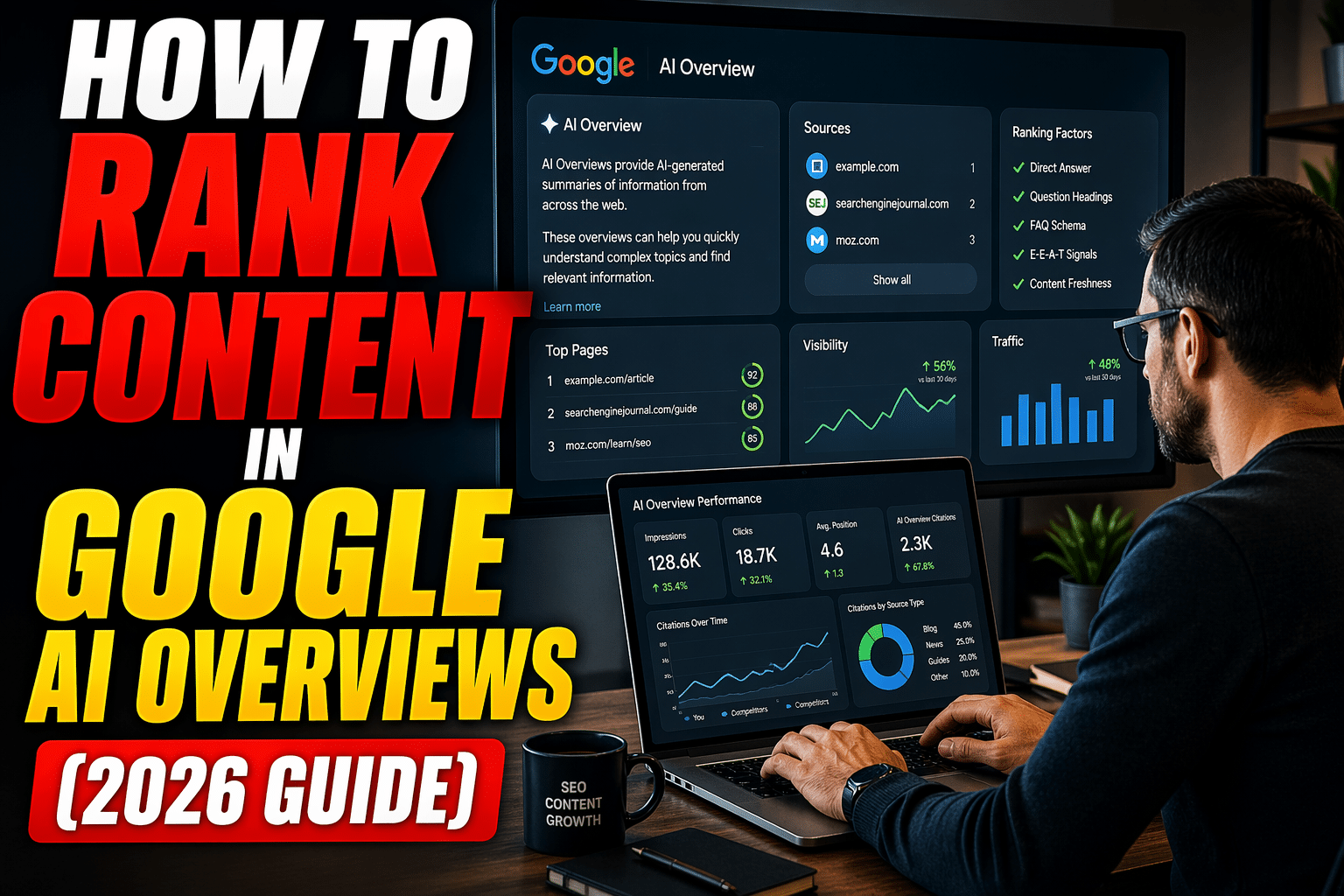
Signal 1: Direct answer positioning. Content that opens with a clear, standalone answer to the primary query is extracted at significantly higher rates. The answer must be complete within 80 words, use the exact query phrase, and not require context from surrounding sections.
Signal 2: Question-format headings. Google’s AI Overview system matches user queries against H2 and H3 headings. Pages where headings are phrased as complete questions (“How does X work?” “What is the difference between X and Y?”) are cited more frequently than pages with declarative headings.
Signal 3: FAQPage schema. Pages with properly implemented FAQPage schema give the AI Overview system pre-packaged Q&A units. Each question-answer pair in the schema is a candidate extraction point. Sites that implement FAQPage schema consistently see higher AI Overview citation rates for FAQ-type queries.
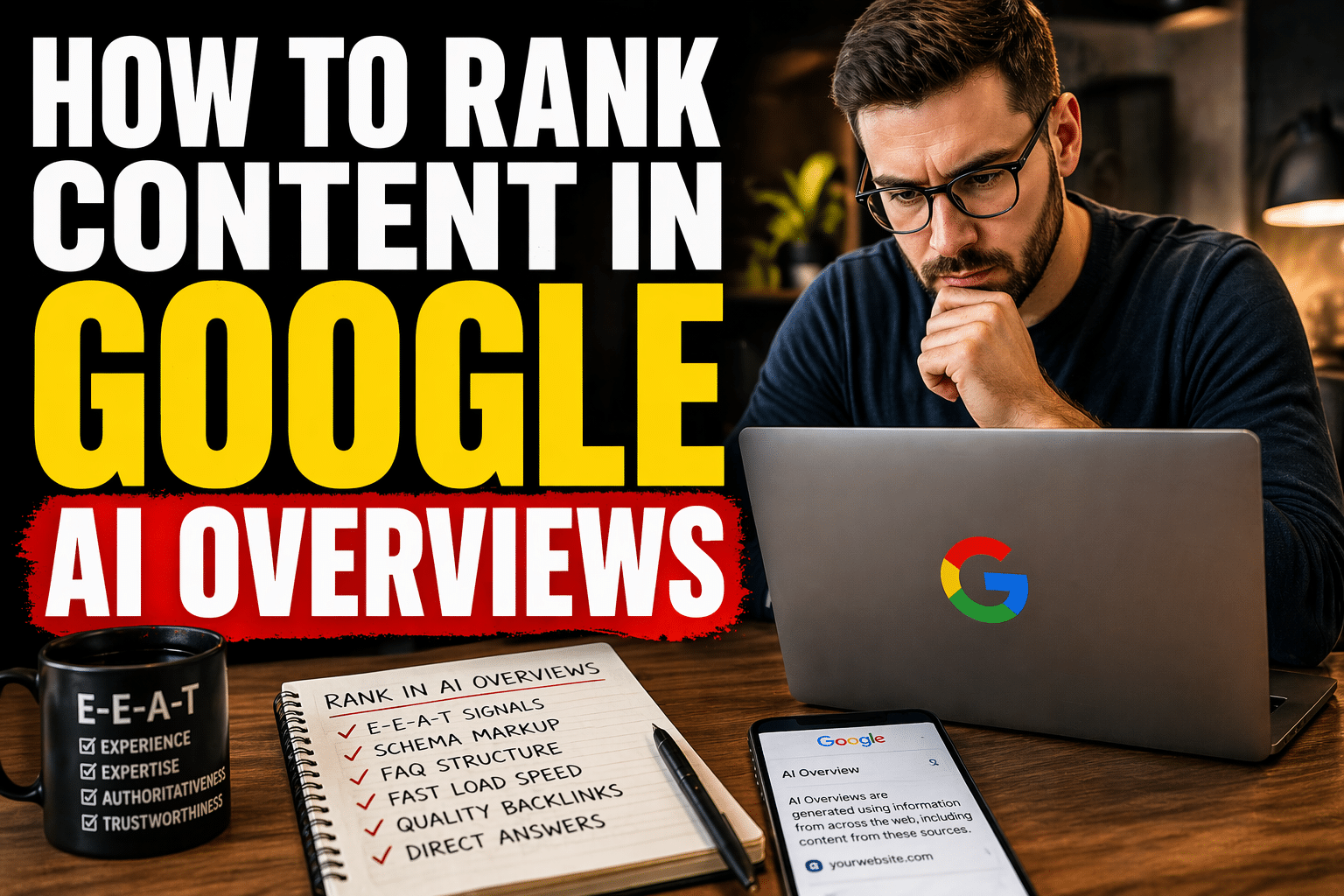
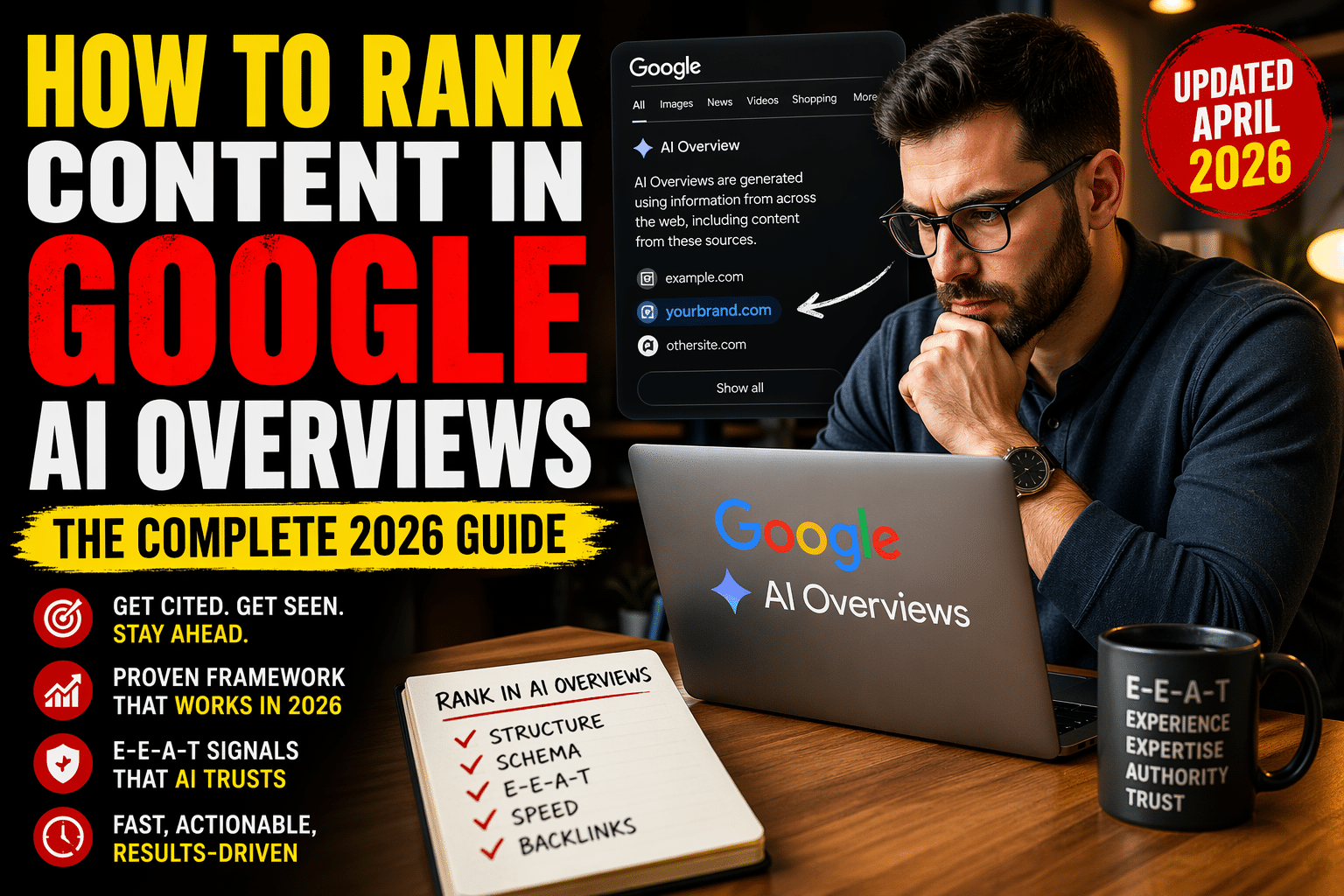
Signal 4: E-E-A-T alignment. Google’s AI Overviews favor content from sources that demonstrate Experience, Expertise, Authoritativeness, and Trustworthiness. This means identified authors with credentials, organizational signals (About page, team page), and cross-source corroboration of claims.
Signal 5: Content freshness. AI Overviews include dateModified signals. Content with recent publication or update dates, combined with dateModified schema, signals currency. For fast-moving topics, stale content is actively deprioritized in favor of recent sources.
2. Content Architecture That Gets Cited
Structure pages for AI Overview extraction with this framework: Open with a 50-80 word direct answer block. Follow with 6-10 H2 sections each addressing a related sub-question. Use short paragraphs of 2-4 sentences. Include tables for data comparisons. Add numbered lists for step-by-step processes. Close with 4-6 FAQ pairs. This structure gives the AI Overview system multiple extraction points per page.
3. The AI Overview Content Audit
Run this audit on your existing content to identify which pages need restructuring. Step 1: List your top 30 organic keywords by traffic. Step 2: Search each keyword in Google and note whether an AI Overview appears. Step 3: For queries showing AI Overviews, identify which pages are being cited. Step 4: Compare your ranking page against the cited pages. Step 5: Identify structural gaps — missing direct answer blocks, declarative instead of question H2s, absent FAQPage schema. Step 6: Prioritize pages where you rank in the top 5 but are not cited in the AI Overview.
4. FAQPage Schema for AI Overviews
FAQPage schema implementation for AI Overviews should include: the primary query as the first question, 3-5 follow-up questions your audience commonly asks, answers between 40-100 words each, specific and verifiable claims (not vague), and exact keyword phrases in both questions and answers. Place the schema in the page’s head or body using JSON-LD format.
5. Google-Extended Access in robots.txt
Google-Extended is the user agent Google uses for AI training and AI Overview content gathering. Many sites block it inadvertently. Add this to your robots.txt:
User-agent: Google-Extended
Allow: /
If Google-Extended is blocked, your content cannot appear in AI Overviews regardless of your traditional ranking position.
6. Recency Signals for AI Overview Priority
Add datePublished and dateModified properties to your Article schema with ISO 8601 format dates. Update the dateModified property every time you make meaningful content changes. Add a visible “Last Updated” line at the top of each article. Google’s AI Overviews use these signals to assess whether a source is current enough to cite for time-sensitive queries.
Article Summary
- Top-10 ranking is necessary but not sufficient for AI Overview citation — 40-60% of top-ranked pages are never cited
- The 5 extraction signals: direct answer positioning, question-format headings, FAQPage schema, E-E-A-T alignment, content freshness
- Direct answer blocks should be 50-80 words, standalone, and use the exact query phrase
- Google-Extended must be allowed in robots.txt — blocking it prevents AI Overview citation regardless of ranking
- FAQPage schema pre-packages Q&A units for AI extraction — include the primary query as question 1
- Run the AI Overview Content Audit on your top 30 organic keywords to find citation gaps
Frequently Asked Questions
How does Google decide what to include in AI Overviews?
Google’s AI Overviews pull from pages that rank in the top results and have content structured for easy extraction. Key factors: direct answer positioning, question-format headings, FAQPage schema, E-E-A-T signals, and content freshness (dateModified schema). Pages that rank highly but have poor extraction structure are frequently bypassed in favor of lower-ranked pages with better structure.
Can you opt out of Google AI Overviews?
Yes. Add the nosnippet meta tag to specific pages to prevent them from being included in AI Overviews. However, this also prevents traditional rich snippets. For most businesses, the goal is to be included in AI Overviews, not excluded.
Does Google AI Overviews hurt organic traffic?
For queries where AI Overviews appear, click-through rates to organic results do decrease. However, sites cited within the AI Overview often see increased brand exposure and can maintain or grow clicks. The strategic response is to optimize for AI Overview citation rather than trying to avoid them.
How long does it take to appear in Google AI Overviews?
Structural changes like adding direct answer blocks and FAQPage schema can show results within 2-4 weeks as Google re-crawls updated pages. E-E-A-T improvements take longer — typically 2-3 months for authority signals to compound and shift citation patterns.
Fuel Editorial Team
Fuel Online Strategist
Fuel Tech Lead
AI & Infrastructure Audit
Editorial Board
Data Integrity & Accuracy