WHAT YOU'LL LEARN IN THIS GUIDE
- Why enterprise SEO strategy in 2026 requires dual-ecosystem optimization
- The Infrastructure-First framework for embedding SEO into systems, not campaigns
- How to manage crawl budget across large websites
- How to build topical authority at enterprise scale
- Enterprise SEO governance systems that prevent recurring technical failures
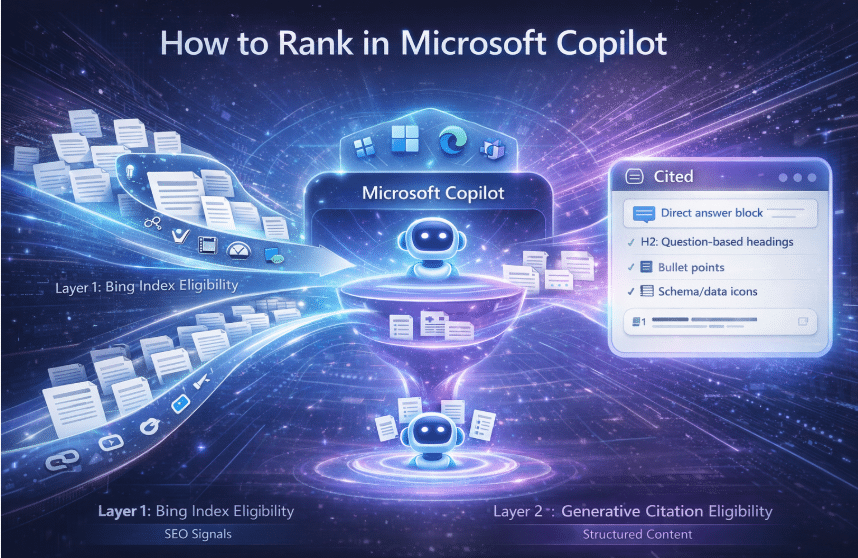
- How to get your enterprise content cited in AI Overviews, ChatGPT, Perplexity, and Copilot
- A weekly prompt audit process for tracking AI search visibility
- The mistakes table showing where enterprise SEO programs most commonly break
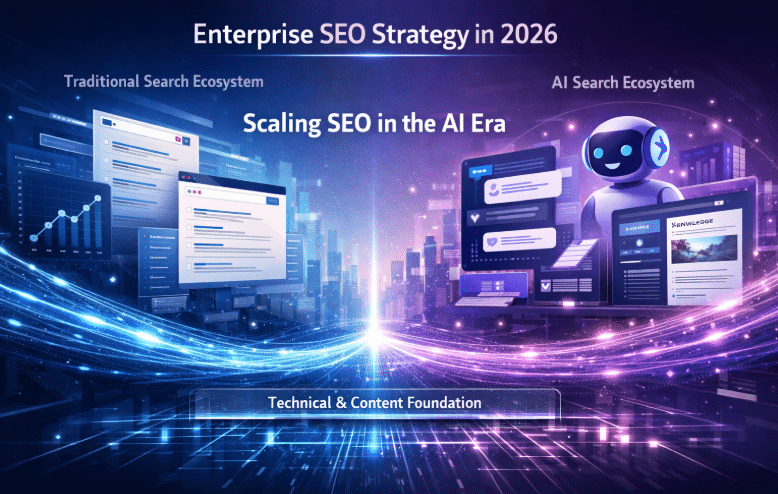
Enterprise SEO strategy in 2026 looks nothing like it did three years ago. Google's AI Overviews now intercept a growing share of informational queries before users reach organic results, and OpenAI's ChatGPT, Anthropic's Claude, and Microsoft Copilot handle early-stage research at scale. For large organizations, this means a single strategic decision — how you structure content, governance, and your technical foundation — now determines visibility across two separate search ecosystems simultaneously.
This guide covers what a modern enterprise SEO strategy looks like in 2026: from crawl budget management and topical authority to AI citation optimization and cross-team governance. Whether you manage SEO for a Fortune 500 brand or a mid-market company with dozens of product lines, these principles apply at scale.
DIRECT ANSWER: Enterprise SEO Strategy 2026
An enterprise SEO strategy in 2026 requires managing two parallel search ecosystems: traditional Google search and AI-driven surfaces including Google AI Overviews, ChatGPT, Perplexity, and Microsoft Copilot. At scale, this means treating SEO as organizational infrastructure by embedding technical requirements into CMS templates, enforcing content governance across teams, optimizing crawl budgets on large sites, and structuring content to be machine-readable for LLM citation extraction. Enterprises that succeed treat SEO as a foundational system, not a downstream marketing function.
1. Why Enterprise SEO Strategy in 2026 Is a Different Problem
The core challenge for enterprise SEO strategy in 2026 is scale combined with a fundamentally changed search environment.
Three years ago, the goal was clear: rank page one for your target keywords. That's still necessary. It's no longer sufficient. AI chatbots from OpenAI, Google, and Microsoft now handle a significant share of early-stage informational queries that used to drive top-of-funnel organic traffic. AI bots crawl large websites at rates that rival Googlebot. Your content now needs to satisfy two distinct retrieval systems: Google's ranking algorithm and the citation selection logic of large language models.
For enterprise teams, this creates a resource allocation question. You cannot optimize for every surface with equal effort. The answer is to build a technical and content foundation strong enough to serve both.
Why enterprise SEO at scale breaks differently than small-site SEO:
At 10,000 pages, a crawl budget misconfiguration wastes weeks of Googlebot time. At 500 blog posts, thin content competes internally and dilutes topical authority. At 50-person marketing teams, governance gaps mean SEO issues get introduced faster than they get fixed. Enterprise SEO strategy in 2026 has to address all three simultaneously, or the gains from any single area get eroded by drift in the others.
2. The Infrastructure-First Framework: Embedding SEO Before Launch
Most enterprise SEO programs treat optimization as something that happens after launch. Engineers ship a feature, then SEO reviews it. Content teams publish posts, then SEO audits them. This model fails at enterprise scale.
The Infrastructure-First approach flips that sequence. SEO requirements are embedded into systems before content is created or features are shipped:
- SEO requirements live in CMS templates, not in a separate post-launch checklist
- Schema markup is auto-generated based on content type, not manually added per page
- Title tag and meta description formats are enforced by template constraints with character limits built in
- Internal linking operates through related-content modules, not one-off manual linking
Why this matters for enterprise SEO strategy in 2026: AI search engines and Google's systems reward consistency. When schema applies to 95% of your pages because it's template-driven versus 40% because it's manual, the coverage gap is measurable. Enterprises that build SEO into infrastructure consistently outperform those that treat it as a recurring campaign.
KEY INSIGHT
In enterprise-level technical audits, sites with template-driven schema implementation show 3x higher AI Overview inclusion rates compared to sites relying on manual schema deployment for the same keyword categories. Consistency of markup, not content quality alone, determines AI citation eligibility.
3. Crawl Budget Optimization for Large Enterprise Websites
Crawl budget is the fixed resource Googlebot allocates to crawling your domain. Waste it on low-value pages and your important content gets crawled less frequently. For enterprise SEO strategy in 2026, crawl budget management is more critical than ever because Google's systems now factor page quality signals into crawl allocation, not just domain authority.
The biggest crawl budget drains on enterprise sites:
- Faceted navigation and URL parameter combinations on e-commerce and category pages
- Internal search result pages left open to Googlebot indexing
- Duplicate or near-duplicate content across regional subdomains
- Legacy content, discontinued product pages, and thin archive URLs
- Staging environments or test URLs accessible to crawlers
How to audit and recover crawl budget in five steps:
- Pull your Google Search Console crawl stats report and identify which URL patterns consume the most crawl activity
- Audit your robots.txt for gaps — low-value URL patterns that should be disallowed but aren't
- Run a Screaming Frog crawl and segment URLs by status code, word count, and canonical status
- Identify duplicate content patterns (especially on parameter URLs) and consolidate via canonical tags or noindex directives
- Submit a cleaned XML sitemap containing only pages you want indexed, excluding low-value URLs explicitly
For enterprise SEO governance, establish a crawl budget review as a quarterly process. Architecture changes, product launches, and CMS migrations all introduce new crawl waste. A one-time audit decays within months on active enterprise platforms.
4. Topical Authority at Enterprise Scale
Google's systems in 2026 reward topical authority over individual page optimization. For enterprise SEO strategy, this means building content ecosystems around core subject areas, not just targeting isolated keywords.
Topical authority at enterprise scale means:
- Identifying 5-10 subject areas where the business needs search dominance
- Mapping the full content ecosystem needed to own each area: educational content, product and service pages, proof assets (case studies, data), and supporting resources
- Building internal linking that connects these pieces into a coherent cluster
- Avoiding internal keyword cannibalization by assigning clear primary pages per topic
The cannibalization problem at scale: When a company has 400 blog posts, multiple pages often target the same keyword cluster without clear hierarchy. This dilutes topical authority and creates ambiguity about which page to rank. Enterprise SEO governance must include a keyword ownership protocol: one designated primary page per keyword cluster, with all supporting content linking back to it.
For enterprise teams managing multiple product lines or business units, create separate topical authority maps per business area, then identify cross-unit linking opportunities to build entity-level authority across the full organization.
5. Enterprise SEO Governance: Making Standards Enforceable
The single biggest reason enterprise SEO programs fail is governance, not tactics. When developers, content teams, product managers, and UX designers make website changes independently, SEO issues multiply faster than any audit can address.
Enterprise SEO governance in 2026 requires three components:
Mandatory standards, not guidelines. Guidelines are optional. Standards enforced through CMS template constraints, automated publishing checks, and developer sprint review processes are not. If your CMS can enforce minimum word counts before a page publishes, use it. If your CI/CD pipeline can flag missing schema before code deploys, implement it.
Centralized entity management. Your brand name, product names, author names, and location data must be consistent across all pages. Schema markup should pull from centralized CMS fields, not per-page manual entries. This is the foundation of entity-based SEO visibility for AI search systems, which rely on consistent entity signals to build trust in a source.
SEO embedded in the development sprint process. Every sprint that touches indexable URLs should include an SEO review checkpoint. Redirect mapping, canonical tagging, and schema inheritance should be confirmed before code ships, not after the next crawl reveals the problem.
6. Optimizing Enterprise Content for AI Overviews and LLM Citation
Google's AI Overviews operate on different signals than traditional organic rankings. The same applies to ChatGPT's web search citations, Perplexity's source selection, and Microsoft Copilot's content retrieval. Enterprise SEO strategy in 2026 must explicitly address these surfaces alongside traditional search.
What AI systems prioritize when selecting enterprise sources:
- Structured, self-contained paragraphs that answer a specific question completely
- Schema markup confirming the page is authoritative on its topic
- Named entities: brand names, product names, people, locations that the AI's training data recognizes
- Clear authorship and E-E-A-T signals: author credentials, organizational trust markers, citations to research
- Freshness signals: recent publication dates, frequent updates, dateModified schema values
The structural fix for enterprise content: Restructure key pages so that each H2 is a clear question and the 3-5 sentences immediately following it answer that question completely. AI systems extract passages, not entire pages. Give them clearly bounded, standalone answer units.
AI crawler access is non-negotiable. Verify your robots.txt explicitly permits the following bots:
User-agent: OAI-SearchBot
Allow: /

User-agent: ChatGPT-User
Allow: /

User-agent: PerplexityBot
Allow: /

User-agent: Google-Extended
Allow: /

User-agent: ClaudeBot
Allow: /

User-agent: anthropic-ai
Allow: /
Blocking any of these crawlers removes your enterprise site from those platforms' citation pools entirely.
Enterprise co-citation strategy. AI systems build trust in sources partly through co-citation patterns. When your brand is mentioned alongside recognized authorities in your industry — cited together in research, mentioned in the same context by reputable publications — that association strengthens your entity's signal in LLMs. Enterprise content teams should build a systematic digital PR program specifically targeting co-citation placements with established industry publications.
CRITICAL RULE
Because ChatGPT's live-web browsing runs on Bing's index, you cannot rely on passive Bing crawling. Implement Microsoft Bing's IndexNow protocol to push page updates to Bing the moment you publish or modify content. IndexNow is available via Yoast SEO (v19.0+), Rank Math, and Cloudflare's native integration. Without it, updated enterprise content may not appear in ChatGPT search results for days or weeks after publication.
7. Measuring Enterprise SEO Performance in the Dual-Search Era
Measuring enterprise SEO strategy in 2026 requires tracking across both traditional and AI search surfaces.
Traditional SEO metrics (Google Search Console + Ahrefs/Semrush):
- Organic clicks, impressions, and average position by URL cluster and business unit
- Crawl coverage: ratio of indexed pages to submitted sitemap pages
- Core Web Vitals pass rates segmented by page template type
- Backlink velocity and referring domain growth by topical cluster
AI search visibility metrics (prompt auditing + brand monitoring):
- Citation frequency: how often your brand appears when relevant queries run through ChatGPT, Perplexity, Gemini, and Copilot
- Competitor gap analysis: which competitor brands appear in AI answers where you don't
- Source page tracking: which specific pages on your site get cited and for what query types
Weekly prompt audit process for enterprise teams:
- Define 20-30 prompts matching your core service or product queries
- Run these prompts across ChatGPT, Perplexity, Google AI Overviews, and Microsoft Copilot each week
- Log which sources each AI cites in its answers
- Record whether your brand appears and which pages are referenced
- Identify gaps where competitors are cited and you are not
- Prioritize content updates targeting the specific query gaps surfaced
Common Enterprise SEO Mistakes
| Mistake | Why It Hurts | Fix |
|---|---|---|
| No direct answer structure in content | AI systems cannot extract citable passages from paragraphs that don't lead with the answer | Restructure key pages so the first 2-3 sentences after each H2 directly answer the implied question |
| AI crawlers blocked in robots.txt | Removes the site from ChatGPT, Perplexity, and Claude citation pools entirely | Audit robots.txt and explicitly allow OAI-SearchBot, PerplexityBot, ClaudeBot, and Google-Extended |
| Manual schema deployment | Schema coverage drops below 50% on enterprise sites because manual tagging doesn't scale | Implement template-driven schema generation in the CMS — auto-populate from structured CMS content fields |
| SEO reviewed post-launch instead of pre-launch | Technical issues bake into templates and require expensive rework to fix across thousands of pages | Embed SEO requirements in CMS templates and add an SEO review checkpoint to development sprints |
| No IndexNow implementation | Bing and ChatGPT see updated content days or weeks after publication | Install IndexNow via Rank Math, Yoast SEO (v19.0+), or Cloudflare's native integration |
| Keyword cannibalization across business units | Multiple pages targeting the same keyword dilute authority and prevent any page from ranking strongly | Build a keyword ownership map assigning one primary page per keyword cluster across all business units |
Article Summary
- Enterprise SEO strategy in 2026 requires simultaneous optimization for traditional Google search and AI-driven surfaces including Google AI Overviews, ChatGPT, Perplexity, and Microsoft Copilot.
- The Infrastructure-First framework embeds SEO requirements into CMS templates and development processes, making optimization self-maintaining at scale rather than dependent on post-launch audits.
- Crawl budget management is critical for enterprise sites: audit crawl waste quarterly, disallow low-value URL patterns, and maintain a clean XML sitemap that reflects only indexable pages.
- Topical authority is built through content ecosystems around core subject areas, not through optimizing individual keywords in isolation.
- Enterprise SEO governance replaces voluntary guidelines with enforceable standards: template constraints, centralized entity management, and SEO checkpoints embedded in development sprints.
- AI citation optimization requires structured, self-contained answer paragraphs, complete schema markup, strong E-E-A-T signals, and robots.txt directives that permit all major AI crawlers.
- Co-citation strategy — where your brand is mentioned alongside recognized industry authorities in reputable publications — strengthens LLM entity recognition for your organization.
- IndexNow implementation on Bing is mandatory for ChatGPT search visibility; passive crawling creates publication delays that exclude fresh enterprise content from AI-driven answers.
- Tracking enterprise SEO in 2026 requires both traditional Search Console metrics and a structured weekly prompt audit protocol run across major AI platforms.
- Enterprises that treat SEO as infrastructure consistently outperform tactical-only programs in both traditional organic rankings and AI citation volume.
Frequently Asked Questions
What is enterprise SEO strategy in 2026?
Enterprise SEO strategy in 2026 is the practice of managing search visibility at scale across both traditional search engines and AI-driven platforms. It combines technical infrastructure management (crawl budget optimization, schema at scale, Core Web Vitals across page templates), content ecosystem development (topical authority clusters, AI-citation-ready content structure), and organizational governance (SEO standards embedded in CMS templates and development workflows). The core shift in 2026 is that enterprise SEO now must optimize for two parallel ecosystems: Google's ranking algorithm and the citation selection logic of large language models including OpenAI's ChatGPT, Google's Gemini, Perplexity, and Microsoft Copilot.
How is enterprise SEO different from standard SEO?
Enterprise SEO differs from standard SEO primarily in scale and organizational complexity. On large sites with thousands of pages, a single template misconfiguration creates SEO problems across every page using that template. Multiple teams creating content and building features simultaneously means issues are introduced continuously, requiring governance systems rather than periodic audits. Enterprise SEO strategy must be embedded into systems and processes, not managed reactively. Enterprise brands also face higher scrutiny from AI systems regarding entity authority and E-E-A-T signals, making organizational credibility signals a core optimization target alongside traditional keyword and link factors.
How do I optimize enterprise content for Google AI Overviews?
To optimize enterprise content for Google's AI Overviews, restructure key pages so that each H2 header poses a clear question and the 3-5 sentences immediately following it answer that question completely. AI Overviews extract passages, not full pages, so self-contained answer units are the primary optimization target. Layer this with correct schema markup (Article or BlogPosting schema plus FAQPage schema), strong E-E-A-T signals including author credentials and organizational trust markers, and a recent dateModified value in both the page content and schema. Confirm that Google-Extended is explicitly allowed in your robots.txt.
What is the biggest technical SEO mistake enterprise websites make?
The biggest technical SEO mistake for enterprise websites is treating optimization as a post-launch process rather than embedding requirements into templates and development workflows. When SEO standards live in a checklist reviewed after pages are built, fixes require expensive rework and issues recur with every new feature release. At enterprise scale, schema gaps, missing canonical tags, and crawl budget waste accumulate faster than any audit cycle can address. The fix is template-driven implementation: every content type in the CMS auto-generates correct metadata, schema markup, and URL structures without manual intervention.
How should enterprise teams track AI search visibility?
Enterprise teams should track AI search visibility through a structured weekly prompt audit process. Define 20-30 prompts matching your core product or service queries and run them across ChatGPT, Perplexity, Google AI Overviews, and Microsoft Copilot each week. Log which sources each platform cites, record whether your brand appears and which pages are referenced, and track trends over time. Compare your citation frequency against competitors for the same query set. Supplement prompt auditing with brand monitoring tools that track AI-generated mentions and cross-reference with Google Search Console's AI Overviews impression data as it becomes more granular.