| ANSWER ENGINE OPTIMIZATION | Updated March 2026 | 15 min read | |
How to Rank in Perplexity: The Complete AEO and AI Search Guide
| WHAT YOU'LL LEARN IN THIS GUIDE How to rank in Perplexity and what the platform actually prioritizesThe 7 core signals that determine whether a page gets citedA proven step-by-step process to optimize pages for LLM extractionSchema markup strategies specific to AI search visibilityHow to use IndexNow, robots.txt directives, and recency signalsHow to track and maintain AI search rankings over timeCommon mistakes that block AI citations and how to fix them |
| Direct Answer:How to rank in Perplexity starts with understanding how the platform retrieves and cites real-time web text. To rank in Perplexity, pages must be structured for Answer Engine Optimization (AEO). This means using direct answer blocks, high factual density, explicit entity mentions, structured schema markup, and freshness signals so AI models can confidently extract and surface information in every relevant query. |
How to rank in Perplexity is one of the most searched questions among AEO strategists and SEO professionals right now, and for good reason. The platform has grown into one of the most widely used AI answer engines in the world, pulling millions of queries away from traditional search engines every single month. If a site is not optimized to be extracted and cited by the engine, it is missing a growing channel of high-intent traffic.
Unlike ChatGPT, which draws heavily from its training data, The platform is a live-web answer engine. It crawls the web in real time for every query and surfaces cited sources directly in responses. That means every article published today has a real shot at being cited tomorrow if it is structured correctly.
The rules for ranking in AI chat platforms are fundamentally different from traditional Google SEO. This guide gives a complete, step-by-step breakdown of how to rank in Perplexity using modern AEO and GEO strategies that are working right now in 2026.
1. How the Platform Works as an AI Answer Engine
The platform is built on a retrieval-augmented generation (RAG) architecture. Every time a user submits a query, the platform fires off real-time web searches, pulls text from the top results, processes it through a language model, and synthesizes a direct answer with cited sources displayed alongside the response.
Understanding this architecture is the foundation of every optimization tactic in this guide. The goal is not writing for an algorithm that counts keywords. The goal is writing for a machine that reads a page like a research assistant and decides whether it is worth citing.
What Makes This Engine Different
- Real-time crawling: Unlike most AI systems, the engine does not rely on a static training dataset for most responses. It actively crawls the web at query time, which means freshness is a primary ranking factor.
- Source citation: The platform shows users which websites it pulled information from. Being cited is visible and drives direct referral traffic.
- Factual density preference: The underlying model is tuned to extract specific facts, stats, and data points. Vague or opinion-heavy text is routinely skipped over.
- Structured extraction: The parser favors clean HTML, numbered lists, clear headings, and summary sections it can slice and surface directly.
2. The New Era: SEO vs AEO vs GEO
Before diving into tactics, it helps to understand exactly where traditional SEO ends and AI optimization begins. The landscape has shifted into three distinct disciplines, and knowing the difference shapes every decision in an AEO strategy.
| Factor | Traditional SEO | AEO (Answer Engine) | GEO (Generative Engine) |
| Primary Goal | Rank on Google Page 1 | Get cited in AI responses | Appear in AI-generated summaries |
| Format | Long-form keyword-rich articles | Direct answer blocks, Q&A structure | Entity-rich, summary-ready pages |
| Ranking Signal | Backlinks, domain authority | Factual density, entity mentions | Co-citation, freshness, structured data |
| Key Platform | Google, Bing | Perplexity, ChatGPT, Claude | Gemini, ChatGPT, Perplexity |
| Schema Priority | Basic Article/Webpage | FAQ, HowTo, ItemList | Speakable, Article with dateModified |
| Update Cycle | Quarterly refresh | Weekly to monthly refresh | Continuous freshness signals |
| Traffic Type | Blue-link click-throughs | Cited source referrals | Brand mention awareness |
AEO and GEO are not replacements for traditional SEO. They are additional layers of optimization that determine whether a page gets cited, summarized, or ignored by AI systems. The best strategy in 2026 covers all three disciplines simultaneously.
3. Step-by-Step Process to Rank in Perplexity
How to rank in Perplexity requires a deliberate, repeatable system. The following steps are the exact workflow top AEO practitioners use to achieve consistent citation visibility inside AI answer engines.
Step 1: Start with a Direct Answer Block
The engine looks for a clear, concise answer immediately below the primary heading. If a user asks a question and the page does not answer it in the first 100 words, the engine moves to the next result.
- H1 Title: Must contain the primary keyword at the very start of the title.
- Direct Answer Block: Two to four sentences immediately answering the query, placed before the narrative introduction.
- Narrative Introduction: After the direct answer, a short contextual intro explaining why the topic matters.
Step 2: Build Factual Density Into Every Section
The platform prioritizes pages that are dense with verifiable, specific facts. Generic statements and opinion-heavy paragraphs are not cited. High factual density means replacing vague statements with data: numbers, named entities, dates, and technical details all increase the factual density score in AI retrieval systems.
Step 3: Use Exact-Match Headings
The parser uses H2 and H3 headings as section identifiers. When a user asks a question, the engine scans headings for an exact or near-exact match. Headings should mirror the language of common search queries rather than creative or vague labels.
Step 4: Optimize for Named Entities
Switch focus from keywords to entities. A keyword is a string of text. An entity is a specific, real-world thing that AI models recognize from training: companies, products, technologies, people, and places. Named entities feed the knowledge graph and signal that a page is authoritative. Instead of writing a vague description, use canonical names like Anthropic Claude 3 Opus, OpenAI GPT-4o, or Google Gemini 1.5 Pro.
Step 5: Implement Custom Schema Markup
Schema markup is machine-readable metadata that tells AI crawlers exactly what a page is and how to use it. The engine actively reads schema data when synthesizing responses. Every target page needs Article schema with dateModified, FAQ schema, and HowTo or ItemList schema depending on the format. Schema tells the engine exactly what it is reading.
Step 6: Maximize Page Freshness
The engine deprioritizes stale pages faster than any other major AI answer engine. For high-velocity topics like AI, technology, and digital marketing, pages that have not been updated within a few weeks can lose citation priority to newer alternatives. Freshness is not a one-time optimization — it is an ongoing maintenance discipline.
Step 7: Build Co-Citation Signals
Co-citation is when a brand or domain is mentioned alongside authoritative sources and relevant topics across the web, even without a direct hyperlink. The underlying models pick up these associations during training updates and use them to weight which sources to surface for a given topic.
4. Information Gain Strategy
Information gain is the most important and most overlooked factor in AI search optimization. It refers to the amount of net-new, unique value a page adds relative to what AI models already know or what competing pages already say.
The engine is tuned to avoid citing material it already has in its training data or that duplicates widely available web text. A page that only repeats what is widely known has near-zero information gain and is rarely cited. A page that includes original research, proprietary data, named frameworks, or counter-narratives backed by evidence has high information gain and is far more likely to be surfaced.
Four Practical Information Gain Approaches
- Original Data: Publish benchmarks, survey results, or aggregated findings from real engagements. A statistic that appears nowhere else on the web is a high-priority citation target.
- Proprietary Frameworks: Create and name a methodology. Instead of writing generically about AEO, write about a specific process and name each component. Give it a name that becomes associated with a brand over time.
- First-Person Specificity: Include real outcomes from real projects with actual numbers. Specificity is what earns a citation; generality is what gets ignored.
- Unique Comparisons: Side-by-side analyses that have never been published before are powerful signals. A table comparing how different AI engines handle the same query type gives the retrieval system something genuinely new to reference.
5. Entity Optimization vs Keyword Optimization
The shift from keyword thinking to entity thinking is the most important conceptual change for anyone learning how to rank in Perplexity and other AI answer engines. Traditional SEO optimized for keyword frequency. AEO optimizes for entity precision.
What Is an Entity?
An entity is any named concept with a clear, consistent real-world definition. People, organizations, products, technologies, and locations are all entities. AI systems organize understanding around entity relationships rather than keyword co-occurrence. When a page uses canonical entity names consistently, it signals genuine subject matter expertise and feeds the knowledge graph associations that AI systems use to validate source credibility. Entity precision is one of the fastest ways to rank in Perplexity above pages with equivalent information.
Canonical Entity Examples for the AI Search Niche
- Perplexity AI (not "an AI search engine" or "a popular AI tool")
- OpenAI GPT-4o (not "the latest GPT" or "OpenAI's model")
- Anthropic Claude 3 Opus (not "Claude" or "Anthropic's AI")
- Google Gemini 1.5 Pro (not "Google's AI" or "Gemini")
- Retrieval-Augmented Generation (not "RAG" without defining it first)
6. AI-Friendly Page Structure
How a page is structured is just as important as what it says. The extraction algorithm is optimized for pages that follow specific formatting conventions. The structure of a page directly determines whether the engine can extract a clean, citable response from it.
| Format Element | Why It Works for AI Extraction | Impact Level |
| Direct Answer Block (under H1) | Immediately satisfies the query for AI extraction | Critical |
| Numbered steps | AI engines treat numbered sequences as structured, citable data | Very High |
| H2/H3 as full questions | Directly matches conversational query formats | Very High |
| Summary block (end of article) | Enables quick extraction for AI overview-style responses | High |
| FAQ section with question H3s | Maps one-to-one with conversational query patterns | High |
| Short paragraphs (2 to 4 lines) | Easier for AI parsers to segment and cleanly extract | High |
| Data tables with labeled columns | Structured data is machine-readable by default | High |
| Bold key factual statements | Signals importance and priority to extraction algorithms | Medium |
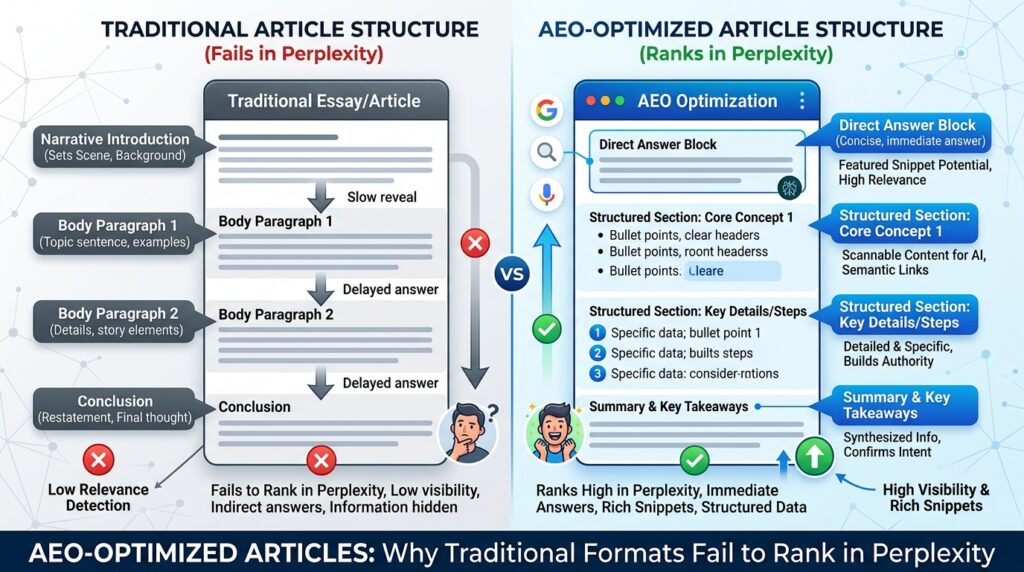
| Image Placement 2Suggested visual: A side-by-side comparison showing a traditionally structured article (narrative intro, body, conclusion) versus an AEO-optimized article (Direct Answer Block first, structured sections, summary). Annotate the AEO version to show where each element appears and why. This reinforces why traditional writing formats fail to rank in Perplexity. |
7. Schema Markup for AI Visibility
Schema markup is the technical language that tells AI systems exactly what type of page they are reading. Implementing the right markup dramatically increases extraction confidence and citation frequency inside AI answer engines.
Article Schema
Every guide and blog post should have Article schema with headline, author, datePublished, dateModified, image, publisher, and description. The dateModified property is especially critical because the platform weights freshness more heavily than any other AI answer engine. A recently updated dateModified value is one of the strongest signals a page can send.
FAQ Schema
FAQ markup is one of the highest-impact structured data types for AI search visibility. It converts question-and-answer sections into discrete, machine-readable data objects. The engine can pull individual question-answer pairs as standalone citations and use them in responses without requiring the user to click through to the site.
HowTo Schema
For process-oriented pages like step-by-step guides and tutorials, HowTo markup maps each step to a structured data object with a name and description. HowTo markup allows AI systems to present step-by-step instructions directly in responses, attributing them to the source page.
ItemList Schema
Use ItemList schema for any page that presents a discrete set of ranked or ordered items, including comparison posts, top-10 lists, and resource roundups. This schema type tells AI systems that the page contains a structured sequential set, making it significantly easier to extract and present in list-style AI responses.
8. Technical Optimization for AI Crawlers
The best pages and schema in the world are useless if AI crawlers cannot access them. Technical optimization is a critical and often neglected layer of how to rank in Perplexity reliably.
IndexNow Implementation
IndexNow is an open protocol supported by Google, Bing, and other search engines. When a page is published or updated, IndexNow sends an automatic ping to participating engines, triggering an immediate crawl rather than waiting for the passive crawl cycle. Because the real-time retrieval layer depends on what is indexed, faster indexing means faster availability for citation. Install IndexNow through a WordPress SEO plugin or configure it via Cloudflare.
How Bing Indexing Influences AI Search Visibility
The platform relies heavily on Bing's index for real-time web retrieval. When a query is submitted, the engine draws from Bing-indexed pages as one of its primary sources. If a page is not in Bing's index with current indexing metadata, it will not be available for AI retrieval layers. This is why IndexNow matters so much — both Google and Bing get pinged simultaneously, maximizing coverage and helping pages rank in Perplexity faster.
Core Web Vitals and Site Health
Pages with poor load times, layout instability, or failed HTTPS configurations receive lower crawl priority. Since the retrieval layer depends on what is indexed and crawlable, technical site health directly affects AI search visibility. Run regular Core Web Vitals audits and resolve any issues that reduce crawl efficiency.
9. Robots.txt AI Bot Directives
One of the most damaging mistakes in AEO strategy is accidentally blocking AI crawlers in a robots.txt file. If PerplexityBot cannot access a site, that site does not exist in AI search. This problem became widespread in 2023 and 2024 when many IT departments added broad scraper blocks to protect pages from being used in LLM training. The unintended consequence was making those same sites completely invisible to AI answer engine retrieval.
AI Bot User-Agents to Allow
A robots.txt audit should be the first step of any AI search optimization project. Confirm the following crawlers are explicitly allowed.
- PerplexityBot: Perplexity's primary web crawler
- OAI-SearchBot: ChatGPT Search crawler
- ChatGPT-User: ChatGPT plugin browsing agent
- Google-Extended: Google Gemini and AI Overviews crawler
- ClaudeBot: Anthropic Claude browsing and retrieval agent
If any of these bots are blocked — either by a wildcard Disallow rule or a specific directive added by a development team — the site does not exist in AI search. Run a robots.txt audit, remove any blocking directives, and submit the sitemap via IndexNow immediately after.
10. Recency and Freshness Signals
How to rank in Perplexity over the long term depends heavily on freshness. The platform places a stronger emphasis on recency than any other major AI answer engine. Because Perplexity crawls the web in real time and is designed to surface the most current information available, recently updated pages have a measurable advantage over static ones.
Five Ways to Maximize Freshness Signals
- Add a visible Last Updated timestamp: Display the most recent update date prominently near the top of every article, ideally below the headline. The parser reads this as a strong freshness indicator.
- Update the dateModified property in Article schema: Every time a meaningful update is made to a page, change the dateModified value. This is what the crawler actually reads when comparing freshness across competing sources.
- Add new information regularly: A cosmetic update without new text does not count. Add new statistics, update outdated claims, or add a new section based on recent developments.
- Prioritize high-velocity topics: For topics where information changes rapidly, such as AI tools, policy changes, or technology releases, update core pages at least every two to three weeks.
- Pair every update with IndexNow: Submit a crawl ping immediately after every update so the refreshed dateModified value is registered in Bing and Google's indexes the same day.
For competitive topics in AI, marketing, and technology, pages last touched more than 90 days ago can lose citation priority entirely. To rank in Perplexity consistently on competitive topics, treat freshness as an ongoing maintenance task, not a one-time optimization.
11. Co-Citation and Entity Association
Co-citation is the practice of having a brand, domain, or methodology mentioned alongside relevant topics and authoritative sources across the web, even without a direct hyperlink. For AI answer engines like Perplexity, co-citation is increasingly important because it influences how the underlying language models build associations between entities during training updates.
Here is how co-citation works in practice: if the crawlers read 40 different Reddit threads, YouTube video transcripts, and industry blog posts where a brand name appears next to the phrase 'AI search optimization,' the model begins to associate that brand with the topic. Over time, this increases the probability of being surfaced when users ask Perplexity about AI search optimization.
Strategies to Build Co-Citation Signals
- Guest posting: Contribute articles to industry publications where the brand name and expertise are mentioned in context, even if the link is nofollow.
- Podcast and interview appearances: Transcripts of podcasts and YouTube videos are crawled. Appearing as a named expert on relevant shows builds entity associations.
- Community participation: Answering questions on Reddit and Quora in the relevant niche, with the brand or name visible, contributes to co-citation over time.
- Product and tool mentions: Getting tools, frameworks, or methodologies mentioned and reviewed in third-party listicles and comparison articles builds strong co-citation signals.
Co-citation is a slow-build signal but one that consistently lifts AI citation rates and helps pages rank in Perplexity for competitive topics over time. It compounds over months, not days. Start now, be consistent, and measure the lift in AI citation rates quarter over quarter.
12. Common Mistakes That Prevent AI Rankings
Knowing how to rank in Perplexity is only part of the equation. Understanding what actively prevents citations is equally important for any site that wants to rank in AI search reliably. Understanding what actively prevents citations is equally important. A single blocking error can undo every other optimization effort.
| Mistake | Why It Hurts Rankings | The Fix |
| Blocking AI crawlers in robots.txt | Site is invisible to PerplexityBot, OAI-SearchBot, and others | Add explicit Allow directives for all AI bots |
| Relying on passive crawling only | Pages take days to be discovered and indexed | Implement IndexNow for instant submission |
| Low factual density | AI models skip vague, opinion-heavy text | Add specific stats, entity names, and data points |
| Zero information gain | Page duplicates what AI already knows | Add original data, frameworks, or unique analysis |
| No schema markup | AI crawlers lack context to categorize the page | Implement Article, FAQ, HowTo, ItemList schema markup |
| Stale pages | AI engines deprioritize outdated sources | Update dateModified and add fresh data regularly |
| Generic AI-written text | Lacks unique voice and information gain | Rewrite with original insights and entity-specific details |
| Buried answer blocks | Direct answer not found in first 100 words | Add Direct Answer Block immediately below H1 |
| Vague headings | H2s do not match query language | Rewrite headings as exact-match questions |
Summary: How to Rank in Perplexity
| Key Takeaways:1. How to rank in Perplexity requires structuring pages for Answer Engine Optimization, not traditional SEO. 2. Add a Direct Answer Block in the first 100 words of every article to match the response format. 3. Maximize factual density: replace vague statements with specific stats, named entities, and verifiable claims. 4. Implement Article, FAQ, HowTo, and ItemList schema on every page. 5. Use IndexNow to submit pages instantly rather than waiting for passive crawling. 6. Allow PerplexityBot, OAI-SearchBot, ChatGPT-User, and Google-Extended in robots.txt. 7. Update pages frequently, display visible Last Updated timestamps, and keep dateModified current. 8. Build co-citation signals through guest posts, podcast appearances, and community contributions. 9. Every article must have information gain: original data, frameworks, or insights that AI models have not already memorized. |
Frequently Asked Questions
How does Perplexity choose which websites to cite?
Perplexity selects sources based on a combination of real-time relevance, factual density, page freshness, structured formatting, and entity specificity. Pages with clear Direct Answer Blocks, named entities, and FAQ or Article markup are prioritized over generic, unstructured alternatives.
Does schema markup help AI search rankings in Perplexity?
Yes. Schema markup provides machine-readable metadata that the crawler uses to categorize and extract a page. FAQ markup in particular allows the engine to directly match Q&A text to user queries. Article schema with a current dateModified property strengthens freshness signals and schema is one of the most reliable technical investments for AI search visibility, which is especially important for how to rank in Perplexity on competitive topics.
What is information gain in AEO?
Information gain refers to the net-new value a page adds compared to what AI models already know. Material that repeats widely known information has near-zero information gain and is rarely cited. Pages that include original research, proprietary data, named frameworks, or counter-narratives backed by evidence have high information gain and are far more likely to be cited by Perplexity.
How often should pages be updated to maintain Perplexity rankings?
For competitive, fast-moving topics like AI, digital marketing, and technology, aim to update key pages every two to four weeks. Update the dateModified property in Article markup and display a visible Last Updated timestamp each time. Add substantive new information rather than cosmetic edits to maximize the freshness signal.
What are the most important robots.txt settings for Perplexity visibility?
Explicitly allow PerplexityBot, OAI-SearchBot, ChatGPT-User, and Google-Extended in robots.txt. A wildcard Disallow rule that blocks all bots except Google will make a site invisible to Perplexity, ChatGPT Search, and Gemini simultaneously. A robots.txt audit should be the first step of any AI search optimization project.
Final Action Plan: How to Rank in Perplexity in 30 Days
Use this step-by-step checklist to implement every optimization in this guide and start ranking in AI search within 30 days.
Week 1: Technical Foundation
- Audit robots.txt and add explicit Allow directives for PerplexityBot, OAI-SearchBot, ChatGPT-User, and Google-Extended.
- Verify the site in Bing Webmaster Tools and submit the XML sitemap.
- Implement IndexNow via Yoast, Rank Math, or Cloudflare.
- Audit all existing pages for schema coverage and add Article schema with dateModified to every page.
Week 2: Page Structure
- Rewrite the opening of the five highest-traffic pages to include a Direct Answer Block in the first 100 words.
- Rewrite H2 and H3 headings to use question-style, exact-match query language.
- Add a Summary Block at the end of each major section, not just the end of the article.
- Add or update FAQ sections with five or more Q&A pairs and implement FAQ markup.
Week 3: Entity and Fact Optimization
- Replace all vague descriptors with exact entity names — brand names, product names, platform names, protocol names.
- Add at least three specific, verifiable statistics or data points to each article.
- Identify the information gain element in each article. If there is none, add original analysis or a proprietary framework.
- Add HowTo or ItemList schema to every step-by-step or list-based article.
Week 4: Freshness and Co-Citation
- Update the three to five most competitive pages with new information and refresh their dateModified markup.
- Add visible Last Updated timestamps to all key pages.
- Identify two to three industry publications for guest posting to build co-citation signals.
- Set a recurring monthly refresh schedule for all high-priority pages.
Follow this checklist consistently and a complete AEO infrastructure will be in place within 30 days. Sites that apply this system consistently rank in Perplexity for more queries month over month. How to rank in Perplexity is not a one-time project. Maintaining those rankings requires the same discipline applied consistently. It is an ongoing system of page quality, technical accessibility, freshness maintenance, and entity association — one that compounds over time.