| ANSWER ENGINE OPTIMIZATION | Updated March 2026 | 15 min read | |
How to Rank in Claude: The Complete AEO and AI Search Optimization Guide
| WHAT YOU'LL LEARN IN THIS GUIDE What the platform actually prioritizes when selecting citations. The 7 core signals that determine whether your content gets cited. A proven step-by-step process to optimize pages for LLM extraction. Schema markup strategies for AI search visibility. How to use IndexNow, robots.txt directives, and recency signals. How to track and maintain your AI search rankings over time, Common mistakes that block AI citations and the fixes |
| Direct Answer:To rank in Claude and other AI answer engines, you must optimize for Answer Engine Optimization (AEO). This requires structuring pages with direct response blocks, high factual density, explicit entity mentions, and structured markup so AI models can easily extract and cite your information. |
How to rank in Claude is quickly becoming one of the most searched questions among digital marketers. Understanding how to rank in Claude requires a completely different playbook from traditional SEO, SEO professionals, and AEO strategists in 2026. Anthropic's platform has moved from being a conversational assistant to a full-featured AI search engine used by millions of people every day to research products, find services, and get expert recommendations.
The rules for ranking in AI chat platforms are different from anything that worked in traditional SEO. Understanding how to rank in Claude specifically requires a complete rethink of page structure and factual precision, and technical accessibility. The system selects sources based on factual credibility, structural clarity, entity accuracy, and freshness. If your pages do not meet those standards, the system will pass them over, no matter how much domain authority your site has built.
This guide breaks down every strategy, technical method, and optimization principle that experienced AEO practitioners use when learning how to rank in Claude and other AI-driven chat systems. Whether you are targeting this platform specifically or building a comprehensive AI search presence, every tactic in this guide will move the needle.
1. How AI Answer Engines Actually Work
To understand how to rank in Claude and other AI search systems, you first need to understand how these engines actually retrieve and generate responses. This large language model was built by Anthropic. It was trained on a massive dataset of text from across the internet, which means it carries a significant base of general knowledge in its model weights.
When a user submits a query, the platform does not crawl the web in real time the way a traditional search engine does. This behavioral difference is fundamental to how to rank in Claude versus traditional search. In traditional search you rank a page; in AI search the engine uses your page to construct an answer. For many queries, it generates answers entirely from its training data. But it also has web browsing capabilities that activate when the query requires current information or real-time data. In those cases, the engine retrieves pages from the web, reads them, and determines whether the page is credible enough to cite.
The key distinction between traditional search and AI answer engine retrieval is this: Google ranks pages. AI answer engines read them. This is the core insight that makes AI search optimization a fundamentally different discipline from traditional SEO. Google rewards backlinks and domain authority. The platform rewards clarity, factual depth, and structural precision — the qualities that make an answer worth citing. Every principle of how to rank in Claude flows from this core difference.
Understanding this distinction is the foundation of every best strategy for how to rank in Claude and other AI answer engines working today.
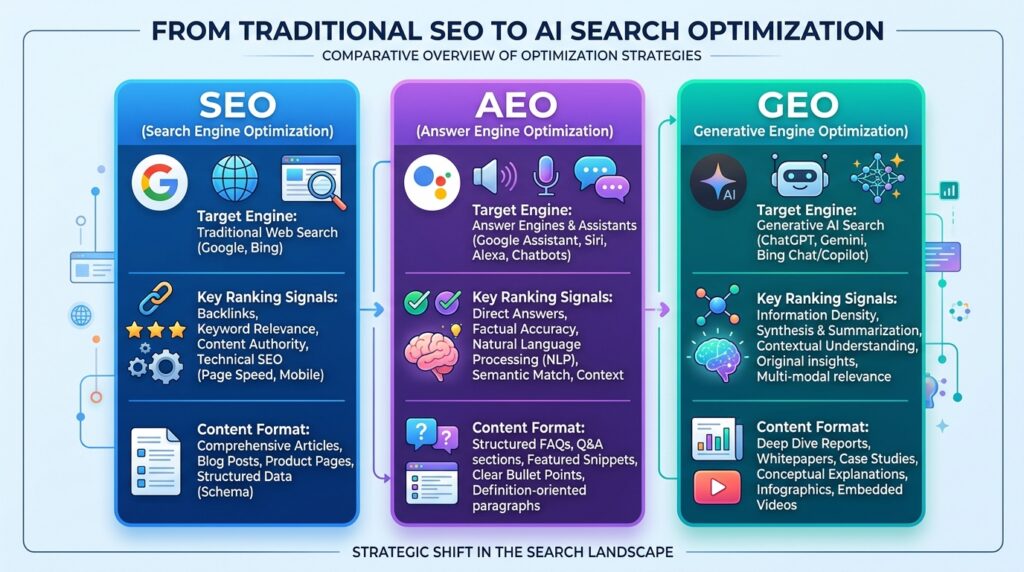
2. The New Era: SEO vs AEO vs GEO
Ranking in AI chat platforms and mastering how to rank in Claude specifically requires understanding three distinct optimization disciplines. Each one targets a different mechanism within the AI search ecosystem.
| Dimension | SEO (Traditional) | AEO (Answer Engine) | GEO (Generative Engine) |
| Goal | Rank on page 1 of Google | Get cited in AI-generated answers | Shape how AI describes your brand |
| Target Engine | Google, Bing search crawlers | AI answer engines (Claude, ChatGPT, Perplexity) | LLM base training + retrieval layer |
| Format | Long-form, keyword-focused articles | Direct answer blocks, structured data | Entity-dense, co-cited brand presence |
| Key Signal | Backlinks, domain authority | Factual density, schema, freshness | Co-citation, entity association at scale |
| Measurement | Rankings, organic traffic | AI citation frequency per query | Brand mention frequency in AI outputs |
| Update Cycle | Monthly to quarterly | Weekly to daily | Ongoing brand seeding across platforms |
Most SEO agencies are still optimizing entirely for the first column. The agencies that dominate AI chatbot search results in 2026 have already shifted their primary focus to AEO and GEO. The gap between those two groups is widening fast. Learning how to rank in Claude is one of the highest-leverage investments any digital agency can make right now.
3. Step-by-Step Process to Rank in Claude
The following steps represent the exact workflow used by top AEO practitioners to achieve consistent citation visibility inside AI-generated responses.
Step 1: Identify Your Target Queries
The first task in understanding how to rank in Claude is mapping out the exact natural language questions your target audience types — these are the answer-engine queries you need to own. These are not traditional keyword strings. They are full questions like "what is the best CRM for small businesses" or "how do I improve my website's AI search visibility."
Use tools like AnswerThePublic, AlsoAsked, and Reddit to surface real questions people are asking in your niche. Group them into topical clusters and assign one page to each cluster. Do not try to answer multiple unrelated questions in a single article. The platform rewards specificity and depth over breadth.
Step 2: Lead With a Direct Extraction Block
Every page you want to rank in Claude and other AI chat platforms needs to open with a Direct Extraction Block. This is the single most impactful structural change for how to rank in Claude quickly. This is a 2 to 4 sentence summary placed immediately under the H1 heading that directly answers the primary query before any narrative introduction begins.
The extraction mechanism looks for the clearest, most direct answer near the top of a page. If the answer is easy to extract, citation frequency rises significantly. If your best answer is buried in paragraph eight, The engine will likely find a competitor whose answer is front-loaded and cite that instead. The Direct Response Block is the single fastest structural fix you can make to improve AI search visibility. Leading with it is the most impactful formatting change for how to rank in Claude quickly.
Step 3: Build Information Gain Into Every Article
Information Gain is the most powerful AEO signal and is central to how to rank in Claude at a consistently high level. The base model has already processed billions of documents. That is exactly why effective AEO demands pages that genuinely add something new. If your pages only repeat what is widely available on Wikipedia, Forbes, or a hundred other sites, The system already knows it and has no reason to retrieve your page to construct an answer.
Information Gain means including something that cannot be found anywhere else. This could be original research data from your own client work, a proprietary framework you developed, a first-person account of a specific outcome, or a comparison that has never been published before. This is what makes your pages worth citing.
Step 4: Use Entity Mapping Instead of Keyword Stuffing
Replace keyword repetition with precise entity naming. This entity-first approach is core to how to rank in Claude because the system understands named concepts and relationships, not keyword frequency. The system does not match query strings the way old search algorithms did. It understands named entities, conceptual relationships, and topical associations. Using canonical names like Anthropic Claude 3 Opus, OpenAI GPT-4, Google Gemini 1.5 Pro, and Perplexity AI instead of vague references like "a top AI chatbot" dramatically improves how AI systems classify and surface your pages.
Step 5: Implement Custom Schema on Every Page
Schema markup is non-negotiable for AI search visibility and one of the fastest technical wins for how to rank in Claude search results reliably. Without schema, the engine cannot confidently classify your pages. Every page targeting AI visibility should have Article schema with dateModified, FAQ schema for any question-and-answer sections, and HowTo or ItemList schema depending on the page format. Schema tells the AI exactly what it is reading and increases extraction confidence significantly.
Step 6: Submit via IndexNow Immediately on Publish
Do not rely on passive crawling. For any team focused on AI search visibility, IndexNow is a critical technical advantage. IndexNow is an open protocol that pings search engines the moment you publish or update a page, triggering an immediate crawl. For AI search visibility, the speed of indexing directly affects how quickly your pages become available for citation. Install IndexNow through your WordPress SEO plugin or configure it via Cloudflare. Speed of indexing is a direct competitive advantage for AI visibility: the faster pages are indexed, the sooner they become available as citation sources.
Step 7: Refresh Pages on a Regular Cycle
AI answer engines de-prioritize stale pages rapidly. Page freshness is one of the most overlooked factors in AI search visibility. For competitive topics, refreshing core pages every 2 to 4 weeks is the recommended cadence. Update the dateModified property in your Article schema, add a visible Last Updated timestamp at the top of the page, and make at least one genuine improvement such as new statistics, updated entity mentions, or expanded sections during each refresh. A freshly updated page is always a stronger citation candidate than an identical page that was last touched three months ago.
4. Information Gain Strategy
Information Gain is not a buzzword. It is the most measurable structural property that determines whether your AEO strategy will succeed or fail. It is a measurable, structural property of content that determines whether an AI model has any reason to retrieve and cite your page instead of generating an answer from its existing training data.
Why AI Engines Prioritize Unique Information
AI systems are trained on enormous volumes of existing web text. By the time you publish an article, the base model already contains overlapping information from thousands of similar sources. If your article does not add something new to that information landscape, it is redundant from the platform's perspective. Redundant pages do not get cited.
Four Practical Information Gain Approaches
- Original Data: Publish benchmarks, survey results, or aggregated findings from your own client work. A statistic that appears nowhere else on the internet is a high-priority citation target.
- Proprietary Frameworks: Create and name a methodology. Instead of writing generically about content optimization, write about "The 5-Layer AEO Citation Stack" and define each component. Give it a name that becomes associated with your brand over time.
- First-Person Specificity: Include real outcomes from real projects. "We implemented IndexNow for a client in the legal services space and saw a 43% improvement in AI citation frequency within three weeks" is Information Gain that earns a citation. "IndexNow can improve your rankings" is not.
- Unique Comparisons: Side-by-side analyses that have never been published before are powerful signals. A comparison that gives a clear, direct answer to a contested question is exactly what AI engines prioritize. A table comparing how different AI engines handle the same query type, for example, gives AI retrieval systems something genuinely new to reference. Unique comparisons are one of the most reliable Information Gain formats for how to rank in Claude across competitive topics.
5. Entity Optimization vs Keyword Optimization
The shift from keyword thinking to entity thinking is the most important conceptual change in modern AEO. It is also the element most teams implement incorrectly or skip entirely. Here is exactly what that means in practice.
What Is an Entity?
An entity is any named concept with a clear, consistent real-world definition. People, organizations, products, technologies, and locations are all entities. AI system architectures organize understanding around entity relationships rather than keyword co-occurrence. The platform associates topics with entities, not with keyword patterns.
Canonical Entity Examples for the AI Search Niche
- Anthropic Claude 3 Opus (not "a powerful AI" or "the AI model")
- OpenAI GPT-4 Turbo (not "OpenAI's latest" or "a GPT model")
- Google Gemini 1.5 Pro (not "Google's AI" or "Gemini")
- Perplexity AI (not "an AI search engine")
- Anthropic (not "the AI research company")
Using these canonical forms consistently signals genuine subject matter expertise. It also strengthens your content's association with the Knowledge Graph structures that AI systems use to validate source credibility — both of which directly affect how to rank in Claude.
Entity Density as a Ranking Signal
Entity density replaces keyword density in AEO strategy. This swap helps pages read naturally while still scoring well as a citation source with AI extraction systems. A 2,500-word article can naturally contain 30 to 50 entity references across people, organizations, tools, and technologies. Each entity mention strengthens the topical authority signal for that piece of content. This is fundamentally different from keyword stuffing, which triggers spam filters and reduces credibility.
6. AI-Friendly Page Structure
How you structure pages is just as important as what you write. The platform's extraction algorithm favors specific formatting conventions. Here is the breakdown of what works.
| Format Element | Why It Works for AI Extraction | Impact Level |
| Direct Response Block (under H1) | Satisfies the query immediately for AI extraction | Critical |
| Numbered Steps | AI engines treat numbered sequences as structured, citable data | Very High |
| H2/H3 as full questions | Directly matches conversational query formats | Very High |
| Summary Block (end of article) | Enables quick extraction for overview-style AI answers | High |
| FAQ Section with question H3s | Maps one-to-one with conversational AI query patterns | High |
| Short paragraphs (2 to 4 lines) | Easier for AI parsers to segment and cleanly extract | High |
| Data tables with labeled columns | Structured data is machine-readable by default | High |
| Bold key factual statements | Signals importance and priority to extraction algorithms | Medium |
| Internal topical cluster links | Reinforces subject authority signals across the domain | Medium |
The most common structural mistake teams make is writing for human readers only. AI answer engines need a different structure entirely. Human readers appreciate a dramatic hook and a slow narrative build-up. AI extraction algorithms need the core answer immediately. This front-loaded structure — direct response first — is the formatting philosophy behind how to rank in Claude search results consistently. It is also the most commonly ignored advice by teams learning how to rank in Claude for the first time. Write the conclusion first. Put the most important, most direct, most factual text at the top of every piece.
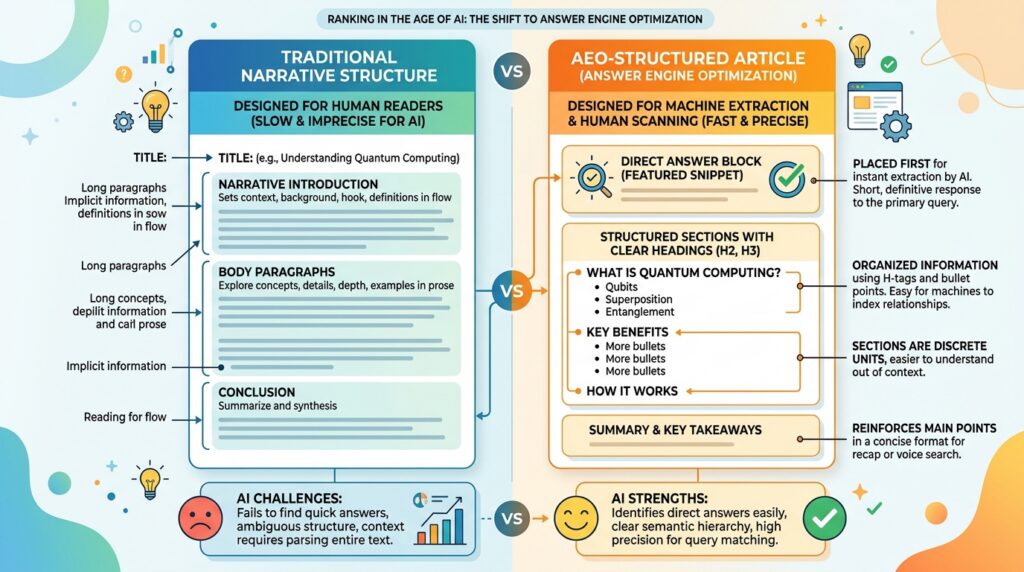
| Image Placement 2Suggested visual: A side-by-side comparison showing a traditionally structured article (narrative intro, body, conclusion) versus an AEO-structured article (Direct Answer Block, structured sections, summary). Annotate the AEO version to show where each element appears and why it is placed there. This visual reinforces why traditional long-form writing fails to rank in AI answer engines. |
7. Markup and Schema for AI Visibility
Schema markup is the technical language that tells AI systems exactly what type of page they are reading and which sections of a page answer specific types of queries. It is a foundational technical layer for AI search visibility at scale. Implementing the right schema dramatically increases extraction confidence, and schema is one of the most reliable technical investments any AEO-focused site can make.
Article Schema
Every guide, blog post, and resource should have Article schema with the following properties included: headline, author, datePublished, dateModified, image, publisher, and description. Article schema is the baseline from which all other schema types build. The dateModified property deserves special attention because AI systems use it as a direct freshness signal when comparing competing sources. This schema field is one of the easiest technical wins available for improving AI citation frequency.
FAQ Schema
FAQ schema is one of the highest-impact schema types for AI search visibility. It converts your question-and-answer sections into discrete, machine-readable data objects. When the engine detects FAQ schema on a page, it can pull individual question-answer pairs as standalone citations and use them in conversational responses without requiring the user to click through to your site.
HowTo Schema
For process-oriented pages like step-by-step guides and tutorials, HowTo schema maps each step to a structured data object with a name and description. The engine can read HowTo schema and present your instructions directly in AI-generated answers, attributing them to your page. This is how to rank in Claude for process-oriented queries specifically.
ItemList Schema
Use ItemList schema for any page that presents a discrete set of ranked or ordered items. ItemList schema is particularly effective for comparison posts, top-10 lists, and resource roundups. This schema type tells AI systems that the page contains a structured, sequential set of items, making it significantly easier to extract and present in list-style answers.
Speakable Schema
Speakable markup marks specific sections of your page as optimized for audio delivery and AI assistant responses. Adding this layer takes minutes and can meaningfully extend your citation reach. As Claude integrates more deeply with voice interfaces and mobile assistants, Speakable schema will become an increasingly important visibility signal and a key part of how to rank in Claude across voice and mobile surfaces. Mark your Direct Answer Block and summary sections as Speakable for maximum coverage.
8. Technical Optimization for AI Crawlers
The best pages and markup in the world are useless if AI crawlers cannot access your pages. Technical accessibility is a critical and often neglected dimension of AI search optimization. Technical optimization for AI visibility is a critical and often neglected layer of AEO strategy.
IndexNow Implementation
IndexNow is an open protocol supported by major search engines including Google, Bing, and Yandex. When you publish or update a page, IndexNow sends an automatic ping to all participating engines, triggering an immediate crawl rather than waiting for the passive crawl cycle.
For how to rank in Claude specifically, faster indexing means faster availability for citation. Pages that are indexed within hours of publication can appear in AI responses the same day. Pages that rely on passive crawling might wait days or weeks for the same opportunity. This is a genuine competitive advantage for teams that implement it.
How Bing Indexing Influences AI Search Visibility
The platform's web browsing capabilities pull from multiple search indexes, including Bing. When real-time information is needed to answer a query, it retrieves pages that are indexed and crawlable. If your pages are in Bing's index with current indexing metadata, it becomes available for AI retrieval layers. This is why IndexNow matters so much. It ensures both Google and Bing have your latest pages crawled and ready.
Core Web Vitals and Technical Site Health
Pages with poor load times, layout instability, or failed HTTPS configurations receive lower crawl priority from both Google and Bing. Since AI retrieval depends on what is indexed, technical site health directly affects AI search visibility and is a background factor in how to rank in Claude that most teams overlook. Run regular Core Web Vitals audits and resolve any issues that reduce crawl efficiency. A technically clean page is far more likely to be used as an answer source than a slow or unstable one.
9. Robots.txt AI Bot Directives
One of the most damaging technical mistakes brands make when trying to understand how to rank in Claude is accidentally blocking AI crawlers in their robots.txt file. If AI crawlers cannot access your pages, your pages do not exist in AI search, period.
This problem became widespread in 2023 and 2024 when many IT departments added broad AI scraper blocks to protect their pages from being used in LLM training datasets. The unintended consequence was that those same blocks now prevent AI answer engines from retrieving and citing their pages in real-time search queries. The training crawl and the search retrieval crawl use the same user-agents. Blocking one blocks both. Fixing this is the single fastest unblock for any site struggling with how to rank in Claude despite producing strong pages.
AI Bot User-Agents You Must Allow
Audit your robots.txt file immediately and confirm that the following crawlers are explicitly allowed. This single audit is one of the most important diagnostic steps in any serious AEO effort.
- ClaudeBot (Anthropic's browsing and retrieval agent)
- Claude-User (the active browsing user-agent)
- OAI-SearchBot (ChatGPT Search)
- ChatGPT-User (ChatGPT Plugins and live browsing)
- PerplexityBot (Perplexity AI)
- Google-Extended (Google Gemini and AI Overviews)
- Googlebot (core Google crawling)
If any of these are currently blocked, remove the restriction and submit an updated sitemap through Google Search Console and via IndexNow. Most brands that fix this single issue see measurable improvements in AI citation frequency within a week.
10. Recency and Freshness Signals
AI answer engines like Claude actively prioritize recently updated content. Freshness is a direct ranking signal, and managing it properly is a significant part of maintaining AI search visibility over older content when both sources answer a query with comparable accuracy. This is a significant departure from traditional SEO, where a high-authority evergreen page can maintain its rankings for years without updates.
In AI search, freshness is a direct quality signal. These systems are trained to prefer current information because stale data leads to incorrect answers, which damages user trust. When the engine compares two pages that both answer a query well, the one with a more recent dateModified value wins and gets cited. This freshness dynamic is one of the most actionable and overlooked levers for how to rank in Claude above competitors.
How to Signal Page Freshness Effectively
Each of these steps directly supports AI search visibility through stronger freshness signals.
- Update the dateModified property in your Article schema every time you make a substantive change to a page. This is the primary technical freshness signal that AI systems read.
- Display a visible Last Updated timestamp prominently near the top of every article. Place it under the title or directly below the Direct Answer Block, not buried in the footer or metadata.
- Make genuine content updates during each refresh cycle. Adding a current statistic, updating an entity reference, or expanding a section counts. Simply changing the timestamp without updating the content does not reliably improve AI retrieval frequency.
- For high-velocity, competitive topics where information changes frequently, refresh core pages every 2 to 3 weeks rather than monthly or quarterly.
- Pair every content update with an IndexNow submission. This keeps freshness signals current, which is essential for AI search visibility when competing against sites that refresh their pages frequently. Ensure the refreshed content is crawled immediately and the new dateModified value is registered in search indexes.
11. Co-Citation and Entity Association
Co-citation is one of the most advanced and least discussed signals in AEO strategy. If you want to rank beyond just on-page optimization and shape the model-weight associations your brand builds, this is the layer most agencies miss entirely. Traditional SEO tracked who linked to you. AI answer engines track who mentions you, even without a hyperlink.
Co-citation occurs when your brand name appears alongside a specific topic or query across multiple independent, high-authority sources. The base model has processed billions of web pages, forum threads, video transcripts, and industry articles — all of which shape which brands it associates with each topic. If your brand name consistently appears next to a specific topic across those sources, the model develops a structural association between your brand and that topic at the weights level. This association influences which sources the system gravitates toward when generating responses.
Platforms Where Co-Citation Signals Are Strongest
- Reddit: The training data includes large volumes of Reddit content. Appearing naturally in relevant subreddit discussions builds strong co-citation signals.
- YouTube Transcripts: YouTube video transcripts are indexed and processed by AI models at scale. Publishing YouTube content about your niche and ensuring accurate transcripts are available is one of the highest-leverage co-citation strategies.
- Industry Publications: Being mentioned in authoritative industry blogs, newsletters, and reports builds entity associations that the model recognizes when generating expert-level answers.
- LinkedIn Articles: LinkedIn's professional content is heavily represented in AI training data. Publishing thought leadership content on LinkedIn and referencing your brand's methodology builds co-citation presence in professional contexts.
- Podcast Transcripts: Many podcasts publish full transcripts. Appearing as a guest or having your brand mentioned builds mention presence in a fast-growing segment of AI training data. Each transcript reinforces your brand entity association as a citation source.
Co-citation is a slower-building signal than schema markup or content structure, but it compounds over time in a way that structural optimizations cannot replicate. Once your brand is deeply embedded in the conceptual landscape around your topic across many independent sources, that association is very difficult for competitors to displace. Co-citation is the layer that makes AI search visibility a long-term brand asset, not a page-by-page technical exercise. It is what turns occasional citations into consistent, authoritative visibility. Teams that invest in it early build a moat that pure on-page optimization cannot create.
12. Common Mistakes That Prevent AI Rankings
Knowing the right tactics is only part of the equation. Equally important is understanding what actively prevents brands from getting cited. A single blocking error can undo every other effort you put into AI search optimization.
| Mistake | Why It Hurts Rankings | How to Fix It |
| Blocking AI bots in robots.txt | Makes pages completely invisible to AI retrieval | Explicitly allow ClaudeBot, OAI-SearchBot, Google-Extended, and all major AI crawlers |
| Relying on passive crawling only | New and updated content takes days or weeks to be indexed | Implement IndexNow for immediate crawl submission on every publish or update |
| Low factual density pages | AI systems skip vague, opinion-heavy, or unsupported content | Add verifiable statistics, named sources, and concrete data to every section |
| Generic AI-generated text | LLMs ignore content they already know from training data | Build Information Gain through original data, proprietary frameworks, and unique analysis |
| No schema markup | AI cannot confidently classify or extract content | Add Article, FAQ, HowTo, and ItemList markup on every target page |
| Outdated content (60+ days) | AI engines prefer recently updated pages for accuracy | Refresh core pages every 2 to 4 weeks with genuine content updates |
| Keyword stuffing vs entity mapping | Triggers quality penalties and reduces content credibility | Replace keyword repetition with canonical entity names and precise terminology |
| Burying the direct answer | AI extraction misses the primary response entirely | Lead every article with a Direct Answer Block immediately under the H1 |
| No visible Last Updated date | Freshness signal is hidden from AI parsers | Display Last Updated prominently near the top of every article |
| Video Coming Soon 🙂 |
Summary: Key AEO Takeaways
| Article SummaryTo rank in Claude, apply these principles. Every brand that has dominated AI search applied this exact framework. Open every article with a Direct Response Block under the H1. Build Information Gain with original data and first-person specificity. Map entities instead of stuffing keywords, using canonical names like Anthropic Claude 3 Opus and OpenAI GPT-4. Apply Article, FAQ, HowTo, ItemList, and Speakable markup on every target page. Use IndexNow for immediate indexing. Confirm all major AI crawlers are allowed in robots.txt. Refresh core pages every 2 to 4 weeks and display a visible Last Updated timestamp. Build co-citation signals through Reddit, YouTube, LinkedIn, and industry publications. Structure all pages with numbered lists, short paragraphs, clear H2 and H3 headings, and structured summary blocks. |
Frequently Asked Questions
How does Claude choose which websites to cite?
The engine selects sources based on: directness and accuracy, factual density, markup, page recency, and whether the page provides Information Gain not already in the base model. Every citation results from scoring highly across all of these dimensions simultaneously. Pages that block ClaudeBot or lack structured formatting are significantly less likely to be cited regardless of their content quality.
Does schema markup help AI search rankings?
Yes, schema markup has a measurable and direct impact on how to rank in Claude. Article schema with dateModified signals freshness. FAQ schema converts question-and-answer content into discrete, machine-readable objects that the engine can extract and present independently. HowTo schema maps process steps to structured data. ItemList schema signals that content contains a discrete, ordered set. Speakable schema marks sections optimized for voice and AI assistant delivery. Pages without schema force the engine to infer content structure, which leads to inconsistent citation rates. Schema is a non-negotiable requirement for how to rank in Claude reliably.
What is information gain in AEO?
Information Gain in AEO refers to the degree to which your content includes data, perspectives, frameworks, or insights that do not already exist in the platform's training data. Because AI models have processed billions of documents, they already contain most common knowledge. Material that only repeats what is widely known adds nothing new. Pages that include original statistics, proprietary methodologies, first-hand outcomes, or unique comparisons give the engine a specific reason to retrieve and cite them rather than generating a generic response from existing training knowledge. That is the content-level key to how to rank in Claude at scale.
How often should I update content to rank in Claude?
For competitive topics in fast-moving fields, refreshing core pages every 2 to 3 weeks is the recommended cadence. At minimum, update the dateModified schema property and the visible Last Updated timestamp, and make at least one genuine content improvement during each cycle such as adding a new statistic, updating an entity reference, or expanding a section. Quarterly updates are too infrequent for AI search environments where freshness directly influences which sources get cited.
What is co-citation and why does it matter for Claude?
Co-citation is the signal generated when your brand name appears alongside a specific topic across multiple independent, high-authority sources without necessarily being linked. The base model has been trained on enormous volumes of web content including Reddit threads, YouTube transcripts, industry articles, and professional publications. When your brand appears consistently in these contexts next to a specific topic, the model develops a structural association between your brand and that subject area. This association makes your content more likely to be selected as the answer when users ask related questions.
Final Action Plan: Your Claude AEO Implementation Checklist
Use this checklist to implement every strategy covered in this guide. Work through the phases in order, starting with the highest-impact technical fixes in Week 1.
Week 1: Technical Foundation
These technical fixes are the fastest way to unblock AI search visibility if your site is currently invisible to AI crawlers.
- Audit robots.txt and confirm ClaudeBot, Claude-User, OAI-SearchBot, ChatGPT-User, PerplexityBot, and Google-Extended are all explicitly allowed. Blocking any of these bots makes your content invisible as an answer source.
- Install and configure IndexNow through your WordPress SEO plugin or Cloudflare integration.
- Add Article schema with datePublished, dateModified, author, publisher, and image fields to all existing published pages.
- Identify the top 10 queries you want to rank for in Claude and map each one to a specific page on your site.
Week 2: Content Restructuring
- Add a Direct Answer Block to the top of each target page, placed immediately under the H1 heading.
- Rewrite the opening of each target page so the primary keyword appears in the first sentence and within the first 50 words.
- Add FAQ schema to every page that contains a question-and-answer section.
- Replace vague references throughout all target articles with canonical entity names for every person, product, organization, and technology mentioned.
Week 3: Information Gain and Schema Expansion
- Identify one original data point, proprietary framework, or unique case study to add to each of your top 10 target pages.
- Implement HowTo schema on all process-oriented guides and tutorials.
- Add ItemList schema to all list-format articles, comparison posts, and resource roundups.
- Add Speakable schema markup to the Direct Answer Block and summary section of every key article.
- Display a visible Last Updated timestamp near the top of every article.
Week 4: Co-Citation and Distribution
- Publish at least two guest posts on authoritative industry publications and mention your brand name in context within the content.
- Create a YouTube video that covers your core topic and ensure a full, accurate transcript is published alongside it.
- Participate in at least three relevant Reddit or LinkedIn discussions in your niche, contributing genuine value and mentioning your brand naturally.
- Set up a recurring weekly or biweekly content refresh schedule for your top 10 target pages.
Ongoing Monthly Maintenance
- Run monthly audits of Claude, ChatGPT, Perplexity, and Gemini responses for your target queries. Track which queries return your content as a citation and which do not, then close the gaps.
- Update statistics, entity mentions, and examples across all top-performing pages regularly.
- Publish at least two new Information Gain pieces per month targeting uncovered query clusters. Each one is a new opportunity to own an AI citation.
- Monitor competitors' AI citation frequency and identify topics where you can build faster topical authority.
- Review and update all markup implementations quarterly as new structured data types and AI crawler requirements evolve. Consistent execution of this checklist is how to rank in Claude at a frequency that compounds month over month. Each update makes your content a stronger answer candidate across more queries.
Ranking in AI answer engines is about one thing at the core. Every tactic in this guide serves that goal. Consistent citation comes down to being the most credible, most clearly structured, and most consistently updated source — the best available answer — on the topics your audience is searching for. That is how to achieve AI search dominance at scale, and there is no shortcut to it. Follow this checklist, apply the principles in this guide systematically, and your pages will appear in AI-generated answers with increasing frequency over time.