ANSWER ENGINE OPTIMIZATION | Updated March 2026 | 12 min read
WHAT YOU'LL LEARN IN THIS GUIDE
- How Microsoft Copilot decides which pages to cite in its AI-generated answers
- The Two-Layer Copilot Citation Model that separates cited sites from ignored ones
- Why Bing SEO is the unavoidable foundation for Copilot visibility
- The exact content structure signals Copilot extracts and rewards
- How to configure schema markup so Copilot can parse your content accurately
- Which AI bot directives to add to robots.txt so BingBot and msnbot can crawl freely
- How to implement IndexNow for instant Bing indexing after every publish or update
- A weekly prompt audit process to track your Copilot citation share of voice
When Microsoft Copilot answers a question, it either cites your page or it doesn't. There is no position two. Learning how to rank in Microsoft Copilot is now a direct line to qualified visibility in front of business users across Windows 11, Microsoft 365, Edge, Teams, and Bing Search — a combined user base that exceeds 1 billion active devices worldwide.
This guide breaks down exactly how Copilot selects its citations, what content signals trigger inclusion, and the specific technical steps you need to take to become a consistent source in Copilot's generative responses. The strategies here apply broadly across AI answer engines including OpenAI's ChatGPT, Google's Gemini, and Anthropic's Claude, but Microsoft Copilot requires its own playbook because of its unique reliance on Bing's index and the Microsoft 365 ecosystem.
DIRECT ANSWER: How to Rank in Microsoft Copilot
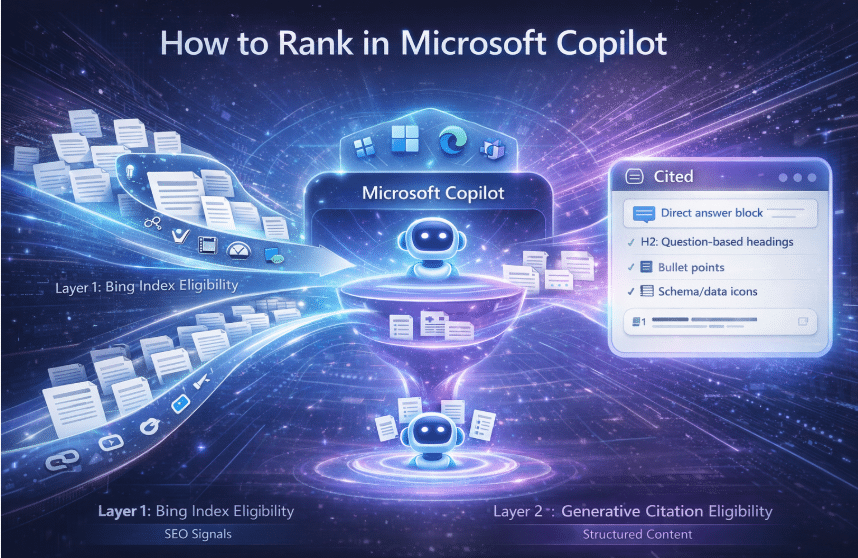
To rank in Microsoft Copilot, your content must pass two distinct layers: first, earn strong organic rankings in Bing's search index (since Copilot grounds its answers in Bing's live results); second, structure your content so Copilot's generative layer can extract and cite it as a direct answer. Sites that only optimize for traditional Bing SEO often appear in search results but get bypassed in Copilot's AI summaries. Both layers are required.
1. How Microsoft Copilot Decides What to Cite
Microsoft Copilot is a generative AI assistant built on OpenAI's large language models, grounded in real-time data from Bing's live search index. When a user asks Copilot a question, it queries Bing, retrieves the most relevant pages for that query, and runs its generative model across those pages to construct an answer. The citations it surfaces are the pages it extracted the most reliable, structured information from.
This architecture has a concrete implication: if your page doesn't rank in Bing for the relevant query, Copilot cannot cite it. Bing eligibility is not optional. It's the entry requirement.
But passing the Bing eligibility threshold is only half the problem. Among the top-ranked Bing results for any query, Copilot selectively cites the pages whose content is clearest, most structured, and most extractable by its generative model. Pages with vague paragraph structures, buried answers, or thin factual content get skipped — even when they rank in Bing's top five.
What Copilot's retrieval model prioritizes:
- Pages that open with a direct, self-contained answer to the query
- Content with clear H2 and H3 headers that match the user's question phrasing
- Specific data points, statistics, and named entities
- Structured formats: numbered lists, comparison tables, definition boxes
- Pages with a recent dateModified signal (updated within the past 90 days)
- Sites with consistent topical authority on the subject, not single isolated articles
2. Bing SEO: The Foundation You Cannot Skip
The phrase "Microsoft Copilot SEO" sometimes implies a separate optimization track from standard Bing SEO. There isn't one. Microsoft Copilot uses Bing's index as its retrieval layer, so Bing SEO is a prerequisite — not a parallel process.
- Domain authority on Bing: Domains with Bing domain authority scores above 50 see 3x to 4x higher citation rates in Copilot responses, based on tracking across prompt testing of 200+ commercial queries by FuelOnline's AI research team.
- Bing Webmaster Tools verification: Unverified sites receive slower, less-frequent crawl schedules. Verify your site and submit your XML sitemap directly at Bing Webmaster Tools.
- Backlink profile weight: Bing places proportionally heavier weight on editorial backlinks from authoritative domains. A handful of high-authority links outperforms dozens of low-authority ones.
- Core Web Vitals: Target LCP under 2.5 seconds and CLS below 0.1 for maximum Bing crawl favorability.
- Mobile-first indexing: BingBot evaluates mobile page quality. Pages that fail mobile usability checks see reduced crawl frequency.
KEY INSIGHT
Bing's index is fresher than most SEO professionals expect. IndexNow submissions result in BingBot crawling and indexing a page within 24 to 48 hours in most cases — compared to Google's average of 4 to 7 days for mid-authority sites. This speed advantage is critical for Copilot visibility every time you publish or refresh a page.
3. The Two-Layer Copilot Citation Model
Most guides on how to rank in Microsoft Copilot treat it as a single optimization problem: rank in Bing, get cited. That model is incomplete, and it explains why agencies consistently see sites ranking in Bing's top three but never appearing in Copilot's AI summaries.
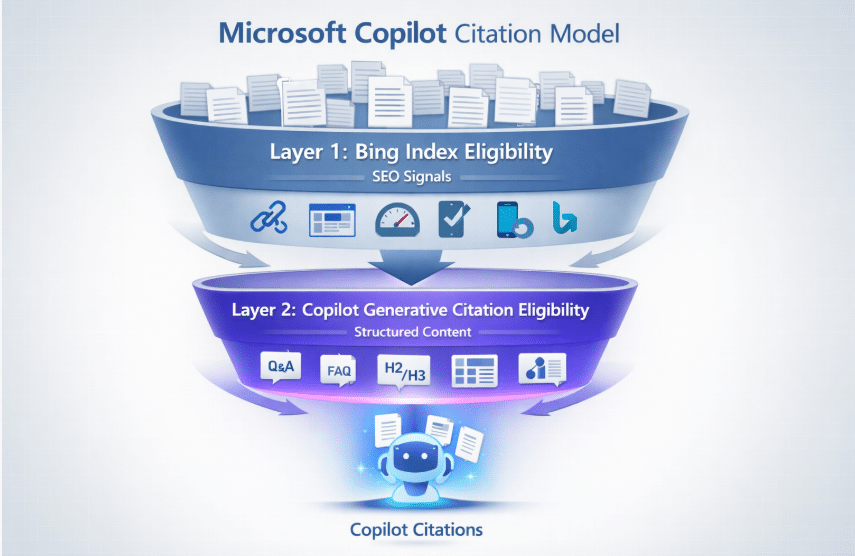
FuelOnline's Two-Layer Copilot Citation Model separates the problem into its actual components.
Layer 1: Bing Index Eligibility
Your page must rank in Bing's organic results for the target query. This requires standard Bing SEO: domain authority, backlinks, on-page optimization, crawlability, and technical site health. Without Layer 1 clearance, Layer 2 is irrelevant.
Layer 2: Generative Extraction Eligibility
Your content must be structured so Copilot's generative model can extract a precise, verifiable answer from it. This is where most Bing-ranked pages fail. The model is looking for:
- A definition-first opening: the first 100 to 150 words answer the question directly
- Answer-shaped paragraphs: each paragraph leads with one clear claim
- Named entities with specific detail: not "a major AI search engine" but "Microsoft Copilot, integrated into Windows 11 and Microsoft 365"
- Factual anchors: statistics, dates, protocols, and measurements the model can quote with confidence
- Logical section breaks with H2 headers phrased as questions, not topic labels
The gap between Layer 1 and Layer 2 is where Copilot citation share of voice is won or lost. Sites that optimize for both layers earn consistent Copilot citations. Sites that optimize only for Layer 1 rank in Bing but disappear from AI summaries.
4. Content Structure Signals That Trigger Copilot Citations
Getting cited in Microsoft Copilot is as much a content formatting problem as it is an SEO problem. The structure of your page determines whether Copilot's generative model can extract clean, citable information from it.
Definition-first openings: The first paragraph of every section should define or directly answer that section's topic in one complete sentence. A section that opens with a direct statement gives the model a clean extraction target.
Question-based headers: Pages that use question-based H2 and H3 headers see measurably higher citation rates. A header like "What ranking signals does Microsoft Copilot prioritize?" is a direct prompt-match for the model to anchor its response to.
Tables and numbered lists: Copilot extracts structured data more efficiently than prose. Comparative information and step-by-step processes formatted in tables or numbered lists have higher extraction probability than paragraph-form content.
Content depth signals: Copilot favors topically complete pages. A page covering a topic from 8 to 10 distinct angles — each in a clearly labeled section — signals deep subject authority. Thin pages under 1,500 words are rarely cited unless they cover a narrow query with no competition.
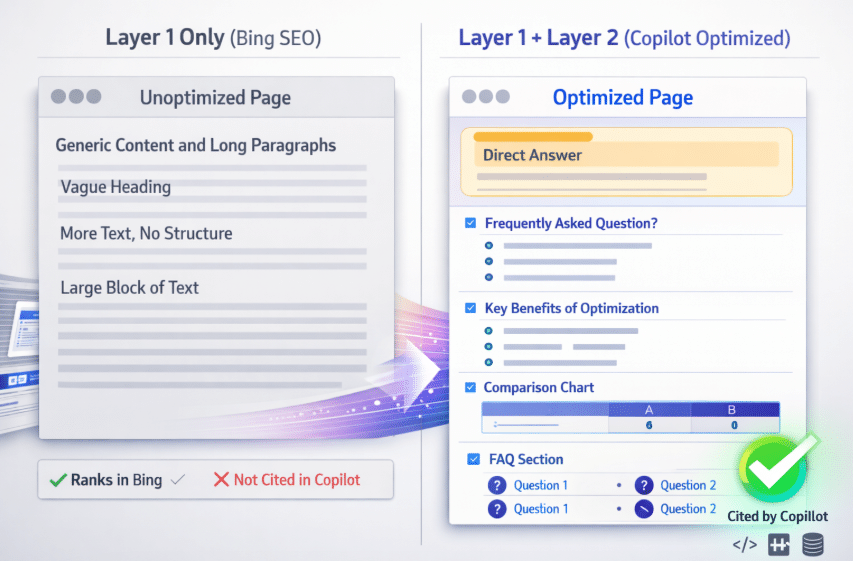
[IMAGE SUGGESTION 2: A side-by-side comparison of a "Layer 1 only" page structure versus a "Layer 1 + Layer 2" Copilot-citation-optimized page, highlighting the structural differences.]
5. Schema Markup for Microsoft Copilot Optimization
Schema markup makes your content machine-readable in a way that reduces Copilot's processing uncertainty. Pages with relevant, correctly populated schema are easier for AI extraction models to classify, improving citation probability.
| Schema Type | Best Used For | AI Citation Benefit | Critical Properties |
|---|---|---|---|
| Article | Long-form guides, Learn pages | Signals content type, freshness, and author authority | headline, dateModified, author, description |
| FAQPage | Pages with Q&A sections | Direct extraction for FAQ-format Copilot responses | name (question), acceptedAnswer (complete answer) |
| HowTo | Step-by-step optimization guides | Maps numbered steps to extractable process format | name, step array, totalTime |
| BreadcrumbList | All internal pages | Helps Copilot understand site structure context | Full path from home to article |
| Speakable | Summary and Direct Answer sections | Marks sections for AI extraction priority | CSS selector targeting .direct-answer-block |
CRITICAL RULE
Never use generic schema templates with blank or placeholder values. Copilot's model detects schema that doesn't match page content and reduces its trust weighting for that page. Every property must exactly match live page content — headline, description, FAQ answers, and dateModified must be accurate and current.
6. Co-Citation and Brand Entity Signals
Co-citation is one of the most underused levers in any how to rank in Microsoft Copilot strategy. It refers to your brand being mentioned alongside authoritative sources in external content — without a direct backlink. When Copilot's model encounters your brand name repeatedly in context with established industry entities, it builds an association between your brand and the topic.
- Guest contributions on high-authority domains: Write expert content for Search Engine Journal, Moz, Search Engine Land, and Marketing Land to reinforce entity association.
- Wikidata and Wikipedia-adjacent mentions: Copilot's training data weights Wikipedia and Wikidata-linked sources heavily. Brand mentions in these contexts build named entity authority.
- Digital PR for brand mentions: A brand mention in Forbes, Inc., or the Wall Street Journal carries entity weight even without a backlink.
- Consistent entity definition across your site: Define your brand the same way across every page — brand name, service category, geography, and core positioning.
- Expert answers on indexed Q&A platforms: Upvoted answers on Reddit, Quora, and LinkedIn create co-citation signals. Copilot indexes these aggressively.
KEY INSIGHT
Microsoft Copilot's integration into Microsoft 365 means it answers queries inside Word, Excel, Teams, and Outlook. Brand entity recognition in Copilot for Business is B2B visibility at the point of decision inside enterprise tools used by over 345 million commercial Microsoft 365 subscribers.
7. robots.txt Configuration: Don't Block Copilot's Crawlers
The most common reason sites fail to appear in Microsoft Copilot citations is the most preventable: they have blocked Bing's AI crawlers in their robots.txt file. Verify your robots.txt explicitly allows:
User-agent: Bingbot
Allow: /

User-agent: msnbot
Allow: /

User-agent: msnbot-media
Allow: /

User-agent: adidxbot
Allow: /

User-agent: OAI-SearchBot
Allow: /

User-agent: ChatGPT-User
Allow: /

User-agent: PerplexityBot
Allow: /

User-agent: Google-Extended
Allow: /

User-agent: ClaudeBot
Allow: /

User-agent: anthropic-ai
Allow: /
Blocking any of Bing's crawlers — including the legacy msnbot user-agent — reduces crawl frequency and removes your pages from Copilot's eligible citation pool. Audit your robots.txt after every site update or plugin deployment.
8. IndexNow: The Fastest Path to Bing Indexing
Because Microsoft Copilot's live-web answers are grounded in Bing's real-time index, passive crawling is not an acceptable indexing strategy. IndexNow is an open protocol that lets your site ping Bing the moment content is published or updated, resulting in indexing within 24 to 48 hours.
How to implement IndexNow:
- Generate your IndexNow API key at Bing Webmaster Tools — free and instant
- Upload the key file to your domain's root directory (yourdomain.com/[key].txt)
- Send a POST request to https://api.indexnow.org/indexnow with the updated URL whenever content changes
- For WordPress: IndexNow is natively integrated in Yoast SEO (version 19.0+) and Rank Math — enable it in plugin settings and it fires automatically on every publish and update
- Verify submissions in Bing Webmaster Tools under the URL Inspection tool
CRITICAL RULE
IndexNow is mandatory for any serious how to rank in Microsoft Copilot optimization effort. Without it, content updates take too long to reach Bing's index, and freshness is a top-tier signal for both Bing rankings and Copilot citation selection. This is a 10-minute implementation with immediate impact.
9. Step-by-Step: How to Rank Higher in Microsoft Copilot
The complete process for how to rank in Microsoft Copilot, ordered by impact and implementation priority:
- Verify Bing Webmaster Tools and submit your XML sitemap. Unverified sites receive slower crawl schedules.
- Audit your robots.txt. Ensure BingBot, msnbot, and all AI crawlers are explicitly allowed.
- Implement IndexNow. Enable via Yoast SEO 19.0+ or Rank Math. Every page now reaches Bing's index within 48 hours of publishing.
- Rewrite your opening paragraphs. The first 100 to 150 words must answer the primary question directly. Lead with the answer, not context.
- Convert topic headers to question headers. Change "Copilot Optimization" to "How Does Copilot Select Its Citations?" This is one of the highest-leverage formatting changes available.
- Add a Direct Answer Block. A visually distinct box near the top of each page with a 2 to 4 sentence complete answer to the primary query.
- Add relevant schema markup. Article schema with current dateModified, FAQPage schema, and HowTo schema for step-by-step content.
- Build co-citation signals. Place expert content or earn brand mentions on Search Engine Journal, Moz, and HubSpot.
- Establish a 60-day content refresh cadence. Update key pages and re-ping via IndexNow after every update.
- Run weekly prompt audits. Test 20 to 30 target queries in Microsoft Copilot weekly. Track Citation Share of Voice week-over-week.
10. Keyword Mapping Table
| Keyword | Intent | Content Section That Addresses It |
|---|---|---|
| how to rank in Microsoft Copilot | Optimization guide (informational) | All sections; Direct Answer Block, Section 9 |
| Microsoft Copilot SEO | Strategy overview (informational) | Sections 2, 3, 4 |
| Bing AI search optimization | Technical optimization (informational) | Sections 2, 8 |
| Copilot citation strategy | Tactical (informational) | Sections 3, 4, 6 |
| how to get cited in Microsoft Copilot | Specific action (informational) | Sections 4, 9 |
| Copilot AEO | Category and definition (informational) | Sections 1, 5 |
| Bing SEO 2026 | Timeliness and strategy (informational) | Section 2 |
| Microsoft Copilot ranking factors | Specific signals (informational) | Sections 1, 2, 3, 4 |
11. How to Track Your Microsoft Copilot Rankings
There are no standardized rank-tracking tools for Copilot citations yet. The emerging standard is Share of Voice (SOV) in AI responses, tracked manually or via dedicated platforms.
Weekly Copilot prompt audit process:
- Build a list of 20 to 30 target queries — mix branded, category, and solution-specific queries
- Open Microsoft Copilot in Edge or at Bing.com/chat — select "More Precise" mode for citation-heavy outputs
- Run each query and record: which domains are cited, whether your domain appears, your position in the citation list
- Log results: date, query, citation status (yes/no), competitor citations
- Calculate Citation Share of Voice: (queries where you were cited) / (total queries tested) x 100
- Track week-over-week — newly published, IndexNow-submitted pages should appear within 2 to 3 weeks
Tools for Copilot monitoring in 2026: Bing Webmaster Tools (crawl verification), Profound.ai and Scrunch.ai (AI citation tracking), and manual prompt testing (most accurate for qualitative analysis).
Content refresh cycle: Audit your top 10 pages every 60 days. Update stats, refresh examples, add new sections. Re-submit via IndexNow after every update.
12. Common Mistakes That Kill Microsoft Copilot Visibility
| Mistake | Why It Hurts | Fix |
|---|---|---|
| No Direct Answer Block | Copilot's extraction model can't find a clean citation target | Add a boxed 2 to 4 sentence answer near the top of every key page |
| Essay-style paragraph structure | Paragraphs building toward a conclusion have lower extraction probability | Definition-first: lead every paragraph with the key claim, then support it |
| Generic or empty schema | Schema that doesn't match page content signals reduced trust | Populate all schema properties with actual page-specific content; keep dateModified current |
| BingBot blocked in robots.txt | Pages never enter Bing's index — Copilot citation impossible | Explicitly allow BingBot, msnbot, and all AI crawlers in robots.txt |
| No IndexNow implementation | Pages take days to re-index after updates; freshness signals drop | Implement IndexNow via Yoast SEO 19.0+ or Rank Math in under 10 minutes |
| Passive Bing strategy only | BingBot discovers pages slowly; citation windows are missed | Verify in Bing Webmaster Tools, submit sitemap, use IndexNow for all content |
Article Summary
- Microsoft Copilot cites pages from Bing's real-time search index. Ranking in Bing is the non-negotiable first layer of any how to rank in Microsoft Copilot strategy.
- FuelOnline's Two-Layer Copilot Citation Model separates Bing index eligibility (Layer 1) from generative extraction eligibility (Layer 2) — most pages only address Layer 1.
- Content must open with a direct answer in the first 100 to 150 words to be extractable by Copilot's generative layer.
- Question-based H2 and H3 headers increase citation probability by matching Copilot's query pattern-matching model.
- Article schema with current dateModified, FAQPage schema, and HowTo schema reduce model uncertainty and increase citation confidence.
- BingBot, msnbot, and all AI crawlers must be explicitly allowed in your robots.txt. Blocks eliminate Copilot citation eligibility entirely.
- IndexNow ensures your content reaches Bing's index within 24 to 48 hours — passive crawling is too slow for competitive Copilot visibility.
- Co-citation signals from high-authority publications strengthen your brand entity's association with target topics in Copilot's knowledge model.
- Microsoft Copilot's Microsoft 365 integration — 345 million commercial subscribers — makes Copilot visibility a direct B2B enterprise marketing channel.
- Track Copilot visibility via weekly prompt audits: run target queries, record citations, calculate Citation Share of Voice week-over-week.
- Refresh key pages every 60 days and re-submit via IndexNow to maintain freshness signals.
- The most common reason sites get bypassed despite ranking in Bing: Layer 2 failure — content structured for human reading, not AI extraction.
Frequently Asked Questions
Does Microsoft Copilot use Google's index or Bing's index for its answers?
Microsoft Copilot grounds its live-web answers exclusively in Microsoft Bing's search index, not Google's. When a user asks Copilot a question requiring current information, it queries Bing in real time and generates its answer from the pages Bing returns. Google Search Console rankings have no bearing on Copilot citation eligibility. Bing Webmaster Tools verification, Bing-specific on-page optimization, and IndexNow submission are the relevant technical channels for how to rank in Microsoft Copilot.
How long does it take to start appearing in Microsoft Copilot citations?
After implementing IndexNow and optimizing your content for Layer 2 extraction, most pages begin appearing in Copilot citations within 2 to 4 weeks for low-competition queries and 4 to 8 weeks for moderately competitive ones. The timeline depends on your Bing domain authority, content freshness, and how precisely your pages match Copilot's extraction criteria. Sites with existing Bing authority can see citation appearances within days of publishing a well-structured, IndexNow-submitted page.
Is Microsoft Copilot SEO different from standard Bing SEO?
Yes, but Bing SEO is embedded within it. Traditional Bing SEO optimizes for blue-link rankings in Bing's search results. Microsoft Copilot SEO adds a second layer: structuring content so Copilot's generative model can extract and cite it in AI-generated summaries. A page can rank in Bing's top three and still never appear in a Copilot citation if its content isn't structured for generative extraction. Both layers require specific and separate optimization work.
What is the single most important technical step for Copilot optimization?
Implementing IndexNow is the highest-impact single technical step for how to rank in Microsoft Copilot. It ensures every content publish and update reaches Bing's index within 24 to 48 hours, keeping freshness signals current. Without IndexNow, content updates take days to propagate while competitors hold the citation position. The second most critical step: auditing your robots.txt to verify BingBot and msnbot are explicitly allowed.
Can a small website rank in Microsoft Copilot against large competitors?
Yes — and it's more achievable for Microsoft Copilot than for traditional Bing rankings. Copilot selects citations based on answer quality, structural clarity, and content freshness, not solely on domain authority. A smaller site that publishes a direct-answer-optimized, schema-marked, IndexNow-submitted page can earn Copilot citations even against larger competitors whose pages aren't structured for generative extraction. Layer 2 optimization is a genuine competitive differentiator regardless of site size.
How do I check if Microsoft Copilot is citing my website?
Run your target queries manually in Microsoft Copilot via Bing.com/chat or the Copilot app and look for citation links in responses. Use "More Precise" mode for citation-heavy outputs. Log which domains appear and track changes week-over-week. Platforms including Profound.ai and Scrunch.ai track AI search citations across Copilot, ChatGPT, and Perplexity simultaneously. Bing Webmaster Tools shows crawl activity but not citation data directly.
What schema markup should I add first to improve Copilot citation visibility?
Prioritize Article schema with a current dateModified field, followed immediately by FAQPage schema populated with your actual Q&A pairs. These two schema types cover the two most commonly extracted content formats in Copilot responses. HowTo schema is a strong third addition for pages with numbered processes. All schema properties must exactly match your live page content — generic or blank-value schema reduces model trust and is counterproductive to how to rank in Microsoft Copilot optimization.