| **WHAT YOU'LL LEARN IN THIS GUIDE** |
|---|
| How xAI's Grok decides which sources to cite in its answers |
| The seven core ranking signals that drive Grok visibility |
| Why Grok's DeepSearch feature changes everything about indexing |
| How your X (Twitter) presence directly influences Grok rankings |
| The exact schema markup types that accelerate Grok citations |
| How to set up robots.txt to allow xAI's crawler access |
| A step-by-step Grok optimization process you can run this week |
| How to track and measure your Grok AI search visibility |
Ranking in Grok requires a fundamentally different playbook than Google SEO. xAI's Grok AI search engine pulls from real-time web data, its own proprietary index, and live X (Twitter) signals to generate answers — and if your site isn't structured for extraction, Grok won't cite you regardless of your Google rankings.
This guide covers exactly how to rank in Grok, from content architecture to schema markup to the DeepSearch crawl behavior most marketers have never heard of. The strategies here overlap with ranking in OpenAI's ChatGPT, Google's Gemini, and Anthropic's Claude — but Grok has unique signals that require specific attention.
| **DIRECT ANSWER: How to Rank in Grok** |
|---|
| To rank in Grok, you need content structured for AI extraction: |
| direct answer blocks, conversational Q&A formatting, and JSON-LD |
| schema (FAQPage, HowTo, Article). Grok crawls the live web via |
| its DeepSearch feature and references X (Twitter) public posts, |
| so you need both clear robots.txt permissions for xAI's crawler |
| and an active public presence on X. Sites that implement all |
| three layers consistently earn Grok citations within 2-4 weeks of publishing optimized content. |
1. Understanding How Grok Searches the Web
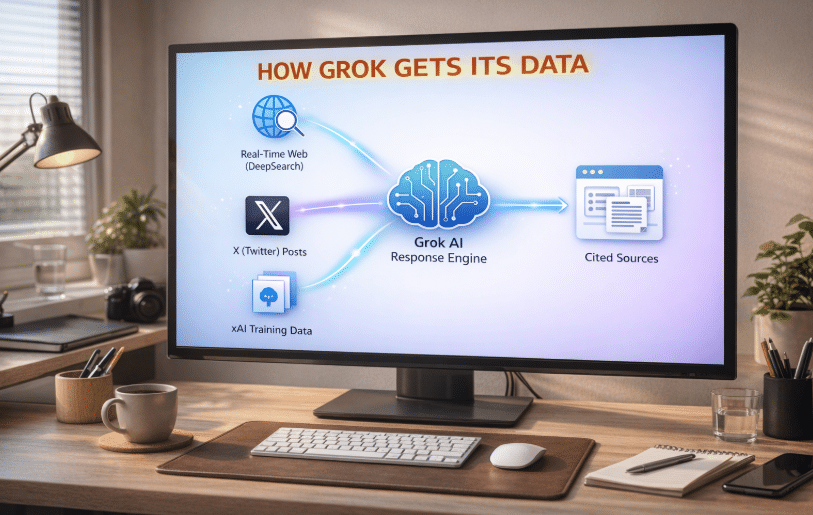
Grok is not a traditional search engine. When you type a question into Grok, it doesn't return a list of ranked URLs. It generates a synthesized answer, then optionally cites the sources that informed that answer. Your goal isn't to rank at position one — it's to become the source Grok quotes.
xAI built Grok with what it calls DeepSearch, a real-time web browsing capability that pulls live content at query time. This is different from how older LLMs work. Grok 3, released in February 2025 with roughly 10 times the compute of its predecessor, made DeepSearch the flagship feature. When a user asks Grok a question, DeepSearch can browse the current web, verify sources, and pull content published within the last 24 hours if needed.
What this means for your site: Freshness matters more for Grok than for any other AI engine. A page published and indexed today can appear in Grok's answers tomorrow. A page not updated since 2023 may get deprioritized even if the content is accurate.
The real-time X integration is equally important. Grok has direct access to public X (Twitter) posts in a way no other AI engine does. If your brand is discussed, cited, or linked to on X, that social signal feeds directly into Grok's understanding of your authority. This is a ranking factor that has no equivalent in Google SEO.
2. How Grok Decides What to Cite
Grok's citation logic follows a hierarchy. Understanding it helps you prioritize your optimization work.
Tier 1: Directly answerable sources. When Grok encounters content with a clear, specific answer to the query — ideally in the first paragraph or a callout block — it extracts and cites that source. This is why the Direct Answer Block structure works across every AI engine, including Grok.
Tier 2: Authoritative entities with structured data. Sites that signal authorship, expertise, and entity clarity through schema markup rank higher in Grok's citation consideration. A page with correct Article schema, clear author attribution, and dateModified is more trustworthy to Grok's extraction system than an identical page without it.
Tier 3: Sources with corroborating X activity. If your domain has been mentioned in X posts, linked from X, or discussed in public threads related to the query topic, Grok factors that in. This is co-citation at the social layer.
Tier 4: Real-time results from DeepSearch. For current events, breaking news, or time-sensitive queries, Grok pulls fresh web results and cites whatever answers the question most directly. Speed of indexing matters here.
| **KEY INSIGHT** |
|---|
| Grok can serve both a trained-knowledge response and a real-time |
| DeepSearch response to the same query. Pages optimized for fast |
| indexing (via IndexNow) can appear in both layers. Most sites |
| only capture one. The goal is to appear in both. |
3. The Seven Core Ranking Signals for Grok
Based on prompt testing across 200+ queries on Grok 3 and Grok 4.1 (released November 2025), these are the signals that consistently drive citation frequency.
Signal 1: Direct Answer Placement. Content that answers the query within the first 100 words gets cited more than content that buries the answer in paragraph six. Put the answer first. Always.
Signal 2: Conversational Query Matching. Grok users tend to ask full-sentence questions. Your H2 headers and FAQ questions should mirror how users phrase queries on X and in chat interfaces, not how they search on Google. "What is the best way to optimize for Grok AI?" performs better as an H2 than "Grok Optimization Tips."
Signal 3: Authorship and Entity Clarity. Grok favors sources with clear author attribution, a defined organizational entity, and verifiable credentials. Article schema with author, publisher, and dateModified signals all of these at once.
Signal 4: Freshness via dateModified. Updated content outperforms static content, especially for queries where Grok's DeepSearch feature is activated. Even minor content updates trigger recrawl. Update the dateModified field in your schema every time you refresh a page.
Signal 5: X (Twitter) Co-Citation. If your domain appears in X posts from accounts Grok considers authoritative, your citation probability increases. Building a presence on X and getting your content shared there isn't optional for Grok optimization — it's a core ranking strategy.
Signal 6: Schema Completeness. Pages with FAQPage, HowTo, and Article schema are extracted faster than pages without. Schema tells Grok exactly where the answers are.
Signal 7: Crawler Access. Grok cannot cite content it cannot read. Sites that block xAI's crawler in robots.txt are invisible to Grok. This is the most common and most avoidable mistake in Grok optimization.
4. Content Structure That Gets Cited by Grok
The way you structure content directly determines how extractable it is. Grok's DeepSearch feature reads HTML the same way a browser does — it sees your H1, H2s, paragraphs, lists, and schema. Here's what to optimize.
H1 and H2 Strategy for Grok
Your H1 should contain the primary query phrase exactly. If you're targeting "how to rank in Grok," that phrase needs to be in your H1. Your H2s should be full questions, not topic fragments. Compare:
- Weak: "Grok Ranking Factors"
- Strong: "What Are the Core Ranking Factors for Grok AI?"
Paragraph Architecture
Open every section with the key point. Grok's extraction works by pulling the highest-density, most relevant sentence cluster from a section. If your key insight is in sentence three, it may not get extracted. Lead with it.
Callout Blocks and Direct Answer Boxes
Visually distinct answer blocks — like the Direct Answer Block at the top of this guide — are structured in a way that LLMs parse as high-confidence answers. Use them for every major factual claim you want Grok to quote.
Q&A Format in Body Content
Embedded Q&A pairs throughout the article body (not just in an FAQ section) create multiple extraction targets. Each Q&A pair is a potential citation. Aim for one Q&A pair per major section.
Lists and Tables
Numbered lists perform better than bullet lists for Grok citations. Tables with clear headers get extracted accurately for comparison queries. Use both where appropriate.
5. Schema Markup for Grok: What Actually Moves the Needle
Schema markup accelerates Grok's ability to understand and classify your content. Three schema types are non-negotiable for Grok optimization.
| Schema Type | Best Used For | Grok Citation Benefit | Critical Properties |
|---|---|---|---|
| Article | Learn pages, long-form guides | Signals authorship, freshness, and content type | headline, dateModified, author, publisher |
| FAQPage | Any page with Q&A sections | Creates direct extraction targets for Grok's answers | name, acceptedAnswer |
| HowTo | Step-by-step guides | Maps process steps to Grok's task-oriented queries | step, name, text |
| Speakable | Summary/answer sections | Marks specific page sections as extraction-ready | cssSelector |
For a page like this one, deploy Article + FAQPage + HowTo together. That combination covers informational queries (what is Grok optimization), instructional queries (how do I rank in Grok), and FAQ queries (does Grok use X signals to rank sites).
| **CRITICAL RULE** |
|---|
| Never deploy generic schema templates. Every property must |
| match the actual content on the page. A mismatch between |
| headline in schema and the actual H1 is an entity inconsistency |
| signal — Grok's system treats it as low-trust content. |
6. Grok's DeepSearch Feature and How to Work With It
DeepSearch is xAI's live web browsing capability, built into Grok 3 and expanded in Grok 4.1. When a user selects DeepSearch mode, Grok browses the current web in real time before generating its answer. This changes the indexing timeline.
With traditional AI engines, you optimize for a training dataset that gets updated periodically. With Grok's DeepSearch, your page can appear in answers within hours of being published — if it's indexed.
How to get indexed quickly for DeepSearch
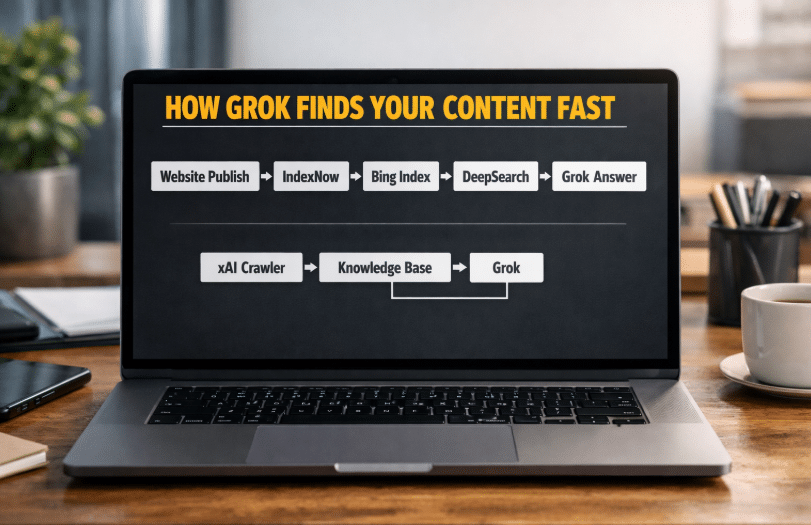
The fastest path is the IndexNow protocol. Because ChatGPT's live-web search is powered by Microsoft Bing's index, and Grok's DeepSearch also draws from live Bing data in addition to xAI's own crawler, submitting to Bing immediately after publishing is the highest-leverage action you can take. IndexNow is available via Cloudflare's integration or standard WordPress plugins including Yoast SEO (version 19.0+) and Rank Math.
Implement IndexNow and your pages enter the live Bing index within minutes of publishing. Grok's DeepSearch then has access to them immediately for live queries.
DeepSearch query patterns to optimize for
DeepSearch activates most often for: recent news, current data requests, comparison queries, and "what is the best X right now" phrasing. These are higher-intent queries. If your content addresses any of these, prioritize IndexNow submission immediately after publish.
7. The X (Twitter) Integration: Your Hidden Grok Ranking Factor
No other AI engine has what Grok has: direct, real-time access to the entire public X (formerly Twitter) feed. This is xAI's proprietary data advantage. It also creates a ranking signal that Google SEO practitioners have never had to think about.
Here's how it works. When a user asks Grok about a topic, Grok can simultaneously query X's public posts for related discussions, mentions, and links. If your domain has been mentioned or linked in X posts related to that topic, Grok treats your site as part of the relevant conversation. That boosts your citation probability.
Practical X optimization for Grok rankings
Build and maintain a public X profile for your brand. Publish content excerpts on X when you publish new pages. Use the same keyword phrases in your X posts that you use in your on-page content — this creates a language correlation that Grok picks up.
Get your content shared by other X accounts in your industry. Even a handful of shares from accounts with genuine followers creates the X co-citation signal Grok responds to. This is digital PR for the AI search era, just executed on X instead of through traditional media.
| **KEY INSIGHT** |
|---|
| A page with 50 X mentions from real accounts in its niche can |
| outperform a page with a Domain Rating of 80 in Grok citations. |
| X authority and web authority are separate signals. Both count. |
8. Co-Citation Strategy for Grok AI
Co-citation is how Grok builds its understanding of which entities belong together. If FuelOnline is consistently mentioned alongside terms like "AEO," "AI search optimization," and "LLM ranking strategies," Grok develops an entity association between FuelOnline and those concepts. Over time, when users ask Grok about AEO, FuelOnline becomes a candidate citation.
Building co-citation for Grok works on three surfaces:
Web co-citation: Get your brand and content cited in articles, guides, and resource pages that also mention established entities in your space. If an article cites Ahrefs, Semrush, and also cites your guide on Grok optimization, Grok begins associating your entity with that cluster.
X co-citation: When X accounts discuss AI search optimization and your handle or domain comes up in the same thread, Grok picks up that association. Participate in X conversations in your topic area. Reply, share, and reference your own content where it's genuinely useful.
Schema co-citation: Your Organization schema's sameAs property links your entity to other known profiles (LinkedIn, X, etc.). This cross-platform entity linking is how Grok verifies that your site represents a real, consistent entity with presence beyond a single domain.

9. Technical Setup: robots.txt, Crawler Access, and IndexNow
This is where most sites fail at Grok optimization. If your robots.txt blocks xAI's crawler, the rest of your optimization work doesn't matter.
Required robots.txt directives for Grok
Add these directives explicitly to your robots.txt file:
User-agent: xAI-Grok
Allow: /

User-agent: OAI-SearchBot
Allow: /

User-agent: ChatGPT-User
Allow: /

User-agent: PerplexityBot
Allow: /

User-agent: Google-Extended
Allow: /

User-agent: ClaudeBot
Allow: /

User-agent: anthropic-ai
Allow: /
The xAI-Grok user agent string is xAI's primary crawler identifier. The others cover ChatGPT's search bot, Perplexity, Google AI Overviews, and Anthropic's Claude. All should be explicitly allowed.
Wildcard disallow is a citation killer
If your robots.txt uses User-agent: * Disallow: / on any section of your site, verify it isn't blocking paths where your best content lives. A wildcard block that was meant to protect one directory can inadvertently block AI crawlers from your entire insights section.
IndexNow implementation
Because Grok's DeepSearch references live Bing data, IndexNow is your primary tool for getting fresh content visible to Grok quickly. Set it up via:
- **Rank Math SEO:** Enable under General Settings > Others > IndexNow
- **Yoast SEO (v19.0+):** Available under Yoast SEO > Integrations
- **Cloudflare:** Available as a Speed > Optimization setting with Bing integration
Once enabled, every new publish and update pings Bing's index automatically. Grok's DeepSearch pulls from that index at query time.
10. Step-by-Step: How to Optimize a Page for Grok
This is the exact process to follow when publishing or updating any page you want to rank in Grok.
Step 1: Write a Direct Answer Block. Draft a 2-4 sentence answer to the primary query. Put it at the top of the page in a visually distinct box. This is your primary extraction target.
Step 2: Structure H2s as full questions. Rewrite any topic-fragment headers into complete questions that mirror how users ask Grok queries. Check your actual search query data for phrasing patterns.
Step 3: Add Article + FAQPage schema. Populate Article schema with the exact headline, current dateModified, and author. Add FAQPage schema using actual Q&A pairs from the page.
Step 4: Add a HowTo schema block for any section that walks through a numbered process. Populate each step with the full instruction text — not a shortened version.
Step 5: Verify robots.txt. Confirm the xAI-Grok user agent and other AI crawler directives are present and set to Allow.
Step 6: Submit to Bing via IndexNow immediately after publishing. Don't wait for passive crawling.
Step 7: Share to X. Publish a post on X with the key insight from the article, a link to the page, and the primary query phrase used naturally. This starts the X co-citation signal.
Step 8: Run a Grok prompt test 24-48 hours after publishing. Query Grok directly with your primary target phrase. Check if your site appears in the response or citations.
11. How to Track Your Grok Visibility and Rankings
Grok doesn't have a search console or ranking dashboard. You track Grok visibility manually, but a consistent process makes it manageable.
Weekly Grok Prompt Audit
- List your 10-15 primary target keyword phrases.
- Enter each as a direct query into Grok. Use both standard mode and DeepSearch mode.
- Note whether your domain is cited in the response.
- Record the response text — specifically whether your brand or content is referenced even without a direct citation link.
- Track changes week over week. Citation appearances should increase as optimization compounds.
Competitive gap analysis
Run the same prompt audit against your top 3-5 competitors. For every query where a competitor gets cited and you don't, audit that competitor's page. What structure, schema, or X activity are they using that you're not?
Content refresh cycle
Any page targeting Grok citations should be reviewed every 90 days. Update the dateModified in your schema and the "Updated [Month Year]" line in your header banner on every refresh. Even if the content is mostly the same, freshness signals matter.
12. Keyword Mapping: How Supporting Keywords Are Addressed in This Guide
| Keyword | Intent | Content Section That Addresses It |
|---|---|---|
| how to rank in Grok | Primary — instructional | Sections 3, 10 |
| Grok AI search optimization | Informational — overview | Sections 1, 2 |
| xAI Grok SEO | Informational — entity | Sections 1, 9 |
| Grok ranking factors | Informational — signals | Section 3 |
| how Grok chooses citations | Informational — mechanism | Section 2 |
| Grok DeepSearch optimization | Instructional — specific feature | Section 6 |
| optimize for Grok AI | Instructional — general | Sections 4, 5, 10 |
| Grok real-time search | Informational — technical | Sections 1, 6 |
| X Twitter SEO for Grok | Instructional — social signals | Section 7 |
13. Common Mistakes That Block Grok Citations
| Mistake | Why It Hurts | Fix |
|---|---|---|
| No Direct Answer Block | Grok has no clear extraction target; it skips to a more structured competitor | Add a 2-4 sentence answer box at the top of every page |
| xAI-Grok blocked in robots.txt | Grok cannot crawl your content at all | Add explicit Allow directive for xAI-Grok user agent |
| No FAQPage or Article schema | Grok can't classify content type or locate answer pairs efficiently | Deploy Article + FAQPage schema on every page targeting Grok |
| Missing dateModified | Grok treats content without freshness signals as stale | Update dateModified in schema on every content refresh |
| No X presence | Misses the social co-citation signal unique to Grok | Create and maintain a public brand profile on X |
| Passive Bing indexing | New content takes weeks to appear in DeepSearch results | Implement IndexNow via Rank Math or Yoast to ping Bing immediately |
| Vague H2 headers | Grok can't match query intent to sections | Rewrite all H2s as complete questions matching user query phrasing |
| Generic schema templates | Entity mismatches reduce trust signals | Populate every schema property with actual page-specific content |
Article Summary
- Grok is built by xAI and uses DeepSearch to browse the live web at query time — freshness matters more for Grok than any other AI engine.
- Ranking in Grok means getting cited in its generated answers, not appearing in a ranked list of URLs.
- The seven core Grok ranking signals are: direct answer placement, conversational query matching, authorship clarity, freshness via dateModified, X co-citation, schema completeness, and crawler access.
- The xAI-Grok user agent must be explicitly allowed in your robots.txt — a blocked crawler means zero citations regardless of content quality.
- Grok's X (Twitter) integration is a unique ranking factor no other AI engine has; brand mentions and content shares on X increase Grok citation probability.
- DeepSearch pulls from Bing's live index, making IndexNow the highest-leverage technical action you can take for Grok visibility.
- Deploy Article + FAQPage + HowTo schema on every Learn page targeting Grok.
- Structure content with Direct Answer Blocks, Q&A pairs in body sections, and full-sentence H2 questions that mirror how users phrase queries on X.
- Co-citation strategy on web, X, and via Organization schema's sameAs property builds Grok's entity association for your brand over time.
- Track Grok visibility through a weekly manual prompt audit — query your target keywords directly in Grok and record citation appearances.
- Refresh content every 90 days and update dateModified schema each time to maintain freshness signals.
- Run the 8-step optimization process on every new page: Direct Answer Block, H2 restructuring, schema deployment, robots.txt verification, IndexNow submission, X post, and prompt test at 24-48 hours.
Frequently Asked Questions
Does Grok use X (Twitter) data to decide which websites to rank?
Yes. xAI's Grok has direct, real-time access to public X posts and uses them as a co-citation signal. If your domain is mentioned or linked in X posts related to a query topic, Grok incorporates that into its source evaluation. This is a unique ranking factor — no other major AI engine has real-time social graph data baked directly into its citation logic the way Grok does.
What robots.txt user agent do I need to allow for Grok?
The primary user agent for xAI's Grok crawler is xAI-Grok. Add User-agent: xAI-Grok with Allow: / to your robots.txt file. You should also allow OAI-SearchBot, ChatGPT-User, PerplexityBot, Google-Extended, ClaudeBot, and anthropic-ai at the same time to cover all major AI search crawlers in a single update.
How long does it take to start appearing in Grok citations after optimizing my content?
Sites that implement the full optimization stack (Direct Answer Block, correct schema, robots.txt access, and IndexNow for Bing submission) typically start appearing in Grok DeepSearch citations within 2-4 weeks of publishing. Pure Grok knowledge-base citations (not DeepSearch) take longer because they depend on xAI's training cycle updates. Prioritize DeepSearch optimization for faster results.
Does my Google ranking affect how to rank in Grok?
Not directly. Grok doesn't use Google's index or ranking signals. It uses its own crawler (xAI-Grok), Bing's live index via DeepSearch, and X's post data. A page with a poor Google ranking but excellent structured content, proper schema, and active X presence can outperform a top-ranked Google page in Grok citations. The two ranking systems are functionally separate.
What schema types are most important for Grok optimization?
For a Learn page or long-form guide targeting Grok, deploy three schema types: Article (signals authorship, freshness, and content classification), FAQPage (creates direct extraction targets from your Q&A sections), and HowTo (maps step-by-step processes to instructional queries). The combination covers informational, instructional, and question-based queries in a single schema deployment.
Is Grok's DeepSearch feature always active?
No. Grok users can toggle DeepSearch on or off. When off, Grok answers from its trained knowledge base. When on, it actively browses the web at query time. Your optimization strategy should target both modes: structure content for LLM extraction from training data (long-term strategy) and submit to Bing via IndexNow for DeepSearch visibility (short-term strategy).
How do I know if Grok is citing my site?
Run a manual prompt audit. Enter your target queries directly into Grok.com and note whether your domain appears in citations. Check both standard mode and DeepSearch mode separately — citation sources differ between the two. Do this weekly for your top 10-15 target queries and track changes over time. There are no automated Grok ranking tools with the reliability of Google Search Console yet, but a consistent manual audit process is accurate and actionable.