ANSWER ENGINE OPTIMIZATION | Updated March 2026 | 10 min read
WHAT YOU'LL LEARN IN THIS GUIDE
- The 6 core AI search visibility metrics and what each one reveals about your brand's citation performance
- Why Share of AI Voice is the primary KPI for generative search in 2026
- The 5-Platform Prompt Audit Method for tracking brand mentions across ChatGPT, Gemini, Perplexity, Copilot, and Claude
- Which tools actually measure AI search visibility (and what each one costs)
- How to build an AI search measurement dashboard inside GA4
- Why 70% of brands are measuring the wrong thing when they look at AI search performance
- The robots.txt and IndexNow setup required for accurate AI search data collection
- How to run competitive gap analysis in generative search
Measuring AI search visibility metrics is now as essential as tracking Google rankings, but most businesses are doing it with the wrong tools, the wrong KPIs, and no structured process. When OpenAI's ChatGPT, Google's Gemini, Anthropic's Claude, Microsoft Copilot, and Perplexity answer a user's question, they either mention your brand or they don't. There is no position two. If you aren't tracking those citations, you are flying blind in the fastest-growing search channel of 2026.
This guide breaks down exactly what to measure, which tools to use, and how to build a repeatable process for tracking your brand's performance in AI-generated answers. The strategies apply across all five major AI engines, and you can start building your measurement stack this week.
DIRECT ANSWER: AI Search Visibility Metrics
AI search visibility metrics measure how often, how prominently, and how accurately your brand appears in AI-generated responses across platforms like ChatGPT, Gemini, Perplexity, Microsoft Copilot, and Claude. The six core AI search visibility metrics are: brand mention rate, share of AI voice, citation frequency, response sentiment, owned URL citation rate, and competitive citation share. Unlike traditional SEO metrics, these are tracked through systematic prompt testing rather than ranking tools.
[IMAGE SUGGESTION 1: Dashboard-style infographic showing the 6 core AI search visibility metrics in a hexagon layout, with brief definitions and example numbers for each. Clean, data-forward design with dark blue and orange color scheme.]
1. Why Traditional SEO Metrics No Longer Tell the Full Story
Google Analytics traffic, Google Search Console rankings, and keyword position tracking still matter. They are not going away. But they only capture what happens in traditional search. AI-generated answers on ChatGPT, Gemini, Perplexity, and Copilot do not always send referral clicks to your site. Many users get their answer directly from the AI response and never visit your URL.
That is the core measurement problem. If your brand is mentioned 40 times per week in ChatGPT responses but those users never click through, your GA4 dashboard shows zero. Your rankings dashboard shows nothing. You appear invisible in every report, while actually being one of the most-cited sources in your category.
Traditional SEO metrics measure what happens after the click. AI search visibility metrics measure what happens before the click, inside the generated response itself. These are two completely different datasets, and most businesses only have one of them.
SparkToro's research from January 2026 found that the top three brands in a given category appear in AI responses an average of 64% of the time on ChatGPT, 73% on Anthropic's Claude, and 68% on Google's Gemini AI Overviews. None of that traffic is reflected in traditional SEO dashboards.
2. The 6 Core AI Search Visibility Metrics You Need to Track
AI search visibility metrics fall into six categories. Every brand doing serious AEO work needs to track all six.
Brand Mention Rate
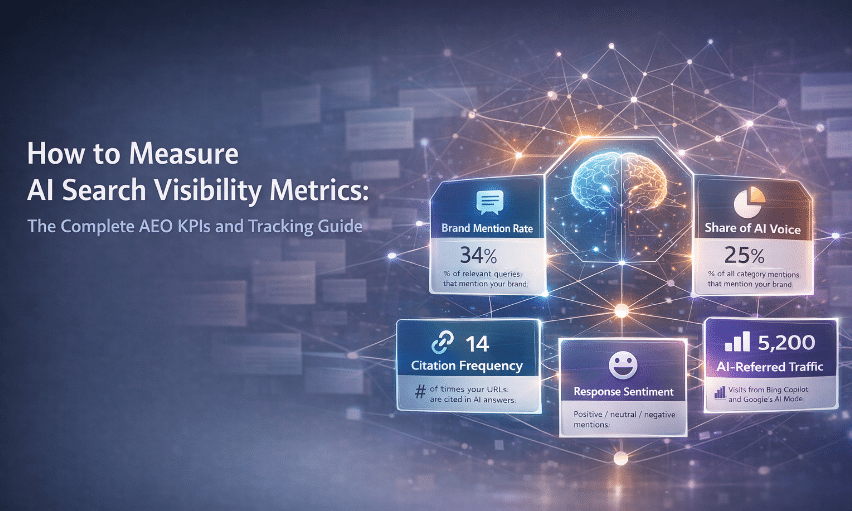
Brand mention rate measures what percentage of AI-generated responses to relevant queries include your brand name. Run 100 test prompts in your category and count how many responses mention your brand. If it's 34, your brand mention rate is 34%. This is the most foundational AI search visibility metric. Without it, every other number is context-free.
Share of AI Voice (SoAV)
Share of AI Voice measures your brand mentions as a percentage of all brand mentions in your category across a set of queries. If your brand appears 34 times across 100 prompts and competitors appear a combined 100 times, your SoAV is 25%. The industry is converging on SoAV as the primary AEO KPI because it contextualizes your performance against competitors. A 34% brand mention rate sounds good until you learn Competitor A is appearing in 80% of the same prompts.
Citation Frequency (Owned URLs)
Citation frequency tracks how often AI engines link to or reference your specific pages as source material. When Perplexity cites your URL in its answer, that is a hard citation signal. A brand can be mentioned without any URL being cited. Cited pages carry heavier authority signal weight and are more likely to drive referral traffic.
Response Sentiment
Sentiment tracks whether the AI positions your brand positively, neutrally, or negatively when it mentions you. Most brands start sentiment tracking once they reach consistent mention rates above 20% and need to qualify the quality of their visibility, not just the quantity.
Competitive Citation Share
This metric maps which competitors appear in AI responses where you don't. If Competitor A appears in 60% of prompts where you're absent, that's a specific content gap you can close. Competitive citation share makes the gap visible and actionable.
AI-Referred Traffic (GA4)
Some AI engines, especially Perplexity and Bing Copilot, send measurable referral traffic. Google's AI Mode has begun generating trackable referral sessions in GA4. This is the only AI search visibility metric with a direct revenue attribution path today.
KEY INSIGHT
AirOps research found that only 30% of brands maintain consistent visibility from one AI answer to the next, and just 20% remain visible across five consecutive runs of the same prompt. This makes continuous monitoring, not one-time audits, the only reliable measurement approach.
3. Share of AI Voice: The Primary KPI for Brand Visibility in Generative Search
Share of AI Voice has emerged as the AEO equivalent of traditional Share of Voice in media buying. If your brand appears more often than your competitors in the conversations most relevant to your category, you are winning the awareness battle in that channel.
For AEO measurement, SoAV is calculated by running a standardized prompt bank of 50-150 queries across your category, recording every brand mentioned in the AI responses, and dividing your mentions by the total number of category mentions.
Semrush monitors over 100 million prompts globally and uses keyword-level daily tracking to produce SoAV scores at scale. Ahrefs Brand Radar draws from 260 million monthly prompts to generate brand visibility scores and competitive share figures. Most mid-market brands will use tools like Peec AI or Otterly.ai to track SoAV without enterprise-level spend.
2026 benchmarks for Share of AI Voice:
- Below 10%: Needs comprehensive content and citation-building work
- 10-15%: Developing baseline visibility; consistent optimization required
- 15-25%: Strong AI search presence; competitive in most category prompts
- 25-45%: Category leader range; brand appears in most relevant AI responses
KEY INSIGHT
Brands achieving Share of AI Voice below 10% in their category typically require 3-6 months of consistent AEO work to reach the 15% baseline. Most SaaS and service brands starting AEO in early 2026 should set 10-20% SoAV improvement as their first six-month target.
4. The 5-Platform Prompt Audit Method
Most AI search tracking tools give you platform-wide aggregate data. The 5-Platform Prompt Audit is a proprietary weekly process developed by Fuel Online for testing brand visibility at the prompt level across all five major AI engines using a consistent prompt bank. This process catches platform-specific visibility gaps before automated tools surface them, and it requires no paid software to run.
- Build your prompt bank. Write 20-30 questions a customer would ask before choosing a vendor in your category. Include informational queries, comparison queries, and unbranded category queries. Aim for 80% unbranded queries — that's where most AI brand mentions happen.
- Run every prompt on all five platforms weekly. Test each prompt on OpenAI's ChatGPT (web browsing mode on), Google's Gemini Advanced, Anthropic's Claude, Microsoft Copilot, and Perplexity. Use consistent incognito sessions to reduce personalization bias.
- Log results in a structured spreadsheet. For each prompt on each platform, record: brand mentioned (yes/no), sentiment (positive/neutral/negative), URL cited (yes/no), and which competitors were mentioned.
- Calculate per-platform brand mention rates. Your brand may appear in 40% of ChatGPT responses but only 15% of Perplexity responses. Platform-specific gaps point to where your content and citation signals are weakest.
- Identify highest-gap competitors. Which competitors appear in the prompts where your brand doesn't? Their content is earning citations yours isn't. That is your content gap list for the next 30 days of AEO work.
KEY INSIGHT
Platform-level variation in AI search visibility is common. A brand can have a 42% mention rate on ChatGPT and a 14% rate on Perplexity for the exact same category prompts. The 5-Platform Prompt Audit surfaces these gaps in two hours. No tool currently provides this cross-platform prompt-level breakdown automatically.
5. The Best Tools for Tracking AI Search Visibility in 2026
No single tool covers every AI search visibility metric. A functional measurement stack combines multiple platforms, selected by budget tier.
Enterprise teams (budget $300+/month)
Semrush One includes the AI Visibility Toolkit, which tracks brand mentions across ChatGPT, Google AI Mode, Perplexity, and Microsoft Copilot at scale. Its Model Context Protocol integration allows the platform to query Anthropic's Claude directly for brand positioning data, making it one of the only tools with live Claude citation monitoring.
Ahrefs Brand Radar tracks 260 million monthly prompts and delivers brand visibility scores, SoAV percentages, and cited domain reports. Individual AI index access starts at $199/month per platform; the full six-platform bundle runs $699/month.
Mid-market teams (budget $75-$300/month)
Peec AI tracks brand visibility across ChatGPT, Gemini, Perplexity, Claude, Microsoft Copilot, Grok, DeepSeek, and Meta AI. It produces prompt-level visibility scores, sentiment scores, and answer position tracking. Plans start at $75/month, making it the most cost-efficient full-stack option for agencies.
Otterly.ai provides citation tracking across six AI platforms with competitive benchmarking reports and brand mention alerts. It's widely used by SEO agencies for client reporting.
Free or near-free options
Bing Webmaster Tools launched its AI Performance Dashboard in February 2026, giving free access to ChatGPT and Copilot citation data for any page in the Bing index. This is the most underused free tool in AI search measurement today.
HubSpot's AEO Grader scores your content's AI search readiness at no cost. Google Search Console's AI Mode filter, now in public beta, shows which of your pages appear in Google's AI Overviews and AI Mode responses with impression and click data.
[IMAGE SUGGESTION 2: Comparison table visual showing the five tools (Semrush One, Ahrefs Brand Radar, Peec AI, Otterly.ai, Bing Webmaster Tools) in a matrix with Budget Tier, Platform Coverage, Key Feature, and Price columns. Color-coded by budget tier.]
6. How to Build Your AI Visibility Dashboard in GA4
Tracking AI-referred traffic requires a manual setup in GA4 because Google does not automatically segment AI referral traffic as its own channel. Without this setup, visits from Perplexity, ChatGPT, and Copilot get collapsed into "direct" traffic, making revenue attribution from AI search impossible.
- Go to Admin > Data Display > Channel Groups and click "Create new channel group."
- Name it "AI Search Referrals."
- Add conditions for source containing: perplexity.ai, chat.openai.com, copilot.microsoft.com, gemini.google.com, claude.ai, bard.google.com, you.com.
- Apply the channel group to your Exploration reports and standard reports.
- Set up a conversion event for your primary CTA and verify it fires correctly for sessions in the AI Search Referrals channel.
For a complete measurement dashboard, combine: GA4 AI Search Referrals channel (direct traffic and conversion attribution), weekly 5-Platform Prompt Audit log (manual brand mention tracking), monthly SoAV report from Peec AI or Ahrefs Brand Radar, Bing Webmaster Tools AI Performance data, and Google Search Console AI Mode filter.
7. Technical Setup for Accurate AI Search Measurement
Your AI search visibility data is only as accurate as your crawlability setup. Two technical requirements directly affect every metric you track.
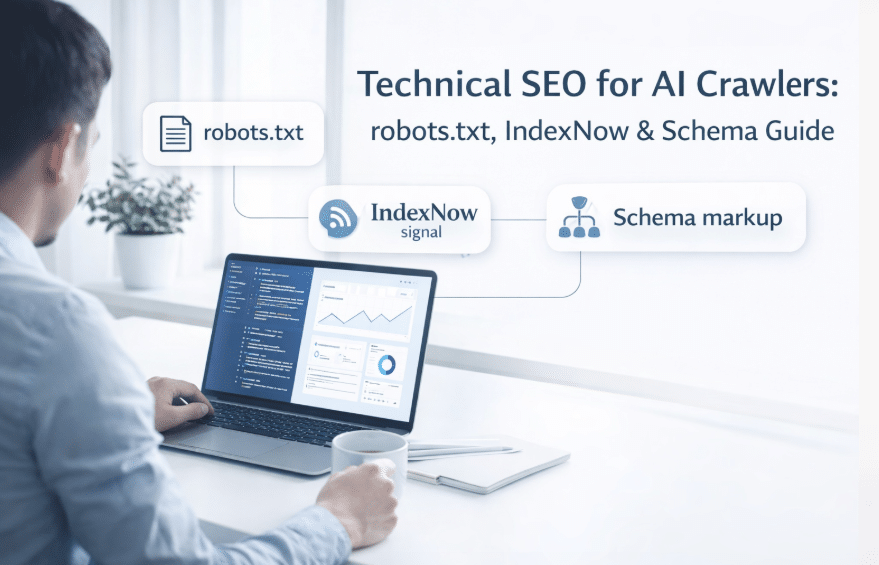
AI bot access in robots.txt
If your robots.txt blocks AI crawlers, none of the measurement tools will surface your content in AI responses. You might run a prompt audit and see zero mentions and conclude you have an optimization problem, when the actual problem is a blocked bot directive. Every AEO-focused site needs these directives explicitly in robots.txt:
User-agent: OAI-SearchBot
Allow: /

User-agent: ChatGPT-User
Allow: /

User-agent: PerplexityBot
Allow: /

User-agent: Google-Extended
Allow: /

User-agent: ClaudeBot
Allow: /

User-agent: anthropic-ai
Allow: /
CRITICAL RULE
If your robots.txt blocks OAI-SearchBot, PerplexityBot, ClaudeBot, or Google-Extended, your AI search visibility metrics will never improve because the engines literally cannot read your content to cite it. Unblock all AI bots before running any measurement audit.
IndexNow for Bing
Because OpenAI's ChatGPT uses Bing's index for live web search, passive crawling is not enough. Implement the IndexNow protocol to ping Bing the moment you publish or update a page. This makes your content immediately retrievable for ChatGPT search queries. IndexNow is available through Cloudflare's integration or WordPress SEO plugins including Yoast SEO (version 19.0+) and Rank Math.
8. Co-Citation Analysis: Finding Your Competitive Blind Spots
Co-citation happens when your brand is mentioned alongside other authoritative brands in the same AI response. If ChatGPT regularly groups your agency with HubSpot and Neil Patel when answering questions about content marketing, that is a strong co-citation signal that tells both users and the AI model that you belong in that authority tier.
To build co-citation intentionally:
- Get your brand referenced in content published by the same authoritative sources AI engines cite most frequently in your category.
- Create content that explicitly names and compares your approach to specific competitors and adjacent tools. AI engines often extract comparative content for multi-brand responses.
- Earn backlinks from the exact domains that appear most frequently as AI-cited sources in your space.
Your prompt audit data reveals co-citation patterns directly. If Competitor A always appears alongside a specific industry publication in AI responses, that publication is a high-priority PR and link-building target for your AEO program.
Common Mistakes When Measuring AI Search Visibility
| Mistake | Why It Hurts | Fix |
|---|---|---|
| Checking AI visibility once per quarter | AI responses shift week to week. Quarterly data misses most changes. | Run weekly prompt audits, monthly tool-based SoAV reports. |
| Tracking only branded queries | Most AI brand mentions happen in unbranded category queries. | Build your prompt bank with 80% unbranded queries. |
| Blocking AI bots in robots.txt | If crawlers can't index you, you're invisible in AI responses regardless of content quality. | Explicitly allow all major AI bots in robots.txt before any measurement. |
| Testing on only one AI platform | Platform-specific visibility gaps are common and highly actionable. | Test across all five major AI engines every week. |
| Ignoring Bing Webmaster Tools AI Dashboard | The free tool provides ChatGPT and Copilot citation data almost no one is using. | Connect Bing Webmaster Tools and check the AI Performance tab monthly. |
| Measuring clicks as the only AI search KPI | Most AI answers don't generate clicks, but brand mentions build awareness and authority. | Track mention rate and SoAV as primary KPIs alongside referred traffic. |
| Using a single-run prompt test for benchmarks | Only 20% of brands maintain AI visibility across five consecutive identical prompt runs. | Run each benchmark prompt at least 3 times and average the results. |
Article Summary
- AI search visibility metrics track how often and how accurately your brand appears in AI-generated responses across ChatGPT, Gemini, Perplexity, Microsoft Copilot, and Anthropic's Claude.
- The six core metrics are: brand mention rate, share of AI voice, citation frequency, response sentiment, competitive citation share, and AI-referred traffic via GA4.
- Share of AI Voice (SoAV) is the primary AEO KPI in 2026, measuring your brand mentions as a percentage of all category mentions in AI-generated responses.
- The 5-Platform Prompt Audit Method is a weekly, tool-free process for tracking brand visibility across five AI engines using a standardized prompt bank of 20-30 queries.
- AirOps research found only 20% of brands maintain consistent AI search visibility across five consecutive runs of the same prompt, making weekly monitoring essential.
- The best tools include Semrush One, Ahrefs Brand Radar, Peec AI, Otterly.ai, Bing Webmaster Tools AI Performance Dashboard, and Google Search Console AI Mode filter.
- Build an AI Search Referrals channel group in GA4 with source conditions for perplexity.ai, chat.openai.com, copilot.microsoft.com, and gemini.google.com to capture revenue-attributable AI traffic.
- Accurate measurement requires all major AI bots to be explicitly allowed in robots.txt. Blocked bots produce zero citation data regardless of content quality.
- Implement IndexNow via Rank Math or Yoast SEO to ensure Bing indexes your content immediately, making it retrievable by ChatGPT's live web search.
- Co-citation analysis reveals which domains appear alongside your brand in AI responses, creating specific link-building and PR targets for your AEO program.
- Category leaders typically run 25-45% SoAV on their core queries. Brands below 10% need foundational AEO work before measurement becomes meaningful.
Frequently Asked Questions
What are the most important AI search visibility metrics to track in 2026?
The three most important AI search visibility metrics are share of AI voice, brand mention rate, and citation frequency. Share of AI voice measures your brand mentions as a percentage of all category mentions across AI responses, making it the most competitive and actionable KPI. Brand mention rate tells you how often your brand appears in relevant AI-generated answers. Citation frequency tracks how often AI engines link to your specific pages as source material. Track all three on a weekly basis for a complete picture of your AI search performance.
How do I track AI search visibility for free?
You can build a meaningful free tracking stack using three tools. Bing Webmaster Tools launched its AI Performance Dashboard in February 2026, providing free ChatGPT and Copilot citation data for your indexed pages. Google Search Console's AI Mode filter shows which pages appear in Google's AI Overviews. HubSpot's AEO Grader scores your content's AI search readiness. For manual tracking with zero cost, run the 5-Platform Prompt Audit weekly across ChatGPT, Gemini, Perplexity, Copilot, and Claude using a spreadsheet to log brand mentions, sentiment, and competitor appearances.
What is Share of AI Voice and how is it calculated?
Share of AI Voice (SoAV) is the percentage of all brand mentions in your category that belong to your brand across a set of AI-generated responses. To calculate it, run a standardized prompt bank of 50-150 category queries across one or more AI platforms, record every brand mentioned in the responses, then divide your total mentions by the total of all brand mentions combined. If your brand is mentioned 34 times and competitors are mentioned a combined 100 times, your SoAV is 25%. Aim for 15% or above as a starting performance benchmark.
Why doesn't Google Analytics show AI search traffic automatically?
GA4 treats visits from platforms like Perplexity, ChatGPT, and Copilot as standard referral sessions or collapses them into direct traffic because these aren't recognized as a distinct channel by default. To isolate AI search visibility traffic, create a custom channel group in GA4 Admin with source-match conditions for perplexity.ai, chat.openai.com, copilot.microsoft.com, gemini.google.com, and claude.ai. Once active, GA4 will separate these sessions in all reports, giving you engagement rates, conversion events, and revenue attribution for AI-referred traffic.
How often should I run AI search visibility audits?
Run a prompt-level audit weekly and a full competitive SoAV report monthly. AirOps research found that AI responses are inconsistent, with only 20% of brands maintaining visibility across five consecutive runs of the same prompt. Single-snapshot audits are unreliable by definition. Weekly audits using your standardized prompt bank produce trend data that reveals whether optimization work is moving the needle. Monthly tool-based SoAV reports from Peec AI, Otterly.ai, or Ahrefs Brand Radar provide the competitive benchmarking context to interpret your weekly numbers correctly.