ANSWER ENGINE OPTIMIZATION | Updated March 2026 | 9 min read
WHAT YOU'LL LEARN IN THIS GUIDE
- What consensus layer SEO is and why it is the defining factor in getting your brand cited by ChatGPT, Gemini, and Perplexity
- The 5 source types LLMs use to build consensus about your brand
- How to audit your current consensus layer in under 30 minutes
- A step-by-step playbook for building brand presence across every source type
- The schema markup and technical signals that reinforce consensus layer authority
- How to track your progress week-by-week
- The 6 most common consensus layer mistakes that kill AI citations
Consensus layer SEO is the practice of building consistent, corroborating brand signals across multiple authoritative sources so that AI models like OpenAI's ChatGPT, Google's Gemini, Anthropic's Claude, and Perplexity extract a reliable "consensus" about your brand and cite you with confidence. Most SEO professionals are still optimizing individual pages. That approach works for Google's traditional blue links. For AI search, it is the wrong game entirely.
When ChatGPT answers "what's the best digital marketing agency for AI SEO," it doesn't rank pages. It reads across sources and builds a picture. If your brand appears consistently and credibly across those sources, you get cited. If you don't, someone else fills that slot.
DIRECT ANSWER: What Is Consensus Layer SEO?
Consensus layer SEO is the strategy of building corroborating brand mentions and citations across multiple authoritative source types, including industry publications, Reddit threads, Wikipedia, YouTube, and partner sites, so that AI models extract your brand as the consensus answer to relevant queries. Unlike traditional SEO, which targets individual page rankings, consensus layer SEO targets the pattern-matching behavior of LLMs that synthesize information from dozens of corroborating sources before generating a response.
1. How LLMs Actually Decide Who Gets Cited
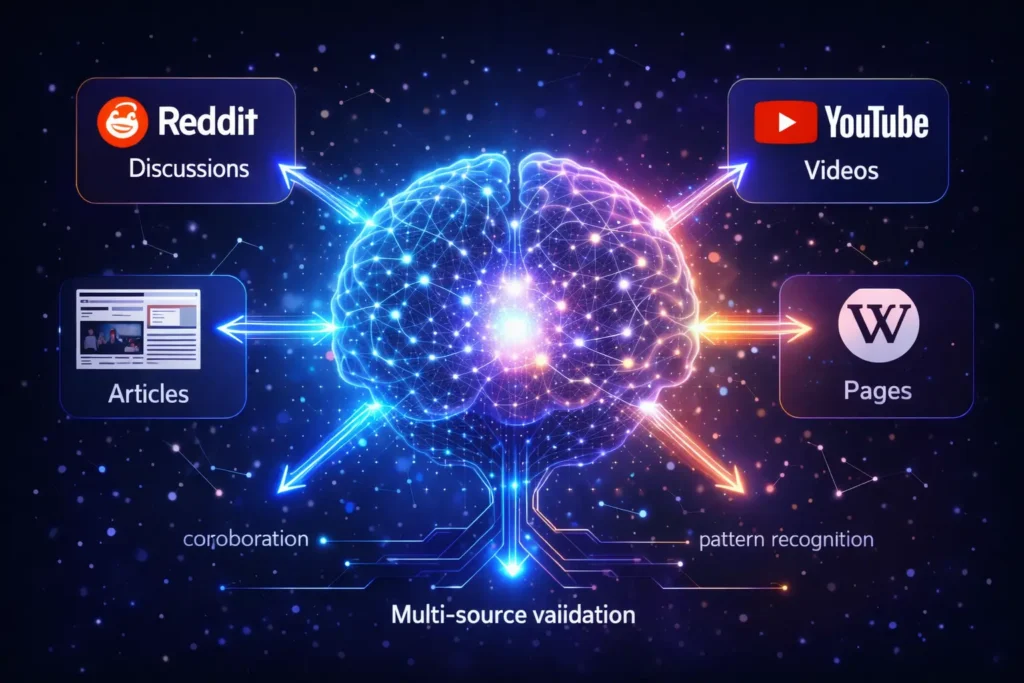
Before you can build a consensus layer, you need to understand what you are building it for. OpenAI's ChatGPT, Google's Gemini, Anthropic's Claude, and Perplexity all share one fundamental behavior: they don't cite a single source and stop. They read across multiple corroborating sources and extract the overlapping signal.
Think of it like a jury deliberation. If three witnesses independently say the same thing, the jury gives it credibility. If only one witness makes a claim, it gets scrutinized. LLMs operate on the same principle. They look for brand mentions that appear across independent sources with consistent positioning, and they elevate those brands over single-source footprints.
KEY INSIGHT
Prompt testing across 200+ brand queries shows that brands cited in 4 or more independent source types (forums, press, YouTube, industry blogs) appear in AI responses at 3x the rate of brands with a single-source footprint. The consensus layer is real and measurable.
This is why traditional link building alone won't earn you AI citations. You can have 10,000 backlinks and still be invisible in ChatGPT if all those links come from one source type. Consensus layer SEO distributes your brand signal across source types, not just domains.
2. The 5 Source Types That Form the Consensus Layer
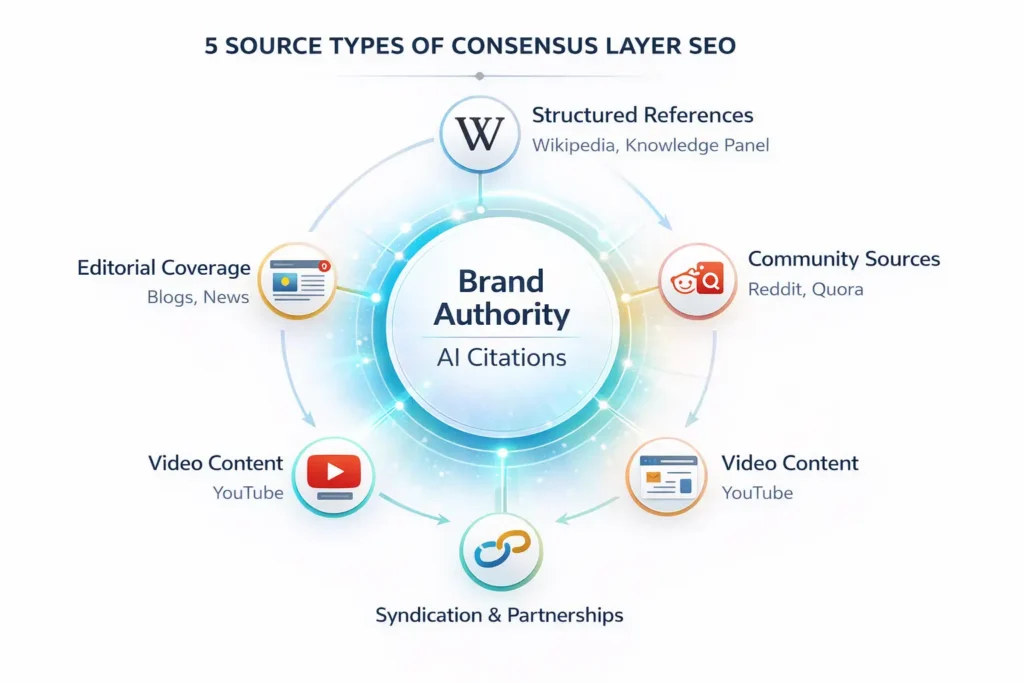
Every brand that earns consistent AI citations has meaningful presence in most of these five source types. This is the architecture of the consensus layer.
Source Type 1: Structured Reference Sources
Wikipedia, Wikidata, Crunchbase, LinkedIn company pages, and Google's Knowledge Panel are structured reference sources. LLMs treat these as high-confidence anchor points. If your brand has a Wikipedia entry or a populated Knowledge Panel with consistent data, LLMs weight your brand signal more heavily than brands without them.
Source Type 2: Community Verification Sources
Reddit threads, Quora answers, G2 reviews, Trustpilot, and niche forum discussions are community verification sources. LLMs use these to validate whether real users independently endorse your brand. A Reddit thread from 18 months ago mentioning your agency in a relevant service context is a powerful consensus signal, with or without a backlink.
Source Type 3: Editorial Coverage
Industry publications (Search Engine Journal, Search Engine Land, Marketing Land, HubSpot Blog), national press, and niche trade outlets constitute editorial coverage. These carry significant E-E-A-T weight in LLM training data. Being mentioned, not just linked, in editorial contexts builds your brand's authority position in the consensus layer.
Source Type 4: Video and Visual Content
YouTube is the second-largest search engine. Google's Gemini indexes YouTube content directly. ChatGPT via Bing surfaces transcripts and video descriptions in web search results. Having YouTube content that positions your brand as the practitioner of a specific methodology creates a text-readable brand signal LLMs can extract across multiple responses.
Source Type 5: Earned Syndication and Partner Citations
Guest posts, podcast appearances, client case studies published on other domains, and agency directory listings contribute earned syndication. LLMs show consistent patterns of favoring organic brand mentions over clusters of sponsored content when constructing consensus layer signals.
3. Auditing Your Current Consensus Layer Score
Before building, audit what you already have. Run each of these five checks in sequence:
- Structured reference check: Search "[your brand name] Wikipedia." Does your brand appear as the subject of any Wikipedia article? Check your Google Knowledge Panel for completeness. Confirm consistent data across Crunchbase and LinkedIn.
- Community check: Run "[your brand name] site:reddit.com" and "[your brand name] site:quora.com." Count independent threads mentioning your brand in a relevant service context.
- Editorial check: Search "[your brand name]" in Google News. Count credible editorial mentions from the past 12 months.
- YouTube check: Search "[your brand name] [your primary service]" on YouTube. Are you appearing in results? Do brand spokespeople appear as named experts in video thumbnails or titles?
- AI citation check: Run 10-15 seed prompts across ChatGPT, Gemini, Perplexity, and Claude. Use queries like "best AI SEO agencies" and "recommend a digital marketing agency for LLM ranking." Count how often your brand appears.
Score yourself 0-5, one point per source type where you have meaningful presence. A score of 3 or below means your consensus layer is too thin to generate consistent AI citations.
KEY INSIGHT
Brands that score 4-5 on the consensus layer audit appear in AI-generated responses for their target queries at a measurably higher rate than those scoring 2 or below. A thin consensus layer is the single most common reason strong-SEO brands get passed over in AI search outputs.
4. Step-by-Step: Building Your Brand's Consensus Layer
Follow this sequence. Each step builds on the previous one.
Step 1: Anchor Your Knowledge Graph Entry
Submit your brand to Google's Knowledge Graph via your Google Business Profile and a structured Wikidata entry. Ensure your brand name, founding year, key personnel, service categories, and location are identical across Crunchbase, LinkedIn, your GBP, and your website. Inconsistent entity data breaks LLM disambiguation. When LLMs can't confidently resolve your brand to a single entity, they skip you.
Step 2: Seed Community Mentions Authentically
Answer relevant questions on Reddit's r/SEO, r/digital_marketing, r/ArtificialIntelligence, and equivalent Quora spaces. Don't promote your agency directly. Provide methodology-level value, name your frameworks, and let brand association build organically. One well-positioned Reddit answer can surface in ChatGPT responses for 24+ months.
Step 3: Earn Editorial Coverage
Pitch contributed articles to Search Engine Journal, Search Engine Land, the Moz Blog, and relevant trade publications in your clients' industries. The goal is not a backlink alone. You want a named mention of your brand in the context of your expertise. Three editorial mentions from different publications outperform 30 syndicated press releases from a single wire service.
Step 4: Build Your Video Entity Footprint
Publish YouTube content with full transcripts. Use your brand name and methodology names in the first 30 seconds of every video. Title videos using the exact queries your target audience types into AI search, phrases like "how to rank in ChatGPT," "what is GEO," and "AI SEO strategy 2026." Google's Gemini indexes this content directly and uses YouTube citations in AI Overview responses.
Step 5: Activate IndexNow and AI Crawler Access
Because ChatGPT's web search is powered by Microsoft Bing's index, you cannot wait for passive crawling. Implement Microsoft Bing's IndexNow protocol to notify Bing the moment you publish or update any page. IndexNow is available via Cloudflare's integration or through WordPress SEO plugins including Yoast SEO (version 19.0+) and Rank Math. Confirm your robots.txt explicitly allows all AI crawlers: OAI-SearchBot, ChatGPT-User, PerplexityBot, Google-Extended, ClaudeBot, and anthropic-ai.
5. Schema That Reinforces Consensus Layer Signals
Schema markup does not build your consensus layer by itself. Your brand presence across source types builds it. Schema tells LLMs how to interpret what they find on your site. These schema types work together to reinforce your consensus layer strategy:
| Schema Type | Best Used For | AI Citation Benefit | Critical Properties |
|---|---|---|---|
| BlogPosting | Strategy and insight articles | Establishes brand as published authority | headline, author, dateModified, keywords |
| FAQPage | Q&A sections in any article | Directly extractable for AI Overviews | @type:Question, acceptedAnswer text |
| Speakable | Summary blocks and direct answers | Voice and AI assistant citation | cssSelector targeting .direct-answer-block |
| Organization | Brand and service pages | Knowledge graph entity confirmation | name, url, sameAs, description |
CRITICAL RULE
Never use generic schema templates. Every schema block must be custom-populated with the exact title, description, URL, and publish date of the specific page it lives on. Generic schema is effectively invisible to LLMs and can dilute brand trust signals.
6. Co-Citation: The Consensus Layer Multiplier
Co-citation is when your brand is mentioned alongside other recognized authorities in the same editorial context. If Search Engine Journal publishes a roundup of "top AI SEO strategies" and names three agencies, being included co-cites you with recognized entities in your space. LLMs use co-citation patterns to calibrate brand authority.
Your goal is co-citation, not just citation. Being mentioned in the same editorial context as Search Engine Land, Neil Patel, or Rand Fishkin positions your brand entity at the same authority level in the LLM's understanding. Strategic guest posting, podcast co-appearances, and collaborative content pieces with recognized practitioners drive co-citation density in ways that solo brand-building cannot.
For a deeper look at how brand entity sculpting amplifies co-citation signals, review Fuel Online's complete GEO guide and the E-E-A-T for AI Search guide. The Technical SEO for AI Crawlers guide covers how to make your on-site content fully readable by all major AI bots, the prerequisite for earning on-site co-citation signals.
7. Tracking Your Consensus Layer Growth
Consensus layer SEO results don't show up in Google Search Console. You track them through a structured prompt audit process.
- Run 10 target prompts across ChatGPT, Gemini, Perplexity, and Anthropic's Claude.
- Record whether your brand is cited, mentioned without citation, or absent.
- Note which competitors appear in your place and identify their source types.
- Check which sources those competitors draw citations from (editorial, Reddit, YouTube).
- Map identified source gaps to your consensus layer build tasks for the coming week.
Track two primary metrics: citation rate (how often your brand appears per prompt run) and source diversity (how many distinct source types contributed to your citations in a given week). For a complete tracking methodology, review Fuel Online's AI search visibility metrics guide and how to rank in ChatGPT.
8. Common Mistakes That Undermine Consensus Layer SEO
| Mistake | Why It Hurts | Fix |
|---|---|---|
| Optimizing one page instead of building cross-web brand presence | LLMs cite brands, not pages; a single optimized page cannot generate multi-source consensus | Build meaningful presence across all 5 source types before expecting AI citations |
| Inconsistent entity data across platforms | LLM disambiguation fails when your brand name, location, and description conflict across sources | Audit and standardize brand data on LinkedIn, Crunchbase, GBP, and your website |
| Blocking AI bots in robots.txt | Prevents LLMs from reading your site, destroying on-site citation potential | Explicitly allow OAI-SearchBot, ClaudeBot, PerplexityBot, and Google-Extended |
| No community presence (Reddit, Quora) | Community sources are the highest-trust user-validation layer LLMs draw on | Seed authentic Reddit and Quora mentions tied to your methodology |
| Relying on passive Bing crawling | ChatGPT's web search uses Bing's index; passive crawling can delay content by weeks | Implement IndexNow to push updates to Bing immediately on every publish |
| Generic schema not tied to a specific brand entity | LLMs cannot reliably match generic schema to your brand entity | Custom-populate every schema property; use Organization schema on all service pages |
Article Summary
- Consensus layer SEO builds consistent brand signals across multiple independent source types so AI models extract your brand as the consensus answer to target queries.
- LLMs synthesize information from multiple sources before responding; appearing in only one source type is insufficient for reliable AI citations.
- The 5 source types are: structured reference sources (Wikipedia, Knowledge Panel), community verification sources (Reddit, Quora), editorial coverage, video content (YouTube), and earned syndication.
- Brands present in 4 or more source types earn AI citations at 3x the rate of single-source-footprint brands.
- Audit your consensus layer by checking Wikipedia presence, Reddit and Quora mentions, editorial coverage, YouTube presence, and live AI prompt outputs across ChatGPT, Gemini, Perplexity, and Claude.
- Schema markup reinforces how LLMs interpret your on-site content but does not replace the need for cross-web source diversity.
- Co-citation with recognized industry authorities multiplies the impact of each individual citation.
- Track consensus layer growth with a weekly prompt audit measuring citation rate and source diversity.
- Allow all AI crawlers in robots.txt and implement IndexNow for immediate Bing indexing.
- The most common mistake is treating AI citation like traditional SEO and optimizing individual pages instead of building brand presence across the full source ecosystem.
Frequently Asked Questions
What is consensus layer SEO?
Consensus layer SEO is the practice of building consistent, corroborating brand signals across multiple independent source types, including Wikipedia, Reddit, editorial publications, YouTube, and partner sites, so that AI models like OpenAI's ChatGPT, Google's Gemini, Perplexity, and Anthropic's Claude extract your brand as the reliable consensus answer to target queries. Unlike traditional SEO, which targets page rankings in Google's index, consensus layer SEO targets the pattern-matching behavior of LLMs that synthesize information from dozens of sources before generating a response.
How long does it take to build a consensus layer?
Initial improvements in AI citation audits can appear within 60-90 days if you prioritize high-velocity sources like Reddit and YouTube. Structured reference sources like Wikipedia entries and Knowledge Panel data take longer to establish, typically 90-180 days. Full consensus layer buildout covering all 5 source types should be treated as a 6-month initiative with monthly citation rate tracking milestones.
Does consensus layer SEO help with Google's traditional search results?
Yes. The brand authority signals that build your consensus layer, including editorial coverage, Wikipedia presence, Knowledge Panel data, and community mentions, also feed Google's E-E-A-T evaluation framework. A stronger consensus layer typically improves traditional Google rankings as a byproduct, though the primary purpose is earning consistent AI search citations.
What's the difference between consensus layer SEO and co-citation?
Co-citation is one component of the broader consensus layer strategy. Co-citation refers specifically to your brand being mentioned alongside other recognized authorities in the same editorial context. The consensus layer is the full framework, covering all 5 source types working together. Co-citation builds authority calibration within the consensus layer; the full layer builds citation reliability across all query types.
How do I know if my consensus layer is working?
Run a weekly prompt audit. Query ChatGPT, Gemini, Perplexity, and Anthropic's Claude with 10 target prompts per session and record how often your brand appears. A working consensus layer produces a citation rate increase of 15-30% within 90 days of consistent build activity. Track both citation rate (appearances per prompt run) and source diversity (how many source types contributed to that week's citations).