WHAT YOU'LL LEARN IN THIS GUIDE
- The 7 core ChatGPT ranking factors that determine citation
- Why only 15% of retrieved pages actually get cited
- How to configure your robots.txt for ChatGPT access
- The role of Bing's index in ChatGPT's live web search
- What "reading mode compatibility" means and why it matters
- How to structure direct answers that LLMs extract on contact
- A weekly ChatGPT citation audit process you can run today
- The co-citation strategy that multiplies your citation odds
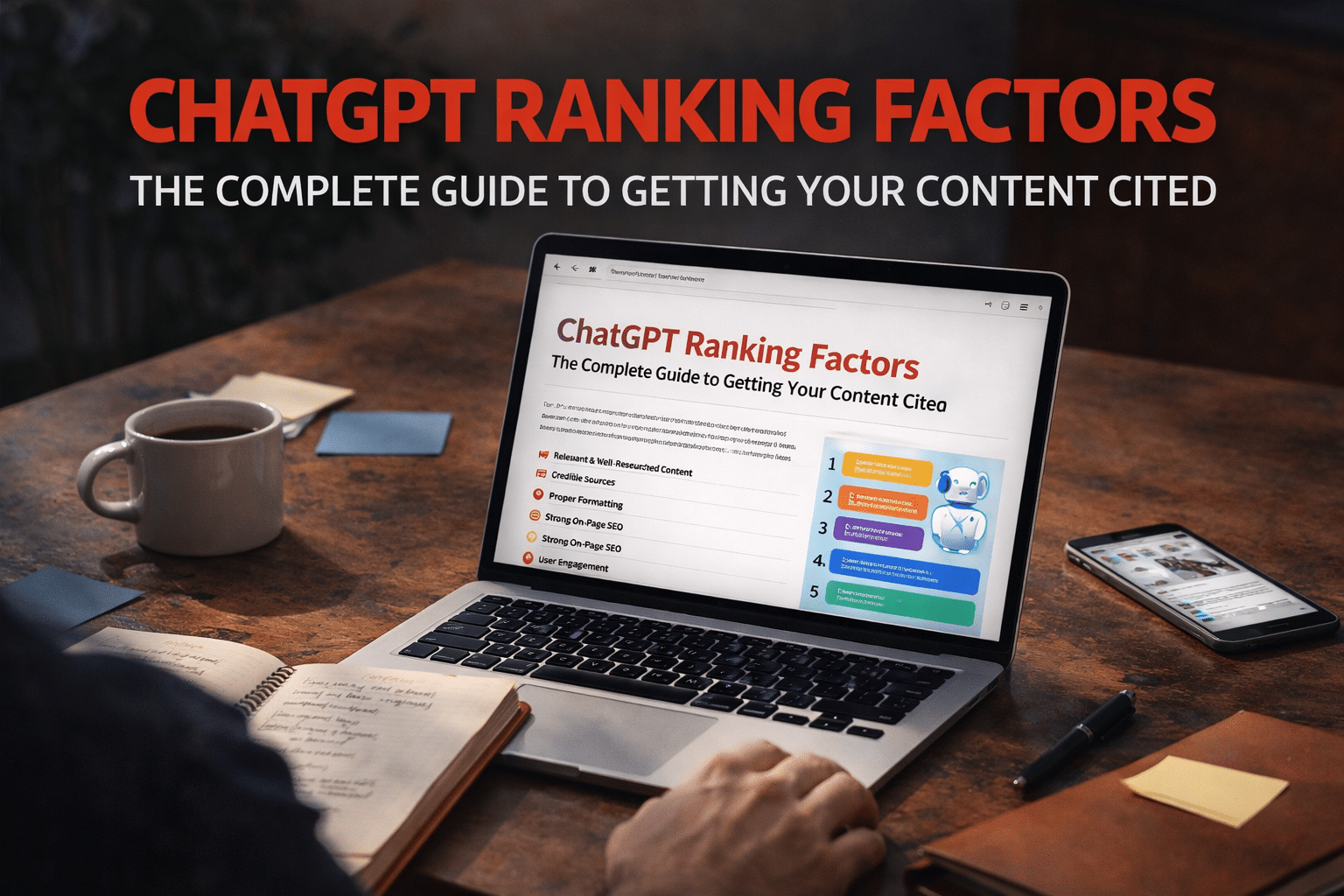
ChatGPT ranking factors are not a mystery -- they are a documented, testable set of signals that OpenAI's ChatGPT evaluates when deciding which sources to cite in a live search response. Most sites that fail to earn citations are not failing because of bad content. They are failing because they have not addressed the technical and structural requirements that sit between "being crawled" and "being cited."
This guide breaks down all seven ChatGPT ranking factors using current 2026 data, explains the two-stage filter that most SEO professionals never see, and gives you a concrete audit process to improve your citation rate across ChatGPT Search, ChatGPT's GPT-4o web browsing mode, and OpenAI's o-series models. The same framework applies, with small adjustments, to Perplexity, Google's Gemini, and Microsoft Copilot.
DIRECT ANSWER: ChatGPT Ranking Factors
ChatGPT ranking factors are the signals that determine whether a webpage moves from retrieval to citation in a ChatGPT response. The seven core factors are: Bing index status, reading mode compatibility, direct answer structure, E-E-A-T authority signals, content recency, co-citation density, and schema markup completeness. ChatGPT retrieves pages via Bing's API in 92% of live searches, and only 15% of retrieved pages are ultimately cited -- meaning most sites are being found but not selected.
1. The Two-Stage Filter: Why "Getting Crawled" Is Not Enough
The biggest misconception in ChatGPT SEO is treating retrieval and citation as the same thing. They are not.
When ChatGPT processes a query that requires current web data, its agent makes a call to Bing's Search API. That call retrieves a set of candidate URLs. Then ChatGPT reads those pages and selects which ones to cite in its response. Research from SeoProfy and Position Digital shows that ChatGPT retrieves content from Bing's API in 92% of live web searches, and that only 15% of pages retrieved during a search session are actually cited. The remaining 85% are read and discarded.
This means your ChatGPT ranking factors challenge is a two-part problem: first, get into Bing's index; second, give ChatGPT a reason to select you over the other nine results it already has access to.
KEY INSIGHT
63% of ChatGPT bot visits end immediately after landing, with no further page interaction. This suggests ChatGPT agents evaluate citation worthiness in the first few hundred tokens of visible content -- making your opening structure the most critical real estate on the page.
2. ChatGPT Ranking Factor #1: Bing Index Status and the IndexNow Protocol
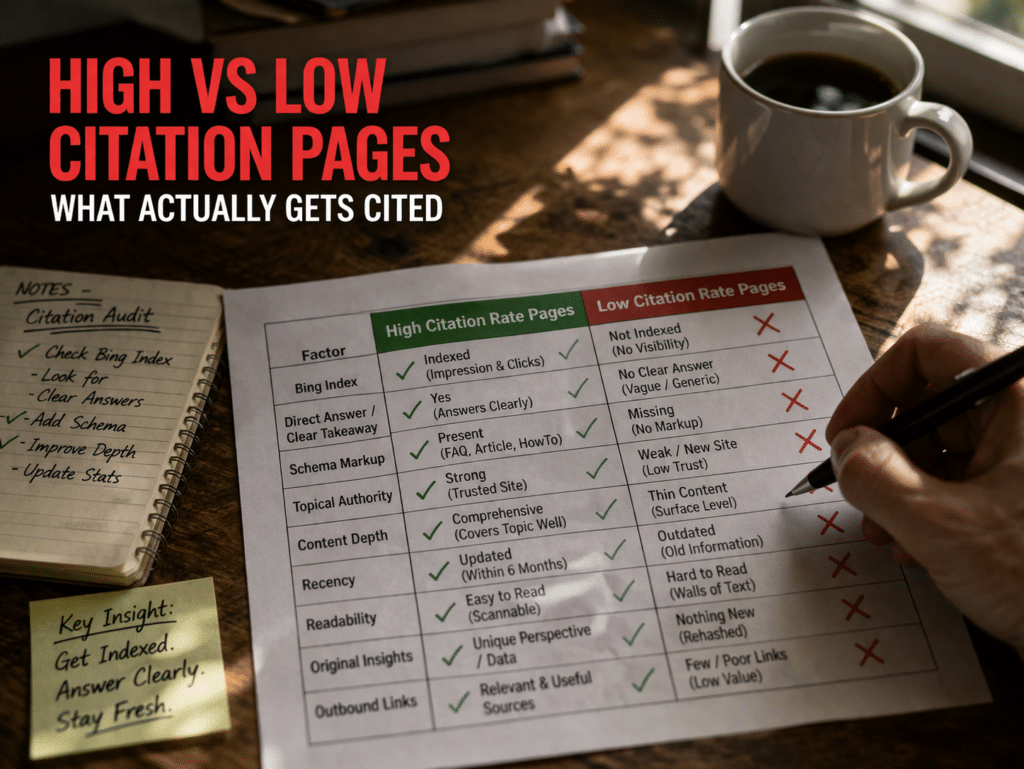
Because ChatGPT's live web browsing is powered by Bing's index, a page that Google has crawled but Bing has not will not appear in ChatGPT search results at all. This is the single most common technical gap across sites pursuing AI search visibility.
Passive Bing crawling is too slow. Implement Microsoft Bing's IndexNow protocol to push new and updated URLs directly to Bing the moment you publish or refresh. IndexNow is available as a native integration in Cloudflare, Rank Math (version 1.0.52+), and Yoast SEO (version 19.0+). Once active, new content typically appears in Bing's index within 24 to 48 hours instead of waiting weeks for passive discovery.
If you are using Rank Math or Yoast, enable IndexNow in the settings and verify it is firing by checking your Bing Webmaster Tools crawl report after publishing your next piece of content.
You can learn more about the full technical setup in our guide to technical SEO for AI crawlers.
3. ChatGPT Ranking Factor #2: Reading Mode Compatibility
The second ChatGPT ranking factor is reading mode compatibility. Data from SeoProfy's ChatGPT crawl analysis shows that 46% of ChatGPT bot visits begin in reading mode, which is a plain HTML view that strips CSS, JavaScript, and images. If your key content -- your direct answers, your data points, your structured headings -- lives inside JavaScript-rendered components, ChatGPT will not see them in reading mode.
What this means in practice:
- Your core content must be server-side rendered or available in static HTML
- Direct answer blocks, statistics, and definition statements must appear in the page's raw HTML, not in JS-loaded containers
- Use semantic HTML (H1, H2, H3, strong, ul, ol) to signal document structure without relying on CSS
Run a quick test: copy your page's URL, paste it into a readability parser like Readable.com, and check whether your key claims survive the plain-text view. If they disappear, your page has a reading mode compatibility problem.
4. ChatGPT Ranking Factor #3: Direct Answer Architecture
ChatGPT agents evaluate citation worthiness in the first few hundred tokens of a page. This makes direct answer architecture the third and most controllable ChatGPT ranking factor.
A direct answer block is a clearly delineated, 40 to 80 word section near the top of the page that answers the primary query without requiring the reader (or the LLM) to scroll. The format follows a simple pattern: state the primary keyword in the first sentence, answer completely in two to four sentences, include at least one specific and verifiable claim.
Pages that provide this kind of front-loaded answer structure are dramatically more likely to earn citations than pages that bury conclusions in paragraph four or five. If you want to understand the full architecture of content that ranks in AI overviews and chat interfaces, the Fuel Online GEO guide covers the citation extraction model in detail.
5. ChatGPT Ranking Factor #4: Authority Signals and E-E-A-T
Sites with over 32,000 referring domains are 3.5 times more likely to be cited by ChatGPT than sites with 200 or fewer referring domains, according to data from Position Digital's March 2026 AI SEO statistics report. This is a blunt authority signal. ChatGPT is not running PageRank calculations, but it is leaning heavily on Bing's quality signals, which include link authority, brand search volume, and entity recognition in knowledge graphs.
The practical implication is that E-E-A-T signals -- demonstrable experience, expertise, authoritativeness, and trustworthiness -- are not just Google signals anymore. They are ChatGPT ranking factors. Every page that targets AI citation should carry:
- A named, credentialed author with a byline linking to a bio page
- Publication date and last-updated date, clearly displayed
- References and outbound citations to primary sources
- First-hand data, proprietary frameworks, or case examples that no competing page has
For a full breakdown of how to build E-E-A-T signals that AI engines respond to, see our guide on E-E-A-T for AI search.
6. ChatGPT Ranking Factor #5: Content Recency and Freshness Signals
ChatGPT weights recency when selecting which sources to cite, particularly for queries about strategies, statistics, tools, or platform behaviors that change frequently. A 2024 guide competing against a March 2026 article on the same query will lose -- even if the 2024 article has stronger backlinks.
Recency signals that ChatGPT reads include:
- The
dateModifiedproperty in your Article or BlogPosting schema - The visual "Last Updated" date displayed near the article header
- The copyright year in the site footer
- In-content references to current dates, recent events, or 2026 data
A page with a dateModified schema value of March 2026 will consistently outperform one with a 2024 date for any query where freshness is a citation factor.
7. ChatGPT Ranking Factor #6: Co-Citation Density
No single article earns citations in a vacuum. Search Engine Land's March 2026 analysis of the "consensus layer" in LLM search described how large language models synthesize agreement across multiple sources rather than relying on a single authoritative page. A brand or claim that appears across 10 to 15 independent sources is treated as consensus, and consensus gets cited.
Co-citation density means your brand name, key claims, and primary data points need to appear on external sites -- not just your own pages. This is why a coherent LLM seeding strategy, where you distribute your methodology, statistics, and named frameworks through guest posts, PR placements, podcast appearances, and social profiles, amplifies every other ChatGPT ranking factor you build.
KEY INSIGHT
LLMs treat claims that appear across multiple independent sources as consensus. A single well-optimized page competes with dozens of results. A brand cited across 10+ external domains is treated as an established authority -- and that co-citation signal is additive to every other ranking factor.
8. ChatGPT Ranking Factor #7: Schema Markup Completeness
Schema markup is not a direct ChatGPT ranking factor in the same way authority is, but it serves two critical functions: it clarifies your content type for the Bing crawler that feeds ChatGPT, and it improves the precision with which ChatGPT can extract structured facts from your page.
Every blog post targeting AI citation should carry at minimum:
| Schema Type | Purpose | Critical Properties |
|---|---|---|
| BlogPosting | Identifies content type and author | headline, author, datePublished, dateModified |
| FAQPage | Maps Q&A pairs for direct extraction | mainEntity with Question and Answer |
| Speakable | Marks sections for voice and AI extraction | cssSelector targeting .direct-answer-block |
Add schema via Rank Math's Schema module or Yoast's SEO schema block. Do not use generic auto-generated templates. Populate every property with content that matches your actual page.
CRITICAL RULE
Never apply generic schema templates to your ChatGPT-targeted content. Every schema property must reflect the actual content on the page. Mismatched schema (headline that differs from H1, author field left blank) signals low trustworthiness to both Bing's crawlers and ChatGPT's citation selection logic.
9. The robots.txt Directives That Open Your Site to ChatGPT
Blocking AI crawlers in your robots.txt file removes you from ChatGPT's candidate pool entirely. Add these explicit allow directives to your robots.txt now:
User-agent: OAI-SearchBot
Allow: /

User-agent: ChatGPT-User
Allow: /

User-agent: PerplexityBot
Allow: /

User-agent: Google-Extended
Allow: /

User-agent: ClaudeBot
Allow: /

User-agent: anthropic-ai
Allow: /
Check your current robots.txt at yourdomain.com/robots.txt. If you see Disallow: / rules for any of these agents, remove them immediately. This is the fastest single fix available for sites that are not appearing in any AI search citations.
10. How to Audit and Track Your ChatGPT Ranking Factors
Tracking ChatGPT ranking factors requires a different process than traditional rank tracking. There is no position one in a ChatGPT response. You are either cited or you are not. Here is the weekly audit process:
- Build a prompt list of 15 to 20 queries that match your target keywords
- Run each prompt in ChatGPT (GPT-4o with web browsing enabled), Perplexity, and Gemini
- Record whether your domain appears as a cited source for each query
- Log the date, query, platform, and cited URL in a tracking sheet
- Note which competitor domains are being cited instead
- Identify the structural differences between your content and the cited pages
- Update your content to close those gaps, then re-test the following week
For a complete framework covering the metrics and tools that support AI search measurement, see our guide on measuring AI search visibility metrics.
Common Mistakes That Kill Your ChatGPT Citation Rate
| Mistake | Why It Hurts | Fix |
|---|---|---|
| No direct answer block in the first 200 words | ChatGPT agents evaluate in first 400 tokens and abandon pages that don't answer immediately | Add a 40-80 word direct answer block above the fold |
| Content not indexed in Bing | ChatGPT uses Bing API -- Google-only indexation means you don't exist in ChatGPT search | Activate IndexNow via Rank Math or Yoast; submit sitemap to Bing Webmaster Tools |
| AI bots blocked in robots.txt | OAI-SearchBot and ChatGPT-User cannot access blocked pages | Add explicit Allow directives for all AI crawlers |
| JavaScript-rendered key content | ChatGPT reads plain HTML in 46% of visits; JS content is invisible | Move core claims to server-side rendered HTML |
| Generic or missing schema | Bing crawlers get no signal about content type or authority | Add BlogPosting + FAQPage schema with fully populated properties |
| No co-citation signals | LLMs rely on consensus; one isolated page cannot establish authority | Distribute brand mentions and key claims across external sources |
| Stale dateModified in schema | ChatGPT favors recency; old modification dates lose to fresh competitors | Update dateModified schema every time you refresh content |
Article Summary
- ChatGPT ranking factors are the signals that determine whether a page moves from retrieval to citation in a ChatGPT response
- 92% of ChatGPT live searches use Bing's API for retrieval, making Bing index status the foundational ranking factor
- Only 15% of retrieved pages are actually cited -- the other 85% are read and discarded, meaning technical and structural quality determines citation
- 63% of ChatGPT bot visits end immediately after landing, so direct answer architecture in the first 200 words is critical
- Reading mode compatibility ensures your core content survives the plain-HTML view that ChatGPT agents use in 46% of visits
- Sites with 32,000+ referring domains are 3.5x more likely to be cited -- authority is an active ChatGPT ranking factor, not just a Google one
- Co-citation density, where your brand appears across multiple external sources, creates the consensus signal LLMs look for
- Schema markup (BlogPosting + FAQPage + Speakable) clarifies content structure for Bing's crawlers and improves ChatGPT's extraction precision
- Robots.txt must explicitly allow OAI-SearchBot, ChatGPT-User, and PerplexityBot, or you will not appear in AI search citations at all
- A weekly prompt audit of 15 to 20 target queries across ChatGPT, Perplexity, and Gemini gives you the feedback loop to improve citation rates systematically
Frequently Asked Questions
How do ChatGPT ranking factors differ from Google ranking factors?
ChatGPT ranking factors focus primarily on citation extraction rather than link-based ranking. Where Google evaluates PageRank, technical health, and click-through behavior, ChatGPT evaluates Bing index status, direct answer structure, reading mode compatibility, and content recency. Authority matters in both systems, but ChatGPT measures it through referring domain volume and co-citation density rather than PageRank. The biggest practical difference is that ChatGPT's web search is Bing-dependent, meaning sites not indexed in Bing cannot appear in ChatGPT responses regardless of their Google ranking.
Why is my site not being cited in ChatGPT even though it ranks well in Google?
Google and ChatGPT use separate indexes. The most common causes of strong Google rankings but absent ChatGPT citations are: the site is not indexed in Bing, AI crawlers are blocked in the robots.txt file, the page lacks a direct answer block in the first 200 words, key content is JavaScript-rendered and invisible to ChatGPT's reading mode, or the dateModified schema value is outdated. Run through each of these ChatGPT ranking factors in sequence as an audit checklist.
How long does it take to see results after optimizing for ChatGPT ranking factors?
Based on published data from GenOptima's Q1 2026 monitoring, new AEO-optimized content achieves its first AI citations within three to five business days of publication when Bing indexation is confirmed and the content is properly structured. Measurable improvements in overall citation rates appear within two to three weeks of systematic optimization across a content library.
Does ChatGPT use Google's index for its web search?
No. ChatGPT's live web search uses Bing's Search API in approximately 92% of queries. Google-indexed content that is not in Bing's index will not appear in ChatGPT search responses. You need to manage your Bing Webmaster Tools presence and implement IndexNow independently of your Google Search Console setup.
What is the single most important ChatGPT ranking factor to fix first?
If you have not confirmed that your key pages are indexed in Bing and that AI crawlers are allowed in your robots.txt, start there. These two issues are binary blockers that prevent ChatGPT from accessing your content regardless of quality. After confirming access, the highest-leverage optimization is adding a 40 to 80 word direct answer block in the first 200 words of every target page.