ANSWER ENGINE OPTIMIZATION Updated March 2026 12 min read
How AEO for ecommerce differs from traditional product page SEO and why conversion rates from AI traffic outperform organic search
Which AI platforms cite ecommerce products and exactly how each one decides what to recommend
The Product, Offer, and AggregateRating schema stack that makes your catalog machine-readable for LLMs
How to build multi-source consensus so AI engines trust your brand enough to recommend your products
A step-by-step process for optimizing product pages, category pages, and buying guides for AI citations
The robots.txt directives and IndexNow configuration that unlock AI crawler access to your store
How to track whether ChatGPT, Perplexity, Google AI Overviews, and Copilot are recommending your products
Common ecommerce AEO mistakes that silently block your products from AI shopping results
AEO for ecommerce is no longer optional if you sell products online. Half of all consumers now use AI-powered search to research purchases, and Gartner projects that traditional search engine volume will drop 25% by the end of 2026 as shoppers shift to ChatGPT, Perplexity, Google AI Overviews, and Microsoft Copilot for product recommendations.
This guide breaks down the complete AEO for ecommerce strategy, from structured data implementation to multi-platform brand presence. The tactics here apply whether you run a Shopify store, a WooCommerce site, or a custom-built ecommerce platform. Every section is built around the same question: how do you get your products cited when an AI answers a shopping query?
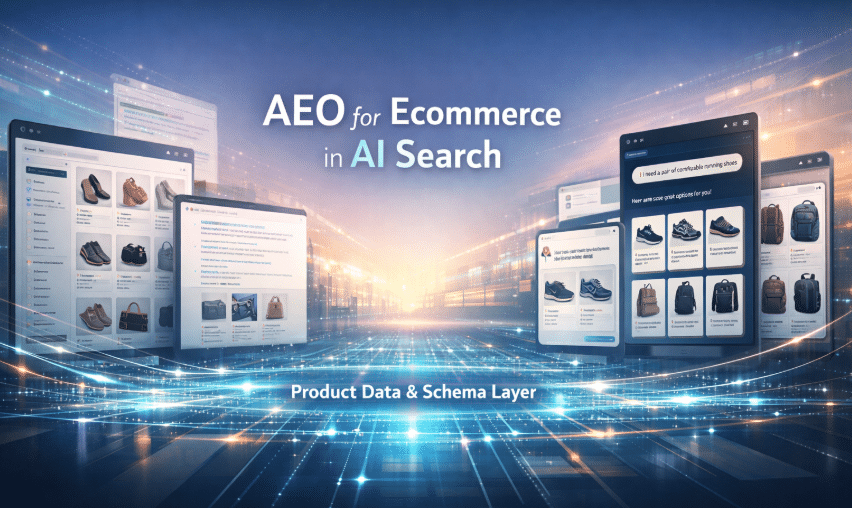
AEO for ecommerce is the practice of optimizing your product pages, category content, and brand presence so AI search engines like ChatGPT, Perplexity, Google AI Overviews, and Copilot cite your products in shopping-related answers. Unlike traditional SEO, which drives clicks to product listings, AEO for ecommerce positions your products as the direct recommendation inside AI-generated responses. Ecommerce sites with proper AEO implementation report 5.53% conversion rates from LLM traffic compared to 3.7% from organic search, making AI citations more valuable per visitor than any other acquisition channel.
1. Why AEO for Ecommerce Changes the Product Discovery Model
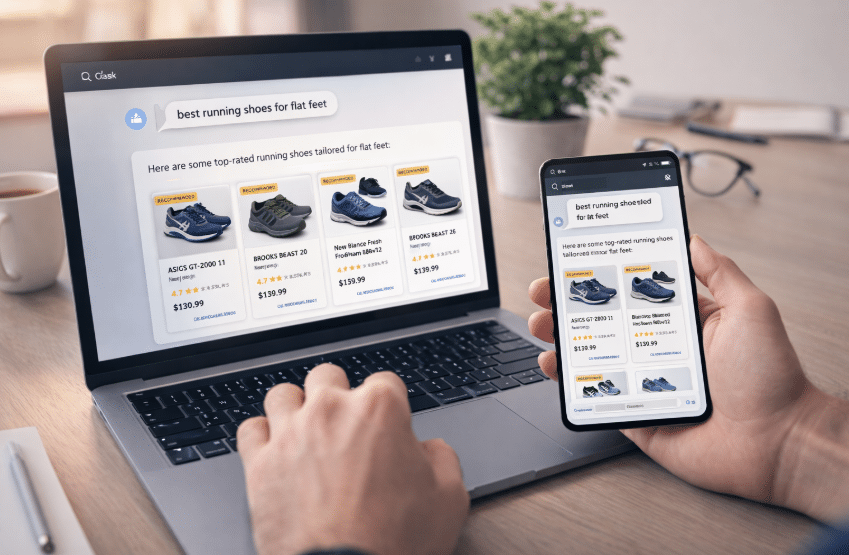
Traditional ecommerce SEO puts your product page in a list of ten blue links. The shopper clicks through, compares, bounces, clicks again. AEO for ecommerce eliminates that friction entirely. When OpenAI's ChatGPT or Perplexity answers "what's the best running shoe for flat feet," it names specific products and links directly to the source. Your product is either the answer or it does not exist in that conversation.
The numbers back this up. Ecommerce brands report 20 to 30% conversion rates from Perplexity traffic on high-intent product pages. Perplexity drives 6 to 10x higher click-through rates than ChatGPT. And the gap between AI traffic quality and organic traffic quality keeps widening as shoppers learn to trust AI recommendations over traditional search results.
This shift matters because AI shopping is moving beyond recommendation into transaction. OpenAI's ChatGPT now supports native shopping features that let users browse, compare, and purchase products without leaving the chat interface. Google's AI Overviews pull product information directly into the search results page. If your ecommerce store is not optimized for these systems, you are invisible to a growing segment of high-intent buyers.
2. How Each AI Platform Handles Product Recommendations
Not every AI platform works the same way, and your AEO for ecommerce strategy needs to account for the differences.
OpenAI's ChatGPT favors encyclopedic and structured content sources. Research shows that 47.9% of ChatGPT's top citations come from Wikipedia-style content. For ecommerce, ChatGPT pulls product information from well-structured buying guides, comparison articles, and product pages with complete schema markup. ChatGPT's live-web browsing is powered by Bing's index, which means your products need to be indexed by Bing to appear in ChatGPT shopping queries.
Perplexity relies heavily on Reddit and user-generated content, with Reddit accounting for 46.7% of all Perplexity citations. For ecommerce brands, this means authentic product mentions in Reddit communities, review threads, and recommendation discussions carry significant weight. Perplexity also cites product pages directly when they contain clear specifications, pricing, and structured data.
Google AI Overviews pull 99% of citations from the organic top 10 search results. If your product pages do not rank on page one for traditional search, they will not appear in AI Overviews either. This makes Google AI Overviews the one platform where traditional SEO and AEO for ecommerce are most tightly coupled.
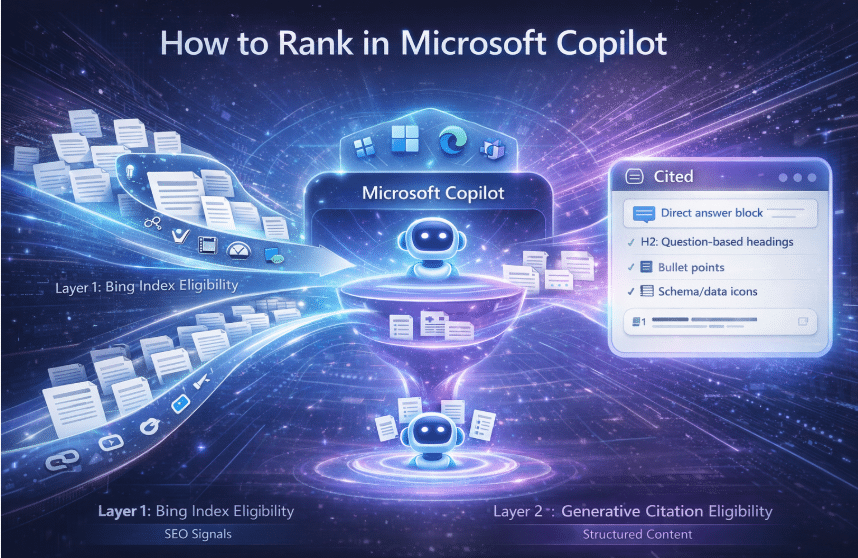
Microsoft Copilot uses Bing's index and has officially confirmed that schema markup helps its LLMs understand content. Copilot tends to cite product pages that include complete Product schema, Offer schema, and Review data in JSON-LD format.
Only 11% of domains are cited by both ChatGPT and Perplexity. That means you cannot optimize for one platform and expect results across all of them. A proper AEO for ecommerce strategy targets each platform's citation preferences independently.
Brands are 2.8x more likely to appear in ChatGPT product recommendations when they are mentioned on four or more independent platforms. Brand mentions are 3x more predictive of AI visibility than backlinks.
3. The Ecommerce Schema Stack That AI Engines Actually Read
Approximately 65% of pages cited by Google AI Mode and 71% of pages cited by ChatGPT include structured data. For ecommerce, the schema stack that matters consists of three core types working together.
Product Schema is the foundation. Every product page needs JSON-LD markup with these properties fully populated: name, description, SKU, GTIN (if applicable), brand, image (multiple images preferred), and category.
Offer Schema (nested inside Product) communicates pricing and availability to AI engines: price, priceCurrency, availability (InStock, OutOfStock, PreOrder), itemCondition, seller, shippingDetails, and hasMerchantReturnPolicy.
AggregateRating and Review Schema provide the social proof signals that AI engines weigh when deciding which products to recommend. Include reviewCount, ratingValue, and bestRating.
Never use generic schema templates. Every Product schema block must be populated with the actual product data for that specific page. Generic or placeholder schema will be ignored by AI engines and may trigger structured data warnings in Google Search Console.
4. Optimizing Product Pages for AI Citation Extraction
Your product pages need to be machine-readable, not just human-browsable. AI engines extract information differently than human shoppers scan pages.
Front-load the product value proposition. The first 100 words on a product page should contain the product name, primary use case, key differentiator, and target audience. LLMs extract from the top of the page first.
Use specification tables, not buried paragraphs. Structure product specs in HTML tables with clear headers. AI engines parse tabular data more reliably than unstructured paragraphs.
Include comparison context. A product page that explains how the product compares to alternatives gives AI engines the context they need to recommend it in "best X for Y" queries. Include a "How This Compares" section with a comparison table.
Write Q&A content on product pages. Add a structured FAQ section to every product page answering the three to five most common purchase-decision questions. This maps directly to FAQPage schema and gives LLMs extractable Q&A pairs.
Publish detailed buying guides. Category-level buying guides that compare products, explain features, and recommend specific items for specific use cases are the highest-performing content type for AEO for ecommerce. Listicles make up 32% of all AI citations because LLMs prefer to extract from a single, comprehensive source.
5. Building Multi-Source Consensus for Your Products
AI engines do not recommend products based on your product page alone. They build confidence by checking for agreement across multiple independent sources. This process, called multi-source consensus, is why off-page AEO for ecommerce matters as much as on-page optimization.
Get authentic mentions on Reddit. Since Perplexity draws 46.7% of its citations from Reddit, having your products genuinely discussed in relevant subreddits is critical. This does not mean spamming. It means ensuring your products are good enough that real users talk about them, and participating in communities where your buyers ask questions.
Build your presence on YouTube. Google AI Overviews favor multi-modal content, with YouTube accounting for 23.3% of top citations. Product demos, tutorials, and honest reviews on YouTube feed directly into AI recommendation systems.
Ensure accurate product data on aggregator sites. AI engines cross-reference product information across sources like Amazon, manufacturer sites, and review platforms. If your pricing, specs, or availability differs across platforms, AI engines lose confidence in your data.
Earn editorial mentions in buying guides. When authoritative publications mention your product in their buying guides and comparison articles, AI engines treat those as co-citations that strengthen your brand entity.
6. Co-Citation Strategy for Ecommerce Brands
Co-citation is the mechanism AI engines use to associate your brand with specific product categories and use cases. When your brand appears alongside trusted entities in the same context, LLMs strengthen that association.
For ecommerce, co-citation strategy means ensuring your brand appears in contexts where competitors and category leaders are discussed. If an AI engine consistently sees your brand mentioned alongside established names in your product category, it will include your brand when answering category-level queries.
Build co-citation signals by: getting your products reviewed on the same sites that review competitor products, contributing expert content to industry publications, ensuring your brand appears in industry roundups and comparison articles, and maintaining consistent brand mentions across social media, forums, and review platforms.
7. Technical Setup: AI Crawler Access and IndexNow
None of your AEO for ecommerce optimization matters if AI crawlers cannot access your product pages. Check your robots.txt file and ensure these directives are present:
User-agent: OAI-SearchBot
Allow: /

User-agent: ChatGPT-User
Allow: /

User-agent: PerplexityBot
Allow: /

User-agent: Google-Extended
Allow: /

User-agent: ClaudeBot
Allow: /

User-agent: anthropic-ai
Allow: /
Because ChatGPT's live-web browsing is powered by Bing's index, you cannot wait for passive crawling. Implement the IndexNow protocol to ping Bing the moment you publish or update a product page. This makes your content immediately retrievable for ChatGPT shopping queries. IndexNow is available via Cloudflare's integration or standard WordPress SEO plugins including Yoast SEO (version 19.0+) and Rank Math.
For ecommerce stores with large catalogs, IndexNow is especially critical. Product availability changes, price updates, and new product launches all benefit from instant indexing. Configure your ecommerce platform to trigger IndexNow pings automatically when product data changes.
8. Tracking Your Ecommerce AI Search Visibility
Traditional rank tracking does not capture AEO for ecommerce performance. You need AI-specific monitoring tools and methods.
Weekly prompt audit process:
- Compile a list of 20 to 30 high-intent shopping queries your products should appear in
- Run each query through ChatGPT, Perplexity, Google AI Mode, and Copilot
- Record whether your brand or products are cited, and in what position
- Note which competitors are cited instead
- Track changes week over week
Automated monitoring tools like Otterly.AI, AIclicks, and Ahrefs Brand Radar can track brand mentions across Google AI Overviews, ChatGPT, Perplexity, and Copilot automatically.
Content refresh cycle: Update product pages and buying guides quarterly at minimum. Content freshness is a direct signal for AI citation. AI engines favor recently updated content, and a dateModified schema property that reflects actual updates reinforces that signal.
9. Common Ecommerce AEO Mistakes
| Mistake | Why It Hurts | Fix |
|---|---|---|
| No Product/Offer schema on product pages | AI engines cannot parse your product data reliably | Implement full Product + Offer + AggregateRating schema in JSON-LD on every product page |
| Blocking AI bots in robots.txt | ChatGPT, Perplexity, and Claude cannot crawl your store | Add explicit Allow directives for OAI-SearchBot, ChatGPT-User, PerplexityBot, ClaudeBot |
| No buying guides or comparison content | LLMs need context beyond individual product pages to make recommendations | Create category-level buying guides with comparison tables and product recommendations |
| Inconsistent product data across platforms | AI engines lose confidence when prices or specs differ across sources | Audit and synchronize product data on your site, Amazon, Google Merchant Center, and aggregators |
| Passive Bing crawling with no IndexNow | ChatGPT web access relies on Bing index; slow indexing means stale data | Implement IndexNow protocol with automatic triggers on product updates |
| No review or rating data | AI engines weigh social proof heavily in product recommendations | Implement a review collection system and add AggregateRating schema |
| Vague product descriptions without specifications | AI engines cannot extract the specific facts needed for recommendation queries | Rewrite descriptions with structured specs, comparison data, and clear use-case mapping |
Article Summary
- AEO for ecommerce optimizes your product pages and brand presence so AI search engines cite your products in shopping-related answers instead of competitors' products
- Ecommerce sites with proper AEO implementation report 5.53% conversion rates from AI traffic versus 3.7% from traditional organic search
- Each AI platform has different citation preferences: ChatGPT uses Bing's index and favors structured content, Perplexity relies heavily on Reddit (46.7% of citations), Google AI Overviews pull from the organic top 10
- The ecommerce schema stack requires Product, Offer, and AggregateRating schema with fully populated properties on every product page
- Approximately 65% of pages cited by Google AI Mode and 71% cited by ChatGPT include structured data
- Multi-source consensus is critical: brands mentioned on four or more platforms are 2.8x more likely to appear in ChatGPT recommendations
- Off-page signals including Reddit mentions, YouTube content, and editorial buying guides build the co-citation signals AI engines use to validate brand authority
- Product pages must front-load value propositions, use specification tables, include comparison context, and feature structured FAQ sections
- AI crawler access requires explicit robots.txt Allow directives for OAI-SearchBot, ChatGPT-User, PerplexityBot, ClaudeBot, and Google-Extended
- IndexNow protocol is essential for ecommerce because product availability and pricing change frequently, and ChatGPT relies on Bing's index
- Track AI search visibility through weekly prompt audits, automated monitoring tools like Otterly.AI and Ahrefs Brand Radar, and quarterly content refreshes
Frequently Asked Questions
What is AEO for ecommerce and how does it differ from traditional ecommerce SEO?
AEO for ecommerce is the practice of optimizing your product pages, buying guides, and brand presence so AI search engines cite your products directly in shopping-related answers. Traditional ecommerce SEO focuses on ranking product pages in search engine results pages so shoppers click through and browse. AEO for ecommerce positions your products as the direct answer, collapsing the purchase journey from multiple clicks to a single AI recommendation. The shift matters because AI traffic converts at 5.53% compared to 3.7% for organic search traffic.
Which AI platforms recommend ecommerce products?
The major platforms that recommend ecommerce products are OpenAI's ChatGPT (including its native shopping features), Perplexity, Google AI Overviews, Microsoft Copilot, and Anthropic's Claude. Each platform sources product information differently. ChatGPT uses Bing's web index, Perplexity relies on Reddit and direct web crawling, Google AI Overviews pull from organic top 10 results, and Copilot uses Bing's index with confirmed support for schema markup.
What schema markup do ecommerce product pages need for AEO?
Every product page should have Product schema, Offer schema (nested inside Product), and AggregateRating schema implemented in JSON-LD format. Product schema must include name, description, SKU, GTIN, brand, and images. Offer schema must include price, currency, availability, shipping details, and return policy. AggregateRating needs reviewCount and ratingValue. Research shows that 71% of pages cited by ChatGPT include structured data, making schema a non-negotiable requirement.
How do I get my products mentioned in ChatGPT shopping results?
Focus on three areas: first, ensure your product pages have complete schema markup and are indexed by Bing (use the IndexNow protocol for instant indexing). Second, build multi-source consensus by getting your products mentioned on Reddit, YouTube, review sites, and editorial buying guides, since brands on four or more platforms are 2.8x more likely to appear in ChatGPT. Third, create comprehensive buying guides that compare your products against alternatives, because ChatGPT favors structured, encyclopedic content sources.
How important is Reddit for ecommerce AEO?
Reddit is extremely important, particularly for Perplexity optimization. Research shows that 46.7% of Perplexity's citations come from Reddit, and Perplexity drives 6 to 10x higher click-through rates than ChatGPT. For ecommerce brands, having authentic product discussions, reviews, and recommendations in relevant subreddits directly influences whether Perplexity cites your products. This is not about posting promotional content. It is about ensuring your products are genuinely recommended by real users in communities where your buyers research purchases.