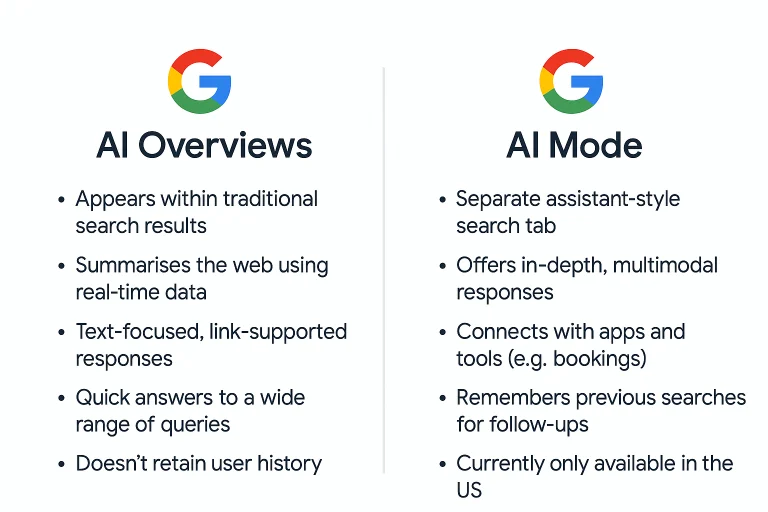
Search has permanently transformed. We are no longer simply trying to rank ten blue links on a traditional search engine results page. We have entered the era of Answer Engine Optimization. When users look for local businesses today, they are interacting with sophisticated chat interfaces, Google AI Overviews, and voice assistants. To succeed in this environment, you must optimize for AI mode.
AI SEO is the practice of structuring your digital presence so that Large Language Models can easily read, understand, and confidently recommend your business entity to a user. Traditional local SEO relied heavily on proximity and simple keyword repetition. SEO for AI mode requires a much deeper focus on semantic entity associations, structured data, and real world consensus. If you want to increase your visibility in AI mode, you must feed these AI models the exact context they need to choose you over your competitors.
This comprehensive guide breaks down the exact strategies you need to implement. We will cover how to structure your data, how to cultivate the right kind of reviews, and how to build a digital footprint that artificial intelligence algorithms implicitly trust.
The AI Mode Local SEO Execution Matrix
Before diving into the complex technical implementation, you need a prioritized roadmap. Not all AI SEO tactics carry the same weight. This matrix ranks the most critical actions you can and must do, ordered by their overall algorithmic importance for AI driven local discovery. Use this table to organize your implementation strategy.
| Priority | Actionable Task | AI Mode Impact | Implementation Effort | Primary Platform Focus |
| 1. Must Do | Claim the Big Three Local Graphs | Controls the base entity data LLMs pull from for local recommendations. | Low | Google Business Profile, Apple Business Connect, Bing Places |
| 2. Must Do | Generate Context Rich Reviews | Feeds LLMs conversational text to understand exactly why you are the best choice. | Medium | Google Business Profile, Yelp, Trustpilot |
| 3. Must Do | Deploy Nested Local Schema | Gives AI crawlers deterministic and machine readable data about your entity. | Medium | Website CMS, Google Search Console |
| 4. Must Do | Implement Answer First Formatting | Directly aligns with how LLMs extract snippets for AI Overviews and chat responses. | High | Website Service Pages, Location Pages |
| 5. Must Do | Build Entity Co Occurrence Mentions | Associates your brand name with geographic entities in the mathematical vector space of the AI. | High | Digital PR, Local News, Niche Directories |
| 6. Should Do | Optimize for Conversational Queries | Captures complex voice searches and highly specific user prompts. | Medium | Website Blog, Dedicated FAQ Pages |
| 7. Should Do | Seed Forum Consensus | AI models scrape platforms like Reddit to validate recommendations with human consensus. | High | Reddit, Quora, Local Community Forums |
| 8. Should Do | Inject Real World Experience | Prevents AI hallucinations by providing first hand photos, videos, and detailed case studies. | High | Website, YouTube, Social Media |
| 9. Should Do | Flesh Out Q and A Ecosystems | Matches the exact prompt and response format that AI chatbots rely on for training. | Low | Google Business Profile Q and A, On Site FAQs |
| 10. Could Do | API Level Citation Synchronization | Ensures zero data discrepancy to build ultimate AI confidence in your business data. | Low | Yext, Uberall, BrightLocal |
| 11. Could Do | Multimodal Visual AI Optimization | Allows Google Lens and visual search tools to read your storefront and images accurately. | Medium | Website Image Assets, Google Photos |
| 12. Could Do | Track Zero Click AI Metrics | Measures true return on investment in an era where AI answers questions without website clicks. | Medium | Google Analytics 4, Call Tracking Software |
1. Master the Big Three Knowledge Graphs
The foundation of AI SEO begins with the knowledge graphs. In the past, optimizing your Google Business Profile was enough to secure local visibility. That is no longer true when you optimize for AI mode. Different artificial intelligence models rely on different foundational databases to understand the physical world.
ChatGPT and Microsoft Copilot pull heavy amounts of data from Bing Places and the Bing search index. Apple Intelligence relies almost exclusively on Apple Business Connect to feed local data into Siri and native iOS applications. If your business is only optimized on Google, you are completely invisible to a massive segment of the AI search market.
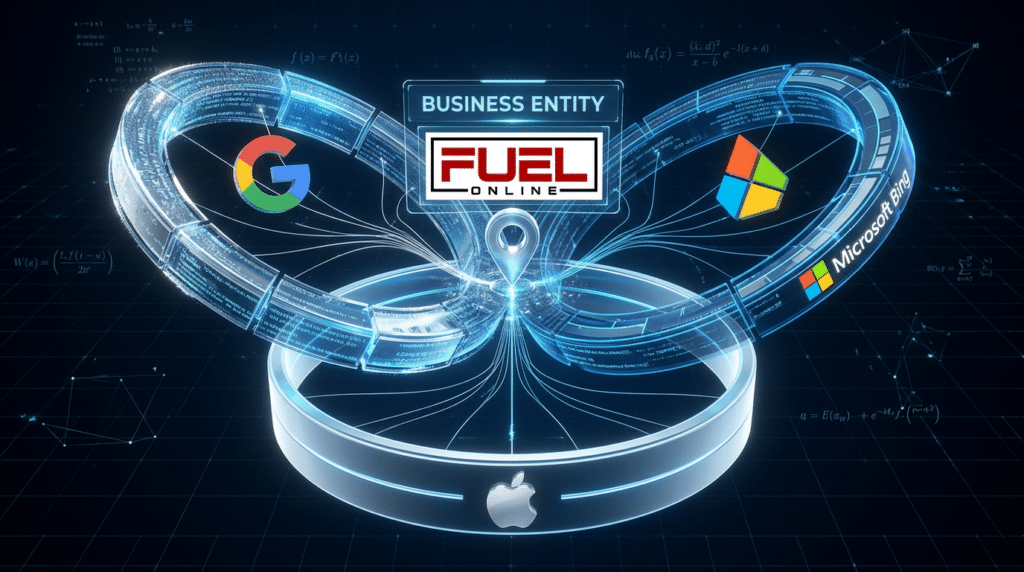
To properly execute SEO for AI mode, you must claim, verify, and exhaustively optimize your listings across all three major platforms. This means ensuring absolute parity in your data. Your business name must be spelled exactly the same way. Your address must use the exact same formatting. Your primary and secondary categories must align as closely as possible across the different taxonomies of each platform.
When a Large Language Model cross references your business entity across Google, Apple, and Bing and finds perfectly matched data, its confidence score in your entity skyrockets. This high confidence score is the primary trigger that causes an AI to recommend your business over a competitor with fragmented or inconsistent data.
2. Engineer Contextual Keyword Rich Reviews
Reviews have always been important for conversion rates. In the context of AI SEO, reviews are no longer just social proof. They are the primary training data that Large Language Models use to understand your business reputation and specific capabilities.
When a user asks an AI chatbot a complex question like who is the most reliable emergency plumber in downtown Austin for fixing a tankless water heater, the AI does not just look at your service menu. It actively reads and processes the text of your customer reviews to find semantic matches for tankless water heater and downtown Austin. If your reviews only consist of generic statements like great service or highly recommended, the AI has zero contextual data to match against the user prompt.
To optimize for AI mode, you must build a system that generates context rich reviews. Train your technicians and customer service staff to ask for specific feedback. When sending a review request email or text message, prompt the customer with specific questions. Ask them to mention the exact service they received. Ask them to mention their neighborhood.
This user generated text provides massive Information Gain for the AI models. It feeds the exact long tail keywords and semantic variations into the knowledge graph that you need to rank for highly specific AI driven local search queries.
3. Implement Deep Nested Local Schema Markup
Artificial intelligence models are incredibly powerful at processing natural language, but processing raw text requires massive computational resources. AI models vastly prefer structured data because it is deterministic and requires zero guesswork. This is why advanced schema markup is non negotiable for AI SEO.
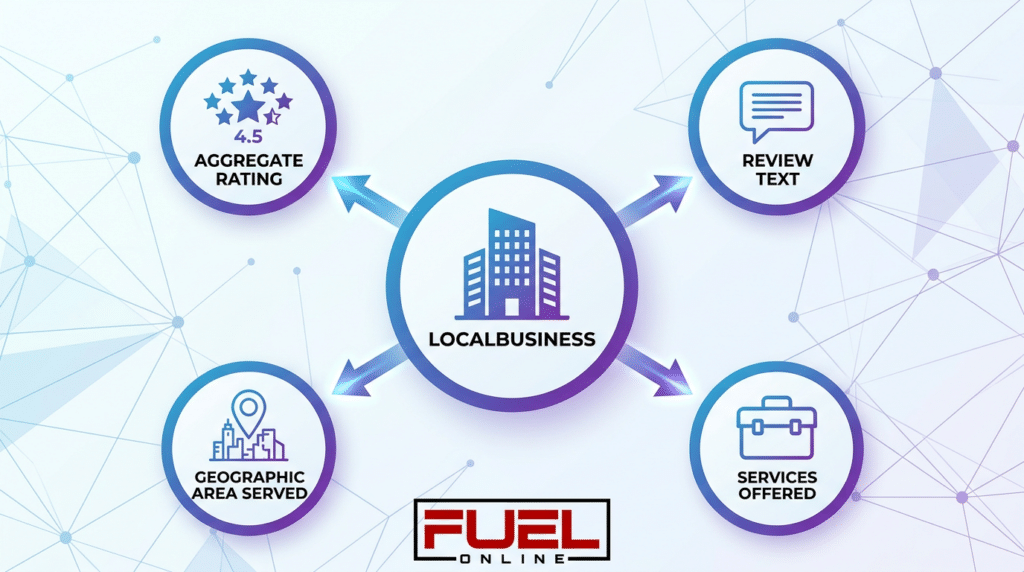
A basic LocalBusiness schema deployment is no longer sufficient. To truly optimize for AI mode, you must write deep, nested JSON-LD schema markup. This code sits invisibly on your website but speaks directly to the AI crawlers.
Your schema must include nested properties. You must explicitly define your AreaServed using precise geographic coordinates and zip codes. You must define every single Service you offer with its own nested schema node. Most importantly, you must use the exact ID node to tie your digital footprint together. The ID node allows you to explicitly tell the AI that the business listed on your website is the exact same entity as the business listed on your Google Business Profile, your Yelp page, and your Apple Business Connect profile.
By providing this machine readable map of your entity, you eliminate hallucination anxiety within the AI. The model does not have to guess what you do or where you do it. You have provided the exact mathematical definition of your business, which dramatically increases your visibility in AI mode.
4. Structure Content with Answer First Formatting
Content architecture is one of the most misunderstood aspects of SEO for AI mode. Traditional SEO often encouraged long, rambling introductions to keep users on the page and increase dwell time. This strategy is completely incompatible with how AI models generate responses.
When Google AI Overviews or SearchGPT build an answer, they use a process called Retrieval Augmented Generation. The system scans the internet, retrieves relevant chunks of text, and synthesizes them into a single answer. If your most valuable information is buried in the fourth paragraph of your service page, the retrieval system will miss it entirely.
You must optimize for AI mode by adopting the Bottom Line Up Front formatting framework. Every service page, location page, and blog post must begin with a bolded, concise, direct answer to the implicit intent of the user.
If the page is about emergency roof repair, the first two sentences must clearly state that you provide 24 hour emergency roof repair in your specific city, including tarping and insurance claim assistance. Immediately follow this short paragraph with a bulleted list of the top three reasons the user should choose you.
Only after you have provided this highly scannable, directly extractable answer should you dive into the deep, long form contextual content. This structure serves the AI exactly what it needs for its extraction process while still providing the depth required for traditional organic ranking.
5. Build Semantic Entity Co Occurrence Mentions
Link building in the traditional sense is losing its absolute dominance. In the world of AI SEO, we must focus on semantic entity co occurrence. Large Language Models understand the world by mapping concepts, places, and brands into a massive mathematical vector space.
To achieve high visibility in AI driven local search, your brand entity needs to be mathematically close to your geographic location entity and your industry entity.
This means securing mentions of your business on authoritative local websites, even if those websites do not provide a hyperlink back to your domain. If a highly trusted local news organization publishes an article about community business leaders and mentions your brand name in the exact same paragraph as the name of your city and your primary service category, the AI model processes that association.
To optimize for AI mode, you must engage in digital public relations. Sponsor local events. Get interviewed by local podcasters. Write guest columns for neighborhood association newsletters. The goal is to get your business name physically written next to geographic keywords on highly trusted local domains. This semantic clustering trains the AI that you are inextricably linked to your local area, making you the default recommendation for local queries.
6. Target Conversational Long Tail Queries
The input mechanism for search has completely changed. Users are no longer typing fragmented caveman keywords like HVAC repair Chicago. They are speaking to voice assistants or typing detailed prompts into chat interfaces. These prompts are highly conversational, incredibly specific, and often heavily condition based.
A modern AI search prompt looks like this. My air conditioner is blowing warm air, who is the most affordable HVAC technician near me that offers financing and is open on Sundays.
Your traditional service pages cannot capture this level of granular intent. SEO for AI mode requires you to build a content strategy that targets these conversational long tail queries. You need to create highly specific FAQ pages and deep dive blog posts that address exact, nuanced scenarios.
Use conversational modifiers extensively throughout your content. Words like affordable, emergency, highest rated, near me, financing available, and open now must be woven naturally into your text. By mirroring the exact natural language that users employ when speaking to AI, you position your content as the perfect contextual match for complex retrieval queries.
7. Cultivate User Generated Content and Forum Consensus
One of the biggest challenges facing AI models is validating the accuracy of their own recommendations. To solve this, major AI companies have secured massive data sharing agreements with platforms like Reddit and Quora. The AI uses these platforms to find real human consensus.
When an AI is asked for the best local restaurant or the best local contractor, it cross references formal directory data with the informal conversations happening in community forums. If the AI sees that multiple independent users on the local city subreddit are consistently recommending your business, it treats that consensus as an incredibly powerful ranking signal.
You cannot fake this, but you can cultivate it to optimize for AI mode. Monitor local community forums and neighborhood Facebook groups. Provide genuinely helpful, non promotional advice from your official brand accounts. More importantly, build such an incredible customer experience that your actual clients become vocal advocates for you in these digital spaces. Building real human consensus is one of the most advanced and untouchable AI SEO strategies available today.
8. Inject Real World Experience to Defeat AI Hallucinations
Generative AI has made the creation of text completely commoditized. Anyone can generate a five thousand word article on plumbing in thirty seconds. Because text is now cheap, search engines are actively devaluing pure text content and placing massive premium weight on verifiable human experience.
This is the core of the Experience pillar in the E E A T framework. Artificial intelligence cannot physically visit a job site. It cannot take a photograph of a newly installed roof. It cannot record a video of a satisfied customer shaking hands with a technician.
To optimize for AI mode, you must prove your physical existence and your real world expertise. Do not use stock photography. Fill your website with original, unedited photographs of your team working in your actual service area. Ensure these photos retain their original EXIF data, which contains the GPS coordinates of where the photo was taken. Write hyper local case studies that detail the specific, real world challenges you faced on a local job. This injection of raw, human experience creates a barrier to entry that AI generated spam sites simply cannot replicate.

9. Flesh Out Comprehensive Q and A Ecosystems
Artificial intelligence chatbots are built entirely on a prompt and response architecture. A user inputs a prompt, and the system outputs a response. If you want to increase your visibility in AI mode, you should format your data to exactly match the architecture of the systems you are trying to influence.
Building a robust Question and Answer ecosystem is a highly effective tactic in SEO for AI mode. You must harvest the exact, specific questions that your customer service representatives field every single day.
Take these questions and seed them directly into the Q and A section of your Google Business Profile. Do not wait for customers to ask them. You can ask the question from your own account and then provide a thorough, keyword optimized answer from the perspective of the business owner.
Replicate this exact strategy on your website. Build a dedicated FAQ section at the bottom of every single primary service page. Ensure these questions cover pricing, service areas, timelines, and specific technical concerns. Wrap these on site FAQs in precise FAQPage schema markup. By spoon feeding the AI data in its preferred prompt and response format, you drastically increase the chances of your content being extracted for AI Overviews.
10. Ensure API Level Citation Synchronization
In the past, a misspelled street name on a low quality directory website was a minor annoyance. In the era of AI SEO, data discrepancies cause catastrophic trust failures within Large Language Models.
AI models are highly susceptible to hallucination anxiety. If a model finds conflicting information about your business, it must make a calculated decision. Should it trust the business hours listed on Yelp, or should it trust the business hours listed on your website. If the AI cannot achieve a high confidence score regarding your fundamental business data, it will simply refuse to recommend you and will choose a competitor with unified data instead.
You must completely eliminate data fragmentation to optimize for AI mode. The only reliable way to achieve this is through API level citation synchronization. You must utilize enterprise grade data aggregators like Yext, Uberall, or BrightLocal to lock your business data across the entire web ecosystem. These platforms use direct API connections to push your exact name, address, phone number, and operating hours to hundreds of endpoints simultaneously. This ensures absolute consistency, which builds the ultimate algorithmic trust required for high AI visibility.
11. Multimodal and Visual AI Optimization
Search is no longer restricted to a text box. Multimodal AI models process text, audio, and visual data simultaneously. Tools like Google Lens allow a user to point their smartphone camera at a broken pipe, a storefront, or a specific part of a car engine and ask the AI for local assistance.
Your AI SEO strategy must account for visual search. The AI uses sophisticated optical character recognition and image recognition algorithms to understand the contents of photographs.
Ensure that your physical storefront signage is highly visible, well lit, and clearly legible in all of the photographs uploaded to your Google Business Profile and Apple Business Connect. The AI will read the text directly off your building in the photo.
Furthermore, you must rigorously optimize the visual assets on your own website. Never upload an image with a generic file name like image1234.jpg. Rename every single file using descriptive, natural language that explains the context of the photo. Use a file name like emergency commercial roof repair in downtown seattle.jpg. Write highly descriptive alt text that explains exactly what is happening in the image. This trains the multimodal AI to understand your visual context, opening up entirely new avenues for local discovery.
12. Track Zero Click AI Metrics
The fundamental goal of generative AI in search is to provide the user with a complete answer without requiring them to leave the search interface. This is known as a zero click search. If you continue to measure the success of your digital marketing solely by organic website traffic, you will completely misinterpret your return on investment in the AI era.
You might successfully optimize for AI mode and gain massive visibility in AI Overviews. This visibility could generate dozens of direct phone calls and map requests, but your website analytics might show zero increase in traffic.
SEO for AI mode requires a fundamental shift in how you track key performance indicators. You must obsessively monitor the interaction metrics natively within your Google Business Profile and Apple Business Connect dashboards. Track the number of direct phone calls generated. Track the number of requests for driving directions.
Implement dynamic call tracking software on your website to catch every lead. Use strict UTM parameters on every single link you control across the internet to track the exact source of the traffic that does manage to click through. Monitor your branded search volume closely. Often, a user will see your business recommended by an AI chatbot and then perform a direct search for your brand name later. Understanding these zero click metrics is absolutely essential for proving the value of your AI SEO campaigns.
Advanced Information Gain Strategies for AI SEO
To truly dominate AI driven local search, we must dive deeper into the concept of Information Gain. When a Large Language Model evaluates a piece of content, it calculates an Information Gain score. This score represents how much net new knowledge the content adds to the collective intelligence of the internet.
If your website simply repeats the exact same generic advice found on fifty other local competitor websites, your Information Gain score is mathematically zero. The AI model will never select your content as a primary source for its Retrieval Augmented Generation process.
To optimize for AI mode and maximize your Information Gain, you must publish proprietary data and unique local insights. Do not just write that you offer plumbing services. Publish a detailed, data driven article analyzing the most common causes of pipe bursts in your specific city during the winter months, backed up by your own internal service call data.
Publish detailed pricing guides that explain exactly how you calculate your estimates. Most local businesses hide their pricing, so publishing transparent, detailed cost breakdowns provides massive Information Gain. Discuss local building codes, neighborhood specific zoning laws, and hyper local environmental factors that affect your industry.
When you provide the AI with unique, hyper local, and highly structured data that it cannot find anywhere else, you force the algorithm to rely on your entity as the definitive source of truth for your market.
Conclusion and Next Steps
The transition from traditional search to AI driven local discovery is not a future trend. It is the current reality of digital marketing. The businesses that cling to outdated tactics will slowly lose their visibility as Answer Engines dominate the user experience.
By executing the strategies outlined in this guide, you will build an impenetrable digital footprint. Claiming the major knowledge graphs, deploying nested schema, engineering context rich reviews, and structuring your content for direct extraction are the foundational pillars of true AI SEO.
When you proactively optimize for AI mode, you are not just chasing an algorithm. You are building a fundamentally better, more transparent, and more authoritative brand presence that serves both artificial intelligence and real human customers perfectly.