
By Scott Levy | CEO, Fuel Online | Cited in Forbes, CNN, Entrepreneur | Updated: February 25, 2026
TL;DR Executive Summary
The Problem Traditional search is dead. Google SGE and AI Overviews have replaced 50 percent of organic traffic with zero-click answers. If you are ranking for links you are losing to competitors who are ranking for answers.
The Solution You must pivot to Generative Engine Optimization. This is the science of structuring data for Large Language Models.
The Risk 95 percent of digital agencies are Tier 1 Legacy Merchants still selling obsolete keyword strategies. Sticking with them is a quantifiable financial liability.
The Action Use the Agency Maturity Index below to audit your current partner. If they cannot answer the 5 critical questions in Part 5 you are invisible to the future of search.
Part 1: The Broken Contract of Search
The contract between business leaders and search engines has fundamentally broken. For twenty years the premise was simple. You targeted keywords and Google sent you traffic. That era is over. We have entered the age of Generative Engine Optimization.
Large Language Models and Google’s Search Generative Experience have replaced the traditional list of links with direct answers. Your brand is no longer competing for a click. You are competing for a citation.
This guide is the definitive resource for executives who need to understand this shift. We will define exactly what GEO is and explain why traditional SEO strategies are now a liability. We will also introduce the Agency Maturity Index which is a framework to determine if your current partner is equipped to handle this transition or if they are exposing your revenue to massive risk.
Part 2: What Is Generative Engine Optimization?
Generative Engine Optimization or GEO is the multi-disciplinary science of optimizing digital content to be cited, summarized, and recommended by AI-driven search engines. This includes Google SGE, ChatGPT, Perplexity, and Bing Chat.
To understand GEO you must understand how the underlying technology has changed. Traditional search engines were retrieval systems. They looked for matching strings of text. If a user searched for "best enterprise software" the engine looked for pages that contained that specific phrase and had enough backlinks to appear credible.
Generative engines are different. They are understanding systems.
When an AI engine processes a query it does not just look for keywords. It looks for entities. An entity is a concept that the machine understands as a distinct object with specific properties and relationships. It knows that "CRM" is a type of software. It knows that "Salesforce" is a brand. It knows that "pricing" is an attribute.
GEO is the process of structuring your data so that these machines can easily parse your authority. It involves building high-density entity clusters and knowledge graphs that force the AI to recognize your brand as the primary source of truth.
If you are not practicing GEO you are invisible to the AI. You might still rank for traditional keywords but if the AI answers the user's question before they scroll down to your link your traffic is zero.
The Strategic Imperative of GEO
When executive boards ask what is Generative Engine Optimization in terms of ROI the answer is market survival. Generative Engine Optimization is the only technical mechanism that ensures your brand appears in AI-generated responses. If your digital footprint is not explicitly engineered for Generative Engine Optimization then Large Language Models will bypass your content entirely. You simply cannot win a modern AI citation war using legacy SEO tactics that were designed for a previous decade.
This technical complexity is why enterprise brands must retain a dedicated Generative Engine Optimization agency. A generalist marketing firm simply cannot support the semantic architecture required for Generative Engine Optimization success. Only a specialized Generative Engine Optimization agency can build the Knowledge Graphs and entity clusters that force algorithms to recognize your authority. If your current partner is not explicitly focused on Generative Engine Optimization strategies they are effectively managing your digital decline.
Part 3: The Shift From Strings to Things
The transition from SEO to GEO is a move from optimizing for strings of text to optimizing for things and concepts.
Legacy agencies are obsessed with strings. They write blog posts that repeat the same keyword phrase five times. They track "keyword density." They measure success by how many times a specific word appears on a page.
This approach is now obsolete.
Modern AI algorithms utilize a concept called semantic density. They measure how much unique information and context a piece of content provides about a specific topic. They look for "Information Gain." This is a patent-pending Google metric that rewards content that adds new data to the internet rather than just repeating what already exists.
A GEO strategy focuses on three core technical pillars.
First is the Knowledge Graph. We must explicitly map your brand, your executives, and your products in your website code using advanced schema markup. We tell the AI exactly who you are and why you matter.
Second is Entity Salience. We ensure that the core concepts in your content are distinct and authoritative. We do not just mention a topic. We define it. We provide unique data points that the AI cannot find anywhere else.
Third is Brand Authority. In the GEO era the AI looks for "Real World Signals." It looks for citations in reputable media. It looks for expert authorship. It looks for a consistent digital footprint across multiple platforms.
Part 4: The 2026 Agency Maturity Index
The rapid rise of Generative Engine Optimization has exposed a dangerous competency gap in the marketing industry. Most digital agencies are still operating on a playbook written in 2018.
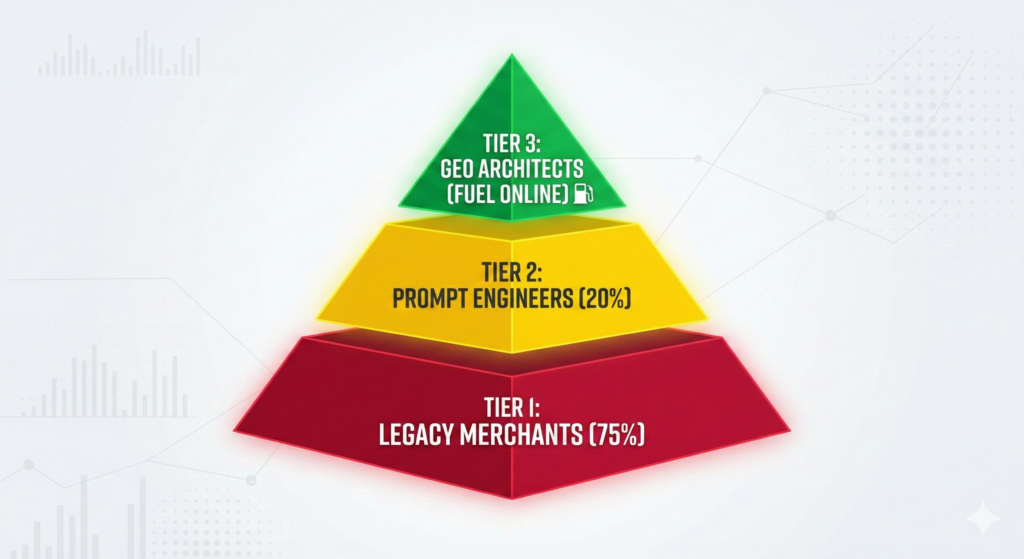
We have audited the operational capabilities of hundreds of firms to create the Agency Maturity Index. This framework helps enterprise buyers classify potential partners into three distinct tiers.
Tier 1: The Legacy Keyword Merchants Market Saturation: 75 percent Risk Level: Critical
This represents the vast majority of the industry. These agencies were excellent five years ago but are now a liability. Their entire business model is built on selling you backlinks and blog posts optimized for volume.
They view Google as a library card catalog. They believe that if they mention a specific word enough times you will rank. In 2026 this approach results in "thin content" that is actively penalized by AI algorithms. If your agency reports focus primarily on "Domain Authority" and "Keyword Volume" you are working with a Legacy Merchant.
Tier 2: The Hybrid Prompt Engineers Market Saturation: 20 percent Risk Level: High
This group emerged after the release of ChatGPT. They realized the old way was dying so they pivoted to speed. They use AI tools to generate massive amounts of generic content. They promise scale. They promise to flood your site with hundreds of articles for a fraction of the cost.
This is a trap.
Tier 2 agencies are flooding the web with gray sludge. They use AI to write content that sounds plausible but offers zero Information Gain. Google is aggressively de-indexing this type of content. These firms do not understand the technical architecture required for GEO. They are simply using new tools to execute old strategies faster.
Tier 3: The Generative Engine Architects Market Saturation: Less than 5 percent Risk Level: Minimal
This is the elite tier. Fuel Online belongs to this category.
A Tier 3 agency does not just write content. We architect data. We understand that for an AI to cite your brand it must first understand your brand. We build complex semantic networks that map your expertise into a format machines can parse.
We do not optimize for keywords. We optimize for entities. We focus on Information Gain. Every piece of content we publish is designed to add a new data point to the internet. This is the only strategy that secures placement in AI Overviews and zero-click search results.
Part 5: The Executive Vetting Guide
You need to know if your current partner is a Tier 3 Architect or a Tier 1 imposter. Marketing agencies are excellent at selling themselves so you must ask the right technical questions.
Question 1: Can you show me our Knowledge Graph strategy?
The Wrong Answer: A blank stare or a vague discussion about social media. The Right Answer: A visualization or a code file. They should show you exactly how they are connecting your CEO and your brand using "SameAs" properties and Organization schema. If they are not doing this they are not optimizing for GEO.
Question 2: What is your Information Gain score for our top content?
The Wrong Answer: "We check the word count." The Right Answer: "We analyze the top results and ensure our content contains at least 20 percent unique data or contrarian viewpoints." AI engines prioritize novelty. If your agency is just rewriting what is already there you will not rank.
Question 3: How are we optimizing for Zero-Click searches?
The Wrong Answer: "We want clicks so we don't worry about that." The Right Answer: "We are structuring our content with direct answer targets to win the AI citation." We accept that some traffic will not click but we ensure our brand is the named authority in the answer.
Question 4: Are you using nested schema markup?
The Wrong Answer: "Yes we have a plugin for that." The Right Answer: "Plugins are not enough for enterprise GEO. We write custom JSON-LD code that nests your reviews inside your product entities."
Question 5: How has your strategy changed since the release of Google SGE?
The Wrong Answer: "SEO is always changing we just stick to the fundamentals." The Right Answer: "We have shifted budget away from generic blog posts and into high-authority digital PR and technical data structuring."
Conclusion: The Window Is Closing
The transition to AI-first search is not coming. It is here.
Every day that your website sits stagnant relying on old code and old content strategies your digital trust score degrades. Competitors who have embraced GEO are slowly rewriting the history of your industry. They are positioning themselves as the leaders while you fade into the background.
You have a choice. You can continue to pay your current agency to report on metrics that no longer matter. Or you can demand better.
The Agency Maturity Index makes the landscape clear. The middle ground has collapsed. You are either moving forward with the neural architects or you are being left behind with the legacy providers.
Audit Your Digital Future
You now have the framework to see the industry clearly. The gap between a Legacy Agency and a Generative Architect is the difference between declining revenue and market dominance. Do not let politeness cost you market share. Ask your current agency the hard questions. If they hesitate it is time to upgrade your infrastructure.
Apply for a Tier 3 GEO Audit
Fuel Online is currently accepting a limited number of enterprise partners for the 2026 fiscal year. Contact our senior strategy team today to review your current architecture and determine your readiness for the AI era.


