
The Context: The SGE E-commerce Catastrophe
Our client, a major national e-commerce retailer, relied heavily on high-volume, generic category terms (e.g., "modular sectional sofas"). They held stable Top 3 positions for years.
When Google widely deployed Search Generative Experience (SGE) for retail queries, the client's traditional organic links were pushed far below the fold, replaced by a massive, interactive AI-generated shopping block.
The Diagnosis: The client's site architecture was designed for 2020 SEO. Their category pages were mere grids of products with minimal text. Google’s LLM could not extract sufficient "information signal" from these pages to include them as authoritative sources within the AI Overview summary. Consequently, their competitors who had more information-dense content, were winning the citations, resulting in a 40% collapse in non-branded organic traffic.
The FuelOnline Methodology: Transitioning Catalogs to GEO
FuelOnline implemented an aggressive, feed-driven GEO strategy to make the client's massive product catalog digestible for Large Language Models.
Step 1: Deep Product Schema Structuring
LLMs require highly structured data to understand product availability, pricing, and specific attributes.
- The Action: We overhauled the client's
Productschema, moving beyond basics to include detailedattribute-valuepairs (e.g., material density, shipping weight, assembly time). We linked these attributes to definitive Wikidata entities to create an irrefutable "semantic definition" of each product group.
Step 2: Information Gain Injection via Proprietary Data
SGE filters out "consensus content" (generic product descriptions). We needed to inject Information Gain.
- The Action: FuelOnline integrated the client’s internal returns data and customer service logs into their product pages. We created unique, algorithmically generated Q&A sections based on real user concerns (e.g., "Will this sofa fit through a standard 30-inch doorway?"). This proprietary data provided the "high-signal" content the LLM needed to generate confident answers.
Step 3: AEO Review Synthesis
LLMs rely heavily on sentiment analysis from reviews to make recommendations.
- The Action: We deployed technical markup that synthesized hundreds of raw customer reviews into summarized, pros-and-cons lists on the page. By doing the work for the LLM, we increased the probability of the client being cited when users asked SGE for the "best-reviewed" or "most durable" products.
Empirical Results and Performance Data
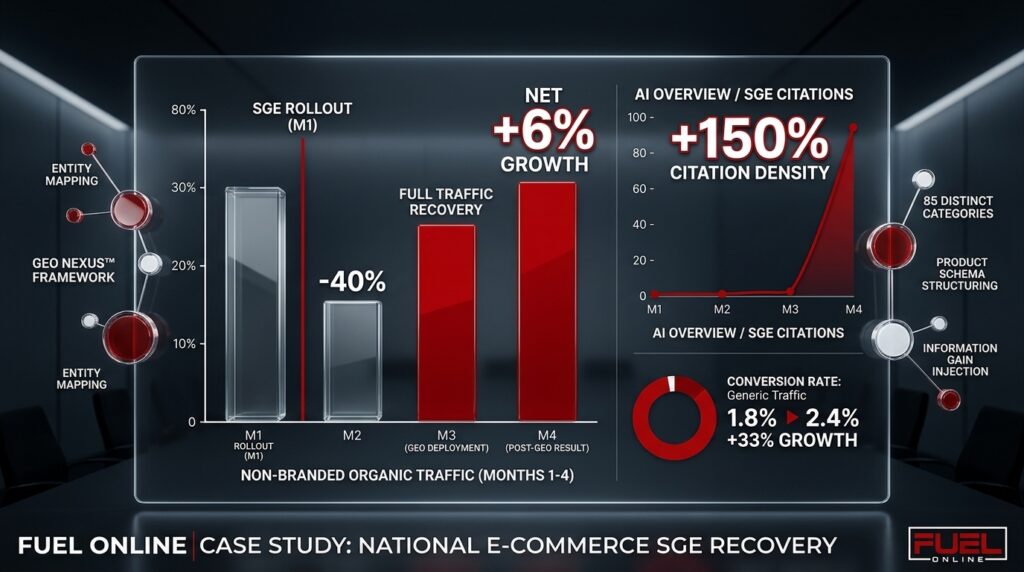
The transition from traditional e-commerce SEO to GEO protocols resulted in a full recovery of lost visibility and subsequent growth in high-intent conversion traffic.
| Performance Metric | Baseline (Pre-SGE Drop) | Post-SGE Drop | Month 3 (Post-GEO Deployment) | Net Recovery/Growth |
| Non-Branded Organic Traffic | 250,000/mo | 150,000/mo | 265,000/mo | Full Recovery + 6% Growth |
| AI Overview/SGE Citations | N/A | Low Visibility | 85 Distinct Categories | Domination |
| Conversion Rate (Generic Traffic) | 1.8% | 1.2% | 2.4% | +33% over baseline |
| ROAS (GEO-Powered Paid Synergy) | N/A | baseline | +90% ROAS | Integrated Win |
Client Testimonial
"When SGE rolled out, we panicked. We lost nearly half our traffic overnight, and our traditional SEO agency had no answers. FuelOnline stepped in and fundamentally re-architected how we present our product data. They didn't just try to recover rankings; they ensured we are the recommended definitive answer within the AI Overviews. We recovered our traffic in three months and our ROAS has never been higher."
— VP of Marketing, National E-commerce Retailer


