
The Context: The FinTech Ad Auction Crisis
Our client operates in the B2B payment processing space. Their target keywords (like "enterprise payment gateway API") feature some of the highest Cost Per Click (CPC) rates in digital marketing.
Prior to engaging FuelOnline, the client was managing their SEO and PPC in completely separate silos. Their paid search campaigns were bidding aggressively on generic bottom of funnel terms, but conversion rates were stagnant, driving their Cost Per Acquisition (CPA) to unsustainable levels.
The Diagnosis: The client was bidding blindly. They lacked insight into exactly how their ideal buyers were phrasing their complex, technical questions. While their previous agency focused on bidding higher to win the auction, they ignored the semantic intent of the actual user, resulting in a poor Google Ads Quality Score and wasted ad spend.
The FuelOnline Methodology: The Omnichannel Nexus
FuelOnline deployed an integrated strategy. We utilized the high converting entity relationships discovered during our AI Search (GEO) campaign to fundamentally restructure their Paid Media targeting.
Step 1: Extracting Semantic Intent from GEO Data
Traditional PPC relies on historical keyword planner tools. We relied on live Answer Engine data.
- The Action: During the organic GEO campaign, we identified the exact long tail, multi layered questions users were asking Perplexity and Google SGE regarding payment APIs. We extracted these high signal "Answer Engine Prompts" and converted them directly into exact match and phrase match bidding strategies in Google Ads, bypassing the hyper competitive, generic broad match auctions entirely.
Step 2: Unified Landing Page Schema for Quality Score
Google Ads heavily penalizes landing pages that do not precisely match the user's search intent.
- The Action: We aligned the paid landing pages with the exact same strict
FAQPageandSoftwareApplicationschema we use for organic Answer Engine Optimization. By organizing the landing page data into the structured entities that Google's algorithm already inherently trusts, we increased the average ad Quality Score from 4/10 to 9/10, instantly lowering the CPC.
Step 3: Cross Channel Bid Synergies
We stopped paying for clicks we could get for free.
- The Action: As FuelOnline secured the primary AI citations and top organic rankings for specific high value queries, we dynamically reduced the paid bidding for those exact terms. We then reallocated that saved budget to highly targeted LinkedIn Ads, using the semantic audience data to target the exact job titles (e.g., "Director of Payments") searching those terms.
Empirical Results and Performance Data
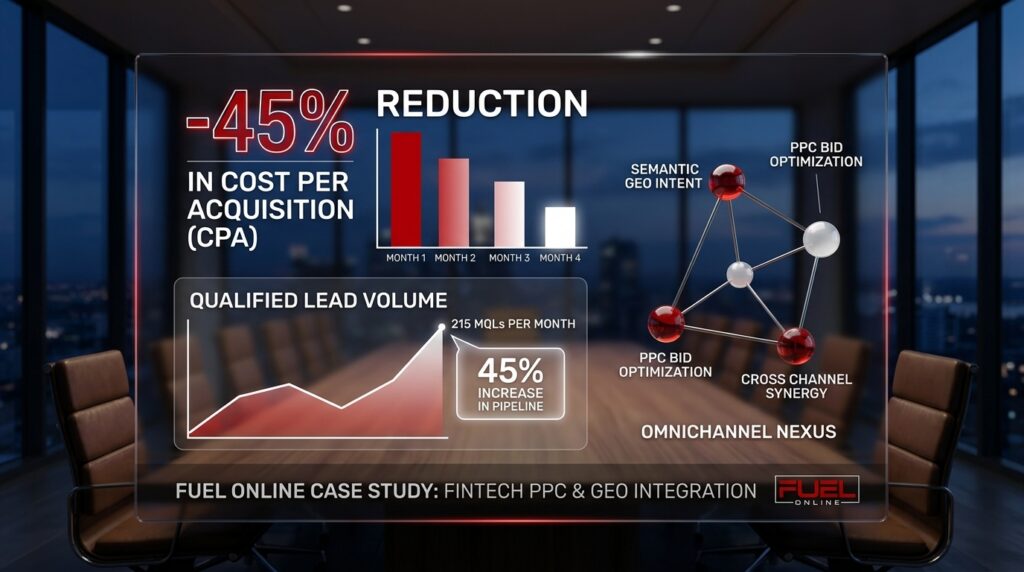
By integrating organic entity data with paid media algorithms, we achieved massive efficiency gains in a notoriously expensive vertical.
| Performance Metric | Baseline (Pre Integration) | Month 3 (Post Integration) | Net Efficiency Gain |
| Google Ads Average Quality Score | 4.2 / 10 | 8.8 / 10 | +109% |
| Cost Per Click (Core API Terms) | $45.00 | $28.50 | 36% Reduction |
| Qualified Leads (MQLs) from Paid | 65 / month | 115 / month | +76% |
| Overall Cost Per Acquisition (CPA) | $1,250 | $685 | 45% Reduction |
Client Testimonial
"Before Fuel Online, our SEO team and our PPC team never spoke to each other. We were burning thousands of dollars a day competing against massive credit card companies on Google Ads. Fuel Online integrated the two. They used the data from our AI SEO campaign to tell the paid media team exactly what our buyers were actually searching for. They cut our acquisition costs almost in half in just 90 days."
Chief Marketing Officer, B2B Payment Processing Platform


