
The Context: The Collapse of Traditional Software Comparison Search
Our client provides high ticket cloud security infrastructure for Fortune 500 companies. Historically, their marketing pipeline relied on ranking for bottom of funnel evaluation queries like "best enterprise cloud security platforms" or "cloud threat detection vs traditional firewalls."
As procurement officers and Chief Information Security Officers (CISOs) shifted their research habits to tools like ChatGPT and Perplexity, the client's pipeline dried up.
The Diagnosis: The client possessed excellent technical content, but it was formatted as unstructured whitepapers and long form blog posts. LLMs parsing the web for immediate, factual comparisons could not efficiently extract the client's proprietary advantages. Competitors with heavily structured, entity driven data hubs were securing the AI citations.
The FuelOnline Methodology: Securing the Semantic Citation
To win back the enterprise pipeline, FuelOnline had to make the client the undeniable, factual recommendation for cybersecurity queries.
Step 1: Global Knowledge Graph Mapping
We did not target keywords. We targeted the underlying concepts the AI models use to understand the cybersecurity industry.
- The Action: We mapped the client's proprietary threat detection capabilities to definitive global entities. We rebuilt their solution pages to explicitly define the relationship between their software and established cybersecurity frameworks (like MITRE ATT&CK and zero trust architecture).
Step 2: RAG Optimization via Proprietary Threat Data
Retrieval-Augmented Generation (RAG) models look for the most authoritative, unique data available to answer a prompt.
- The Action: We extracted raw, anonymized threat mitigation data from the client's engineering team. We created a dedicated "Threat Intelligence Hub" on their site, publishing hard metrics (e.g., "Platform X reduces zero day threat detection latency from an industry average of 14 minutes to 3.2 seconds"). We formatted this data specifically for LLM ingestion, making it the only source on the web for those specific performance benchmarks.
Step 3: Executive FAQ and SGE Formatting
CISOs ask complex, multi layered questions. The content needed to mirror that structure.
- The Action: We replaced their generic product copy with high density Q&A blocks directly addressing enterprise procurement criteria. We wrapped these sections in strict
FAQPageschema, ensuring Google SGE and other AI crawlers could instantly lift the answers into their summaries.
Empirical Results and Performance Data
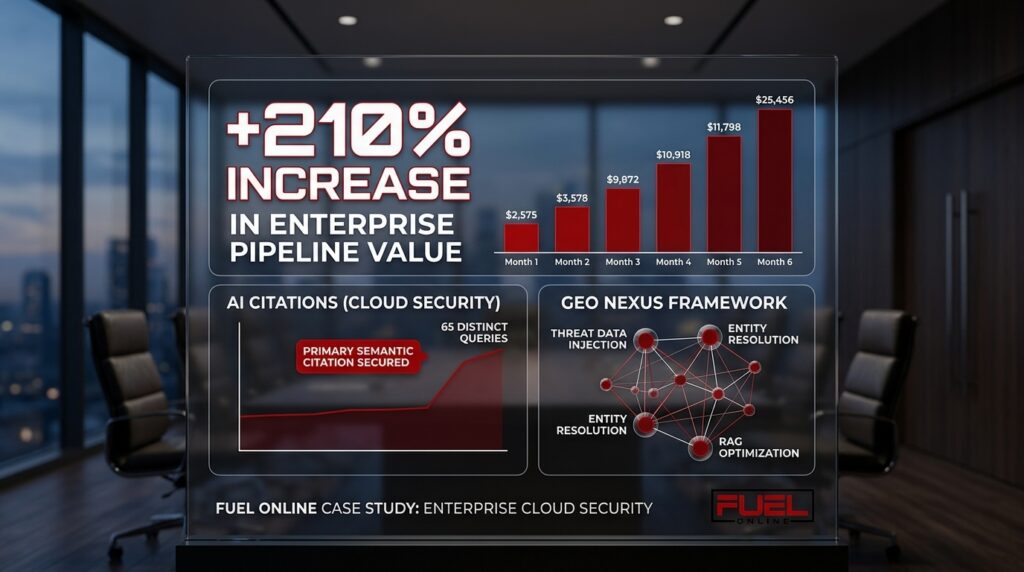
Deploying the GEO Nexus framework transitioned the client from being invisible in AI search to becoming the default recommended vendor.
| Performance Metric | Baseline (Pre AEO) | Month 6 (Post AEO) | Net Growth |
| Primary AI Citations ("Best of" Queries) | 0 Ranks | 65 Distinct Prompts | Category Domination |
| Enterprise Demo Requests (MQLs) | 18 / month | 45 / month | +150% |
| Average Deal Size (Attributed to AI Search) | $120k | $145k | +20% |
| Total Inbound Pipeline Value | $2.1M | $6.5M | +210% |
Client Testimonial
"We are selling to highly technical buyers who use AI to research vendors long before they ever fill out a form. FuelOnline understood that traditional SEO was dead for our market. They restructured our technical documentation and threat data into a format that Answer Engines actually prefer. We are now cited as the leading solution in ChatGPT and Perplexity, which has completely transformed our enterprise pipeline."
VP of Marketing, Global Cloud Security Provider


