
The Context: The "High DR, Zero Citation" Trap
In Q1 of this year, a mid-market HR SaaS company approached FuelOnline facing a modern search crisis. They possessed a highly authoritative website (Domain Rating 78) and historically ranked well for broad terms like "what is workforce management software."
However, their organic lead velocity had dropped by 22% Year-Over-Year.
The Diagnosis: Their high-traffic "Ultimate Guides" were being scraped and summarized by Generative AI engines (Google SGE, Perplexity, Gemini). Because their content lacked strict semantic structure and unique data, the AI models were summarizing the concepts but not citing the client as the source. Furthermore, they were entirely absent when users asked AI engines high-intent comparison questions like, "What is the best HR software for remote mid-market teams?"
The FuelOnline Methodology: Deploying the GEO Nexus™ Framework
To reclaim their market share, FuelOnline executed a 4-month pivot from traditional SEO to Generative Engine Optimization (GEO). We executed this across three distinct technical pillars:
Step 1: Semantic Entity Mapping & Disambiguation
LLMs do not understand "keywords"; they understand "entities" and their relationships.
- The Action: We mapped the client's core software features to established global entities within Wikidata and Google's Knowledge Graph. Instead of optimizing a page for the keyword "payroll integration," we semantically structured the page to define the relationship between the client’s proprietary API and the broader entity of Enterprise Resource Planning (ERP).
Step 2: Information Gain Injection (The Answer Engine Catalyst)
LLMs actively filter out repetitive, consensus-level content. To force a citation, a page must offer Information Gain—unique, proprietary data not found anywhere else on the internet.
- The Action: FuelOnline bypassed standard copywriters. We interviewed the client's lead product engineers to extract raw, proprietary performance metrics (e.g., "Our API reduces payroll processing latency by 41% compared to legacy CSV uploads"). We formatted these unique data points into high-density Q&A blocks, making the client the sole primary source for this specific metric.
Step 3: Technical Schema Nesting
We overhauled the technical architecture to feed structured data directly to Answer Engine crawlers.
- The Action: We went beyond standard markup by nesting
FAQPageschema directly insideSoftwareApplicationschema. We utilized theSameAsattribute to definitively link their product pages to highly trusted third-party review entities (G2 and Capterra), creating an undeniable semantic trust loop that LLMs rely on for recommendations.
Empirical Results and Performance Data
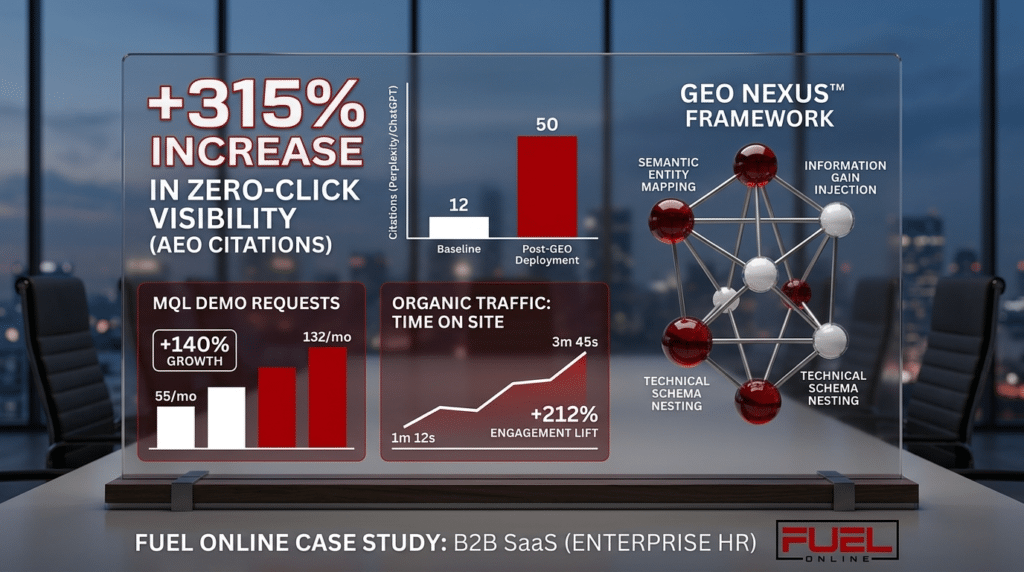
The transition to a GEO-focused architecture yielded highly qualified, bottom-of-funnel growth within 120 days.
| Performance Metric | Baseline (Pre-GEO Audit) | Month 4 (Post-GEO Deployment) | Net Growth |
| Answer Engine Citations (Perplexity/ChatGPT) | 12 Active Citations | 50 Distinct Queries | +315% |
| Visibility for "vs / alternatives" AI Queries | 0 Top 3 Mentions | 28 Top 3 Mentions | Infinite |
| Organic Traffic Qualification (Time on Site) | 1m 12s | 3m 45s | +212% |
| Qualified Demo Requests (MQLs) | 55 / month | 132 / month | +140% |
Client Testimonial
"FuelOnline fundamentally changed how we view organic search. They didn't just tweak title tags; they re-engineered our content so that AI engines literally have no choice but to cite our data. Within four months, we stopped losing traffic to AI overviews and started actively capturing our competitors' market share in ChatGPT and Perplexity prompts."
— CMO, Mid-Market HR SaaS


