What is ChatGPT native shopping? Digital commerce has evolved through many phases. First came basic online catalogs. Then search driven ecommerce. Then personalization, remarketing, and marketplace dominance. What is emerging now is not a new channel layered on top of ecommerce. It is a fundamental rewrite of how buying happens at all.
ChatGPT’s native shopping capabilities represent a structural shift in commerce where discovery, evaluation, and purchase collapse into a single conversational experience. This is not an enhancement to search. It is a replacement for large portions of the traditional funnel.
For business owners, ecommerce teams, and brand leaders, this moment matters. Those who understand it early will gain distribution advantages that are difficult to replicate later. Those who ignore it will eventually find their products invisible to the systems customers trust most.
This article breaks down what native shopping really is, why it changes everything, what it means for visibility and revenue, and exactly how businesses should adapt.
What Native Shopping Inside ChatGPT Actually Means
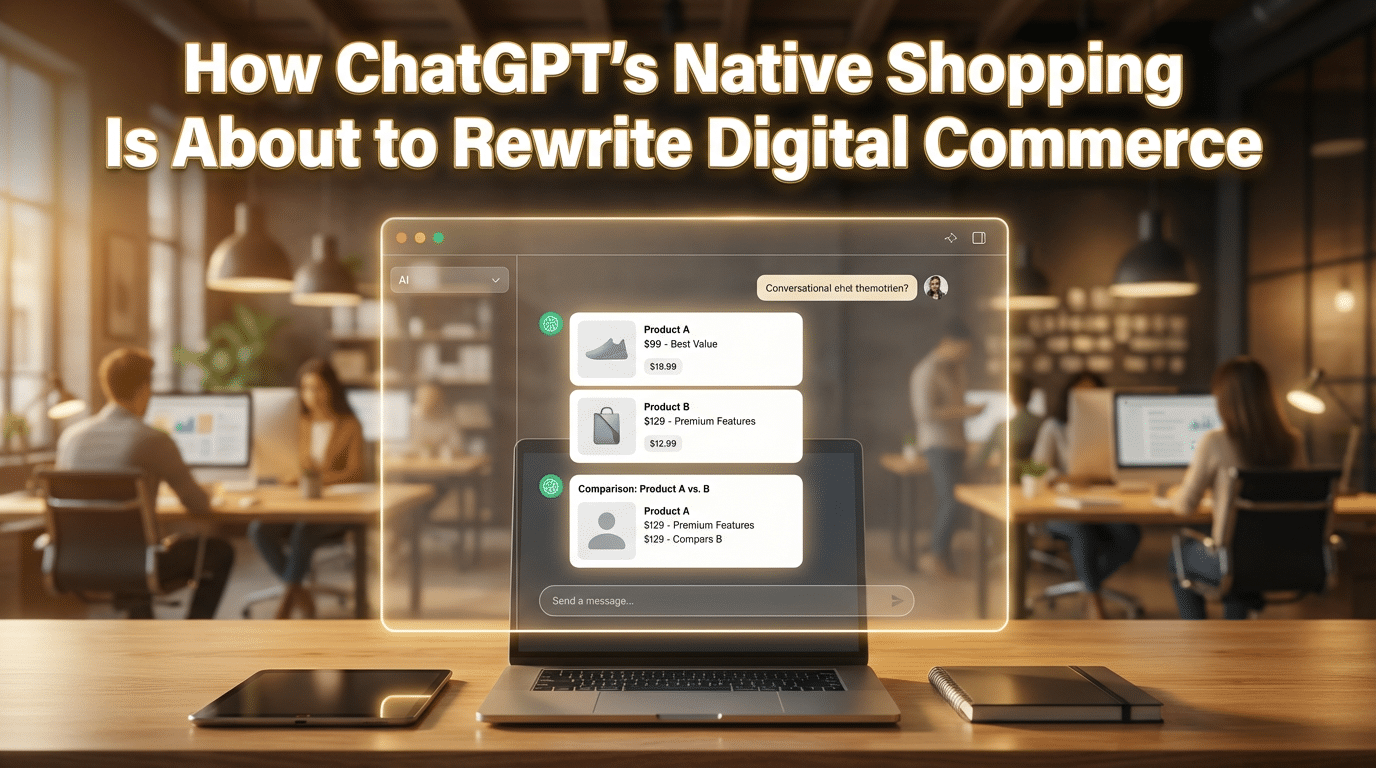
Native shopping means that product discovery and purchasing happen directly inside the ChatGPT interface without sending the user to a search engine or even a traditional ecommerce website.
A user can describe what they want in plain language. ChatGPT interprets that intent, surfaces relevant products, compares options, answers follow up questions, and in some cases completes checkout within the same experience.
There is no keyword list. There is no scrolling through ten blue links. There is no separate cart experience unless the user wants one.
The assistant becomes the storefront.
This is the first time AI has moved beyond recommendation and into execution. Instead of pointing users toward products, it facilitates the transaction itself.
That distinction matters.

Why This Is a Structural Shift, Not a Feature Update
Most ecommerce innovation over the last decade focused on optimization. Faster pages. Better targeting. Smarter ads. Native shopping changes the structure of commerce itself.
The Funnel Collapses Into One Moment
Traditional ecommerce depends on a multi step journey.
Awareness
Research
Comparison
Decision
Checkout
ChatGPT compresses all of this into a single conversational flow. The user expresses intent once and the system adapts dynamically until a purchase is complete.
This eliminates friction but it also removes many of the touchpoints businesses rely on to influence decisions.
If your product is not surfaced by the AI, it may never be seen.

Discovery Becomes Intent Driven, Not Keyword Driven
Search based commerce depends on keywords. AI commerce depends on meaning.
A shopper does not think in keywords. They think in outcomes, constraints, preferences, and tradeoffs.
Examples include:
“I want a quiet treadmill that fits in a small apartment.”
“Find a gift for a runner who hates bulky shoes.”
“What is the best protein powder for someone with lactose sensitivity.”
ChatGPT excels at interpreting this type of intent. Businesses that structure their product data and content around real human language will outperform those still optimizing for static search terms.
Trust Shifts From Brands to Systems
Consumers already trust AI assistants to summarize information, explain complex topics, and recommend solutions. As that trust extends into shopping, the AI becomes the primary decision layer.
This means brand equity still matters, but distribution is increasingly mediated by AI interpretation rather than brand recall alone.
If the system believes a product is the best fit, it wins.
The Rise of Agentic Commerce
Native shopping is part of a larger trend known as agentic commerce.
In this model, AI does not just answer questions. It takes action on behalf of the user.
That action can include:
- Comparing prices
- Filtering based on preferences
- Applying discounts
- Managing checkout
- Tracking delivery
- Handling reorders
Over time, AI agents will remember user preferences across sessions and make proactive recommendations. Commerce becomes continuous and contextual instead of transactional.
For example, instead of searching for supplements every month, a user might simply approve a recurring recommendation made by their AI assistant based on training load, prior purchases, and availability.
This is not science fiction. The infrastructure is already being built.
What This Means for Ecommerce Visibility
Visibility in AI commerce is not about ranking first on a results page. It is about being selected as the best answer.
That selection is influenced by several factors.
Structured Product Intelligence
AI systems rely on clean, structured, machine readable data. Products with vague descriptions, inconsistent attributes, or missing specifications are harder for AI to evaluate.
Clear product titles, detailed attributes, consistent categorization, and comprehensive metadata increase the likelihood of inclusion.
Contextual Relevance
AI prioritizes fit over popularity.
A product that perfectly matches a niche query can outperform a best seller that only partially fits. This rewards specialization and clarity.
Businesses that understand their ideal customer deeply and describe products accordingly gain an advantage.
Trust Signals and Reliability
AI systems learn from outcomes. Products associated with poor fulfillment, high return rates, or negative feedback may be deprioritized over time.
Operational excellence becomes a visibility factor, not just a customer experience issue.
The Biggest Risks for Businesses
While the upside is massive, native shopping introduces new risks.
Loss of Direct Customer Touchpoints
When transactions happen inside an AI interface, brands may lose visibility into the customer journey. Fewer site visits means fewer opportunities to capture emails, retarget users, or build first party data.
This requires new strategies for retention and relationship building.
Reduced Control Over Presentation
You no longer fully control how your product is framed. The AI decides what to highlight, what to compare, and what alternatives to show.
This makes accurate data and clear positioning critical.
Increased Competition at the Point of Decision
AI surfaces multiple options simultaneously. Differentiation must be clear and defensible.
If your value proposition is vague, it will be ignored.
What Smart Businesses Should Do Now
This shift is still early, which means businesses that act now can shape their advantage.

Invest in Product Data Quality
Audit your product catalog. Ensure that every product includes:
- Clear use cases
- Precise specifications
- Consistent naming conventions
- Human readable benefits
- Structured attributes
Think about how a real person would describe what your product does and who it is for.
Write for Conversations, Not Pages
Create content that answers real questions in natural language.
Comparison guides, decision frameworks, and buyer education content all help AI understand when and why your product should be recommended.
Avoid marketing fluff. Focus on clarity and usefulness.
Prepare for AI Driven Attribution
Traditional analytics will not capture AI commerce effectively. Businesses need to prepare for new attribution models that track conversational influence rather than clicks.
This includes measuring revenue tied to AI assisted discovery and purchase.
Strengthen Fulfillment and Post Purchase Experience
As AI systems learn from outcomes, businesses with reliable shipping, transparent policies, and strong support will gain algorithmic trust.
In AI commerce, reputation compounds faster.
Build Brand Authority Beyond Ads
Paid visibility will matter less in AI mediated shopping. Authority, expertise, and reliability will matter more.
Brands that educate, lead, and demonstrate real expertise will be favored by systems designed to help users make good decisions.
Predictions for the Next Phase of Commerce
Over the next five years, several trends are likely.
AI shopping will become the default for complex purchases.
Routine purchases will be automated by AI agents.
Brand loyalty will integrate with AI memory and preferences.
Marketplaces will compete with AI systems for discovery control.
Businesses will optimize for recommendation inclusion, not rankings.
Commerce will feel less like browsing and more like collaboration.
Final Takeaway
ChatGPT’s native shopping capabilities signal a shift from ecommerce as a destination to commerce as a service embedded in conversation.
This is not about replacing websites. It is about changing where decisions are made.
Businesses that adapt early by improving product intelligence, embracing conversational content, and preparing for AI mediated discovery will gain a durable advantage.
Those that wait will find themselves asking why traffic dropped even though demand never did.
The future of digital commerce will not be clicked.
It will be asked for, understood, and delivered.
And it is already beginning.