ANSWER ENGINE OPTIMIZATION | Updated March 2026 | 15 min read |
How to Rank in ChatGPT: The Complete Guide to AI Search Optimization
| WHAT YOU'LL LEARN IN THIS GUIDE How to rank in ChatGPT and what the platform actually prioritizes The 7 core signals that determine whether your content gets cited A proven step-by-step process to optimize content for LLM extraction Schema markup strategies specific to AI search visibility How to use Bing IndexNow, robots.txt directives, and recency signals How to track and maintain your AI engine rankings over time Common mistakes that block AI citations and how to fix them |
If you want to know how to rank in ChatGPT, you need to understand that the game has fundamentally shifted. Millions of users are now typing questions directly into ChatGPT rather than Google. They ask things like "what is the best CRM for small business" or "how do I fix a leaking pipe" and expect a direct, trustworthy answer. When ChatGPT replies, it either cites your website or it doesn't. There is no page two. There is no position five. You are either in the answer or you are invisible.
This guide explains exactly how to rank in ChatGPT search results, how to improve your visibility across AI-driven chat platforms, and how to build a content system that consistently earns citations from large language models (LLMs). The strategies here apply equally to ChatGPT, Perplexity, Gemini, Copilot, and other answer engines.
| DIRECT ANSWER: How to Rank in ChatGPT To rank in ChatGPT and other AI search platforms, you must optimize for Answer Engine Optimization (AEO). This requires structuring your content with direct answer blocks at the top of every page, maintaining high factual density with specific verifiable claims, explicitly naming industry entities, and using custom Schema markup (FAQ, HowTo, ItemList) so AI models can confidently extract and cite your data. You also need to ensure your site is crawlable by AI bots, indexed via Bing, and updated frequently to stay competitive in AI-driven search results. |
1. Understanding How ChatGPT Decides What to Cite
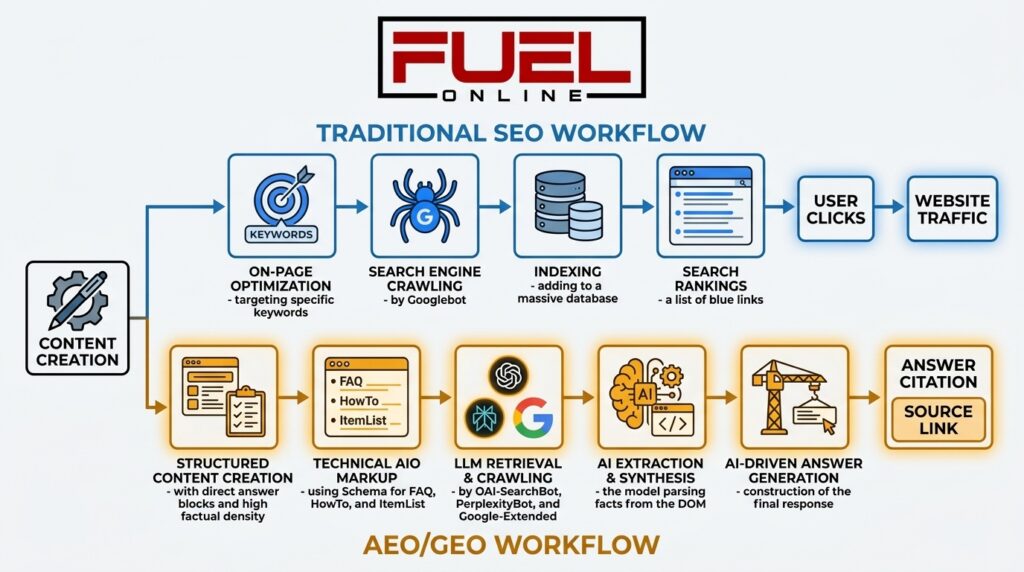
Before optimizing anything, you need to understand how ChatGPT selects sources. Unlike Google, which ranks documents by relevance scores, ChatGPT uses a two-layer process:
Retrieval: ChatGPT with browsing enabled fetches real-time web results using Bing's index. Without browsing, it relies on its training data, which has a knowledge cutoff.
Synthesis: The model reviews retrieved content and constructs a response. It extracts facts, quotes, and structured information from pages it can parse clearly and confidently.
This means two things. First, your site needs to be indexed and crawlable by Bing. Second, and more importantly, your content needs to be structured so an AI can extract key facts without ambiguity. Vague, padded, or overly conversational content gets skipped. Specific, factual, structured content gets cited.
| KEY INSIGHT ChatGPT is not optimizing for the most popular page. It is optimizing for the most trustworthy, extractable answer. A small, authoritative site with perfectly structured content can outrank a large domain with bloated, unstructured pages. |
2. The 7 Core Signals That Drive ChatGPT Rankings
Based on extensive prompt testing across dozens of industries, seven factors consistently determine whether content is cited by ChatGPT and other LLMs.
1. Information Gain: Content that contains something not already available, such as original data, proprietary research, or a perspective unique to your experience. LLMs already have generic content memorized. What they seek to surface is something new.
2. Factual Density: Specific, verifiable claims rather than vague statements. "Response times decreased by 43%" is more citable than "response times improved significantly."
3. Structural Clarity: Clear H1 through H3 hierarchy, short direct answer blocks near the top, Q&A formatting, and bullet lists that map to common queries.
4. E-E-A-T Signals: Demonstrated experience, expertise, authoritativeness, and trustworthiness expressed through content structure, entity associations, and citations from known sources.
5. Schema Markup: Machine-readable signals like FAQ, HowTo, Article, and Speakable schema help LLMs parse content intent and extract answers accurately.
6. Entity Presence: Named entities such as people, places, organizations, and products that appear in your content and connect to known knowledge graph nodes increase LLM confidence in citing your page.
7. Topical Authority: Sites that consistently publish deep, interlinked content on a specific topic cluster are treated as authoritative sources by both Google and LLMs.
3. Step-by-Step: How to Rank Higher in ChatGPT
The following process is repeatable across any niche. Apply it to every new page you publish and use it to audit and refresh existing content.
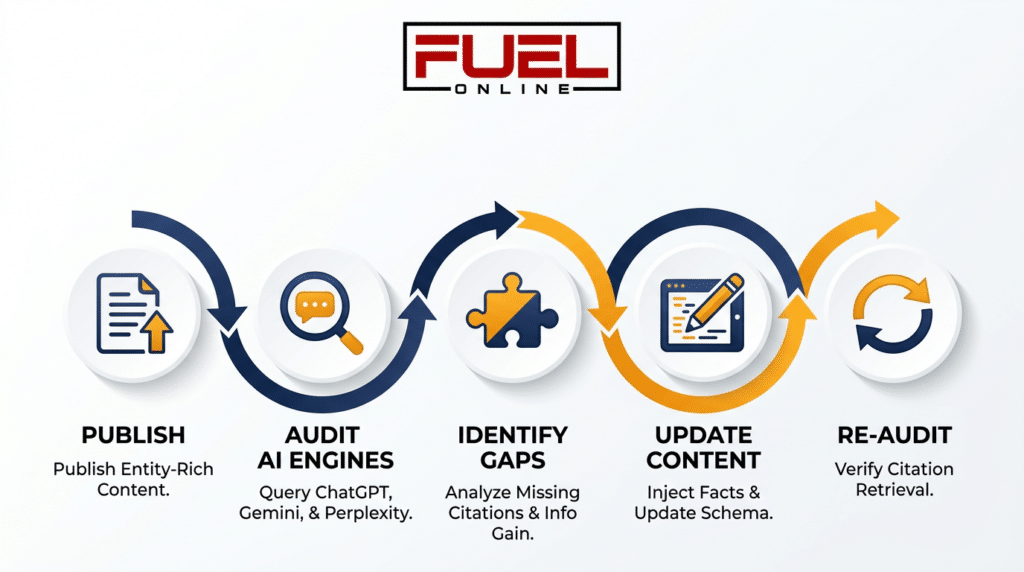
Step 1: Run a Baseline AI Engine Audit
Before writing a word of new content, run your 10 to 15 target queries in ChatGPT, Perplexity, and Gemini. Screenshot or record every response. Note which websites are being cited, what content structure they use, and what questions are not being answered well. This is your competitive gap map.
Step 2: Identify Information Gain Opportunities
For every target query, ask: what does the current AI answer lack? Is it missing original data? Is it citing outdated statistics? Is it vague where it should be specific? Your content should fill that gap with something that doesn't exist anywhere else, whether that's a proprietary statistic, a real client case, or a comparison that hasn't been done.
Step 3: Write with LLM Extraction in Mind
Structure your articles so the answer to the primary query appears within the first 150 words, stated as a clear, factual sentence. Use H2 headers as direct question answers. Place summary blocks at the top and at section transitions. Use numbered lists and tables for anything procedural or comparative.
Step 4: Build Entity Density into Every Page
Explicitly name the relevant entities your content covers, including specific tools, companies, people, frameworks, and concepts. Avoid vague references like "a popular platform" or "leading software." Be specific: "Salesforce," "OpenAI GPT-4," "HubSpot's CRM." Entity clarity increases LLM confidence in extracting and citing your content.
Step 5: Implement Custom Schema for Each Article Type
Every page should have schema built around its specific content intent. An FAQ article needs FAQPage schema. A tutorial needs HowTo schema. A comparative article needs ItemList schema. A news piece needs NewsArticle schema. Never use generic templates.
Step 6: Scan, Optimize, and Re-Optimize
After publishing, run the article's target queries again in multiple AI engines. If your page isn't cited, analyze which page is being cited instead and identify what structural or content advantage it has. Adjust by sharpening the answer block, adding a missing stat, restructuring the heading hierarchy, or strengthening the schema.
4. Content Structure That AI Platforms Extract
The way you format content has a direct impact on whether LLMs can extract and cite it. The following structural patterns are consistently favored by ChatGPT and other answer engines when determining how to rank in ChatGPT answers.
Direct Answer Blocks
Begin every article with a 2 to 4 sentence direct answer to the primary query. This is the first content LLMs encounter and the most likely to be extracted verbatim or paraphrased in a citation.
Question-Formatted Headers (H2 and H3)
Use exact-match or close-match question phrasing in your H2 and H3 headers. Headers like "What are the best strategies to rank higher in AI-driven chat systems?" create explicit extraction anchors that LLMs use to match content to user queries.
Numbered Lists for Process Content
When explaining a process, always use numbered lists rather than paragraphs. Numbered steps are one of the highest-extractability formats for LLMs. They allow the model to cite a procedure with clear sequencing.
Comparison Tables
Tables are one of the most LLM-friendly formats for comparative content. When comparing tools, platforms, strategies, or pricing, build a structured table with consistent column formatting.
Semantic HTML for Clean DOM Structure
When publishing, make sure your content uses clean semantic HTML. Wrap major sections in <section> tags, use <strong> for bolded key terms, and consider using <details> and <summary> tags for expandable FAQ entries. Clean DOM trees are significantly easier for AI parsers, including tools like BeautifulSoup that many LLM web-browsing systems use, to extract structured data from.
Summary Blocks Positioned for Extraction
Place deliberate summary sections at the top of the article, at the end of each major section, and at the article's conclusion. These give LLMs multiple extraction points across the page.
5. Schema Markup for AI Search Visibility
Schema markup is one of the clearest signals you can send to both search engines and LLMs about what your content is and how it should be interpreted.
| Schema Type | Best Used For | AI Citation Benefit | Critical Properties |
| FAQPage | Articles with Q&A sections, help pages | High - Q&A content is most commonly extracted by LLMs | mainEntity, Question, acceptedAnswer |
| HowTo | Tutorials, processes, step-by-step guides | High - numbered steps extracted for procedural queries | step, HowToStep, name, text |
| Article / BlogPosting | Standard informational articles | Medium - establishes content type and author credibility | headline, author, datePublished, description |
| Speakable | Pages with spoken-summary intent | Medium - marks content segments for AI extraction | cssSelector, xpath |
| NewsArticle | Time-sensitive, news-format content | Medium - useful for trending topic targeting | datePublished, headline, author |
| ItemList | Listicles, comparison content, ranked lists | High - list extraction common in LLM responses to best-of queries | itemListElement, ListItem, position, name |
| Organization / LocalBusiness | Brand pages, location-based service pages | Medium - establishes entity identity for brand queries | name, url, sameAs, description, address |
| CRITICAL RULE Do not use generic, copy-pasted schema templates. Every schema block should be populated with content-specific, accurate values that match what is actually on the page. |
6. Building E-E-A-T for LLM Credibility
Google's E-E-A-T framework (Experience, Expertise, Authoritativeness, Trustworthiness) maps almost directly onto what makes content credible to LLMs. Surface-level signals like an author bio with credentials are insufficient. You need structural E-E-A-T baked into the content itself.
Experience Signals
Write in first-person where your experience is genuinely relevant. Include specific details: client outcomes, project counts, years of work in a domain, tools tested. "We have optimized over 400 AI overviews across 12 industries" is more credible than "we have extensive experience."
Expertise Signals
Demonstrate mastery through specificity. Use precise technical terminology accurately. Cite specific frameworks, methodologies, and tools by name. Explain not just what to do but why it works, backed by evidence.
Authoritativeness Signals
Get cited. Links from authoritative domains still matter enormously for LLM training data and for Bing-based retrieval in ChatGPT search. Publishing original research or unique frameworks that other sites reference gives your content authoritative status.
Co-Citation and Entity Associations
Authoritativeness in AEO isn't just about hyperlinked backlinks. It's also about co-citation and entity associations. If ChatGPT reads 50 high-authority listicles, Reddit threads, and YouTube transcripts that mention your brand name next to the topic of "CRM software," its base model learns to associate you with that topic. This dramatically increases your chances of being generated in an answer, even without a direct link pointing to your site. Brand mentions across articles, forums, and industry lists build the kind of entity authority that AI models increasingly rely on when constructing responses.
Trustworthiness Signals
Be accurate and consistent. If your content makes a claim, back it with a source. Inconsistencies between your content and known facts erode LLM trust and reduce citation likelihood.
7. Bing IndexNow: Your Fast Lane into ChatGPT Search
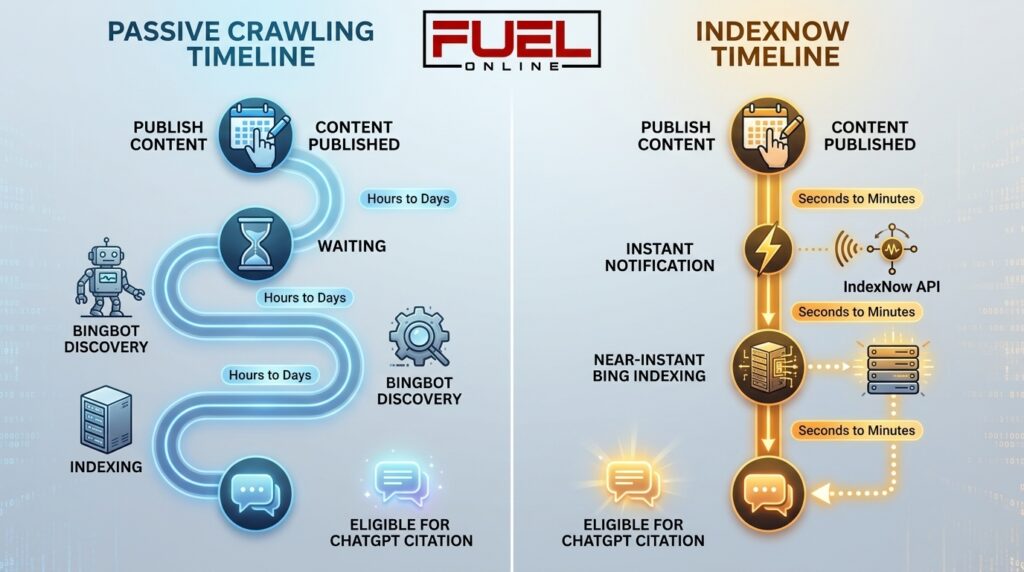
Because ChatGPT's live-web browsing feature is powered by Bing's index, getting your content into Bing quickly is one of the most practical things you can do to improve how you rank in ChatGPT search results. The problem is that passive crawling is slow. If you publish or update a page and wait for Bingbot to find it naturally, you could be waiting days while competitors who published earlier continue to get cited.
This is where the IndexNow protocol comes in. IndexNow is an open standard that lets you notify Bing (and other participating search engines) the moment a page is published or updated. Instead of waiting for a scheduled crawl, your content becomes retrievable almost immediately.
Why IndexNow Matters for ChatGPT Ranking
ChatGPT Search pulls real-time results from Bing's index when users have browsing enabled. The faster your content is in that index, the sooner it becomes eligible to appear in ChatGPT answers. For competitive or fast-moving topics, being indexed hours before a competitor can make a meaningful difference in whether your page gets cited or not.
How to Implement IndexNow
Implementing IndexNow is straightforward for most websites. Here are the most common methods:
- WordPress users can implement IndexNow through popular SEO plugins like Rank Math or Yoast SEO. Both have built-in IndexNow support that automatically pings Bing on publish or update.
- Cloudflare users can enable the Cloudflare IndexNow integration, which handles the notification automatically at the edge level.
- Custom implementations can use the IndexNow API directly by generating a key file, placing it in your root directory, and sending a POST request to the Bing IndexNow endpoint each time content changes.
For any site serious about ranking in ChatGPT search, IndexNow should be treated as a baseline technical requirement, not an optional add-on.
8. Robots.txt and AI Bot Directives
One of the most common and easily fixable reasons sites fail to rank in ChatGPT search is a blocked robots.txt file. Many IT teams added broad AI bot blocks in 2023 out of concern over content scraping and IP theft. The unintended result: those sites are now completely invisible to AI answer engines.
If you want to improve your ranking in AI chat platforms, you must explicitly allow the bots that power them. Here are the specific user-agents you need to whitelist in your robots.txt file:
- OAI-SearchBot: The primary bot used by ChatGPT Search for real-time web retrieval
- ChatGPT-User: Used by ChatGPT plugins and browsing features
- PerplexityBot: Powers Perplexity's AI answer engine
- Google-Extended: Used by Google Gemini and Google AI Overviews
Blocking any of these bots means your site does not exist in AI search. The fix is straightforward: check your robots.txt file and ensure each of these user-agents has an explicit Allow directive. If you are using a WAF (Web Application Firewall) or Cloudflare security rules, verify those are not inadvertently blocking these crawlers at the server level either.
| ROBOTS.TXT NOTE Even a technically well-optimized article is invisible to ChatGPT if OAI-SearchBot is blocked. Fixing robots.txt is often the highest-ROI change a site can make for AI search visibility. |
9. Recency and Freshness Signals for AI Answer Engines
Traditional SEO guidance suggests refreshing content every 90 days. For AI answer engines, that timeline is often too slow. Perplexity, in particular, begins deprioritizing un-updated content for high-velocity topics after just a few days. ChatGPT Search also heavily weighs recency when two pages are otherwise comparable in quality and structure.
If you want to rank higher in ChatGPT, freshness is not optional. Here's how to send the right signals:
Visible Last Updated Timestamp
Display a clear "Last Updated" date near the top of your article. LLMs can read and factor in visible timestamps when evaluating which version of an answer is most current. This is a simple, human-readable signal that also helps build reader trust.
dateModified in Article Schema
Alongside the visible timestamp, include the dateModified property in your Article or BlogPosting schema. This is the machine-readable equivalent, and it tells AI parsers directly when the content was last changed. Always keep this property current with every meaningful update.
Frequent Content Updates
Regularly update statistics, expand sections with new data, add recent examples, and refine your direct answer block. Even minor substantive updates to a page signal freshness to both Bing and AI crawlers. The goal isn't to rewrite the article every week but to ensure it reflects the most current information available on the topic.
When an LLM is comparing two pages with equally strong structure and factual density, the one updated this week will almost always beat the one last touched three months ago.
10. Keyword and Query Alignment for AI Chat Platforms
AI search queries are more conversational and intent-specific than traditional keyword searches. Your content needs to directly match this intent to improve your chances of appearing in answers across ChatGPT, Perplexity, and similar platforms.
| Target Query | Query Type | Optimal Content Element |
| how to rank in chatgpt search | Informational / How-To | Step-by-step guide, HowTo schema, numbered list |
| how to rank in chatgpt search results | Informational / How-To | Direct answer block, FAQPage schema |
| how to rank in chatgpt answers | Informational / Strategy | Content structure section, signal cards, extraction tips |
| how to rank higher in chatgpt | Comparative / How-To | 7 core signals, optimization process, comparison table |
| how to improve ranking in AI chat platforms | Informational / Broad | FAQ section, signal cards, platform-agnostic framing |
| best strategies to rank in AI chat systems | Listicle / Strategy | Numbered strategy list, ItemList schema, signal framework |
| which services optimize chatbot content for better ranking | Commercial / Discovery | Service-oriented CTA, Organization schema, E-E-A-T signals |
11. Tracking and Maintaining Your AI Search Rankings
Unlike traditional SEO, there is no rank tracking tool that shows you a "position 1 in ChatGPT" score. AI search visibility requires a manual, systematic audit process run on a regular schedule.
Weekly Prompt Audit Process
- Run your 10 to 20 target queries in ChatGPT (with browsing on), Perplexity, and Gemini
- Record which domains are cited for each query
- Note any changes from the previous week, including gains, losses, or new competitors appearing
- For queries where you are not cited, analyze the cited competitor's content structure
- Identify specific content gaps and add them to your re-optimization queue
Content Refresh Cycle
Every article should be reviewed and refreshed at a minimum every 90 days for stable topics, and more frequently for high-velocity niches. Add new data or statistics, update outdated examples, refine the direct answer block, and add schema for new Q&A pairs. Remember to update both your visible timestamp and the dateModified schema property every time you make a meaningful change.
Competitive Gap Analysis
Run a monthly analysis of your competitors' AI search visibility. For each major query cluster, identify every domain being cited by at least two AI engines. Analyze their content for structural, topical, or entity advantages. Build a content calendar targeting the specific gaps their pages leave unanswered.
12. Common Mistakes That Block AI Citations
| Mistake | Why It Hurts | Fix |
| No direct answer at the top | LLMs extract the first clear answer they find; if it's buried, they skip to a competitor | Add a 2 to 4 sentence direct answer within the first 150 words |
| Vague or padded writing | LLMs cannot extract confident facts from ambiguous content | Replace adjectives with numbers; replace vague claims with specifics |
| Generic schema templates | Mismatched or empty schema fields reduce trust signals | Build custom schema for every page, populated with page-accurate content |
| No information gain | If an LLM already has the content memorized, it has no reason to cite you | Add at least one original data point, case study, or insight per article |
| Inconsistent entity naming | Varying names for the same entity create extraction ambiguity | Use the canonical entity name consistently throughout the page |
| No internal linking strategy | Isolated pages without topical cluster links appear less authoritative | Build content clusters with deliberate internal links across related pages |
| AI bots blocked in robots.txt | OAI-SearchBot, ChatGPT-User, PerplexityBot, and Google-Extended cannot crawl the site | Add explicit Allow directives for all major AI crawlers in robots.txt |
| Relying on passive Bing crawling | New content may not appear in ChatGPT search for days without active notification | Implement the IndexNow protocol via WordPress plugins or Cloudflare |
| No recency signals | AI engines deprioritize stale content when a fresher answer exists | Display a visible Last Updated date and keep dateModified schema current |
Article Summary
Here is a quick restatement of the key steps for anyone working to rank in ChatGPT and other AI answer engines:
- ChatGPT cites content that is structured, factual, entity-rich, and easy to extract, not necessarily the most popular page
- The 7 key ranking signals are: information gain, factual density, structural clarity, E-E-A-T, schema markup, entity presence, and topical authority
- Every article should open with a direct answer block, use question-format headers, include numbered steps for processes, and close with a clear summary
- Schema must be custom-built per page: FAQPage for Q&A content, HowTo for tutorials, ItemList for listicles
- Allow all major AI crawlers in robots.txt, including OAI-SearchBot, ChatGPT-User, PerplexityBot, and Google-Extended
- Implement Bing IndexNow to speed up indexing and get content into ChatGPT search faster
- Use visible Last Updated timestamps and dateModified schema to signal freshness to AI answer engines
- Build co-citation by getting your brand mentioned across third-party content, forums, and industry lists, even without direct hyperlinks
- Maintain a weekly prompt audit cycle across ChatGPT, Perplexity, and Gemini to track citation shifts
- The most common citation blockers are: no direct answer at the top, vague writing, generic schema, blocked AI bots, and no original information gain
Frequently Asked Questions
How can I improve my ranking in AI chat platforms?
Improving your ranking in AI chat platforms requires structuring content for machine extraction, not just human reading. Use clear Q&A formatting, factual entity-rich writing, custom schema per page, original data that LLMs cannot find elsewhere, and a consistent topical authority strategy across your site's content cluster. Also make sure your robots.txt allows all major AI crawlers, and implement IndexNow to get content indexed quickly.
Which services optimize chatbot content for better ranking?
Answer Engine Optimization (AEO) is the specialized discipline that covers chatbot content optimization. Agencies specializing in AEO offer services including AI prompt auditing, LLM-structured content creation, schema implementation, entity optimization, and weekly prompt rank tracking across multiple AI engines.
What are the best strategies to rank in AI chat systems?
The most consistently effective strategies are: (1) writing direct answer blocks at the top of every page, (2) using numbered and bulleted formatting for process content, (3) adding original information gain to differentiate content, (4) implementing custom FAQPage, HowTo, and Article schema, (5) running regular prompt audits to identify and close citation gaps, and (6) using IndexNow to ensure fast Bing indexing for ChatGPT search retrieval.
Does Google E-E-A-T still matter for ChatGPT rankings?
Yes, E-E-A-T signals matter for both Google and LLM rankings because both prioritize trustworthy, authoritative content. For ChatGPT specifically, E-E-A-T is expressed through structural credibility, entity associations, co-citation in third-party content, and content accuracy.
How long does it take to rank in ChatGPT?
There is no fixed timeline. Pages that are newly published and well-optimized have been observed earning AI citations within days, especially when combined with IndexNow for fast Bing indexing. The most reliable predictor is content quality and structural clarity, not age or domain authority alone.
What is co-citation and why does it matter for AEO?
Co-citation refers to your brand or entity being mentioned alongside a relevant topic across the web, even without a direct hyperlink. If AI models encounter your brand name repeatedly next to a topic in high-authority articles, forums, YouTube transcripts, and industry lists, they begin to associate your brand with that topic. This association increases the likelihood that your content will be generated in relevant AI answers, making co-citation one of the most underrated factors in Answer Engine Optimization.