
AI SEO – AEO Course 02
What should AI visibility tracking measure?
Build an AI visibility tracking panel by choosing real buyer tasks, dividing them into useful families and preserving a fixed set of questions with recorded conditions. Repeat observations, score distinct outcomes and version every meaningful panel change. The panel is a measurement instrument. Its purpose is to make AI-search observations comparable and actionable, not to turn selected prompts into a claim about every buyer or the entire market.

Start with the decisions you can serve. A company selling workflow software may need to understand fit, features, integration limits, total cost, implementation and risk. Those families describe different evaluation tasks. Choose questions from available audience evidence and label hypotheses. A generated list can help explore wording, but it does not establish actual search frequency.
Keep branded accuracy questions separate from neutral discovery questions. “Does our product support this integration?” tests a known entity's description. “Which product supports this workflow?” creates a discovery opportunity. Mixing them can flatter a brand's visibility score because questions that name it are more likely to produce its name. Both sets can be useful when their purposes and denominators remain distinct.
Define the panel's scope before collecting results: audience, geography, language, offer, engine or interface, search state and business task. A US software-evaluation panel cannot establish global brand share. An API response does not automatically represent the consumer interface. Preserve the scope in the report rather than hiding it behind one prominent percentage.
Give AI visibility tracking an explicit maintenance owner. Someone must keep the task map current, protect question versions, review capture failures and route consequential errors. A dashboard that refreshes automatically can still measure the wrong questions. The durable output is a well-defined observation record tied to buyer decisions, with enough history to explain what changed.
How do you build a buyer-task panel for ChatGPT visibility tracking?
Separate buyer tasks from prompt variants
Build ChatGPT visibility tracking from task families rather than a pile of interchangeable prompts. For each family, define the buyer decision, expected constraints and the outcome that would count as suitable. A pricing family needs comparable currency, commitment and usage assumptions. An integration family needs the actual objects, direction and supported path. This makes scoring more precise than searching every answer for a brand string.
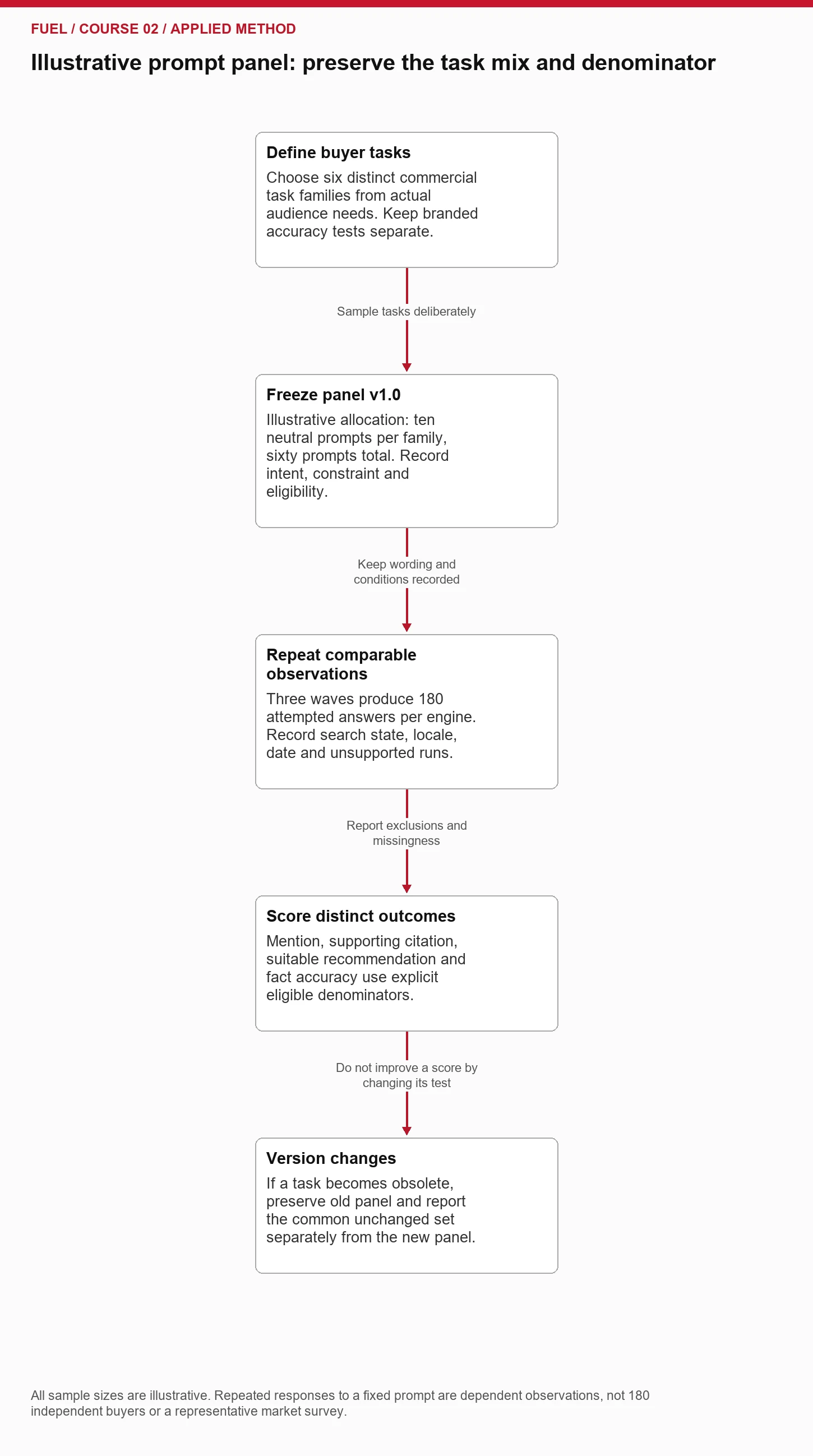
Use a deliberate allocation. In an illustrative panel, six families receive ten neutral prompts each, for sixty prompts total. Equal allocation creates a balanced diagnostic instrument; it does not imply equal market demand. If the business chooses another weighting, document the rationale and preserve the unweighted family results.
Separate the task from its wording variants. Three paraphrases of one purchase question may reveal wording sensitivity, but they are related observations. They should not silently count as three independent buyer needs. Give each question a family and task identifier so the analyst can inspect both variant-level and task-level results.
Include constraints and valid exclusion cases
Include constraints that affect commercial suitability. Examples include a required integration, an actual service area, a commitment boundary or a supported language. Also include valid exclusion cases where the offer should not be recommended. AI visibility tracking becomes more useful when it can reveal overbroad recommendations as well as missed appearances.
Freeze a first version with exact wording, input conditions and eligibility rules. Save a reason for each item and its source evidence where available. Do not rewrite awkward questions after seeing unfavorable answers without recording a new version. A cleaner sentence can change the task or encourage another kind of source.
The panel diagram shows the instrument's logic: buyer tasks become a fixed question set, repeated observations receive explicit scores and changes are versioned. These are proposed operating choices. The illustrative sixty-question size is a workload example, not a provider requirement, a market sample or a statistical sufficiency threshold.
Which conditions belong in an AI visibility tracking baseline?
Capture a baseline using the conditions defined for the panel. Record the exact product surface, available model identifier, search-enabled state, date, locale and relevant account or session limitations. Use fresh sessions where appropriate and preserve what cannot be controlled as an explicit limitation. Do not claim to eliminate personalization merely because the conversation is new.
Store attempted runs as well as completed answers. A service failure, unsupported mode and valid answer without a brand mention are different states. Define the exclusion rule before collection. An unavailable response should not be silently converted into a negative recommendation, and removing failures should not make the report's denominator invisible.
Preserve the full answer and supporting destinations when visible. A dashboard summary can help triage, but the original artifact lets a reviewer check whether the brand was criticized, cited or recommended. Save the inspected source passage when evaluating support. A citation alone does not prove that the linked page establishes the answer's decisive claim.
Choose a practical observation schedule and rotate collection order when useful. If one engine is always tested before a major release and another afterward, time can become a confounder. Record actual capture time rather than only the planned reporting date. Keep missed observations in the log so later comparisons do not assume uniform coverage.
Record site and offer changes during the same period. A new plan, corrected service boundary or revised integration can alter what a correct answer should say. AI visibility tracking needs the applicable fact version as well as the prompt version. Do not mark yesterday's historically correct answer wrong because today's offer has changed.
Finish the baseline with a coverage statement: families, questions, attempted and eligible answers, excluded cases and known limitations. This is more informative than an unsupported overall score. It tells the team which observations can support a comparison and which decisions need more evidence before interpretation.
Should AI citation tracking use manual, API or monitoring-service collection?
Choose an AI citation tracking collection method according to the question. Manual interface observation can help inspect what a user actually sees on a particular surface. Its limits include effort, access conditions and reproducibility. Record the interface rather than describing every observation as a generic response from the underlying model.
An authorized API collection can make repeated capture more consistent and manageable. Its limits include differences from the consumer product, available search features and account configuration. Do not label API results as consumer-interface results without evidence of equivalence. Keep them as a distinct panel or clearly identified measurement surface.
A monitoring service can provide history and workflow support. Evaluate what it actually captures, how it defines a mention or citation, whether it preserves raw answers and how it handles failures. A convenient score is not a substitute for knowing the sample and rule. Do not purchase a tool or assume access is authorized merely because the methodology mentions it.
Use human review for consequential interpretation. A string match can find a product name, but suitability depends on constraints and facts. An automated judge can triage claims, yet its judgments need calibration and a route for ambiguous cases. Keep model agreement separate from verified truth.
For AI visibility tracking at modest scale, a simple evidence table may be enough. As workload grows, automate repeated capture and mechanical checks while preserving the same definitions. Changing the collection system can create a measurement break; compare a shared sample before treating the new series as a continuation.
Keep this course distinct from an intervention study. A stable panel helps observe changes and diagnose questions. It does not by itself prove which website change caused a result. A separate controlled design needs its own assignment, comparison and causal assumptions. Do not call a well-maintained dashboard an experiment merely because its lines move.
How do you calculate AI search visibility metrics correctly?
Attempts, eligible answers and mention rates
Calculate AI search visibility metrics with this illustrative sixty-prompt panel across six task families and three waves for one engine. That creates 180 attempted answers. Suppose nine runs fail under the predefined eligibility rule, leaving 171 eligible answers. The sample and outcomes are fictional teaching inputs, not Fuel results or a measurement of any current provider.
Suppose the brand appears in 114 eligible answers. The observed mention rate is 114 divided by 171, approximately 66.7%. Suppose sixty-eight eligible answers cite the site's URL. The observed site-citation rate is 68 divided by 171, approximately 39.8%. A mention and a citation are distinct outcomes; neither guarantees a suitable recommendation.
Recommendation opportunities and claim accuracy
Now define recommendation opportunity. Assume only 120 eligible answers involve a task where a recommendation is appropriate and the offer could meet the stated constraints. If seventy-six give a suitable recommendation, the rate is 76 divided by 120, approximately 63.3%. Do not divide by 171 merely to reuse another metric's denominator. The relevant population is different.
For factual accuracy, suppose reviewers audit 225 consequential claims across the saved answers and verify 202. That is approximately 89.8% under the claim-level rubric. It is not an answer-level accuracy rate, and the unverified claims need a classification distinguishing wrong, unsupported and unscorable. Several claims can occur in one answer.
Inspect family results before interpreting the combined view. Pricing questions may produce frequent mentions with incorrect commitments, while integration questions produce fewer but accurate qualified recommendations. An overall mention rate can hide both a valuable asset and a material commercial error.
In an October 2026 report, SaaStr said it surfaced in forty-six of fifty cold prompts while some answers mixed event years and audience facts. Its prompt list was agent-generated; this was a self-reported audit, not a controlled experiment. [1]
That contemporary example illustrates why AI visibility tracking should score factual suitability separately from appearance. It does not validate the fictional panel's outcomes or establish a universal method. Keep the selected sample, repeated observations and actual evidence visible whenever a headline percentage is reported.
| Measure | Calculation | Interpretation |
|---|---|---|
| Mention rate | 114/171 ≈66.7% | Eligible answers naming the brand. |
| Site-citation rate | 68/171 ≈39.8% | Eligible answers citing the site's destination. |
| Suitable recommendation rate | 76/120 ≈63.3% | Defined recommendation opportunities meeting the task. |
| Verified-claim proportion | 202/225 ≈89.8% | Audited claim-level checks, not answer accuracy. |
| Capture coverage | 180 attempts;171 eligible;9 failures | Collection workload and exclusions, not market size. |
Which prompt-panel changes invalidate a visibility trend?
Watch for instrument drift. Replacing hard questions with easy branded ones can improve a score without improving discovery. Adding more prompts from a strong family can change the aggregate even when every family's performance stays the same. Preserve the original panel and show new allocations as another version rather than presenting a composition change as progress.
Treat prompt wording as part of the instrument. A question asking what people on a particular forum say can encourage a different source mix from a neutral category question. Both can represent legitimate tasks, but they should not be compared as if only the website changed. Record any shift in source-seeking language.
Avoid false independence. Repeated answers to the same question share task, wording and often similar available sources. Related paraphrases share meaning. Results from one account or narrow period may share context. A large output count does not automatically create a representative sample or justify a simple uncertainty calculation based on independent people.
Separate capture failure from absence. If a run never returns an answer, you have evidence about collection availability. If it returns an answer without the brand, you have a visibility observation. If it names the brand but violates a required condition, you have a suitability problem. A single zero label loses those distinctions.
Use an adjudication queue for ambiguous scoring. One answer may mention a company as an unsuitable alternative; another may cite a page without supporting the decisive claim. Have reviewers explain their judgment against the rubric. Disagreement can reveal an unclear definition rather than a need to force a majority answer.
AI visibility tracking also needs a correction policy for its own data. If a source URL was misclassified or a product alias was missed, preserve the old and revised rule and identify affected observations. Do not silently repair history only when the correction benefits the reported brand.
How do you operationalize an AI SEO reporting panel?
Operationalize AI SEO reporting with stable identifiers for family, task, prompt version, run and fact reference. Store the exact capture conditions and source artifacts in a durable location. Keep the scoring rule version with each result. An analyst should be able to reproduce the reported numerator and denominator without asking the original collector what a spreadsheet abbreviation meant.
Assign roles for capture, fact verification and interpretation. A collector may confirm that an answer was saved successfully without knowing whether a technical recommendation is suitable. A product owner can verify capability but may not control acquisition reporting. Keep those responsibilities explicit so an operational completion marker does not imply broader review.
Use a small calibration set before dividing work. Give reviewers the same answers and reference facts, then inspect why their judgments differ. Improve ambiguous rules and preserve unresolved cases. Agreement improves consistency but does not prove truth, so consequential facts still need appropriate sources.
Version panel changes deliberately. A retired product, new market or obsolete buyer task can justify replacing a question. Record the reason, preserve the old version and report the unchanged common set separately. The new full panel answers a current planning question; the common set supports a more comparable trend.
Connect AI visibility tracking to source repairs. Use an approved pricing reference for wrong commitment or cost statements, the integration capability contract for unsupported workflows and content freshness controls for stale facts. The panel should create specific owner tasks rather than another generic instruction to improve authority.
Keep commercial measurement connected but separate. The AI referral attribution workflow can preserve observed visits and opportunity associations. A panel's mention rate is not a referral rate, and a referral rate is not incremental revenue. The combined program is stronger when each stage retains its own evidence and limits.
How should AI visibility tracking guide the next investment?
Use panel results to select the next discriminating action. If a priority family repeatedly produces an incorrect price, inspect the cited source and current commercial facts. If a suitable page is rarely selected, investigate accessible evidence and observed source choices. Do not infer a private ranking mechanism solely from the outcome pattern.
Prioritize consequence and business relevance alongside frequency. One incorrect claim about a mandatory contract can matter more than several harmless wording variations. A low-visibility family may be strategically important if it addresses a decisive requirement. Explain the decision rather than hiding subjective business value inside an unexplained score.
Keep a distinction between correction and experiment. Fixing a false fact is justified by accuracy. Testing a new content presentation for selection requires a design that can address alternative explanations. AI visibility tracking can supply observations for both, but it does not erase their different purposes.
Report component results when presenting an executive total. Show task coverage, eligible observations, mention counts, site citations, suitability and material error categories. If the total is weighted, state the weights and keep the family values available. An unfamiliar reader should understand what improved and which unresolved risks remain.
Avoid optimizing the panel to the dashboard. A tool's available metric should not determine what counts as useful to buyers. If a product cannot score suitability, retain a separate review for that task. If an interface does not expose sources, mark source support unobservable rather than calling it a confirmed failure or inventing a citation.
End a reporting period with a short evidence-backed decision record. Name the relevant task, observed issue, proposed repair, owner and next observation condition. A maintained panel earns its effort when AI visibility tracking leads to clearer facts and better buyer decisions, not when it produces an attractive score with no accountable next step.
When comparing agency reporting scopes, request a sample export containing question ID, exact prompt, interface, date, run state, full answer, source destinations and scoring-rule version. Recalculate one numerator and denominator from that export. Then inspect one materially wrong answer and ask how it becomes an owner-assigned correction ticket. A service that supplies only a trend chart leaves you unable to distinguish a real improvement from changed question composition. Reporting ownership should include version control and access to the underlying evidence, even when the collection is automated.
Can you repair a misleading ChatGPT visibility report?
Repair this fictional report: “AI visibility increased from 60% to 80%.” The second period replaced ten difficult integration questions with ten branded questions, omitted failed runs and changed from a consumer interface to an API. No common-set result is shown.
Do not approve the headline as a like-for-like improvement. The task mix, eligibility and measurement surface changed. Preserve both series with their conditions, reconstruct the eligible common set where artifacts permit, and report the new full panel separately. If the historical evidence cannot support a comparable figure, state that limitation.
Next calculate the worked example's four measures independently: mentions 114/171, site citations 68/171, suitable recommendations 76/120 and verified claims 202/225. Explain why the denominators differ and why the repeated outputs are not independent buyers. Include the nine capture failures in the coverage statement.
Submit a panel charter, one version-change record and one correction ticket based on a consequential factual error. A strong answer preserves the instrument's history, gives each metric a clear meaning and turns the observation into a specific task without promising future AI-search outcomes.
Sources and evidence notes
[1] SaaStr, The Agent-Led Growth Playbook. Accessed October 25, 2026.
Apply the workflow
Discuss a practical AI-search measurement and implementation scope with Fuel Online.
Explore the AI SEO and AEO course curriculum.
Discuss AI SEO and AEO implementation with Fuel Online.