
AI SEO – AEO Course 01
What should an AI SEO audit diagnose first?
For an AI SEO audit of missing visibility, identify the first outcome you cannot verify: public access, relevant eligibility, observable source retrieval, accurate answer inclusion, suitable recommendation or qualified human action. Capture the exact question and response before changing the website. Then run a test that distinguishes competing explanations at that stage. A missing mention alone cannot tell you whether the problem is technical delivery, missing evidence, buyer fit, answer behavior or simply insufficient observation.
Begin an AI search visibility investigation with one consequential buyer question. “Which payroll service supports our country and union reporting requirements?” creates a different diagnostic task from “What does this named company sell?” The first concerns discovery and suitability. The second checks factual recognition. A website can pass the branded question and fail the buyer task, or be recommended while its pricing is wrong. Record those as separate findings rather than averaging them into a comforting score.
The AI search visibility deliverable is a short case record: the business decision, observed failure, evidence already established, unresolved stage, two plausible explanations, next discriminating test and repair owner. This forces the investigation toward a concrete choice. An instruction to improve authority gives the team little to verify. An instruction to restore the anonymous pricing response so its minimum commitment appears beside the price describes both a defect and an acceptance condition.
This course uses an evidence ladder as a management framework. It does not claim that every provider operates six sequential internal components. Actual systems can combine sources and omit visible citations. A recommendation may originate from third-party material even when an owned page is unavailable. The ladder organizes what your team knows about a specific website route and observation; it does not expose hidden selection logic.
Google's current guidance does not promise AI placement after optimization. Source note: Google Search Central, Optimizing your website for AI search, accessed October 2026. That boundary matters operationally: successful repair can mean removing a demonstrated access defect while the downstream selection question remains open. Report the completed repair and the unresolved observation separately. This is more useful than declaring either universal success or universal failure.
Which evidence should an AEO audit collect at each stage?
Access and eligibility require different proof
For an AEO audit, define access narrowly: the intended public resource delivers the relevant content under documented anonymous conditions. Preserve the requested URL, final destination, response status, main text and any challenge or authentication state. A browser screenshot can establish what that browser saw. It cannot establish that a verified crawler received the same text. Access evidence should identify the actor and request conditions rather than collapse every fetch into a single green check.
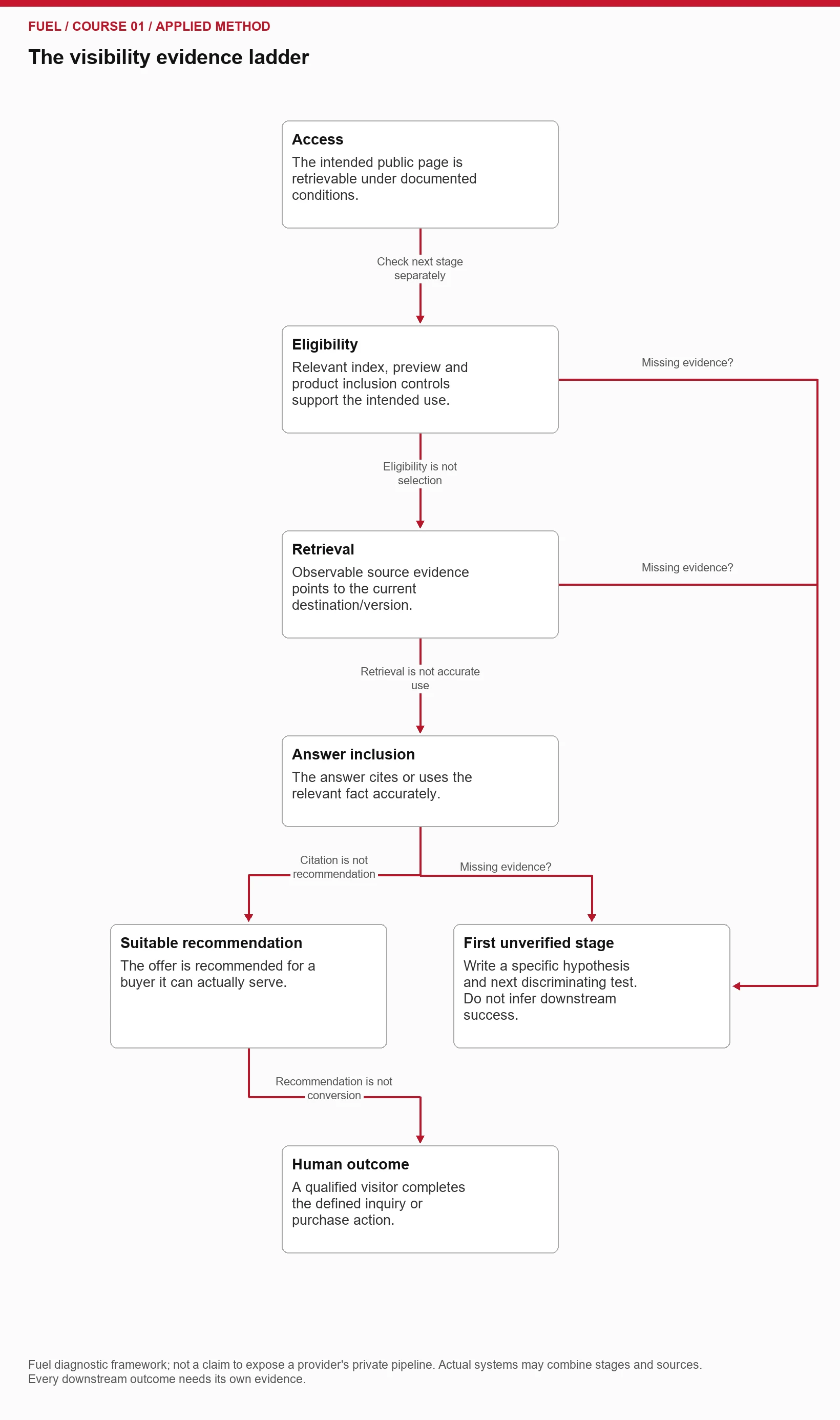
Eligibility is a separate control question. Inspect the controls relevant to the actual product and intended use, including applicable indexing or preview permissions. Do not transplant one provider's rules to another. OpenAI distinguishes its search crawler from its training crawler. Source note: OpenAI, Overview of OpenAI crawlers, accessed October 2026. Inspect the relevant role and infrastructure together; an allowed search policy can coexist with a firewall challenge that prevents useful delivery.
Source use, accuracy and suitable recommendations
Observable retrieval means you have evidence connecting the answer or exposed source set to a particular destination. A visible citation provides a source-use clue, not a complete execution trace. Open it, preserve the inspected version and compare the decisive passage. If the interface exposes no sources, mark retrieval unobserved. Do not convert absence of a citation into proof that the page was never fetched, or a brand mention into proof that the owned page was selected.
Answer inclusion asks whether a material fact appears accurately, with its limiting condition. Recommendation asks whether the suggested offer actually fits the stated buyer. A correctly cited service description can still produce an unsuitable recommendation when country coverage or implementation capacity is ignored. Record factual support and suitability independently. The website team may need clearer exclusions, a source correction or no content change at all, depending on what the evidence shows.
Human outcome requires its own observation: an actual visit, inquiry or purchase meeting a defined qualification rule. A displayed citation is not a recorded visit. A recorded visit is not automatically a qualified lead. Treat the ladder's arrows as prompts to check another outcome, not as multiplication factors in a funnel. Unless the observations are joined on a defensible unit, stage counts should never be presented as conversion rates between stages.
How do you establish an AI search visibility audit baseline?
Freeze buyer questions and observation conditions
Begin an AI search visibility audit by freezing a small question panel before inspecting results. Include buyer tasks, constraint questions, comparison questions and a branded accuracy check, with labels that keep their purposes distinct. Choose tasks because they matter to qualified demand, not because the company already appears for them. Preserve exact wording, language, intended market and relevant offer version. A later wording change creates a new item; it should not silently replace a difficult question in the original panel.
For each attempt, capture product surface, model label if available, search-enabled state, observation time, locale, session approach and supplied context. Save the complete response and visible sources, including an explicit no-answer or timeout result. Unknown settings stay unknown. An analyst should be able to tell whether two records differ because of the website or because one used a different interface, buyer location or question. Similar brand names do not make different surfaces interchangeable.
Preserve units, reference facts and denominators
Choose the unit before calculating. A question, an attempt, a response, a source and a visitor are different objects. If six questions are each repeated three times, you have eighteen attempts, not eighteen independent buyer needs. Keep question-level summaries beside attempt-level counts. A question that alternates between correct and incorrect answers deserves a variation note, not a false impression that additional repeats expanded market coverage.
Build a reference sheet for facts that determine suitability: supported regions, minimum commitment, required customer capacity, material exclusions and current offer terms. Each fact needs a responsible owner, effective date and approved evidence. If the company cannot establish a fact, mark the evaluation item unscorable until it is resolved. The diagnostic team should not invent a convenient reference answer and then score the assistant against its own guess.
Record AI search visibility as a set of measures with explicit denominators. For example, report responses that mention the brand, responses with a supporting owned source, accurate decisive claims and suitable recommendations. Keep these counts distinct even when the same answer satisfies several. Add a dated observation window and the selected question population. The result describes this panel under these conditions, rather than a universal percentage of all AI search demand.
Which ChatGPT visibility audit test distinguishes the likely causes?
In a ChatGPT visibility audit, compare three approaches by the decision they can support. A delivery inspection is best when a public route may be broken: it can establish a reproducible response defect quickly, but says little about future selection. A source-to-claim inspection is best when an answer exists: it can show unsupported or contradicted reasoning, but cannot reveal every hidden retrieval event. A controlled content intervention is appropriate only after the defect, expected outcome and competing explanations are defined.
Use a discriminating-test rule. Write two explanations that predict different observable results, then choose the smallest safe test that separates them. Suppose the approved page includes a regional restriction but the answer ignores it. Hypothesis one is that the restriction is missing from delivered main text. Hypothesis two is that current delivered evidence contains it but the answer fails to preserve it. Comparing saved response text with the approved reference directly informs that choice; rewriting the whole page does not.
For an access concern, inspect the canonical public route after redirects, then compare the relevant text under intended request conditions. A claimed crawler user-agent alone does not prove identity. For a source concern, inspect the actual cited destination and locate support for each decisive statement. For a suitability concern, hold the offer facts constant and vary a legitimate buyer constraint. Keep this last diagnostic question set separate from the fixed baseline so exploratory tests do not contaminate the before-and-after report.
Once an intervention is justified, specify the changed artifact, unchanged comparison conditions, planned observation window and stop rule. A stop rule may be operational: the anonymous page consistently delivers the approved restriction and a release regression check is recorded. It may instead concern sampled answers, with enough repeated observations to characterize variation. Do not promise that a technically correct release must produce an assistant recommendation by a chosen date.
Prefer reversible, informative work first. Repair a demonstrated delivery error before commissioning a new research campaign. Verify an unsupported commercial fact before adding schema that repeats it. If the available evidence cannot distinguish competing explanations, record the uncertainty and choose a test that reduces it. Uncertainty is a state of the investigation, not permission to describe a speculative ranking factor as established.
What does a worked AI SEO audit reveal?
Consider fictional Harbor Ledger, a service available only to US businesses with an internal finance lead. This is an invented teaching fixture, not a Fuel or client result. Its team selects eight buyer questions and makes three planned attempts per question, producing twenty-four attempts. Two attempts time out, leaving twenty-two usable answers. The first report keeps all twenty-four attempts in the operational denominator and separately labels the twenty-two answered observations.
Among the twenty-two answers, ten mention Harbor Ledger, seven cite its owned material, six both cite that material and accurately state the decisive facts, and four recommend it suitably. The corresponding answered-observation rates are 45.5%, 31.8%, 27.3% and 18.2%, rounded to one decimal. These are separate outcomes over the same twenty-two answers. The team should not calculate four divided by seven as a general citation-to-recommendation conversion rate; the small panel was not designed to establish that relationship.
One unsuitable answer recommends Harbor Ledger to a Canadian company without an internal finance lead. Its citation points to a general service page that discusses finance support but says nothing about country coverage. The approved eligibility page does state both restrictions. The first defensible finding is a source-support gap for this answer. The general citation does not establish suitability. It also does not prove that the eligibility page was never available to the system.
The team checks the eligibility URL and finds that anonymous requests redirect to a login screen. The source record, final destination and saved text reproduce the defect. Engineering can now own a precise access repair: deliver the approved public eligibility facts without requiring login. The editor also reviews whether the general page should summarize the restrictions where the commercial promise appears. These are two related but distinct artifacts, each with an owner and acceptance condition.
After repair, the public route passes its delivery check. A new observation window shows seven suitably constrained recommendations in twenty-two usable answers, compared with four previously: 31.8% versus 18.2%, a 13.6 percentage-point difference after rounding. This descriptive change does not establish causation, because the answer environment and other sources were not controlled. The completed deliverable is a verified access fix plus a dated panel comparison, with attribution of the downstream change left unresolved.
Which AI SEO audit reporting errors mislead buyers?
The first mistake is treating all missing mentions as the same event. A page inaccessible behind authentication needs different work from an accessible page whose offer fails the buyer's requirements. A response that cites a competitor's stronger evidence creates another question entirely. Classify the observed defect before assigning the task. Otherwise engineering, editorial and research teams can each complete work while the original buyer problem remains unchanged.
The second mistake is overstating a successful check. A manually opened page establishes neither crawler access nor answer selection. A valid schema report establishes neither accurate business facts nor recommendation suitability. A current cited source establishes neither faithful answer wording nor a qualified visit. These counterexamples are useful acceptance tests for the report itself: every claim should name the outcome actually observed and stop before the next unverified outcome.
The third mistake is confusing a question-panel change with an AI search visibility improvement. If a team removes difficult nonbranded questions and adds easier branded ones, the score can rise without any website improvement. Preserve the original panel and label expansion separately. If a platform setting changes, annotate the comparison. If there are missing responses, show their count and treatment instead of quietly deleting the inconvenient denominator.
The fourth mistake is diagnosing intent from a source list. A missing owned domain may reflect a better external source, a narrow question, variation or unknown internal selection. A citation attached to a paragraph may support only one sentence. Inspect claim-level support before interpreting domain presence. When the evidence only shows a source mismatch, write that finding. Do not transform it into proof that a specific authority signal caused the outcome.
The fifth mistake is using a commercial outcome to retroactively prove a technical mechanism. An inquiry arriving during a content release does not establish that the new page generated it. Preserve referral evidence, timestamps and any known session relationship; keep unknowns explicit. A useful business report can state that qualified demand appeared during the period while declining to invent an identifiable journey from a particular assistant answer.
What belongs in an AI SEO audit checklist and repair ticket?
Create one case identifier that joins the question record, captured answer, approved fact reference, source inspection and release ticket. Store raw observations separately from the analyst's diagnosis. A later correction should not overwrite the original response or silently change its evaluation rule. This separation lets another reviewer determine whether new evidence changed the answer, the reference facts or merely the interpretation of an unchanged record.
Use a concise handoff contract. The analyst names the observable defect and competing explanations. The relevant owner verifies the fact or implements the repair. An independent reviewer checks the acceptance evidence. The business owner decides whether the buyer outcome matters enough to justify further investigation. In a small team one person may hold several roles, but the record should still distinguish the decision from the evidence supporting it.
An access ticket should include exact URL, actor conditions, redirect chain, expected public content and an observed failure. An editorial ticket should include the unsupported claim, approved replacement, scope and dependent assets. A measurement ticket should identify missing event data or a denominator error. Avoid a single improve-AEO ticket spanning all three. Broad tickets make completion subjective and can hide the fact that the most consequential defect has no accountable owner.
For release verification, compare the approved fact with the final anonymous delivery and preserve the resulting version. Test the important exception as well as the positive claim. If a restriction applies only to one region or plan, verify that those qualifiers remain connected after extraction. Then schedule the separate answer observation. Record what changed on the website and what changed in the sampled answers without implying that timing alone proves the relationship.
Route specialized work to its detailed procedure. Crawler-role analysis belongs with the access policy workflow; missing rendered facts belong with JavaScript extraction QA; unsupported passages belong with content structure and evidence review. This course supplies the triage logic that chooses those jobs. It should prevent a generic audit from generating dozens of low-value tasks while a single blocked eligibility page continues to distort the buyer decision.
Use an AI SEO audit checklist as a handoff contract, with columns for the buyer question, failed stage, approved fact, observed artifact, proposed correction, owner and acceptance test. For example, a visibility screenshot without its source passage cannot close an answer-support defect. Ask a prospective agency to show one completed case record and its delivered correction, with confidential details removed. Confirm whether the engagement includes implementation or only diagnosis; if your team must execute the repairs, name that capacity before accepting the scope. This makes agency proposals comparable by the work and proof they deliver.
How should an AEO audit guide agency investment?
Prioritize AI search visibility work by demonstrated consequence and evidential confidence before estimating reach. A wrong contract minimum that can mislead a qualified buyer may deserve immediate correction even when seen once. A harmless missing mention across a speculative question set may justify more observation. Write the affected decision, severity, reproducibility and owner beside each case. Do not turn a guessed traffic multiplier into numerical precision that the underlying observation cannot support.
Compare repair value with learning value. A reproducible access fix can both help public delivery and eliminate one explanation. A small source-support test can reveal whether an expensive new asset is necessary. A complete rewrite may cost more while changing too many variables to teach anything. Prefer the intervention that addresses a verified defect and leaves a clear record of what the next observation will mean.
Define suitable stopping conditions. Close a factual repair when the approved correction is delivered and dependent owned assets are verified. Keep the separate AI search visibility observation open if selection remains uncertain. Escalate when repeated evidence shows a consequential unresolved defect, rather than leaving every case permanently active because an assistant might answer differently tomorrow. A case can close with a bounded finding and a future monitoring trigger.
For leadership, report three parallel categories: verified defects repaired, sampled answer outcomes and qualified human outcomes with their evidence limits. This preserves completed work without inflating attribution. It also reveals whether the next budget should support engineering, stronger commercial evidence, a broader question panel or conversion measurement. A single blended visibility score would conceal these choices and make unrelated work appear interchangeable.
Can you classify an AI search visibility failure correctly?
Use this paper exercise before collecting live observations. A fictional vendor serves organizations with at least fifty employees, but a captured answer recommends it to a ten-person company. The answer cites an owned capability page. That page is publicly accessible and correctly describes the service; the minimum size is documented only in a separate PDF. Your task is to name what is established, what is unknown and which test should come next.
The established facts are that the answer contains an unsuitable recommendation under the approved eligibility rule, and that its cited capability page does not itself establish the missing condition. The record does not yet establish whether the PDF is accessible, whether the system used it or whether any page wording caused the recommendation. The first next test is to inspect the PDF's public delivery and the actual cited passage, preserving versions and actor conditions.
Now add a second observation: the PDF is public, but its main text extraction omits the minimum-size line because the condition appears only inside an image. A repair ticket can require that the eligibility condition be available as ordinary text with the relevant service claim. The website release can pass this acceptance test. A later assistant response remains a separate observation; neither a successful extraction test nor an unsuitable answer should overwrite the other.
Finish the lab by producing a seven-line case record: buyer constraint, observed answer defect, approved reference, verified stage evidence, unresolved explanation, smallest next test and accountable owner. A passing submission preserves the distinctions between access, observed source use, factual accuracy, suitability and human action. A failing submission jumps from an allowed crawler or a corrected page directly to a promised recommendation. Use this rubric on real cases before committing a larger optimization budget.
Source notes
Google Search Central, Optimizing your website for AI search; OpenAI, Overview of OpenAI crawlers. Both accessed October 25, 2026. The evidence ladder, tickets, numerical examples and exercise are Fuel teaching synthesis. Source documentation supports only the explicitly bounded provider statements.
Apply the diagnosis
Use a concrete failure record to scope implementation. Review Fuel AI SEO services when you need help moving from an observed defect to a verified release.
Explore the AI SEO and AEO course curriculum.
Discuss AI SEO and AEO implementation with Fuel Online.