
AI SEO – AEO Course 18
Maintain Content Freshness for AI Search Through Verified Facts
Maintain content freshness for AI search by updating the facts that actually changed, coordinating their dependent pages and verifying the delivered result. Assign sources, owners and effective dates to volatile claims. Use meaningful modification signals and inspect later AI answers separately. Changing a date alone does not make an old price, policy or capability current.

Start with the buyer consequence. An expired offer can change a purchase decision. A retired integration can make a recommendation unsuitable. A historical example can remain useful when its scope is clearly labeled. Content freshness is therefore a fact-maintenance problem before it is a publishing-calendar problem. Ask what must be true for the reader's current task.
Separate four times: the underlying fact's effective time, the source's update time, your publication time and the later observation time. They can differ legitimately. A policy announced today may take effect next month. A page can be corrected before an assistant is observed using the correction. Preserve those distinctions instead of presenting a single updated label as a complete history.
Create a compact fact register for material claims. Record what the claim means, its source, owner, volatility, consequence, dependencies and next review trigger. Do not inventory every ordinary sentence with equal effort. Focus on the facts whose expiry or contradiction can materially mislead a buyer.
Choose completion criteria within your control. A content freshness job can finish when the approved facts are correctly published, dependencies are reconciled and the customer task works. External recrawling, citations and recommendations remain observations to collect. Keeping that boundary clear lets the team demonstrate real progress without claiming to control a platform's update schedule.
AI SEO content maintenance should identify which buyer-changing facts can expire and who authorizes their replacement. Content freshness for AI search is therefore different from a recurring rewrite quota. An AEO content update strategy connects volatile facts to event triggers, dated evidence and dependent assets, while preserving useful historical examples and explanations whose meaning has not changed.
Prioritize AI SEO Content Maintenance by Buyer Consequence
Classify claims by volatility and consequence. Prices, stock, deadlines, support availability and product capabilities can change quickly. A mathematical explanation may remain valid for years while its example inputs need labels. An organization's founding date is generally less volatile than its current service boundary. Let those differences determine review effort.
Use a simple severity explanation rather than an unexplained score. A wrong mandatory contract minimum can prevent a qualified purchase. An obsolete screenshot can create setup confusion. A minor stylistic issue may have little effect on a decision. Record the consequence in the ticket so a reviewer understands why one fact deserves attention before another.
Identify the actual source owner. Finance may approve a billing rule; product may approve a capability; operations may approve availability. A content editor can maintain the explanation but should not infer the underlying business decision. Content freshness fails when nobody can establish which competing version is authoritative.
Separate a changed fact from an aging evidence source
Distinguish fact expiry from evidence expiry. A price may have a fixed end date. A provider capability may remain current until documentation changes. A study's historical result does not become false merely because it is old, but it may no longer describe the current system. Preserve the historical claim and update the present-day interpretation where necessary.
Handle high-consequence unknowns explicitly. If an important service condition cannot be verified, narrow or temporarily withdraw the claim through the business's approved process. Do not keep a reassuring statement merely because the page needs a smooth paragraph. An unknown fact and a known negative fact need different language.
Define which changes trigger immediate review. A branch closure, promotion ending, API deprecation or revised contract rule should not wait for a quarterly article check. Other claims can follow a scheduled review. The goal is a reasonable relationship between actual change and maintenance, not a universal rule that every page must be rewritten at the same interval.
Build Dependencies for AI Search Content Change Control
Build the dependency register around facts rather than page titles alone. One contract rule may appear in a pricing table, comparison page, FAQ, sales worksheet, onboarding guide and image. Assign a stable fact identifier and list the dependent assets. This makes the scope of a real change visible before an editor starts patching individual paragraphs.
Record where each dependency uses the fact. A page may quote the rule, calculate a total from it or explain an exception. Changing the source can affect those uses differently. A revised minimum may require recalculating a worked example while leaving a general budgeting explanation intact. Preserve unaffected useful content instead of rewriting the entire page.
Keep future and grandfathered terms scoped to their audience
Give each record an effective version. Store the approved wording or structured value, source evidence, decision owner and applicability. A future policy should be marked future; a grandfathered term should identify its eligible audience. Content freshness includes accurate scope, not just the newest available number.
Include nontext dependencies. A diagram can display an old limit, alt text can describe a retired feature, and structured data can preserve an expired price. A cache or embedded calculator can serve a different version from the surrounding prose. The dependency review should reach the representations that matter to the customer's task.
Keep maintenance ownership usable. One person should coordinate the release while subject owners verify the facts within their responsibilities. Assign a fallback and escalation path for consequential changes. A register that merely names a department without an actionable owner can become another stale document.
Use the register to isolate blockers. If one unsupported claim needs further evidence, hold that claim and its dependent assets while finishing independent ready work. Do not let a missing historical benchmark prevent a verified current-pricing correction. Conversely, do not mark a dependent calculation complete while its required input remains unresolved.
Worked AEO Update Example: Preserve Customer Cohorts
Consider a fictional software company changing its minimum contract commitment and refund boundary. The new rule applies to new agreements beginning next month; existing agreements retain their stated terms. The facts appear on the pricing page, a comparison guide, a FAQ and onboarding instructions. This is an illustrative workflow, not a real company policy or legal interpretation.
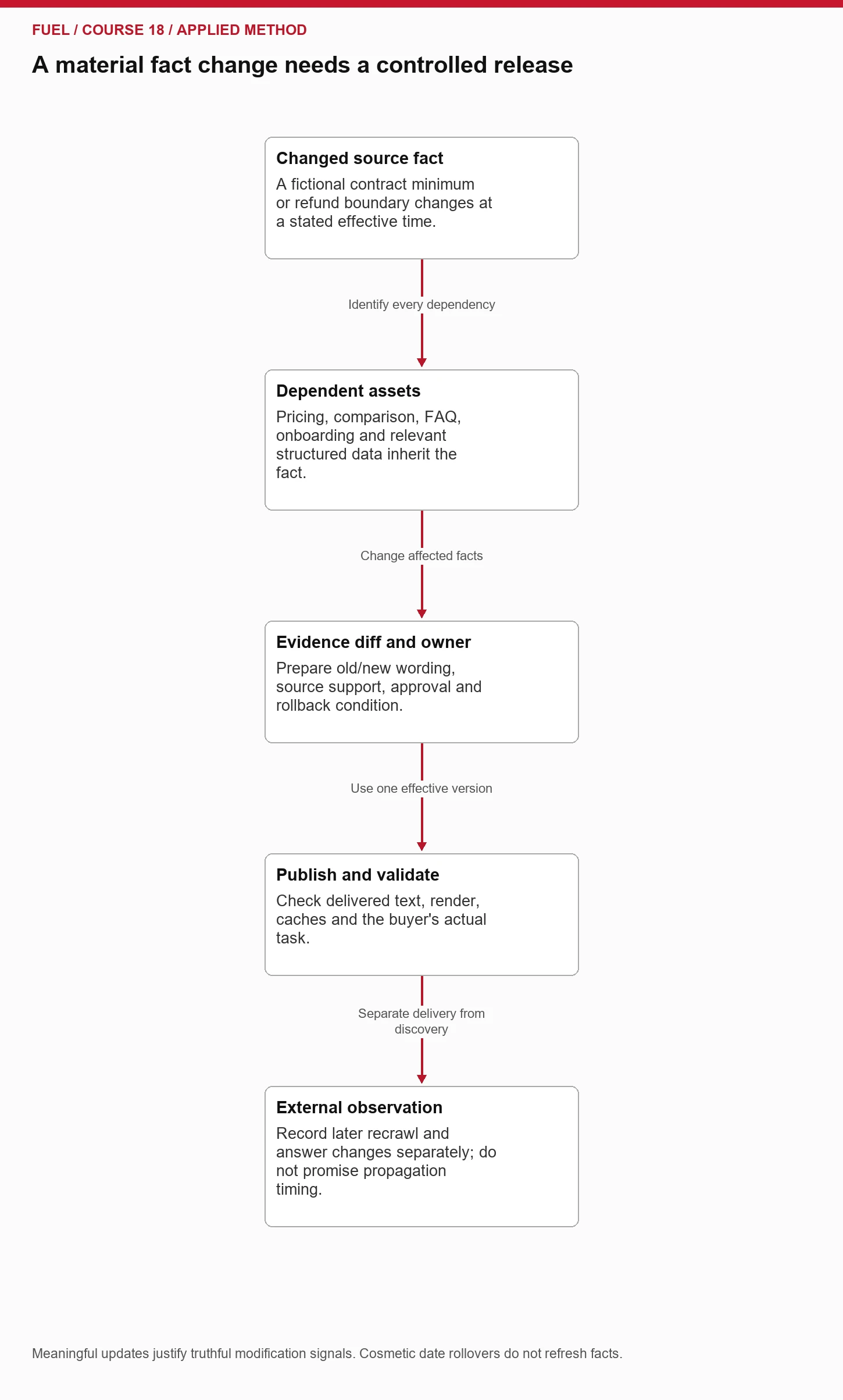
Start with the approved source record. Confirm the effective date, eligible audience, current rule, future rule and owner. Ask which terms require specialist approval within the business. The content team's job is to communicate the approved boundary accurately, not invent a contractual interpretation from a short announcement.
Map the dependencies. The pricing page needs the future minimum and its effective scope. The comparison guide may need a recalculated first-year example. The FAQ must distinguish new and existing agreements. Onboarding instructions need the rule that applies to the actual customer cohort. One shared sentence pasted everywhere would lose those differences.
Prepare an evidence diff showing the old claim, proposed claim, supporting source and affected calculation. Review only the changed facts and necessary context. Keep existing accurate sections. This preserves useful depth and makes it easier to detect an accidental expansion of the rule.
Verify the active rule before and after the effective time
Plan the release with the effective time. The team may publish a clear advance notice before switching the active offer. Verify that the current action path still applies the current rule until the approved transition. Avoid a page that advertises future terms while checkout or sales quotes continue presenting them as already active.
Define rollback and containment. If the release misapplies the new rule to existing customers, restore the approved safe explanation and route the affected process to its owner. Preserve the incident evidence. Do not silently erase the change history or pretend that a correction means the original publication was accurate.
The example's content freshness job ends with coherent scope across delivered assets and a working customer path. Later AI answers may still use an older source or omit the cohort distinction. Record and investigate those observations without repeatedly rewriting the correct current explanation.
| Checkpoint | Before the effective date | After the effective date |
|---|---|---|
| New-customer pricing | The active offer states the current minimum; any future notice clearly names its start date. | The active offer uses the approved new minimum and preserves relevant exclusions. |
| Existing-customer FAQ | The explanation retains the applicable agreement terms rather than silently applying the future rule. | The explanation continues distinguishing existing agreements from newly signed terms. |
| Comparison example | Calculations use their declared rule version and label any future scenario explicitly. | Current comparisons use the new approved inputs; historical examples retain their dates. |
| Quote or onboarding route | The selected customer cohort receives the correct current instructions. | The cohort and effective-date boundary survive the complete inquiry or onboarding handoff. |
| Rollback check | The previous safe version and change owner are recorded before release. | A misapplied cohort rule triggers containment, evidence preservation and the approved correction. |
Choose an AEO Content Update Strategy by Fact Type
Compare scheduled review, event-triggered updates and expiry-based withdrawal. Scheduled review helps find overlooked changes and checks stable assets at practical intervals. Its weakness is that a fact can change between reviews. A monthly schedule is not evidence that a rapidly changing offer stays accurate for an entire month.
Event-triggered updates connect maintenance to an operational change. A product release, contract revision or service-area adjustment can create a content task when the underlying owner approves it. The method depends on reliable handoffs. If the product team changes a capability without informing the content owner, the calendar cannot guarantee timely correction.
Expiry-based withdrawal fits a claim with a known deadline. A promotion can be prepared to end at a specific effective time, with a replacement explanation and verification. Withdrawal should not leave an empty or misleading destination. Decide what useful current information remains after the claim ends.
Combine these methods by fact type. Use event triggers for operational changes, expiry rules for known boundaries and scheduled reviews as a backstop. Set the cadence from volatility, consequence, exposure and team capacity. Treat those choices as internal controls rather than a provider-prescribed freshness formula.
A completed review does not require a cosmetic edit
Do not confuse a review with an edit. A responsible owner can verify that a stable explanation remains accurate and make no material change. Record the review privately or publish an appropriate review label when supported, but do not fabricate a new publication date. The valuable action was verification, not a cosmetic alteration.
Measure content freshness using the process you can observe. Track overdue consequential facts, source-to-publication lag and unresolved dependency conflicts. Keep these measures separate from traffic and AI citations. A lower backlog can show better maintenance discipline even when external visibility remains unchanged or cannot yet be measured reliably.
Review Evidence Diffs and Assign Real Approval Owners
Review the evidence diff before approving a change. Ask whether the source actually changed, whether the new wording preserves limitations and whether a calculation needs updating. An editor can accidentally remove a condition while trying to make a sentence concise. A responsible review checks the meaning, not just whether the latest date appears.
Separate approval boundaries. A native-language editor can assess clarity; a product owner can verify supported features; finance can verify a price rule. Do not imply that one review establishes all three. Assign real responsibility without inventing a human reviewer or credential that the project does not have.
Keep hypothetical examples recognizable. If a teaching calculation uses fictional rates, updating those rates to resemble a current market price can create a misleading appearance of research. Either retain the example's illustrative label or replace it with genuinely sourced inputs and appropriate scope. Historical examples should remain dated when their time context matters.
Check whether a change affects linked resources. A comparison page may rely on a pricing explanation; an implementation article may reference a retired integration. Use pricing-page change checks and the integration capability contract for those specific dependencies. Do not assume that a functioning link means the linked factual relationship remains correct.
Freeze accepted unaffected work. A change to one threshold should not trigger a new broad introduction across the entire cluster. Focused repairs reduce review burden and make source changes easier to trace. If a shared template caused the error, repair that shared source and retest representative affected pages.
Record the decision in language another operator can follow: what changed, why it changed, which assets were touched, what was tested and what remains unknown. Content freshness becomes more dependable when the record explains the factual transition instead of listing a series of completed editing tasks.
Verify Content Freshness With Truthful Dates and Delivered Facts
Use truthful publication and modification signals after meaningful changes. Google says sitemap lastmod should reflect significant updates and be consistently accurate. [1] Align the signal with the actual page change, not every request or routine deployment. A shared footer revision should not make every article appear substantively new.
Google also warns against artificially refreshing a story without significant new information. [2] Apply that principle to the visible explanation. A date label cannot correct an obsolete claim by itself. Content freshness should be demonstrated in the facts and their applicable scope, with dates helping readers interpret them.
Distinguish published, modified, reviewed and effective dates
Distinguish published, modified, reviewed and effective dates where the difference matters. A price policy can be published before it takes effect. A guide can be reviewed without material modification. A historical finding can remain tied to its original period while a new note explains present-day relevance. Avoid collapsing all four events into an ambiguous updated label.
Verify actual delivery after publication. Inspect the initial response, rendered page, structured data and any relevant cache or calculator. Check the decisive facts and qualifications, not only the presence of a new date. A successful save in the editor does not prove that anonymous readers receive the intended version.
Test the customer action affected by the claim. Follow the relevant booking, inquiry, quote or purchase path with safe authorized conditions. An accurate paragraph paired with an obsolete form condition remains a broken task. Record what was actually observed and which access-dependent checks remain incomplete.
Keep search notifications and later observations distinct. A submitted sitemap or update notification can be recorded as an action with its result. It does not establish immediate recrawling, indexing or answer correction. Content freshness verification is strongest when it identifies the checkpoint reached instead of skipping straight from publication to an assumed external outcome.
Observe ChatGPT Outdated Business Information After Controlled Repairs
Observe AI answers with a stable record. Save the exact question, engine or interface, search state, locale, date, answer and supporting source when visible. Compare the answer's claim with the fact version applicable at that time. A statement can be historically correct but unsuitable for a current buyer, and the record should explain which problem occurred.
Classify the stale answer before rewriting an accurate page
Classify the observed error before changing content again. An answer may use a retired price, select another region's page, lose an exception or cite a correct source while misstating it. These cases suggest different investigations. Do not assume that every unfavorable result proves your current page needs another rewrite.
Use repeated comparable observations where useful. A single corrected answer is evidence under those conditions, not a permanent certification. A single stale answer is a reason to inspect the source path, not proof that all current content is invisible. Keep the observation panel version and exclusions stable enough to interpret differences.
Retire invalid claims deliberately. Remove an expired active offer or unsupported recommendation while preserving useful historical context where readers need it. Explain the current alternative if one exists. Do not keep a misleading claim prominent solely because the page once received traffic, and do not delete accurate history merely to make the site appear newer.
For ecommerce offers, use the product prices and stock reconciliation process because transaction state changes more frequently than an editorial review can handle. For measured business outcomes, use AI referral attribution rather than inferring a customer journey from a changed citation.
Close a content freshness incident with the approved current fact, delivered dependencies, completed customer task and unresolved external observations. This is a complete controlled repair even when an engine's later selection is unknown. The next observation can add evidence without erasing the value of the work already verified.
When commissioning AI search content change control, request a fact register, dependency list, evidence diff and delivered-state check for each consequential transition. ChatGPT outdated business information is a later incident observation to investigate, not proof that the current page needs another rewrite. Ask the agency to distinguish the approved correction, the public version actually delivered and the dated assistant answer, with a separate owner for unresolved external copies.
Exercise: Prioritize Ten Content Maintenance Jobs
Prioritize this illustrative queue: an expired promotion still visible at checkout; a wrong minimum contract on a comparison page; tomorrow's holiday hours missing from a branch page; an obsolete integration screenshot; a stable formula reviewed last year; a typo in an old introduction; a changed support-language promise; a retired product shown as purchasable; a research example clearly labeled historical; and a new shared footer design.
Start with active customer promises: expired purchase offers, retired purchasable products, wrong contract minimums and incorrect support availability. The holiday update has a near-term effective boundary and may deserve the same immediate release group. Actual exposure and consequence determine the final ordering; the list is a reasoning exercise, not a universal severity chart.
Next inspect the integration screenshot for operational confusion. The stable formula and historical example may need verification rather than rewriting. The typo and footer design can be handled separately without pretending they materially refresh every dependent page. Explain why each choice improves a reader's decision.
Submit one dependency map, one evidence diff and one acceptance test for the highest-priority item. Record the source owner, effective time and rollback condition. A strong answer demonstrates content freshness through accurate facts and a verified task, while leaving future AI-search observations explicitly separate.
Sources and evidence notes
[1] Google Search Central, Build and submit a sitemap. Accessed October 25, 2026. [2] Google Search Central, Help Google Search know the best date for your web page. Accessed October 25, 2026.
Apply the workflow
Ask Fuel Online to evaluate the reader's evidence, content and measurement system using the defined task.
Explore the AI SEO and AEO course curriculum.
Discuss AI SEO and AEO implementation with Fuel Online.