
AI SEO – AEO Course 03
What can matched-page AEO testing establish?
Run AEO testing with a matched-page experiment by defining one useful intervention, pairing comparable pages, assigning the change within each pair when feasible and preserving a fixed observation process. Verify the release, retain the comparison pages and apply the planned analysis and stopping rules. Treat matching as a design aid, not proof that pages are equivalent or that a later difference must be causal.

Begin with a question narrow enough to test. For example: does adding a verified compatibility table change observed support for the relevant buyer questions, compared with leaving otherwise suitable pages unchanged? The intervention is the table and its supported information. It is not a bundle of rewritten titles, new navigation, fresh links and a different prompt panel.
Choose an outcome that matches the question. You might measure source-supported answers, accurate eligibility statements or citations to the intended page. Define the eligible observation and the success rule before collection. A rise in citations is not automatically a rise in suitable recommendations, and neither is a measured lead outcome.
Use AEO testing to make a bounded decision about an actual publishing choice. The experiment can help decide whether to retain, revise or expand the tested method in a comparable setting. It should not be designed merely to produce a favorable number for a presentation. Record a meaningful failure condition, such as more incorrect compatibility claims.
Write a short design record before assignment: population, page eligibility, matching variables, intervention, primary outcome, observation conditions, exclusions, analysis, guardrails and decision rule. Keep the original record when a later deviation becomes necessary. A reviewer should be able to distinguish the intended experiment from the one that actually ran.
All numbers in this course's worked example are fictional. They illustrate paired allocation and calculation, not a completed Fuel test, an expected effect or a sufficient sample size. A well-defined experiment can still produce an inconclusive result, especially when few independent units and changing external systems limit what it can establish.
Which units should AI SEO experiments assign and compare?
Page assignments, paired blocks and repeated answers
For AI SEO experiments, make the units explicit before selecting pages. A page can receive the intervention; its matched pair forms a block for comparison. A prompt-run answer is an observation associated with that page and buyer task. Repeating answers does not create additional independent page assignments. If shared templates or tightly connected content require cluster-level assignment, define that cluster before the test rather than treating each URL as independent.
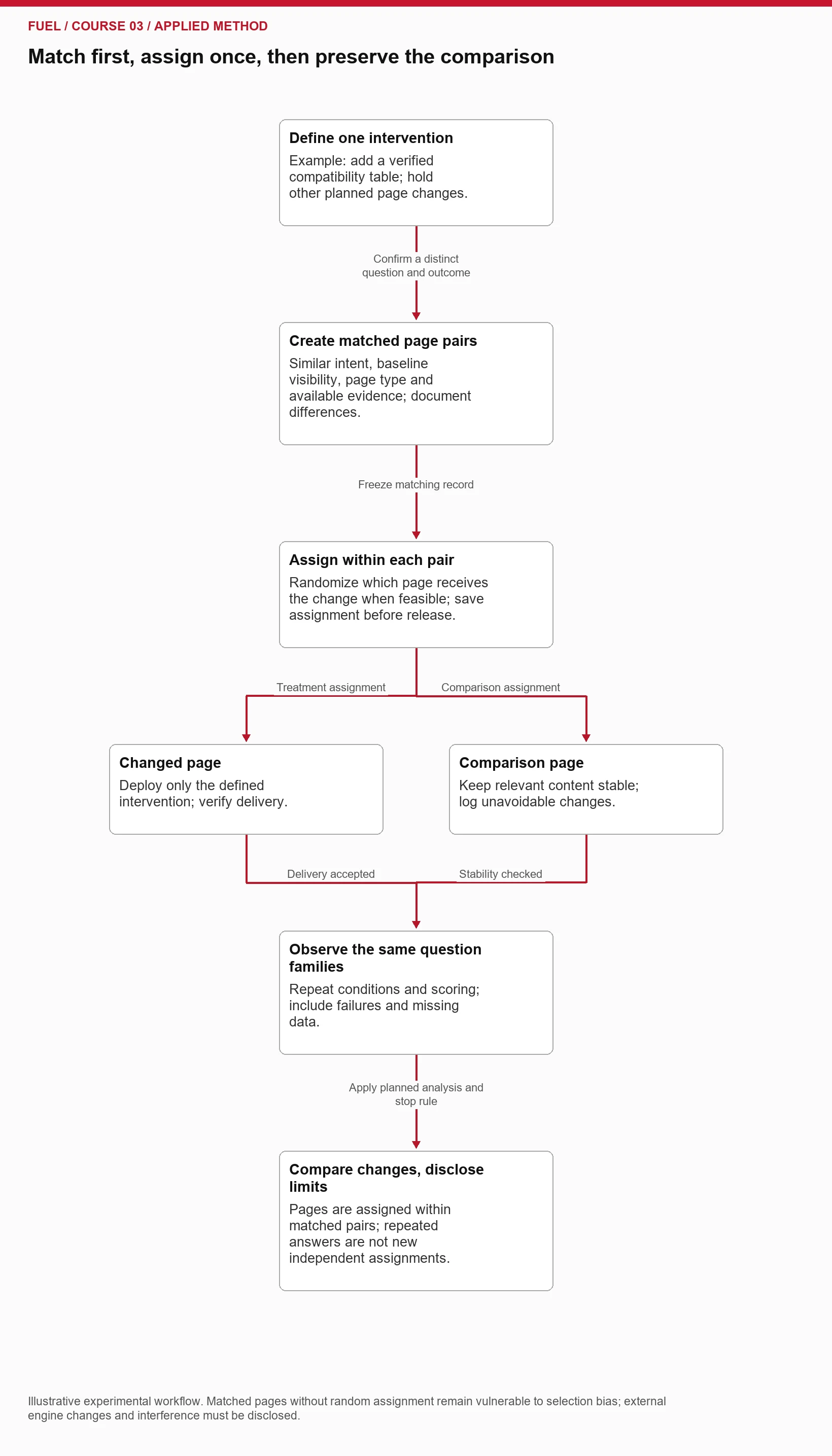
Match on characteristics relevant to the outcome and intervention. Consider intent, page type, baseline visibility, offer maturity, source evidence, topical difficulty and the planned buyer-question family. Record the important differences that remain. Similar historical citation rates do not establish that two topics face the same sources or will respond similarly to a change.
NIST describes blocking as grouping experimental units to manage important nuisance variation while comparing treatments within blocks. [1] Applying that principle to webpages requires your own defensible unit and interference decisions. NIST's general design guidance does not validate an arbitrary page match or predict an AI-search outcome.
Random assignment and interference checks
For a two-page block, random assignment can determine which page receives the defined change. Save the assignment method and result before release. Do not give the treatment to the page that appears most likely to improve after seeing the baseline and then describe the assignment as random. Matching and randomization perform different jobs.
Check whether the two pages compete directly for the same answer. If changing one can redirect citations away from the other, the pages may interfere rather than provide a clean comparison. A cluster-level design or another pairing can be more appropriate. Document the reason instead of assuming every pair of similar pages is suitable.
The AEO testing diagram preserves this structure: define one change, match, assign within pairs, maintain separate treatment and comparison paths, then observe and analyze. The page or declared cluster is assigned; the pair is the block. The diagram's repeated-answer stage supplies observations without pretending to multiply the number of independently treated units.
How do you freeze an AEO page testing baseline?
Freeze the AEO page testing baseline using the same outcome definitions and collection conditions you intend to use later. Save exact prompt versions, page destinations, engine or interface, search state, locale, dates and relevant account limitations. Preserve the complete answers and inspected support evidence, not only aggregate scores.
Choose a practical preperiod and observation schedule before looking for a favorable contrast. The schedule should reflect the business decision and feasible collection, while acknowledging that external discovery may not update immediately. A period with no evidence that the changed page was available cannot be interpreted as though every answer had an equal chance to use it.
Keep baseline page facts and offer versions. A compatibility claim may change legitimately during the test. If a product stops supporting an integration, the correct answer changes even when the experimental page treatment remains untouched. Record that event and its implications rather than scoring all later answers against an obsolete reference.
Define missing states. A collection failure, an unavailable search mode and an eligible answer without a citation are different records. Predeclare whether and how each enters the primary denominator, and report availability separately. If exclusions change, preserve both the original rule and a transparent revised analysis.
Review baseline concentration. A page with one repeated branded question may have a high mention rate while supplying little information about broader discovery. Keep task-family identifiers and inspect which prompts drive results. Do not choose a match solely because its aggregate score resembles another page's score.
Ask another reviewer to reproduce a baseline count and score a few difficult answers from the rubric. Resolve ambiguity before assignment where possible. This is a calibration step, not an independent proof of truth or market representativeness. AEO testing needs both reliable collection and a substantive reference for the facts being evaluated.
Which design fits AI search optimization testing?
Randomized and observational releases
Compare three designs for AI search optimization testing honestly. A paired randomized release can strengthen the treatment contrast when enough suitable independent units exist and interference is manageable. Its limits include small samples, implementation deviations and shared external shocks that affect pairs differently. The design label does not guarantee a credible result.
A matched observational release can be useful when random assignment is unavailable. State how pages were selected, why they are comparable and which differences remain. The result may support a descriptive or conditional comparison rather than a clean causal claim. Do not erase the selection limitation by calling the pages controls.
Supplied documents test handling, not discovery
A supplied-document experiment can isolate how an answer handles a changed passage under constructed inputs. Its limitation is retrieval: providing the documents directly does not show that ordinary search would find them. Keep that experiment separate from a public-page release. Both can answer useful questions without combining their outcomes into one success rate.
Choose an intervention with reader value independent of the result. A verified compatibility table can clarify actual support and exclusions. It should not invent new capabilities, hide conditions or present different facts to people and crawlers. AEO testing is easier to defend when the tested asset remains useful even if the visibility outcome is null.
Hold other planned changes stable within the practical scope. Record unavoidable updates to pricing, products, templates, links or distribution. A shared navigation change can affect both sides; a new third-party source can affect only one topic. The record should identify these events rather than claim perfect control over the entire web.
Set the primary analysis and decision rule before release. Specify whether the result is summarized by pair, how repeated observations are aggregated and which guardrails prevent expansion. Retain secondary exploration as exploration. Selecting whichever metric improves most after the experiment is not the same as evaluating the original question.
How do you calculate six matched-page AEO contrasts?
Work through an illustrative design with six matched pairs, twelve pages total. Randomly assign one page in each pair to receive a verified compatibility table and keep the other comparison page stable. Collect twenty eligible answer observations per page in each of two periods. The workload is twelve pages × twenty answers × two periods = 480 answers. There are six within-pair treatment contrasts, not 480 independent experiments.
Use the fictional counts in the table. For Pair A, the treated page rises from four to eight successes out of twenty, while its comparison rises from five to six. The treated change is twenty percentage points and the comparison change is five points, giving a fifteen-point contrast. The success definition must remain the same for both periods.
For Pair B, both pages rise by one success, so the contrast is zero. Pair C has a ten-point contrast; Pair D has five points; Pair E has zero; Pair F has minus five points. Retain the negative and null pairs. They show the result's distribution and prevent one attractive page from standing in for the entire experiment.
The treated pages total twenty-eight baseline successes and thirty-eight follow-up successes out of 120 observations per period. Their rate rises from about 23.33% to 31.67%, a change of 8.33 percentage points. Comparison pages total thirty baseline and thirty-five follow-up successes, from 25% to about 29.17%, a change of 4.17 points.
The descriptive difference in changes is therefore about 4.17 percentage points. Averaging the six equal-weight pair contrasts gives the same result: (15 + 0 + 10 + 5 + 0 − 5) divided by six. Equal observation counts make this illustration simple. Unequal counts and a different target population require a declared weighting decision rather than an improvised average.
The calculation alone does not establish statistical confidence, practical value or generalization. Inspect assignment integrity, independent units, spillover, exclusions and guardrails. AEO testing should report the pair-level pattern and design limits before calling the aggregate a winner.
If the primary outcome is accurate source-supported answers, label it that way throughout. Do not turn these fictional successes into leads, revenue or a universal citation-lift percentage. The example supplies arithmetic for a bounded operational comparison, with no claim that six pairs provide adequate power for a real decision.
| Pair | Treated before | Treated after | Comparison before | Comparison after | Difference in changes |
|---|---|---|---|---|---|
| A | 4 | 8 | 5 | 6 | +15 percentage points |
| B | 6 | 7 | 5 | 6 | 0 points |
| C | 2 | 5 | 3 | 4 | +10 points |
| D | 8 | 9 | 7 | 7 | +5 points |
| E | 3 | 4 | 4 | 5 | 0 points |
| F | 5 | 5 | 6 | 7 | −5 points |
| Total | 28/120 | 38/120 | 30/120 | 35/120 | Average paired contrast≈4.17 points |
Which spillover and stopping errors compromise AEO testing?
Inspect interference and drift throughout AEO testing. A shared template, global navigation change or broad product announcement can affect several pages at once. A third-party comparison article can alter the information available for one topic. Record these events and examine whether they compromise the planned contrast.
Watch for contamination of the comparison path. An editor might copy the compatibility table to the comparison page because it looks useful. That can be a sensible eventual product decision, but it changes the experiment. Record the release time and treat the affected period according to the predefined deviation rule. Do not silently preserve the comparison label.
Distinguish implementation failure from an ineffective intervention. If the table never reached the delivered page, the test did not evaluate the intended public change. If it reached the page but no relevant observation used the source, that is another evidence state. A null primary result cannot by itself reveal which hidden retrieval stage explains it.
Check whether the outcome reference changed. A newly supported product version can make yesterday's compatibility answer incomplete. Update the factual source through the proper process, protect readers and retain the incident in the test record. An experiment is not a reason to leave a known material error published.
Avoid stopping as soon as the graph looks favorable. Predeclare the observation window, permissible safety stops and treatment of incomplete collection. A factual or security guardrail can justify immediate action even if it weakens the study. Preserve the reason and narrow the interpretation instead of hiding the deviation to maintain a clean result.
Do not fix an inconvenient pair by replacing it after observing outcomes. If a page becomes ineligible because its offer genuinely disappears, document that event and the rule used. A new page can enter a later experiment. Keeping selection history visible is essential to understanding what the completed AEO testing actually compared.
How do you release ChatGPT citation experiments without contamination?
Release ChatGPT citation experiments through an explicit change manifest. Identify the page, assigned condition, intervention version, supporting facts, scheduled time and acceptance checks. Keep the comparison condition in the same record. The deployment team needs to know which assets must change and which must remain stable, without reconstructing the design from a presentation.
Verify actual delivery before interpreting later answers. Inspect the initial and rendered content as relevant, the compatibility table's values and exclusions, and the intended customer action. A successful editor save is not the full release. Retain the observable version and time so the analysis can distinguish planned assignment from implemented exposure.
Use expected-version protection where the publishing system supports it. Avoid overwriting a concurrent correction with an older experiment draft. If a legitimate offer change must occur, coordinate it through the fact owner and record its effect on the study. Protecting the customer and preserving a truthful record take precedence over keeping the original treatment perfectly isolated.
Assign separate responsibilities for release, capture, scoring and subject verification. A collector can confirm that an answer artifact exists without verifying the integration claim. A product owner can approve compatibility without deciding the statistical interpretation. AEO testing needs an accountable handoff across those tasks rather than one broad approved flag.
Use the AI visibility tracking panel method to preserve prompt versions and observations. Use integration capability contracts for the table's actual support facts and content change control for dependencies. These methods support the experiment while retaining their own completion criteria.
Checkpoint after each meaningful stage: design frozen, assignment saved, release verified, collection completed and analysis reviewed. Keep raw records and transformation notes in the authorized evidence store. A later analyst should be able to reconstruct which page received the change and how each reported contrast was calculated.
When should AEO testing results justify expansion?
Use AEO testing to support a bounded next investment. Start with whether the intervention was delivered and whether the primary measure and guardrails were evaluated as planned. If the release failed or the reference facts changed materially, repair or redesign before interpreting a headline effect.
Compare practical importance with uncertainty. A small positive average may not justify expanding a costly maintenance burden, especially when the pair-level results vary. A clearer compatibility explanation can still be worth retaining for readers even if the external visibility result is inconclusive. Separate the content's usability value from an unproven selection effect.
Decide whether the finding travels. A result on one page type, market, question family and interface does not automatically apply to every service page or engine. Define a comparable next cohort and repeat a meaningful test where the business value warrants it. Do not multiply a narrow estimate into a sitewide revenue projection.
Keep the final report aligned with assignment. If the treatment was a verified table plus required explanatory context, report that package. Do not credit only the table's visual format if the underlying facts changed too. The causal question concerns the actual intervention, not the most memorable component.
Document retain, revise, expand or stop with evidence. A factual guardrail failure can require revision despite more citations. A successful reader task with inconclusive external effects can justify limited retention. A credible repeated benefit in comparable settings can support expansion without guaranteeing the same result everywhere.
When the work becomes a public case, use the AI SEO case-study measurement framework to separate delivered work, comparative observations and commercial outcomes. Attribution to referrals or revenue needs its own evidence. AEO testing is useful because it narrows a decision, not because every completed experiment must yield a success story.
Ask an agency proposing a test to provide its design card before deployment: assigned unit, comparable pages, exact intervention, primary outcome, factual guardrails and planned decision. Request the page-level assignment record and a delivered-version check, not merely repeated answer screenshots. If the agency also changes navigation, prompts and commercial facts, the intervention must be described as that package. Use the resulting evidence to decide whether a bounded method deserves another cohort; avoid turning the illustrative 4.17-point contrast in this lesson into an expected client result.
Can you repair a contaminated AEO page testing plan?
Repair this fictional AEO testing plan. Twelve pages form six pairs, but the strongest page in each pair is deliberately assigned treatment. During collection, the team rewrites its prompts, adds a global navigation link and removes the pair with a negative result. It then describes 480 answers as 480 randomized experiments.
Identify four failures. Assignment was selective rather than random. Prompt and navigation changes altered the contrast. Removing an unfavorable pair after outcomes introduces selection. Repeated answers were incorrectly treated as independent assignments. More collected outputs cannot repair these design errors.
Prepare a defensible response. Preserve the original record, label the completed comparison observational and compromised, and avoid a causal headline. Retain useful accurate content and correct any customer-facing problem. Design a new bounded test with prospective assignment, a fixed panel, stable relevant changes and explicit deviation rules.
Submit a corrected design card, an assignment manifest and the six pair contrasts from the worked example. State the descriptive 4.17-point average with its fictional status and limits. The exercise succeeds when the page, pair, answer and business outcome remain distinct, and the next decision follows the evidence rather than the desired story.
Sources and evidence notes
[1] NIST/SEMATECH, Randomized block designs. Accessed October 25, 2026.
Apply the workflow
Discuss a scoped AI-search experiment and implementation plan with Fuel Online.
Explore the AI SEO and AEO course curriculum.
Discuss AI SEO and AEO implementation with Fuel Online.