
Cover photo: Peter Bond / Unsplash.
Inventory the filter URL space
Make a product-filter URL eligible for indexing when it answers a distinct, useful shopper task and can remain a maintained landing page. Keep the rest of the filter space under intentional crawl and indexing controls. The decision depends on the purpose of the URL, not simply on whether a shopper can select the filter. A useful on-site refinement does not automatically deserve its own search destination, while a carefully selected filtered collection can be more helpful than a broad category.
Start with an inventory of what the store actually generates. Record filter attributes, allowed values, multi-select behavior, parameter order, sorting, pagination and tracking additions. Select a few real journeys and save the resulting URLs. Two visually identical selections may produce different addresses because shoppers chose filters in a different order. Conversely, a URL may appear stable while its products change so much that its promised selection becomes unreliable.
The hypothetical arithmetic illustrates the scale problem. Three colors, four sizes and two materials produce 3 × 4 × 2 = 24 full combinations if every combination exists. That is not a count of all possible URLs. Partial selections, multi-select options, reordered parameters, sorting and pagination can create additional routes. The example is deliberately small and contains no actual crawl or inventory observations from a client site.
Use several inventory views rather than one crawler export. A crawl shows discoverable links under its configuration; a database or route specification may reveal combinations the crawler did not visit. Server evidence can show requested URLs where available. Search reporting can show indexed or excluded examples, with its own limitations. Label the source of each list so an incomplete sample is not mistaken for the complete generated space.
Give each URL class a proposed role: selected search landing, equivalent variant, shopper-only utility or invalid combination. Then inspect representative examples before applying a broad rule. The purpose of classification is to prevent a single parameter pattern from accidentally treating valuable destinations and meaningless combinations the same way. A catalog can need both effective filtering for people and a much smaller, carefully maintained set of search landings.
Select landing pages by distinct demand
Choose potential landing pages around a shopper decision, not a list of all attribute permutations. A black work shoe collection may serve a recognizable selection task, but adding every possible size, material, sort order and delivery option can produce many pages without distinct value. Look for evidence of relevant demand, meaningful product choice and a reason the refined destination is better than the parent category for that task.
Use actual site queries, customer questions and merchandising knowledge where available. Separate observed language from a merchandiser's useful hypothesis. You do not need to invent search volume to make an initial decision, but you should record confidence and the next evidence needed. A proposed landing can be tested within a bounded set while stronger evidence is collected. It should still offer a complete, useful selection experience at launch.
Compare the candidate with existing categories and guides. If a maintained category already serves the same buyer task, a second filtered route may create duplication rather than coverage. Prefer a single clear owner for the intent. The underlying filter can continue helping shoppers without being promoted as another search destination. Do not create parallel pages just because one has a cleaner slug or a more attractive phrase in the title.
Assess the selection itself. Can shoppers meaningfully compare products, understand relevant differences and reach accurate product information? Does the page explain the constraint that makes the selection useful? Copy should clarify the choice, including limits, instead of repeating the category name around a product grid. The amount of prose should follow the reader's need and the page's role; a filtered collection is not improved by hiding products under an unrelated essay.
Document why each chosen landing earns maintenance. Its row should identify the intended shopper, distinct task, existing competing destination, inventory condition and responsible owner. If the justification is only “the filter exists,” leave it in the utility class until there is a stronger case. That keeps the initial indexable set explainable and makes later expansion a deliberate decision rather than the side effect of a theme setting.
Check inventory and content durability
A filter landing is a continuing promise about a selection. Check whether the inventory supporting that promise is durable enough to justify the destination. A page that repeatedly contains no relevant products can frustrate shoppers and complicate search management. A page with a few genuinely useful choices may still serve a clear task. There is no universal product-count threshold that settles the decision; inspect usefulness, alternatives and the stability of the offer.
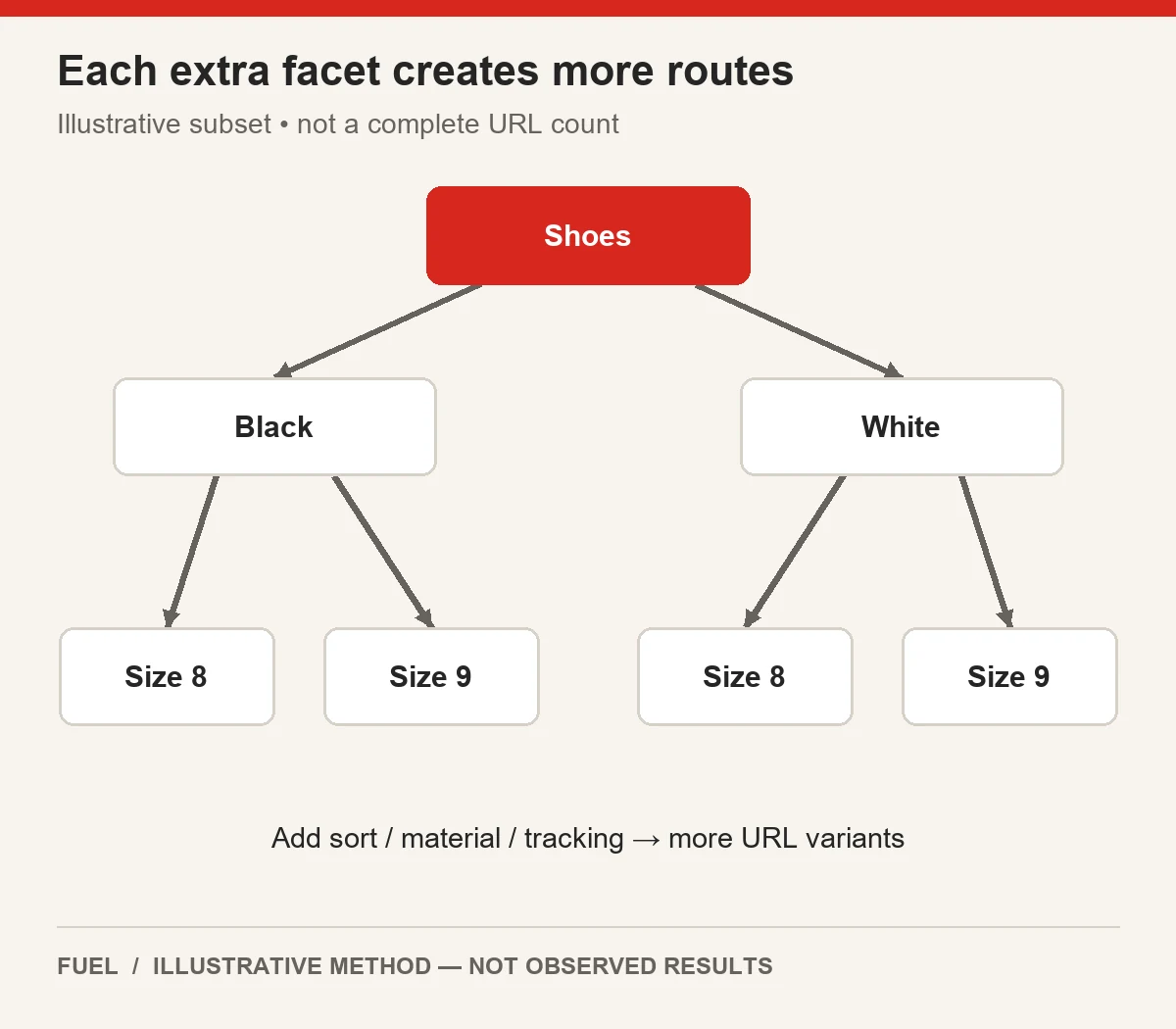
The branching diagram shows how a small shoes category can split by color and then size. It is a conceptual sample, not a complete catalog or measured crawl count. Add further attributes and more branches appear. The diagram helps explain why maintaining every path as an editorial destination is a different commitment from allowing a shopper to narrow a grid. Before promoting a branch, decide who will keep its promise accurate when stock or merchandising rules change.
Review the product data that makes filtering reliable. Attribute values need consistent meanings. A material filter should not combine conflicting labels that mislead a buyer; a size filter should reflect the relevant sizing system. Correcting the taxonomy can be more useful than adding a new landing page. A search page that promises a constraint but displays unsuitable products fails its practical purpose even if its metadata looks well optimized.
Plan the page's unique content around actual selection criteria. Explain relevant use cases, differences or constraints that the products and business can substantiate. Avoid assigning unsupported performance, compatibility or certification claims to the entire collection. When a claim applies to only some products, make that boundary clear and link to the product details. A useful collection helps a shopper narrow the choice without pretending every item has the same capabilities.
Set a review trigger for inventory and information changes. A seasonal collection, discontinued material or changed availability can alter whether the landing remains useful. Record whether the expected condition is temporary, recurring or permanent, and inspect the actual customer experience before changing the URL's role. This turns durability from an optimistic assumption into an operating responsibility that can be checked during normal catalog maintenance.

Choose controls for the remaining combinations
Use different controls for different goals. A canonical annotation communicates a preferred equivalent version; a crawl restriction limits retrieval; noindex tells a supporting crawler not to index accessible content. None is a universal “hide filters” switch. Decide first whether the problem is duplication, wasteful exploration, an unwanted search destination or an invalid URL. Then choose a control whose behavior matches that problem and verify the delivered result.
Google's faceted-navigation guidance warns that combinations can create very large crawl spaces and slow discovery of useful URLs. For filter routes that need potential indexing, it recommends standard parameter separators and consistent ordering; invalid, empty or nonsensical combinations should return appropriate 404 responses. Its crawl-control advice does not mean every store should index every filter, or that every useful selected landing should be blocked.
For genuine equivalents, Google's canonical guidance supports communicating one preferred destination and aligning internal links with it. Do not point a distinct, useful filtered collection at an unrelated broad category merely to reduce an index count. A filtered selection and its parent can complete different shopper tasks. Establish equivalence from the actual content and purpose before applying canonical rules across the catalog.
Be careful when combining noindex with robots restrictions. Google's noindex documentation explains that the crawler must access the page to see the rule. Blocking retrieval can prevent it from seeing a noindex instruction. A store trying to remove already discovered utility pages therefore needs an intentional sequence and verification, rather than adding both directives and assuming they reinforce each other. Keep the goal and observed crawler behavior explicit.
Test rules against exceptions before release. A pattern intended to block sort URLs might also match a selected landing whose path uses the same parameter name. A rule intended to remove impossible combinations might catch a temporarily unavailable but meaningful selection. Build test cases for valuable pages, utility pages, malformed routes and edge conditions, then save the expected and actual response. This is safer than judging success only by a smaller number of URLs in a crawler report.
| URL role | Intended treatment | Verification question |
|---|---|---|
| Distinct maintained selection | Candidate index-eligible landing with useful content and discovery links | Does it answer a real task with accurate relevant products? |
| Genuinely equivalent variant | Preferred canonical or appropriate consolidation policy | Are content and shopper purpose actually equivalent? |
| Shopper-only refinement | Deliberate crawl/index policy suited to the goal | Can the crawler observe the chosen rule where required? |
| Invalid or nonsensical combination | Meaningful not-found response at the requested URL | Does the delivered status match the invalid condition? |
Preserve discovery and pagination
Keep products and useful collections reachable through real discovery paths. If a shopper needs to click an interactive control to reveal a product, inspect whether the resulting route and important content are also understandable to a crawler. Do not assume a visually functional filter proves search discovery works. Likewise, do not disable a useful customer control merely because its current implementation produces too many URL variants. Separate the experience from the URL policy.
Selected landings should receive appropriate contextual links from relevant categories, buying guides or other maintained pages. The link should describe the destination accurately and lead to the preferred route. A landing that exists only in a sitemap has a weaker human discovery path than one integrated into the catalog. Choose links for shopper usefulness rather than adding an all-to-all filter directory that simply recreates the combinatorial problem in another form.
Inspect pagination as its own route class. A valid filtered collection may span multiple pages, while a nonexistent page number is an invalid destination. Confirm that shoppers can reach the available products, links remain coherent and out-of-range requests behave intentionally. Do not assume every paginated page is an equivalent copy of page one. Compare the actual product selection and purpose before applying a template-wide canonical rule.
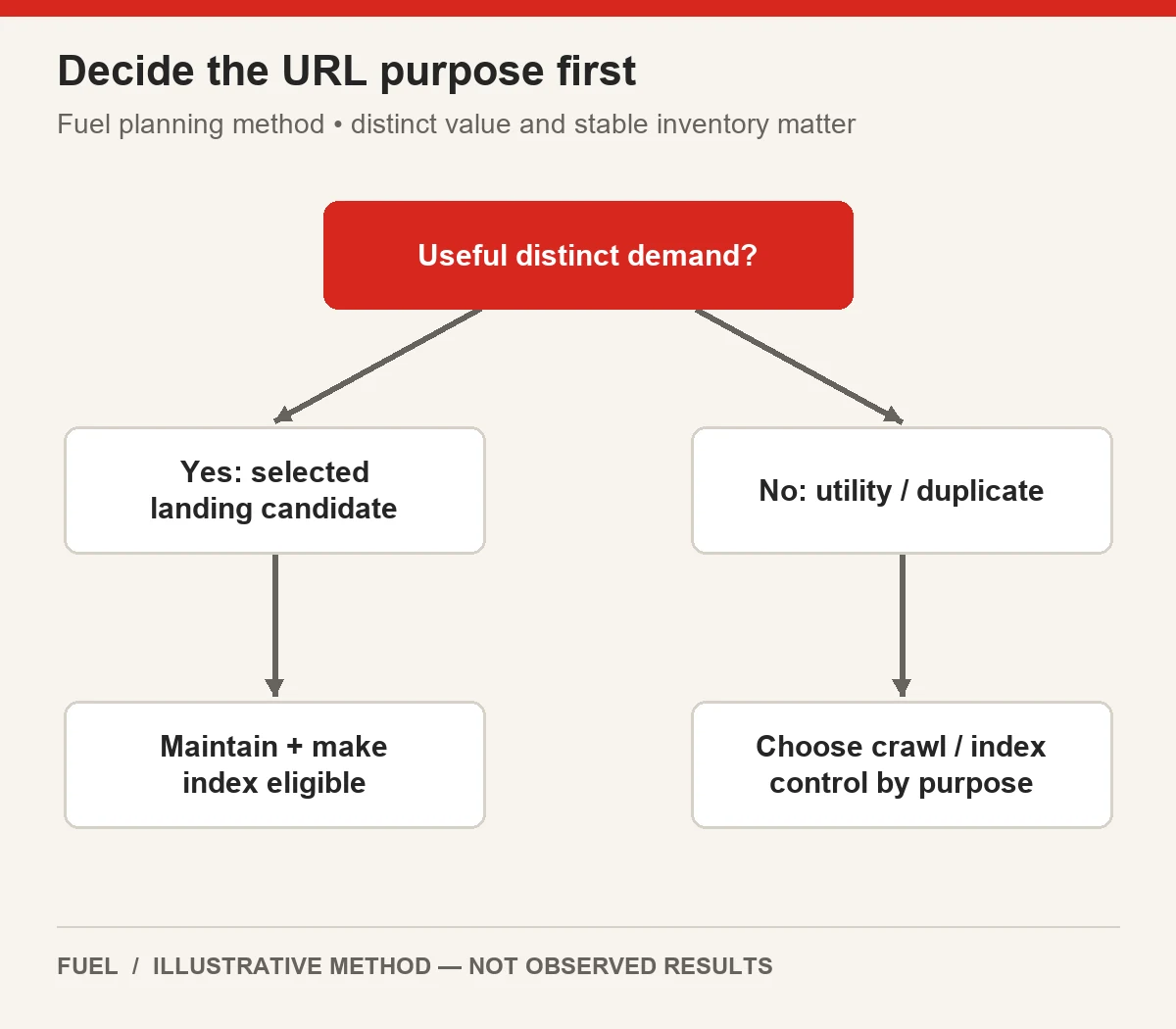
The decision diagram distinguishes maintained index-eligible landings from utility or duplicate routes. Eligibility still does not guarantee indexing. Google's technical requirements describe basic access, successful responses and indexable content, but external selection remains outside the store's control. Use those requirements to verify that chosen pages are eligible, then keep future indexing observations separate from the immediate implementation acceptance check.
After a change, follow representative buyer journeys on mobile and desktop. Confirm that selected filters, back navigation, pagination and product links behave as expected. Check that the page's visible promise matches the selected products and that key information is not available only in an image. A technically neat URL policy should preserve the practical ability to compare and buy. If it damages that journey, the release is incomplete even before search behavior is evaluated.
Roll out and monitor a bounded subset
Roll out a bounded selection before applying the policy to every filter. Choose examples that cover the real cases: a useful selected landing, an equivalent variant, a utility refinement and an invalid combination. Include a difficult case, such as multi-select behavior or a collection with changing availability. A small but representative release can expose a pattern error before it affects a large catalog.
Write acceptance checks for each role. The selected landing should deliver the intended content and indexability signals. The equivalent variant should communicate its preferred destination consistently. The utility route should follow the chosen retrieval/indexing policy. The invalid combination should return the intended response without pretending it is a useful successful page. Save actual responses, not only screenshots of configuration fields, because application and delivery layers can disagree.
Assign an implementation owner and a catalog owner. The technical team can control routing, templates and directives, but merchandising changes determine whether the selection remains useful. Agree how new attributes, filter values and theme updates enter the policy. Otherwise, a careful initial cleanup can be undone when a later feature silently creates another set of crawlable combinations. The ongoing process should be lightweight enough to survive normal operations.
Monitor selected destinations and unintended URL growth separately. Useful pages may need time for indexing observations, while a broken rule can be visible immediately in delivered responses or generated links. Where logs and search data are available, use them to investigate actual behavior without treating one report as complete coverage. Note the sampling limits, dates and URL classes so a new problem can be compared with the release baseline.
For a complex store, a scoped ecommerce SEO architecture review can connect catalog intent, URL generation and delivery checks. Bring representative routes, filter definitions, inventory constraints and the existing owner map. The useful outcome is a maintainable policy with verified exceptions, rather than a generic instruction to block parameters. Clear responsibilities help the team preserve both product discovery and a useful search landing set.
When an indexable filter should be retired
Revisit an indexable filter when the task or the catalog changes. A selection may lose its distinct purpose because a new category now serves the same need. Its products may disappear permanently, its filter meaning may change or another maintained page may become the clearer owner. These are reasons to reassess the destination, not automatic instructions to delete every low-traffic landing.
Check remaining value before retirement. Review useful content, incoming routes, customer use and suitable replacement destinations where evidence is available. If an equivalent replacement genuinely serves the same task, plan the transition and update discovery paths. If no relevant replacement exists, do not redirect visitors to an unrelated category simply to avoid an error response. The response should reflect what the destination can honestly provide.
Keep the decision record with the URL policy. State why the page changed role, which paths are affected, what shoppers will see and what immediate checks passed. Future search behavior can then be interpreted alongside an understandable release history. Without that history, a deliberate retirement can look like an unexplained loss and a generated-URL regression can go unnoticed.
Good product filter indexation is selective and maintainable. It gives important shopper tasks stable destinations, preserves useful refinements for people and prevents the unselected combination space from becoming an accidental publishing strategy. The store can expand that selected set when actual demand and inventory justify it, with each addition earning its place through a clear purpose and a verified implementation.