
Cover photo: Lightsaber Collection / Unsplash.
Specify the release contract
An SEO fix can pass staging and fail in production because the environments deliver different responses, directives, URLs or customer journeys. SEO release QA should therefore verify the public production behavior against a written release contract. A passing staging test proves what happened in staging under the tested conditions. It does not establish what an anonymous visitor or crawler receives from the live hostname after deployment.
Define the contract before release: which URLs change, what each should return, which host is canonical, what content must be present and which customer action must work. Include redirects for affected old routes and any template variants. Write observable outcomes, such as this service URL returns a successful response with its own production canonical and an accessible inquiry path. A vague requirement to preserve SEO cannot tell a release owner whether a specific response is acceptable.
Google's migration guidance explicitly warns about retained development noindex or robots restrictions, incorrect redirects, outdated canonical destinations and other migration faults. Those documented failure modes justify release checks; they are not evidence that every deployment suffers them. Use the checklist to test the actual changed scope. When URLs are unchanged, apply the relevant response and directive checks without pretending that the release is necessarily a full site migration. Read the supporting Google documentation.
Save the baseline in a usable form. Retain the previous public response, important directives, canonical destination, visible decision content and working customer action for representative routes. Record the deployment identifier and the recovery owner. A screenshot can show appearance, but it cannot replace response and header evidence. Keep enough information to distinguish a new defect from a pre-existing issue discovered during the release review.
Agree on the observation boundary. This article's method accepts or rejects an implementation using public-delivery evidence. It cannot certify that Google will index the page, retain its ranking or produce more inquiries. Set later search observations separately. That separation helps a team stop an objectively broken release immediately without waiting for search traffic to fall, while avoiding a premature ranking-win claim merely because the deployment finished successfully.
Find the differences staging missed
Begin the investigation by comparing environment facts. List staging and production hostnames, authentication requirements, runtime configuration, template version, plugin or middleware settings and the delivery layers relevant to the site. Do not assume an identical code revision implies an identical response. Production may use different host variables, permissions, content records or infrastructure rules. Record those differences before attributing the symptom to the source code alone.
Use an explicitly hypothetical incident to make the method concrete. A service template passes staging because its canonical points to the approved test URL and its content renders correctly behind authentication. Production uses a host-setting value that was not updated, so the same template declares the staging hostname as canonical. The page can look correct in the browser while its declared destination violates the release contract. This scenario is illustrative; it is not a reported Fuel incident.
Google's technical requirements specify crawler access, a successful HTTP 200 response and indexable content for indexing eligibility, without guaranteeing indexing. Test those requirements on the live environment. A logged-in editor seeing a complete page cannot establish whether the public request receives a login screen, error or different content. Preserve the identity and conditions of each test so the evidence describes an actual access path. Read the supporting Google documentation.
Compare only the environments and states that matter to the release. A broad stack inventory can consume time without resolving the fault. If the change affects canonical generation, examine host settings, template output and any response modification along that route. If content disappears only for anonymous users, compare the access and delivery conditions. Keep a hypothesis column that names why each difference could explain the observed failure and what result would disprove it.
Ask the system owner which production rules are actually active. Caching, security, localization and experiments can introduce variants, but their behavior depends on the implementation. Do not assert a particular cache key or bot treatment without inspecting it. Where access is missing, record the specific evidence required and continue tests you can perform. A public failure should remain an observed failure even when its internal cause is still uncertain.
Verify response and directive behavior
Inspect the actual production response before relying on the rendered page. Record the requested URL, redirect chain, final URL, status, relevant headers and source. A page that visually resembles the intended content can still arrive through an unintended redirect or declare the wrong canonical. Test the important host and path variants affected by the release, especially if the change touches trailing slashes, HTTPS, language paths or retired destinations.
Separate crawl access from indexing directives. Read the applicable robots rules and check both page-level metadata and relevant response headers. An unintended noindex delivered through a header can be missed if the review examines only a template's visible source. Conversely, a development block may prevent access to a page whose template looks correct in the editor. The acceptance test must follow the delivered response, not just the configuration value someone intended to set.
Google's noindex documentation explains that it must crawl a page to see the noindex rule. A robots block can prevent that observation. This is why adding a crawl block is not a general substitute for correcting an unwanted indexing directive. Diagnose the purpose of each control, then test the intended combined behavior. Avoid a sequence of contradictory fixes that makes the page harder to inspect and leaves the original cause unexplained. Read the supporting Google documentation.
For canonical checks, compare the declared destination with the contract and inspect whether it is a valid intended public URL. Review template output and representative variations. A service page declaring a staging host is a concrete discrepancy even before Google processes it. A canonical that differs from an internal link destination deserves investigation. Keep the observed declaration separate from any later Google-selected canonical evidence; they answer different questions.
Test failure paths as deliberately as successful ones. A malformed route, retired URL or empty result should produce the behavior the site intends, with an appropriate response. Do not map every error to the homepage merely to make the browser show a successful page. Review the relevant route policy with its owner, then record the actual outcome. A release contract should make clear which paths must work, which must redirect and which legitimately no longer exist.
Compare source, rendering and cache variants
Compare delivered source with the rendered customer experience. Confirm that essential decision content, navigation and the primary action appear under the tested production conditions. Where JavaScript changes the page, capture the final state as well as the initial response. This comparison can reveal a rendering or runtime problem without assuming that every difference harms search. The test asks whether the release delivered the intended usable page.
Keep a small state matrix. Include anonymous access and the relevant mobile or desktop view; add authenticated, language, region or experiment states only when the site genuinely serves them and the release affects them. Record how each state was established. Do not manufacture an exhaustive matrix of theoretical variants that the application does not implement, and do not silently claim coverage of states you could not reproduce.
Canonical output deserves consistency across these views. Google describes redirects and canonical annotations as strong canonicalization signals. A signal must first be delivered as intended; a declaration that changes to a staging host in one production variant fails that requirement. Record the initial and rendered values when both are relevant, then repair the implementation responsible for the discrepancy. This observation does not prove how Google will ultimately select the canonical. Read the supporting Google documentation.
Treat cache behavior as a testable implementation detail. If the delivery system can serve cached responses, ask which invalidation and variation rules apply to the affected route. Compare the ordinary public path before and after the approved cache action, recording timestamps and observable version markers. A direct-origin success can help locate a discrepancy, but it does not establish that customers using the normal delivery path receive the fix. Verify that path again.
Avoid a false pass caused by your own session. An editor account or preview parameter may bypass a problem that anonymous requests still encounter. Equally, a forced fresh request can differ from the ordinary cached experience. Preserve both observations with their conditions instead of choosing whichever result looks correct. If a particular variant remains uncertain, name it in the release status and identify the owner who can supply the missing evidence.
Test important routes and discovery signals
Test routes from the perspective of discovery and use. Follow the changed page from its relevant hub, navigation and supporting content rather than testing only a pasted URL. Confirm that the route leads to the intended production destination without unnecessary detours. Check that updated destinations appear where the release says they should. A page can be technically accessible yet absent from the paths the team expected readers to use.
Select the sample before declaring success. Include representative URLs for each affected template and all high-consequence known exceptions. A service template with optional location data may require both populated and unpopulated examples. A redirect change may require old URLs, current URLs and meaningful malformed cases. State the sample coverage precisely; a successful set of tests does not prove every URL on a large site was inspected.
For a hypothetical release, the acceptance matrix might include a service page, its supporting guide, an old equivalent route and a localized variant. Record expected and observed status, final URL, canonical, indexing directive, essential content and customer action. Keep failures visible. Do not replace an inconvenient failing example with a passing route and then claim that the template passed. Expand the sample when a defect suggests a shared cause.
Review sitemap and internal destination changes against the actual route plan. If URLs changed, make sure the relevant discovery signals use the intended public destinations. If URLs did not change, do not create unnecessary URL churn just to make the release look comprehensive. The goal is coherent delivery and navigation around the approved change. Record a missing discovery update as its own task, with its own acceptance evidence.
Test the primary customer action through a safe, authorized path. A form should lead to the intended confirmation and receiving system; a phone route should reach the correct destination; a booking link should preserve necessary context. Distinguish a front-end click from completion of the handoff. Where a real transaction or external message would exceed the authorized test scope, document that boundary and use the approved test mechanism. Never claim the downstream action passed merely because its button appeared.
| Route type | Evidence to capture |
|---|---|
| Current service | Response, canonical, indexability, essential offer and working inquiry. |
| Supporting guide | Public destination and intended route to the service. |
| Retired equivalent | Expected redirect and suitable final destination. |
| Localized variant | Correct host, language route and customer context. |
| Failure path | Deliberate response for a genuinely invalid route. |
Define stop and rollback criteria
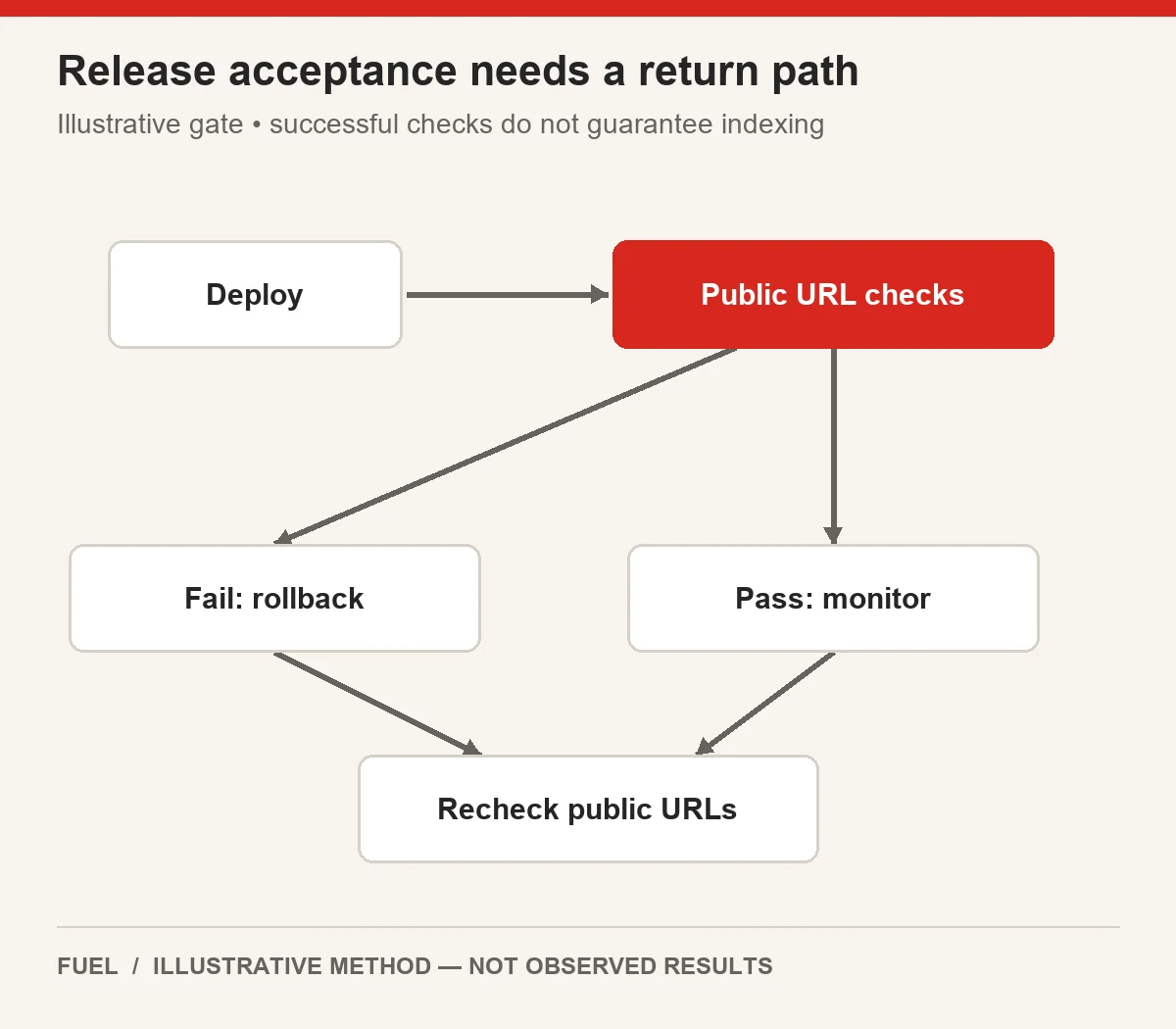
Set stop criteria before release pressure makes every defect negotiable. Examples include unintended sitewide indexing restrictions, wrong-host canonicals across an affected template, broken primary customer actions or a material route returning the wrong destination. Severity depends on the real scope and business consequence. Assign the person who can pause the rollout and the person who can decide between a focused correction and recovery of the previous state.
A rollback plan needs more than a previous code revision. Content, configuration, database changes, cached responses and external dependencies may affect recovery. Ask the owners what can actually be restored and what must be corrected forward. Record the tested recovery path and its limitations. Do not describe rollback as safe or instantaneous when the team has not established how the public environment will behave after it.
Use a bounded incident record: affected routes, first observed time, deployment reference, observed failure, likely scope and current action. Preserve a failing response before changing it where possible. After the correction, repeat the exact test that failed and a small set of relevant regression checks. A successful home page request does not validate a repaired service template, and an origin-only response does not validate public delivery if that was the failing layer.
If the cause remains uncertain, separate mitigation from diagnosis. Restoring a known usable customer path may be justified before the internal explanation is complete. Record what the mitigation demonstrably changes and what it does not establish. Later, use the saved evidence to identify the shared cause and improve the release contract. Avoid quietly turning a temporary workaround into a verified permanent fix without retesting its dependencies.
For complex enterprise releases, support should connect implementation with observable acceptance. Bring the change list, affected templates, expected responses, representative failures and the recovery constraints. A useful review helps the delivery team decide what to stop, what to correct and what to verify next. It should leave a concrete record another engineer or marketer can follow, with no need to infer whether a green status refers to staging, origin or the actual public path.
For implementation support, review Fuel’s SEO services. Share the affected scope, actual evidence and the decision you need to make.

Close the release with stored evidence
Close the release with an evidence bundle that survives the meeting. Retain requested and final URLs, timestamps, deployment identifiers, response samples, rendered checks, customer-action results and sample coverage. Link each failed contract item to its correction and successful retest. Keep unresolved variants and owners visible. A concise reproducible record is more valuable than a large folder of screenshots whose conditions nobody can identify.
Report three statuses separately: deployed, publicly verified and awaiting search observation. Deployment means the change reached the target system. Public verification means the tested production paths meet the release contract. Search observation concerns later indexing, canonical selection or visibility under defined conditions. The first two can be complete while the third remains unobserved. None of them alone establishes a change in qualified demand or revenue.
Use the incident to improve the smallest missing acceptance check. A wrong-host canonical suggests adding a production-host assertion to the relevant route tests. A session-specific pass suggests including anonymous delivery. A stale public response suggests documenting and verifying the delivery-layer recovery path. Keep the lesson tied to the demonstrated fault. SEO release QA improves when each release adds reliable evidence around the behavior that matters, rather than accumulating checks whose relationship to the customer and search path is unclear.