
Cover photo: Kelly Sikkema / Unsplash.
Start with the constraint on growth
Allocate the next marketing budget dollar to the constraint you can usefully change, with an outcome you can measure and a commitment the business can afford. That may mean repairing a conversion path, improving a valuable service page, testing paid demand or investigating inaccurate AI recommendations. A permanent percentage split across SEO, AI SEO and PPC cannot answer those questions without evidence about your offer, economics, current assets and time horizon.
This framework addresses the marginal decision: what should the next increment of money or delivery capacity fund? It does not claim that one channel wins universally or supply an industry allocation benchmark. Existing commitments may continue while the next increment is tested. That distinction matters because a business can preserve a working acquisition program and still redirect new effort toward a different bottleneck without replacing its whole strategy.
Start with a qualified commercial outcome. Define the customer you can serve, the relevant offer and the action that creates a real opportunity. Then identify the limiting stage. Are suitable people unaware of the offer? Do interested people reach an incomplete page? Are enquiries unqualified, or are good enquiries unanswered? Paying for more visibility is a weak response when the immediate constraint is inaccurate availability or failed follow-up.
Separate urgency from certainty. Paid campaigns can be designed to test demand promptly, but that does not guarantee efficient acquisition. Organic improvements can create useful maintained assets, but their search outcomes are not guaranteed either. AI visibility work may address an important factual error before it generates identifiable visits. State the role of the proposed work and the observation you expect, rather than treating a channel label as a timetable or return promise.
Finally, define the financial and operational guardrails. How much can be committed before the next review? Which costs are already fixed, and which truly change with the decision? Can the business fulfill additional demand? A budget that looks sensible in a channel report can still be unsuitable if it consumes cash before sales mature or produces enquiries the team cannot handle. The decision needs both acquisition evidence and a realistic operating context.
Separate channel roles and shared foundations
Describe channel roles in terms of buyer tasks and controllable work. SEO can improve eligible, useful destinations and their discovery routes. PPC can test specific demand, offers and audiences under paid campaign controls. AI SEO can include clearer business facts, source-worthy information and observation of relevant answer behavior. Those descriptions overlap in practice. The same accurate service page can support an organic visit, an AI-cited reference and a paid visitor deciding whether to enquire.
Avoid paying twice for the same foundation under different names. If an SEO project fixes accessibility and clarifies an important offer page, an AI proposal should explain what additional work it contributes. That could be a defined recommendation-accuracy audit, evidence development or a reproducible measurement panel. Count the shared implementation once in the budget, then account for genuinely additional tasks separately. This is a management convention for avoiding duplicated scope, not a claim that every provider offers the same service.
For Google specifically, its generative AI optimization guidance describes reliance on Search foundations and does not require a special AI markup layer. That supports evaluating Google AI work alongside the ordinary eligible-content system. It does not mean every AI product behaves identically, nor that ordinary SEO guarantees a recommendation. A proposal covering other products must name its observed scope and explain which additional evidence or access it uses.
Inspect actual service scope before allocating. Compare SEO implementation and content work, AI SEO measurement and visibility work and paid search campaign management against the constraint you identified. The useful comparison concerns deliverables, dependencies and acceptance evidence. It is less informative to compare three channel names when each proposal includes different amounts of content, technical work, reporting and execution.
Keep the buyer journey joined up. A paid ad should lead to a destination matching its promise; an educational search page should help a suitable reader continue when ready; an AI-recommended offer should be represented accurately. Improvements to that shared experience can matter even when attribution credits only one final touchpoint. Record the common investment and the specific hypothesis for each channel rather than forcing all shared benefits into a single silo.
Price the measurement and conversion work
Reserve enough effort to know what the budget is buying. Verify the important event, test the action and reconcile the resulting enquiry with the business record. A button click, form submission, qualified opportunity and sale are different stages. Choose the stage relevant to your decision and preserve the later outcomes where available. Do not award a campaign a qualified lead because a dashboard uses the word “conversion” for an unreviewed action.
Google's explanation of key events and conversions distinguishes on-site important events from advertising conversion use. Your implementation still needs clear event definitions and consistent reporting settings. Record what is counted, how duplicates are handled and which window is used. If qualification happens outside analytics, agree how those records will be reconciled before comparing channel efficiency. A clean event label is not a substitute for a working business process.
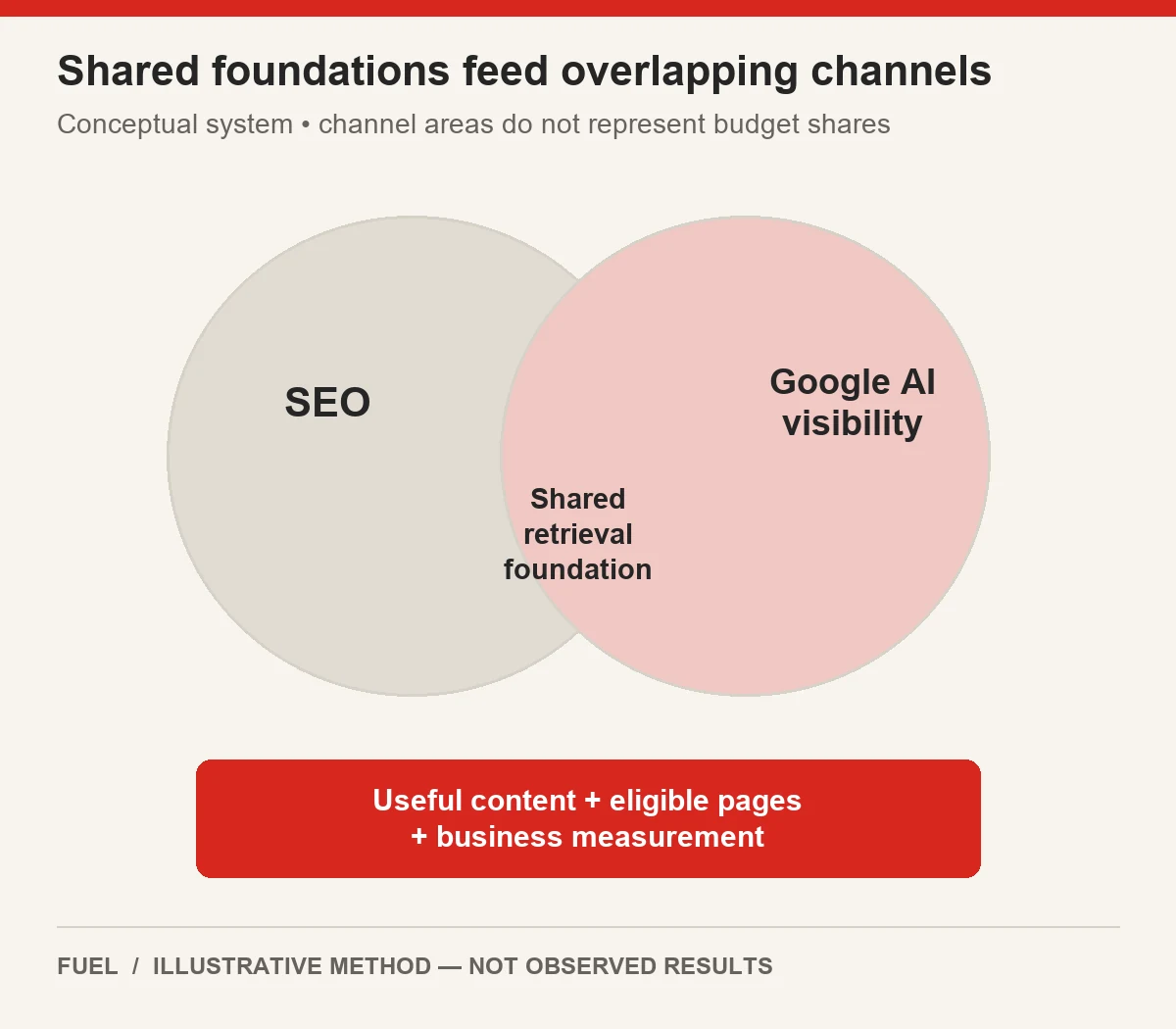
The shared-foundation diagram shows conceptual overlap, not measured attribution or budget percentages. Useful content, technical eligibility and business measurement support several acquisition paths. Treat those costs as identifiable shared work where possible. If the same page improvement is included in two agency budgets, resolve the overlap. If a shared measurement repair is necessary before either channel can be judged, schedule it as a prerequisite instead of letting two teams produce incompatible reports.
Keep attribution scopes compatible. Google's acquisition-report guidance distinguishes user-scoped and session-scoped dimensions. A report about how users were first acquired does not answer precisely the same question as a report about the source of a particular session. Document which view informs each decision. Otherwise, apparent disagreement between channels may come from comparing different definitions rather than from a real change in performance.
Measurement repair should remain proportionate. You do not need to postpone every useful page correction until a perfect attribution model exists. Fix an obviously broken enquiry action and verify that it works; keep its commercial effect uncertain until evidence arrives. The aim is enough reliable information to choose and assess a bounded investment, while making the remaining gaps explicit rather than hiding them behind a polished combined dashboard.
Compare marginal options under uncertainty
Compare the next options using their incremental costs and plausible qualified outcomes, with uncertainty visible. Start with unit economics rather than an assumed industry ROI. Identify gross contribution per completed sale, qualified-lead close rate, the time between enquiry and payment and the costs the business still has to cover. Use your actual accounting definitions. Revenue alone can make an acquisition source look attractive even when fulfilling its sales leaves little contribution.
The worked example uses explicitly hypothetical arithmetic: $1,000 gross contribution per sale multiplied by a 20% close rate equals $200 expected gross contribution per qualified lead. It is not a target cost per lead, a forecast or a recommendation to spend $200. Acquisition cost, overhead, risk and the required profit still need room. The linear plot holds the contribution assumption fixed to illustrate how sensitive the value is to the close rate.
Extend the hypothetical example carefully. If a proposed paid test assumes $10 per click, a 5% enquiry rate and half of enquiries qualifying, its expected cost per qualified lead is $10 ÷ (0.05 × 0.5) = $400. Compared with the illustrative $200 contribution before acquisition, that set of assumptions would not justify scaling. These are invented inputs, not market prices or Fuel performance. Their purpose is to show which assumptions need evidence and why cheap clicks alone cannot establish good economics.
Evaluate an organic or content project with equally explicit costs. Include research, verified evidence, implementation and maintenance rather than treating an organic click as free. The future volume and timing may be much less certain than the project cost. Record a range of scenarios and the milestone that would update your view. Do not compare a short paid-test window with an optimistic multi-year organic scenario and call the difference a fair channel result.
For AI work, identify whether the immediate outcome is factual correction, measured answer coverage, identifiable referrals or qualified business. An observation panel can be worth funding to investigate a consequential uncertainty without having a defensible revenue forecast. Keep that exploratory allocation bounded. Do not multiply a sample mention rate by all market demand to create a pipeline estimate; the panel does not measure every buyer's exposure or behavior.
| Input or decision | Hypothetical value / required evidence | Meaning |
|---|---|---|
| Gross contribution per sale | $1,000, illustrative only | Before acquisition, overhead allocation, risk and required profit |
| Qualified-lead close rate | 20%, illustrative only | Use comparable qualified cohort and mature sales outcomes |
| Expected contribution per qualified lead | $1,000 × 0.20 = $200 | Not a spending target or guaranteed value |
| Illustrative paid acquisition inputs | $10 click cost; 5% enquiries per click; 50% qualify | $400 expected qualified-lead cost under these assumptions |
| Next marginal commitment | Actual cost, owner, milestone and approved limit | Select by constraint and evidence, not universal channel ratio |
Build a phased budget with stop rules
Build a phased commitment around the most useful next decision. For an urgent offer with a functional landing page and usable measurement, a bounded PPC test may produce relevant demand evidence. For a valuable service page that is inaccessible or materially misleading, repairing the foundation may take precedence. If AI answers appear to misrepresent the business, a small documented accuracy investigation can clarify whether a targeted factual correction is needed. These are conditional options, not a universal sequence.
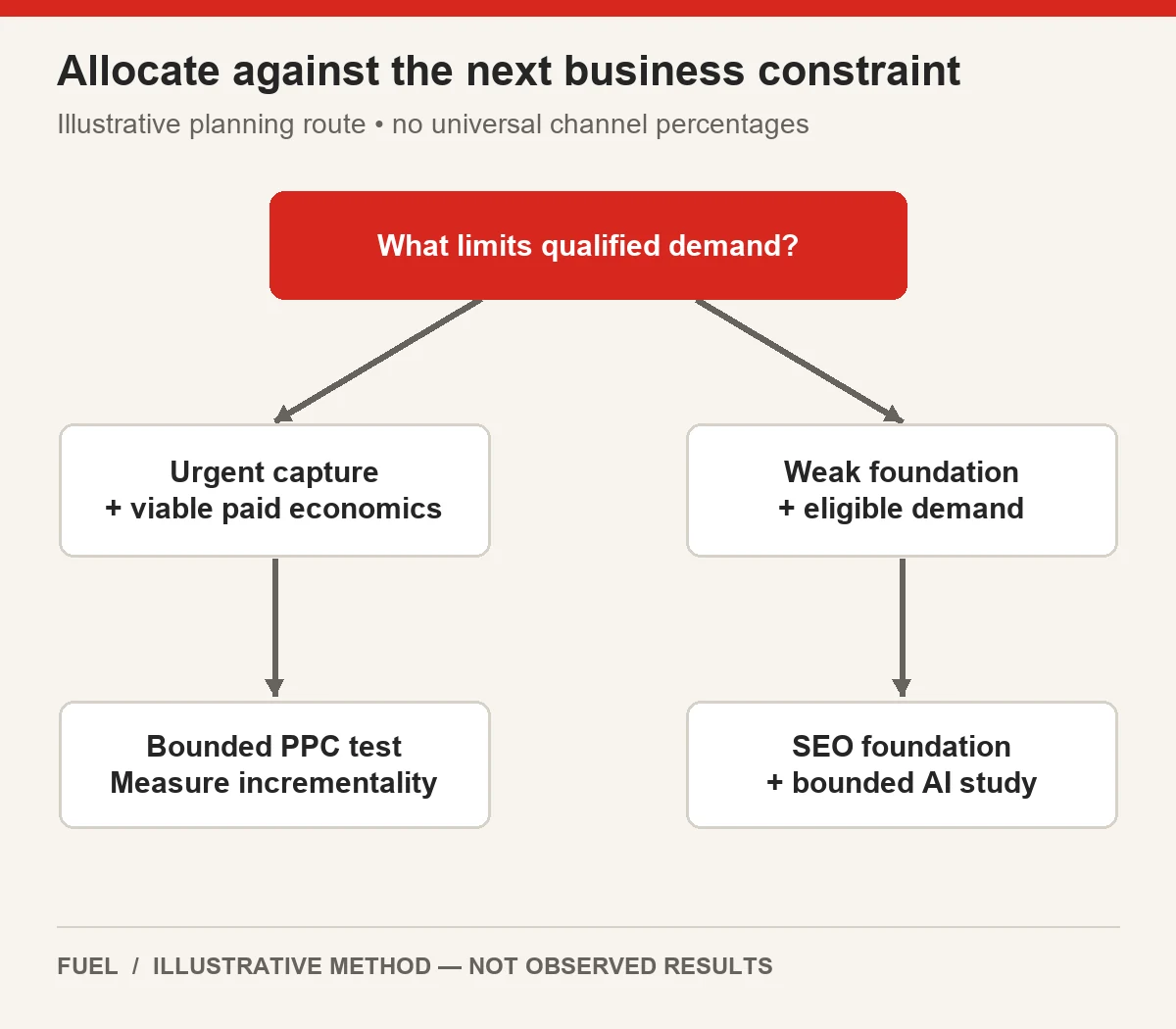
The budget decision diagram therefore branches by constraint and evidence, not by a predetermined spending ratio. It shows a bounded paid test for urgent demand capture and foundation improvement plus limited AI observation where those gaps are material. The illustration does not forecast which branch will succeed. In practice, several tasks may proceed together when they have distinct owners and the business can fund them without weakening essential delivery.
Define stop and continuation rules before the test. A paid experiment might stop if the enquiry path fails, the eligible audience is materially wrong or spend reaches the approved learning limit without usable evidence. A content project might pause expansion when factual inputs are unavailable or a representative page fails acceptance. An AI panel might require redesign if the prompts do not represent the stated service decision. Those rules protect the budget from being extended merely because work has begun.
Use milestones that can be observed immediately as well as later. A deployed page can be checked for accurate content, meaningful response, usable mobile action and coherent links. A campaign can be checked for intended targeting, destination and event behavior. Those checks establish implementation, not business lift. Later reviews should inspect the relevant qualified outcomes and the conditions under which they were observed.
Keep some flexibility for learning rather than committing every available dollar to the first plan. The amount depends on the business and is not supplied here as a percentage. Record what would trigger reassignment: verified demand outside the current coverage, a material change in close rate, a capacity limit or a failed hypothesis. A phased budget becomes useful when it tells the team what to do with new evidence, not simply when it divides a spreadsheet into stages.
Review incrementality and overlap
Review overlap before crediting separate channels with the same result. A person may research through organic content, encounter a brand in an answer and later click a paid ad. Reporting systems can assign different credit depending on their definitions. Preserve the observed path where available, but do not assume a reported touchpoint tells you what would have happened without that channel. Attribution and incremental business impact are different questions.
Google's paid and organic report can compare organic visibility with Search text-ad metrics after the relevant accounts are linked. Its stated coverage excludes Shopping and click-to-download ads. Use it to investigate query overlap within that scope, not as a complete cross-channel profit statement. Combined clicks show observed interactions under the report's rules; they do not establish that advertising added the same number of customers.
Where a consequential reallocation depends on incrementality, consider an appropriately designed test with suitable controls and business outcomes. The right design depends on available volume, geography, seasonality and operational constraints. If a controlled test is impractical, use the best available descriptive evidence and report the causal uncertainty. Do not make the claim stronger merely because the budget decision is important; a high-stakes decision needs its uncertainty understood.
Watch marginal performance rather than only historical averages. A channel can have a strong total record while the next expansion reaches a less suitable audience or more expensive demand. Conversely, a modest new project may address a sharply defined gap that past aggregate reports conceal. Compare the next feasible option with the next best use of the same resources, including improvements to conversion or fulfillment when those are the actual constraints.
Use the review to update assumptions. Reconcile qualified leads and sales, inspect changes in offer or capacity and record which costs were truly additional. If a project produced useful infrastructure but not yet measurable acquisition, describe both facts. The business can then decide whether to maintain, extend, repair or stop the work without forcing every outcome into a winning-channel narrative.
When to rebalance instead of adding spend
Rebalance when the evidence or business constraint changes. A new service may need demand validation; an established offer may need stronger delivery; a capacity shortage may make additional leads temporarily undesirable. The budget should follow the opportunity the business can actually fulfill. A fixed annual split can be a planning convenience, but it should not prevent a measured response to a material change.
Make the reallocation record concise: previous assumption, new evidence, affected commitment, expected mechanism, owner and next review. Preserve the functioning assets and campaigns that still serve a clear role. A change in marginal funding does not require dismantling every existing channel. It may simply mean completing shared work, testing a different audience or reducing an experiment whose evidence no longer justifies more spend.
When several channels and service lines are involved, compare the overall digital marketing service scope against the decision record. Bring actual economics, event definitions, delivery capacity and the known evidence gaps. A useful integrated plan accounts for shared implementation once and explains the additional work each channel needs. It also separates verifiable delivery from future organic selection, AI recommendation and sales outcomes.
The next budget dollar belongs where a bounded, affordable action can address an important constraint and produce useful evidence. Sometimes that is acquisition; sometimes it is the infrastructure that lets acquisition work. Keep the assumptions explicit, protect the customer journey and review qualified outcomes with their limitations. That approach gives the business a reasoned allocation process without pretending a universal SEO, AI SEO and PPC percentage can substitute for its own facts.