
AI SEO – AEO Course 19
Define AI Search Referral Tracking Before Reporting Revenue
Set up AI search referral tracking through your CRM by preserving observed acquisition evidence, connecting it to authorized first-party records and reporting distinct opportunity outcomes under explicit rules. Keep referral observations, self-reported influence and modeled attribution separate. An answer can influence a buyer without producing a measurable click, while a click can occur without creating a qualified opportunity. Neither uncertainty justifies relabeling every unknown visit as AI traffic.

Define the question before designing fields. You might need to know which visits came from an identifiable assistant referrer, which leads reported using an assistant or which opportunities included those touches. Those are related but different questions. A dashboard called AI revenue becomes misleading when its audience cannot tell which evidence and rule produced the number.
Use AI referrals as an observed acquisition category, not a complete account of assistant influence. Preserve the source value, landing context, timestamp and collection method when available and appropriate. Missing referrer information remains unknown. A deep-page direct visit can suggest a research question, but it does not prove an assistant caused that visit.
Decide what sourced means in your business. For example, the first qualifying inquiry that creates an opportunity might establish its source. Another organization may use first known acquisition or a different documented rule. Choose one, state it and retain the evidence. Do not change the rule after seeing which version gives AI referrals the largest total.
Distinguish pipeline from revenue. An open opportunity amount is not a completed sale. A closed-won amount may still differ from recognized revenue depending on the organization's accounting definition. Use the approved measure and label it precisely. Attribution is a reporting framework; causal or incremental impact requires additional evidence beyond linking a touch to a deal.
AI search referral tracking preserves the acquisition signals actually available at a visit or inquiry. ChatGPT traffic attribution then describes how a declared reporting rule treats those signals; it cannot recover every unseen assistant interaction. AEO ROI measurement needs an additional distinction between observed pipeline association, accepted delivery work and a causal incremental return. This course establishes the evidence and reconciliation layer rather than manufacturing an ROI percentage from citation counts.
Choose the Right Scope for ChatGPT Traffic Attribution
Separate first-user, session and event-level questions in analytics. First acquisition asks where a user was initially observed. A session dimension describes the acquisition context assigned to a session. Event attribution allocates credit under the applicable reporting model. Comparing these without their scope can make a legitimate difference look like a tracking failure.
Google Analytics documents distinct user, session and event scopes for traffic-source dimensions. [1] Use the actual dimension definitions in the current property and report. Do not import assumptions from an older analytics product or assume every dashboard called source represents the same acquisition event.
Preserve raw acquisition evidence beside normalized categories
Preserve raw evidence alongside normalized categories. The observed source or referrer can be retained in a restricted acquisition record where appropriate, while a normalized field groups confirmed AI referrals. Record the mapping version. This lets an analyst revise a classification without overwriting what the collection actually saw.
Keep the evidence date. A source mapping can change when a provider changes domains or referral behavior. A current rule should not silently rewrite historical records into a category that was not supported at the time. If you reprocess history, retain the rule version and explain which report uses the revised classification.
Treat internal navigation differently from acquisition. A user moving from an article to a pricing page has not necessarily acquired a new external source. Avoid overwriting the original handoff with the last internal page visited. Keep landing page, later content interactions and form destination as distinct facts.
Review attribution comparisons at the same scope. If a CRM report uses opportunity creation date while analytics uses visit date, their totals need not match. Define the cohort, timezone, stage, currency and extraction window. Reconciliation should explain those differences rather than force two systems into agreement by reassigning uncertain records.
Design Fields for AI Search CRM Attribution
Design a minimal CRM evidence schema. Useful fields include acquisition evidence type, observed source category, source timestamp, initial landing page, self-reported discovery, qualifying-inquiry timestamp, opportunity linkage and attribution-rule version. Separate immutable observations from editable classifications. A salesperson should not need to overwrite the evidence to add a buyer's explanation.
Google Analytics describes source and medium as traffic-origin dimensions. [2] They help characterize acquisition, but they do not by themselves establish the buyer's full journey. Keep the original analytic field meaning when mapping it into CRM. A convenient custom label should not silently change a session-level value into a first-touch claim.
Separate observed referral, self-report, modeled credit and unknown
Use controlled evidence states such as observed referral, buyer self-report, modeled allocation and unknown. Store the relevant detail in a way your team can review. Do not let a free-text field containing ChatGPT automatically establish deterministic referral evidence. A buyer may mention an assistant during later evaluation rather than initial discovery.
HubSpot documents default and custom properties for storing information on CRM records. [3] Typed fields can support a controlled implementation in that platform, but the model applies more broadly. Check actual account capability, permissions and data governance before choosing how to store or synchronize the fields.
Link records through authorized first-party identifiers and the actual business relationship. A form submission can create or update a known contact; an opportunity can associate multiple contacts. Avoid guessing an individual's identity from an anonymous assistant mention or an unverified third-party profile. The attribution record should preserve what the systems legitimately know.
Keep unnecessary data out. You generally do not need a private conversation transcript or sensitive prompt contents to record that a buyer reported using an assistant. Restrict access to raw acquisition details as appropriate and define retention through the organization's approved process. Better attribution should improve evidence quality rather than encourage collecting everything available.
Worked AI Search CRM Attribution Example: Deduplicate Pipeline
Consider six fictional contacts associated with three open opportunities, all valued in USD. Opportunity A is worth $10,000 and has contacts one and two. Its first qualifying inquiry carries an observed AI referral; the second contact arrives directly later. Under the declared rule, A is AI-sourced. The direct follow-up does not erase the earlier qualifying evidence.
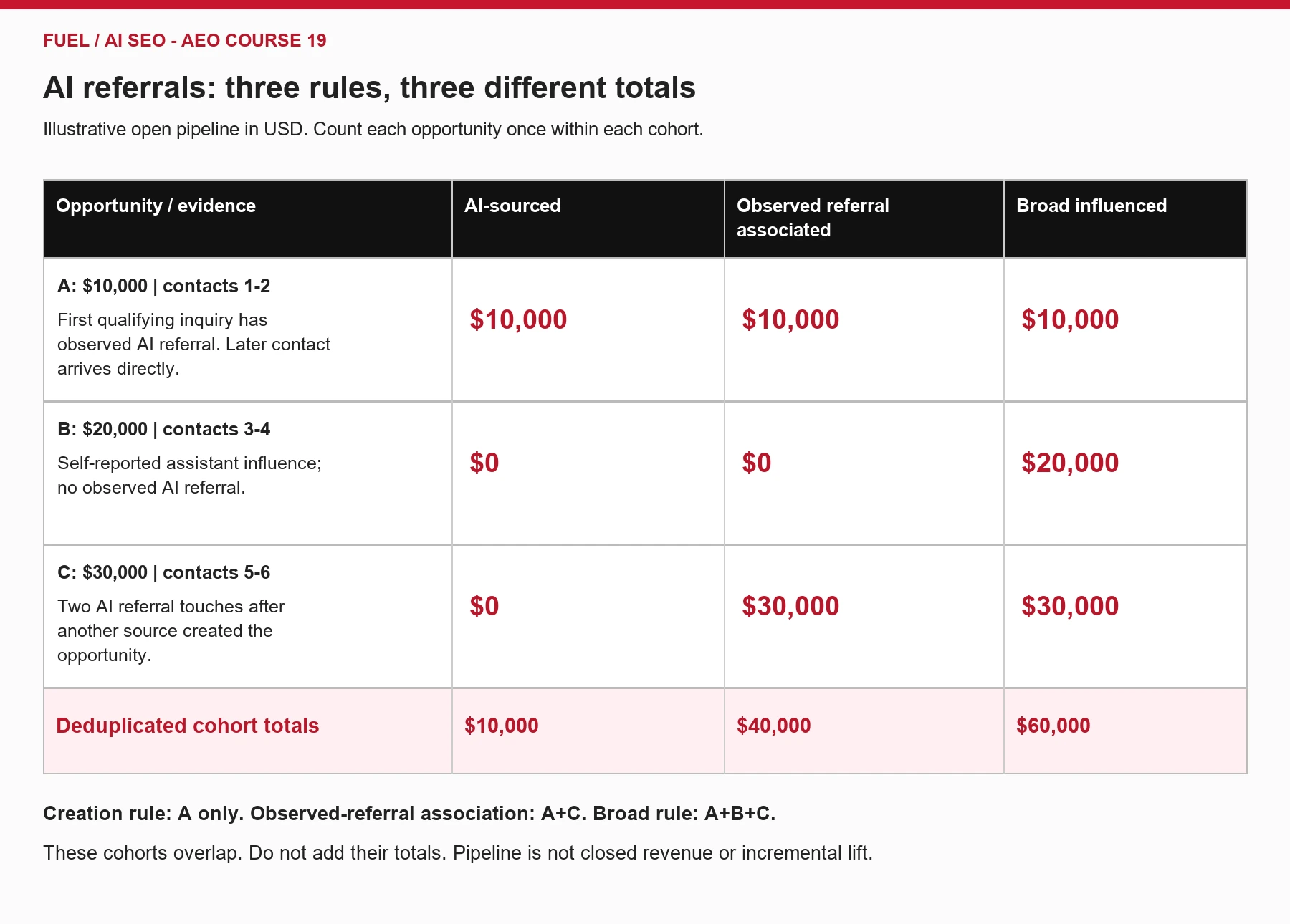
Opportunity B is worth $20,000 and has contacts three and four. A buyer reports that an assistant helped evaluate the options, but no observed AI referral is available. The first qualifying acquisition came through another source. B therefore has self-reported AI influence, not deterministic AI-sourced evidence under this example's rule.
Opportunity C is worth $30,000 and has contacts five and six. Another source created the opportunity first. Both later contacts have observed AI referrals. C is associated with observed AI-referral activity, but those later touches do not make it AI-sourced under the creation rule. Two contacts also do not create two copies of the opportunity's amount.
Reconcile sourced, associated and influenced views
Calculate three views. AI-sourced pipeline is A only: $10,000. Observed-referral-associated pipeline is A plus C: $40,000. A broad AI-influenced view, if its declared rule accepts either observed referrals or self-report, includes A, B and C: $60,000. Each total is defensible only with its stated evidence and rule.
Count the opportunity once instead of summing contact copies
Now inspect a common error. Adding opportunity amounts at the AI-referral contact level yields A once and C twice: $10,000 + $30,000 + $30,000 = $70,000. That total double counts C and exceeds the entire three-opportunity pipeline. Deduplicate by opportunity identity before summing amounts. Preserve contact-level touches for journey review, not as repeated revenue units.
Do not add the three reporting views together. They overlap. The $10,000 sourced opportunity is already included in the associated and broad influenced views. The dashboard should present separate measures, with definitions, rather than a combined $110,000 headline.
All contacts, values and journeys in this example are invented for teaching. The amounts represent open pipeline, not closed revenue or incremental sales caused by AI search. If opportunities later close, report the appropriate closed cohort under the same transparent rules and explain changes in stage or amount.
| Opportunity | Value USD | Evidence | Included view |
|---|---|---|---|
| A | 10,000 | First qualifying inquiry has an observed AI referral; later direct contact. | Sourced, observed-associated and broad influenced. |
| B | 20,000 | Buyer self-report of assistant influence; no observed AI referral. | Broad influenced only under the declared rule. |
| C | 30,000 | Two later AI-referral contacts; another source created the opportunity. | Observed-associated and broad influenced, counted once. |
Preserve AI Referrals at the Form-to-CRM Handoff
Capture evidence at the handoff where it is available. A visit, form submission, contact creation and opportunity creation are different events. Decide which system preserves each fact and which event establishes the qualifying inquiry. Store original observations before a later workflow normalizes or enriches them.
Test new and returning contacts through the real form
Test the actual form path. Confirm that the landing context and observed source reach the intended CRM fields under the applicable consent and collection conditions. Check both a new contact and a returning contact. Updating an existing record should not silently replace its historical first acquisition with the latest visit.
Handle multiple forms deliberately. A newsletter signup, support request and sales inquiry have different purposes. A support customer arriving through AI search should not automatically create a new-sales opportunity. Define what qualifies a contact for the pipeline report and preserve the event type. AI referrals can be useful across customer stages without all belonging in one acquisition total.
Record buyer self-report separately. Ask a neutral question about discovery or evaluation when appropriate, and preserve that question's wording and date. Do not lead the buyer toward the assistant category your team wants to demonstrate. A later response can add influence context without rewriting the observed referral history.
Assign ownership for corrections. Marketing operations may manage acquisition mapping, sales operations may manage opportunity association, and the account owner may clarify self-report context. One coordinator should reconcile the reporting rule. A field corrected for data quality should retain enough history to explain why earlier reports differ.
Connect relevant content context without inventing a causal path. If a buyer viewed a pricing explanation or integration capability page, preserve those interactions where legitimately observed. Do not assume the page supplied the decisive answer or caused the inquiry merely because it appears earlier in the session.
Compare deterministic matching, self-report and modeled credit
Compare deterministic matching, self-report and modeled credit by the uncertainty they address. Deterministic first-party matching can connect a known form submission to an observed acquisition event and CRM record. Its limits include missing evidence, device changes and incomplete linkage. It should not be described as capturing every assistant-influenced journey.
Self-report can reveal influence that produced no identifiable referral. It is vulnerable to memory, wording and interpretation. A buyer may say ChatGPT helped them compare vendors after another channel introduced the category. Preserve that distinction. Treat the response as valuable reported evidence rather than a replacement for the acquisition log.
Modeled attribution distributes credit among observed touches using a defined method. It can support internal comparison when the assumptions are clear. It does not prove that removing one touch would remove the corresponding revenue. Changing the model can change allocated credit while every underlying customer event remains the same.
Use these methods together without collapsing their labels. A report can show sourced, observed-associated and self-reported-influenced opportunities side by side. Keep overlaps explicit and avoid a combined total unless the rule defines a deduplicated union. A buyer with both referral and self-report evidence is still one opportunity.
Avoid inferring AI referrals from unexplained direct traffic. Direct visits can arise from many unobserved or ordinary paths. Investigate collection and handoff issues, examine known acquisition evidence and state the remaining uncertainty. A model that allocates unknown visits to AI should be labeled as a model with assumptions, not presented as recovered fact.
Choose a method for the business question. If you need to debug a broken form mapping, deterministic evidence matters most. If you need to understand a buyer's evaluation process, self-report can help. If leadership needs a consistent credit framework, a declared model can provide one. The methods solve different problems and should be evaluated accordingly.
Test the Complete AI Referral-to-CRM Handoff
Validate the complete chain with safe test records. Start from a known permitted acquisition condition, land on the intended page, complete the relevant form and inspect the resulting contact and opportunity association. Check the source timestamp, normalized category and rule version. Verify the final record rather than stopping at a successful form message.
Inspect redirects and cross-domain handoffs. A form hosted elsewhere, a booking service or an authentication step can lose useful context. Record which checkpoint still contains the evidence and where it disappears. Use supported configuration to repair the specific loss. Do not compensate by assigning the desired source after the fact without supporting data.
Test duplicate-contact behavior. Two contacts from one company may belong to one opportunity, several opportunities or an existing account process. The association must follow actual CRM rules. A domain match alone may not identify the correct opportunity, especially when several business units or active deals share a company.
Keep unknown and failed states visible. A submission with no permitted acquisition evidence is not necessarily a broken record. A mapping that drops available evidence is a different case. Distinguish unavailable, intentionally uncollected, malformed and lost values so the repair addresses the right cause.
Use a reconciliation sample with edge cases: new lead, returning contact, multiple contacts on one opportunity, self-report without referral and a later referral on an already sourced deal. Include the fictional pattern from the worked example to check deduplication. A single happy-path test cannot establish that the reporting logic handles these relationships.
Maintain a change log for field mappings and reports. A renamed source category, revised qualifying-event rule or altered opportunity association can change totals. Use content and evidence change control to keep reporting definitions aligned with public explanations and internal dashboards. Preserve the prior rule when comparing historical cohorts.
Keep AI SEO Revenue Reporting Tied to Opportunity Cohorts
Choose the visit, creation or close cohort before summing amounts
Report AI referrals with a cohort definition. State whether the report includes visits during the period, leads created during it, opportunities created during it or deals closed during it. Specify the relevant stage and amount. A long sales cycle can connect a recent closed deal to a much earlier acquisition event, so a visit-period report and a close-period report answer different questions.
Use unique opportunity identity for financial aggregation. Sum the approved amount once per included opportunity and state how currency conversion or amount changes are handled. If the organization reports recognized revenue rather than contract value, use the actual approved accounting measure. Do not label every amount field revenue because the dashboard needs a concise title.
Show the underlying counts. A large associated-pipeline amount from one opportunity has a different interpretation from a similar amount across many. Report opportunity count and stage distribution alongside amount, while protecting confidential details. Avoid a percentage without the eligible denominator.
Separate current and historical views. An opportunity can change amount, stage or associations after the original report. If you restate prior totals, say so and retain the extraction date and rule version. A reproducible report needs more than a screenshot of today's pipeline.
Do not present citation counts as a substitute for acquisition evidence. An assistant may cite a page many times without any observed visits. A referral may occur without the monitored question set ever showing the brand. These measures can inform the same program, but their relationship requires observation rather than an assumed funnel.
End the report with an actionable question. You might need to repair source loss, clarify an integration page or investigate why qualified AI referrals rarely become inquiries. The next step should follow the observed bottleneck. An association report becomes useful when it guides a defensible decision without overstating its ability to explain incremental revenue.
An agency scope for AI search CRM attribution should include a field contract, permitted collection conditions, new/returning-contact tests and a unique-opportunity reconciliation sample. AI SEO revenue reporting must name the stage, amount definition, cohort, extraction date and rule version. Ask the agency to preserve unknown origin and self-report as separate states, and to demonstrate how one deal with several contacts is counted once. Reported association remains different from proven incremental revenue.
Exercise: reconcile a misleading AI revenue dashboard
Repair this fictional dashboard: “AI revenue: $70,000,” calculated by adding the opportunity amount for every contact with an AI referral. The underlying records are the three open opportunities from the worked example. Identify the arithmetic, evidence and labeling errors separately.
The arithmetic double counts Opportunity C because two contacts carry referral evidence. The observed-referral-associated total is $40,000 after deduplication. The evidence does not make C AI-sourced because another source created it under the declared rule. The amount is open pipeline, so the word revenue is also incorrect.
A repaired dashboard shows AI-sourced pipeline of $10,000, observed-referral-associated pipeline of $40,000 and broad influenced pipeline of $60,000, with overlap and self-report rules explained. It does not add those views. It preserves B's self-report without pretending an observed referral exists.
Submit the corrected totals, one CRM field contract and a test that catches the duplicate-opportunity error. Explain which unknown journeys remain unmeasured. A strong answer keeps AI referrals useful as real evidence while refusing to turn missing data, model credit or repeated contacts into invented revenue.
Sources and evidence notes
[1] Google Analytics, Scopes of traffic-source dimensions. Accessed October 25, 2026. [2] Google Analytics, About traffic-source dimensions. Accessed October 25, 2026. [3] HubSpot, Properties API. Accessed October 25, 2026.
Apply the workflow
Ask Fuel Online to evaluate the reader's evidence, content and measurement system using the defined task.
Explore the AI SEO and AEO course curriculum.
Discuss AI SEO and AEO implementation with Fuel Online.