Cover photo: Ian Noble / Unsplash.
Name the mismatch precisely
To diagnose the wrong page ranking, identify the exact query, the page Google reports and the page you want visitors to reach. Then compare intent, technical eligibility, selected canonicals and internal links. Make the smallest change that addresses the evidence. Redirecting the visible page before understanding its role can remove a useful entry point while leaving the intended page's underlying problem unresolved.
Start by completing a sentence: For this search, from this audience, we expected this destination because it helps the visitor do this task. That final clause matters. A preferred URL is a business choice; a useful search destination must also satisfy the visitor. Your team may want an inquiry page to rank while the person searching wants a checklist, comparison or troubleshooting answer. In that situation, the disagreement begins with the search intent rather than the URL.
Consider a hypothetical commercial HVAC company. Its maintenance checklist appears for commercial HVAC maintenance, while its sales team wants the maintenance service page to appear. That alone does not prove a defect. The broad query could describe a building manager researching responsibilities or someone looking for a contractor. Add cost, contract or provider to the query, and the task becomes more commercially specific. Add checklist, schedule or requirements, and the guide may be the stronger destination.
Also separate a live search observation from a report. Google's Performance report documentation explains that results vary with time, place, device and recent history. Its average position uses the topmost result, with aggregation varying by dimension. A search on one employee's laptop cannot settle what every prospect sees.
Write down the consequence before choosing a fix. Are visitors failing to find an inquiry route, misunderstanding the offer, reaching obsolete information or simply landing somewhere unexpected? Each consequence demands different evidence. If the guide attracts suitable buyers who successfully move to the service page, improving that journey may be more useful than trying to replace the guide in search. If an outdated service page misstates coverage, correcting the information deserves attention even before a ranking diagnosis is complete.
Build a query-to-URL comparison
Create a small comparison around the affected query family. Start with the exact query that triggered concern, then add closely related searches that express different tasks. Keep the country, device, search type and date window consistent. Compare a suitable earlier period, noting seasonality, campaign changes and site releases. You are trying to explain a particular mismatch, so a whole-site average is too broad to act as your main evidence.
For each query, record the appearing URL, desired URL, clicks, impressions and the visitor's likely task. Include whether the desired page is receiving any visibility for that query family. Where available, add landing-page actions and qualified inquiries separately. An impression is exposure, a click is an arrival, and an inquiry is a different event. Do not describe improved position as recovered demand before checking what happened farther along the journey.
| Query | Appearing destination | Decision to investigate |
|---|---|---|
| commercial HVAC maintenance checklist | Maintenance guide | Keep the guide; check whether it answers the checklist task. |
| commercial HVAC maintenance contract | Maintenance guide | Compare the guide with the service page's contract information. |
| commercial HVAC maintenance company | Old service page | Check whether the current service page is eligible and clearly differentiated. |
This comparison prevents two common errors. First, a guide can be appropriate for one query and poorly suited to another; it does not need one universal verdict. Second, the same destination can perform different jobs across searches. A guide receiving exploratory traffic does not automatically compete with a service page receiving contractor searches. Judge the overlap at the level of the reader's decision, then decide whether separate pages still make sense.
Keep an evidence column beside your interpretation. For example, guide explains inspection intervals is an observation you can check on the page. Searcher intends to hire is an interpretation that needs support from the query wording and the results you inspect. Mark uncertain interpretations openly. If the contract query has too little information to support a decision, group it with a coherent family without pretending that broader data proves the behavior of that exact phrase. A narrow, honest record is more useful than a confident diagnosis built on incompatible comparisons.
Separate competing intent from technical duplication
There are two different questions here: do these pages help people complete different tasks, and does Google treat them as versions of the same content? Answer both before calling the situation cannibalization. Two URLs mentioning the same service are not necessarily interchangeable. A maintenance checklist, contract comparison and contractor service page can share vocabulary while serving distinct decisions. By contrast, a tracking-parameter copy of the service page may add no separate value at all.
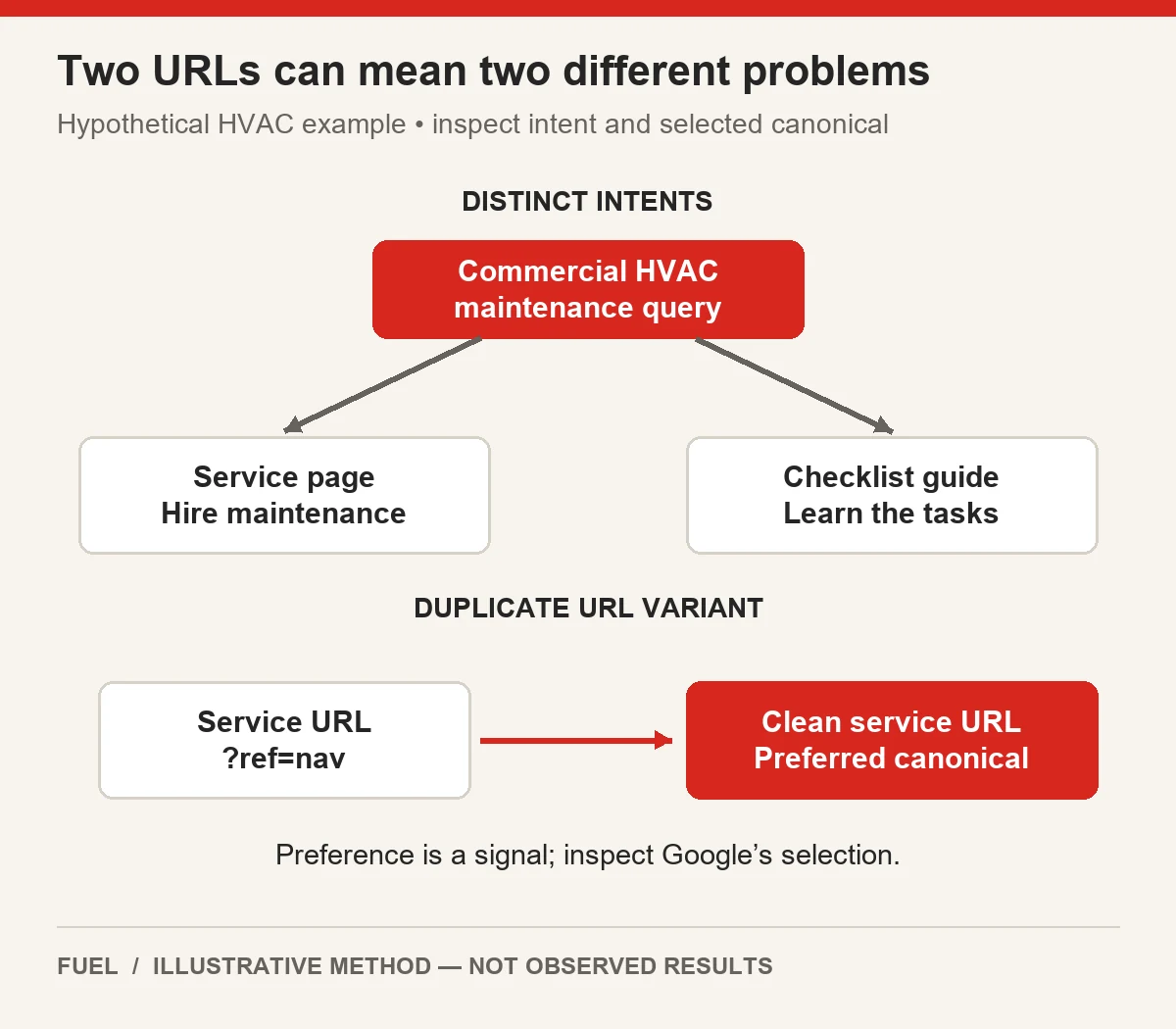
Reporting adds another layer. Google's explanation of Performance metrics says that data generally goes to Google's selected canonical, although exceptions exist. The URL in a report can therefore represent several variants. Compare the reported destination with the final browser landing URL and the canonical information available in Search Console before assuming each row represents an independent competing page.
For genuinely duplicate or very similar content, Google's canonical guidance describes redirects and canonical annotations as strong signals; sitemap inclusion is weaker. These signals communicate a preference. They do not let you assign any unrelated page to a query, and they do not make an incomplete service page more useful to a buyer.
Use a side-by-side review. Hide the navigation and compare each page's promise, main explanation, evidence and next action. Could the same visitor reasonably need both pages in sequence? Does either page provide information the other cannot replace? In the HVAC example, a checklist helps a facilities manager understand recurring tasks; a service page explains who performs those tasks, coverage and how to request an assessment. That sequence supports keeping both, even when their introductions currently sound too similar.
A different conclusion follows if two service pages describe the same offer, same coverage and same inquiry process with only cosmetic wording changes. Consolidation may be sensible, but first inventory information, links and practical uses that would be lost. Choose the retained destination deliberately. Do not default to whichever URL happens to rank today or whichever slug looks cleaner. The destination should be able to absorb the useful content and continue serving the people who currently depend on either page.
Trace links and page signals
Before rewriting, check whether the intended page is a credible destination inside your own site. Follow the routes a visitor would use from the service hub, related guides, case material and navigation. Does commercial maintenance lead to the current service page, a generic overview or an old URL? Does the guide offer a contextual next step at the moment a reader begins evaluating outside help? This is a practical journey review as well as an SEO investigation.
Google recommends crawlable links with useful context and describes ordinary anchor elements with an href as the dependable format. Its guidance supports relevant internal routes and descriptive anchors; it does not prescribe an ideal link count. Adding dozens of repetitive links is therefore a poor substitute for correcting the important paths.
Build a short link inventory containing the source page, current destination, anchor wording and intended reader benefit. A link labelled maintenance services should accurately describe its destination. A checklist link should lead to checklist information. If nearly every buying-context link leads to the guide, changing the most relevant routes can make the site's distinction clearer without dismantling the guide. Preserve links that still help readers complete an informational task.
Next, compare titles, main headings and opening answers. The service page should quickly explain the actual offer and relevant boundaries. The guide should make its educational purpose clear. If both pages open with the same generic definition and postpone their distinctive information, edit the introductions around the separate tasks. This recommendation comes from the intent comparison; it is not a claim that changing a heading guarantees Google's preferred result.
Keep canonical selection in the same review. Record each page's declared canonical, the selected canonical where inspected, and the destination used by internal links. A service page declaring the guide as canonical deserves investigation. So does a template that still references a staging hostname. Check representative variants rather than assuming one correct page proves the whole template is correct. Save the actual response or inspection evidence, the inspection date and the affected URLs so another person can reproduce the finding and distinguish it from an untested suspicion.
Choose a reversible intervention
Choose the intervention that matches the diagnosed cause. If the intended page is inaccessible, fix access before expanding its copy. If the pages answer different tasks but blur their purpose, differentiate them. If useful buying links point to an unsuitable destination, correct those routes. If equivalent pages duplicate the same offer, plan consolidation. A wrong page ranking is a symptom; there is no single redirect rule that resolves every version of it.
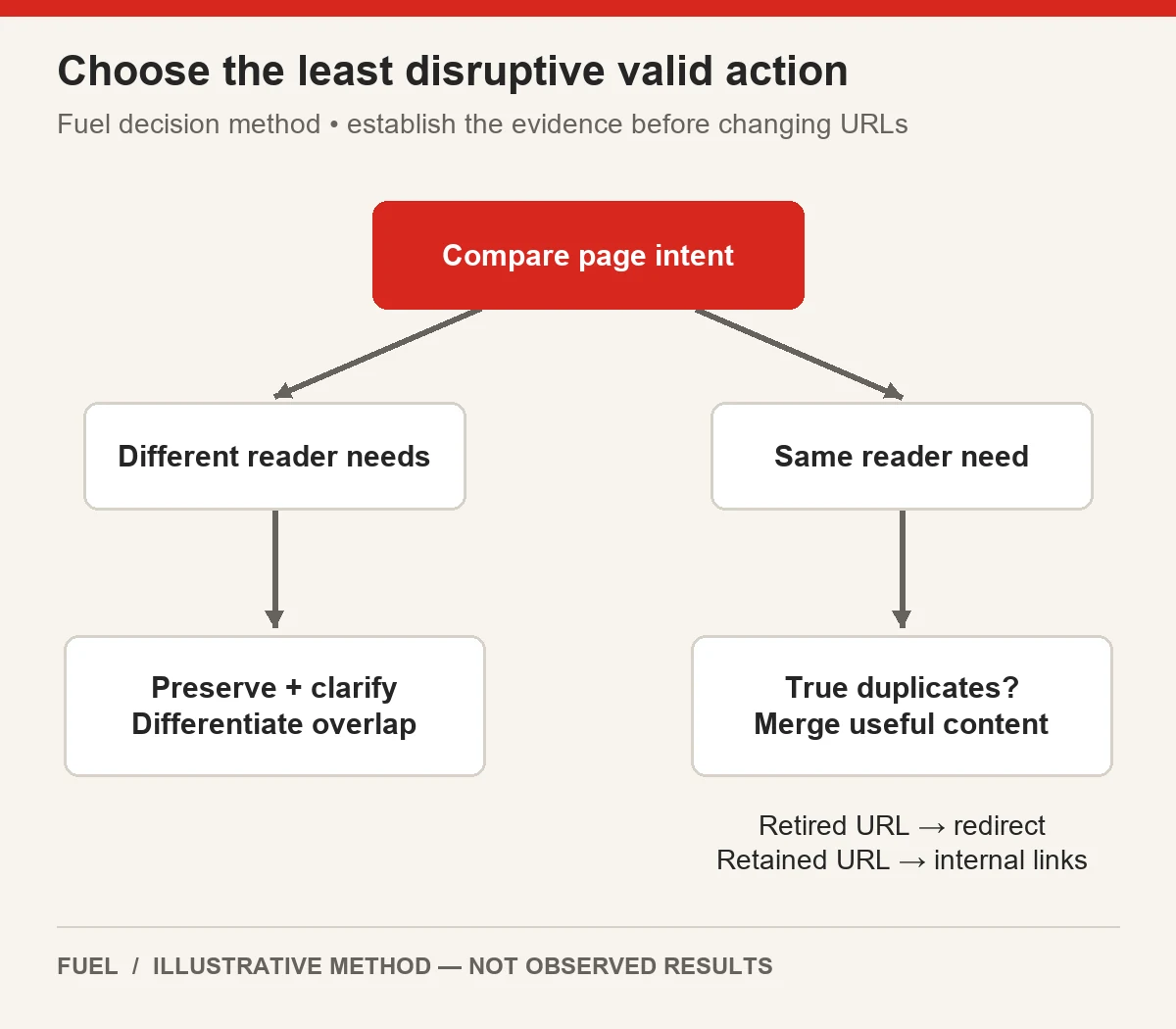
For the hypothetical HVAC pair, start with a bounded change when the evidence supports distinct intent. Keep the checklist's maintenance schedule and inspection guidance. Strengthen the service page's explanation of coverage, engagement process, responsibilities and suitable inquiries. Add a contextual link from the checklist where a reader needs help evaluating a maintenance provider. Use an anchor that describes that next step accurately. Leave unrelated guides alone so the work remains understandable and reviewable.
If two service URLs are equivalent, prepare the retained page before retiring the other. Move useful, accurate information into a coherent destination; retain important detail rather than stitching two repetitive introductions together. Record the old-to-new mapping, update links and check the destination's response. A redirect changes where existing visitors go, so test the old paths as well as the new page. Keep a change record and a recovery plan for mistakes, without repeatedly reversing a sound consolidation because of daily fluctuations.
Avoid using noindex as a quick way to force the service page to win. Google discourages noindex for selecting a canonical within one site. Removing a useful guide from search can sacrifice its discovery role while failing to solve the service page's intent or access problem. Canonical and redirect decisions should follow the relationship between the pages.
Document the expected mechanism in plain language: buying-context links will now lead to the service offer, or duplicate service URLs will resolve to one maintained destination. Then name the observation that would challenge your explanation. If appropriate links already reached the service page and its content clearly answered the buyer's task, link changes alone are a weak diagnosis. A written counterexample helps prevent a preferred tactic from becoming the explanation for every unexpected result.
Validate the intended landing page
Validate the implementation immediately, then evaluate search behavior separately. Open the changed routes, follow important links, confirm final destinations and inspect the delivered page. Check the inquiry action on the devices your audience uses. A technically correct consolidation can still produce a poor customer experience if the destination drops essential details or its contact form fails. Record passing observations and unresolved dependencies separately.
For indexing eligibility, Google's technical requirements specify Googlebot access, a successful HTTP 200 response and indexable content. Meeting those conditions does not guarantee indexing. A successful deployment proves that a change shipped; it does not prove that Google processed it or that a particular query will now show the desired page.
Retain the original query comparison and revisit the same segments after there is useful post-change evidence. Look for changes in which pages receive visibility, whether commercially specific queries reach a suitable destination, and whether visitors complete meaningful actions. Separate brand and nonbrand demand where the data allows. Note new campaigns, seasonality, offer changes and sales-process changes that could influence the result. Do not attribute every movement to the page edit simply because it happened afterward.
Define success around the original consequence. If visitors previously landed on an obsolete offer, accurate information and a functioning route are immediate acceptance checks. If the concern was qualified inquiries, retain a separate record of inquiry quality rather than counting every button click as a sales opportunity. If the concern was only an unexpected URL, ask whether the actual journey improved before scheduling another intervention.
When several templates, variants or service lines are involved, a scoped SEO diagnosis and implementation review can connect the search evidence with the site's architecture. Bring the affected query family, competing URLs, dated examples and change history. That gives the review a concrete starting point and helps distinguish a technical correction from a broader content decision. The useful deliverable is an evidence-backed action and validation plan, with clear limits on what can be concluded before indexing and customer behavior are observed.
What to do when both pages deserve to exist
Keep both pages when each earns a distinct role. A guide can help readers understand a problem, while a service page helps suitable buyers evaluate assistance. Make that division visible through the title, opening answer, supporting detail and next step. Remove unnecessary overlap where it obscures the purpose, but keep shared facts when both readers need them. Different intent does not require deliberately incomplete pages.
Create an explicit handoff between the tasks. In the HVAC example, a checklist reader might discover that the building needs a contractor-supported maintenance program. A relevant link can take that reader to the service scope. Someone already comparing providers should find the offer, responsibilities and inquiry process on the service page without having to reverse-engineer them from a general guide. Evaluate both paths as customer journeys rather than treating one page's visibility as the other's failure.
If search visibility improves while inquiries weaken, investigate why rankings can rise while leads decline before deciding the landing-page choice caused the loss. The query mix, offer and conversion path may have changed. If many service pages need attention, use a service-page prioritization framework to choose the next intervention based on business value and evidence rather than whichever unexpected result was noticed most recently.
The final decision should be easy to explain: retain separate pages because they serve separate tasks, differentiate pages whose promises overlap, or consolidate equivalents into a maintained destination. Keep the observations supporting that decision alongside the change record. When the next unexpected URL appears, reuse the evidence ladder. It helps you preserve useful content, identify actual faults and avoid turning a normal variation in search behavior into an unnecessary site restructure.