
Cover photo: Randy Fath / Unsplash.
Separate blockers from optional opportunity
Service page prioritization begins with a gate: can the intended customer reach the page, understand the actual offer and complete the main action? Repair damaging eligibility or customer-path failures before scoring optional improvements. Among pages that pass that gate, prioritize a credible business opportunity that the team can realistically implement. The highest search-volume estimate is an input to that decision, rather than a sufficient reason to put a page first.
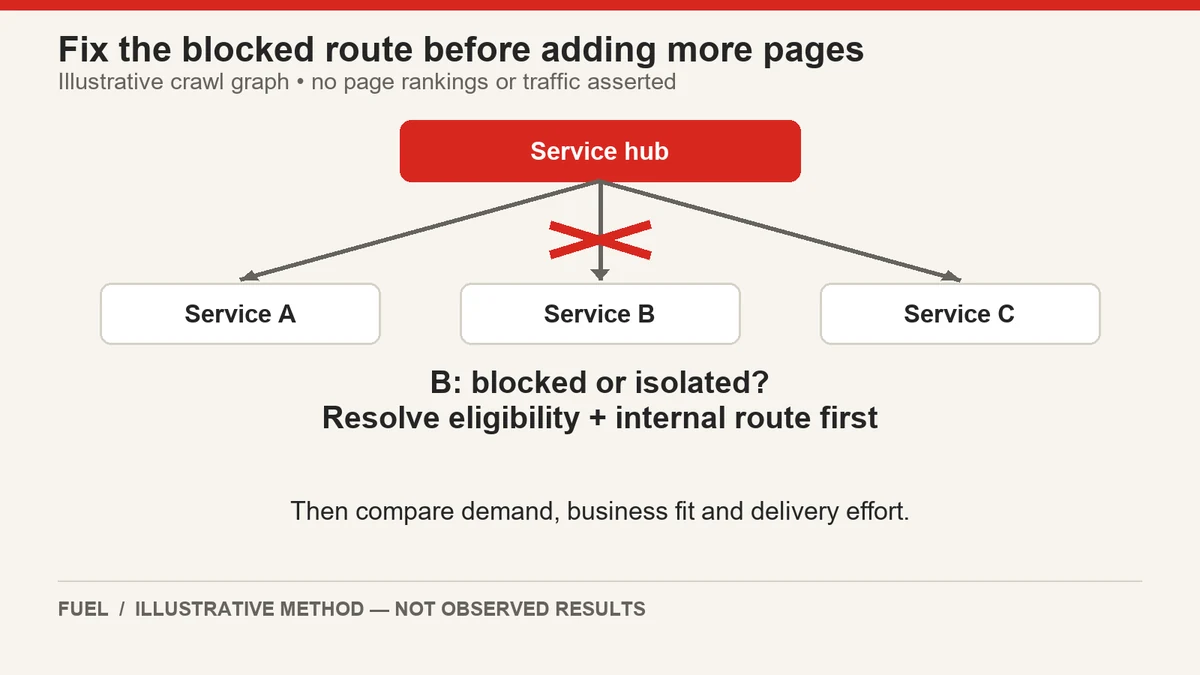
Google's technical requirements distinguish eligibility from guaranteed indexing. They require Googlebot access, a successful HTTP 200 response and indexable content. A commercially important page that fails a relevant requirement needs a concrete repair investigation; adding more copy does not address an inaccessible destination. The conceptual service graph above illustrates that prerequisite. Its blocked branch is a planning example, not a finding about a particular website. Read the supporting Google documentation.
Use a separate blocker queue so serious faults cannot disappear inside an average score. A broken inquiry form, inaccurate service boundary or unintended indexing restriction should have an owner, affected scope and acceptance test. Classify the severity using the actual business consequence. A cosmetic inconsistency and a page that sends buyers to a retired offer do not deserve equal urgency simply because both appear on an audit checklist.
Then distinguish maintenance from expansion. Repairing an established service page that lost essential information is different from developing a new offer page. The former may have existing demand and a clear regression; the latter may depend on proof, operational readiness and a new customer path. Put both on the planning board, but record why each exists. Otherwise, a speculative expansion can displace a necessary repair because its estimated market sounds larger.
The framework below uses small ordinal scores and explicit assumptions. It is a Fuel planning method, not a Google ranking formula or revenue forecast. Its purpose is to make choices inspectable: which facts support the order, which uncertainties could reverse it, and which prerequisites must be completed first? A useful priority list should survive a conversation with the people who deliver the service, answer inquiries and maintain the website.
Build an evidence row for every service
Build an evidence row for every candidate service landing page before assigning a score. Record the actual service, supported customers, geography, primary task and the page that owns that task. Note whether another page already serves the same decision. A prioritization exercise should not automatically create new URLs for every keyword variation; first establish what the existing page should accomplish and whether the business can support the resulting inquiries.
Add demand evidence with its limitations. Relevant Search Console queries can indicate existing visibility; inquiry records can reveal repeated customer needs; sales conversations can expose unanswered decision questions. Keyword estimates can suggest a market to investigate, but should not be treated as guaranteed visits. Keep brand demand, exploratory questions and commercially relevant searches distinct enough that a large informational audience cannot silently substitute for the intended buyer.
Document commercial contribution without inventing precision. Depending on available records, use verified contribution margin, capacity, repeat business, strategic importance or a simple relative category agreed with operations. Revenue alone can mislead if a service is costly to deliver or the business cannot accept additional work. Where values are unavailable, label the assumption and identify who can resolve it. An unknown value is not zero and should not inherit an optimistic default.
Define the business event you intend to improve. Google's Analytics documentation distinguishes key-event and conversion settings, including attribution and counting differences. Your planning row should therefore state whether evidence concerns successful inquiries, qualified opportunities or sales, and which system supplies it. Do not compare one service's button clicks with another's accepted opportunities and describe the larger number as stronger commercial evidence. Read the supporting Google documentation.
Finish the row with the specific content or journey gap. Examples include an unexplained engagement process, missing eligibility information, an absent route from a relevant guide, or a case example that no longer reflects the offer. Write what the page needs to help a suitable visitor decide. Expand the evidence only where it resolves a real question; a longer page is not inherently a higher-priority investment. Attach the evidence date so the score can be reviewed when the offer or capacity changes.
Score value without false precision
Score value on a short, defined scale. For an illustrative worksheet, use three dimensions from 1 to 3: business contribution, purchase fit and observed demand evidence. A score of 1 means weak or uncertain, 2 means credible but limited, and 3 means strong relative to this candidate set. Define each rating in the worksheet rather than relying on a team's shared intuition about what strong means.
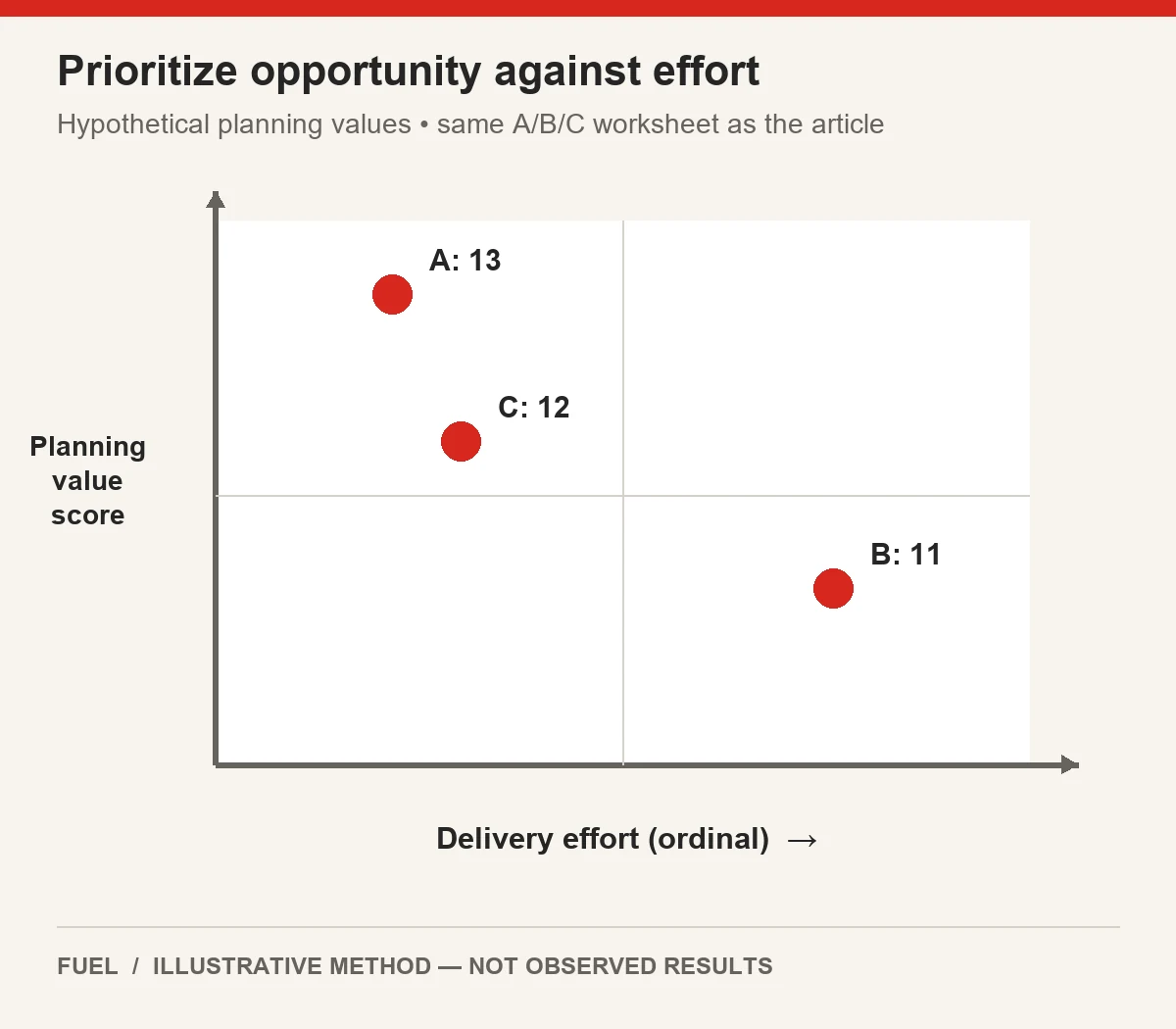
Weight contribution twice, purchase fit twice and demand once. The value score is therefore 2 × contribution + 2 × fit + demand, with a possible range of 5 to 15. These weights deliberately emphasize business usefulness over raw demand. They are a planning choice that a company can challenge. Do not call the resulting units dollars, expected leads or probability of ranking; they are only a consistent way to compare judgments.
Consider three hypothetical service pages. A has contribution 3, fit 3 and demand 1, producing 13. B has contribution 2, fit 2 and demand 3, producing 11. C has contribution 2, fit 3 and demand 2, producing 12. Under this weighting, A comes before C and B even though B has the strongest demand rating. That order follows the stated priorities, not an assertion that low-volume pages always win.
Keep confidence beside the score rather than burying it in a decimal multiplier. Rate confidence high when the important inputs have current, relevant records; medium when some are reasonable proxies; low when essential inputs remain conjecture. A high-scoring, low-confidence page may deserve a short evidence task before a large content project. This distinction prevents a polished spreadsheet from making guesses appear equivalent to observed customer behavior.
The supporting scatterplot uses hypothetical ordinal axes to show the relationship between opportunity and effort. It is a visual planning aid, not measured performance. Plot the candidate pages only after defining what the axes mean. If two candidates cluster closely, treat them as a planning band rather than pretending a tiny numerical separation settles the order. The useful discussion concerns the evidence and constraints behind the points, especially where the next step differs.
| Page | Contribution / fit / demand | Original score |
|---|---|---|
| A | 3 / 3 / 1 | 13 |
| B | 2 / 2 / 3 | 11 |
| C | 2 / 3 / 2 | 12 |
Estimate effort and dependencies
Estimate effort at the level of a deliverable. Rewrite service page is too vague to schedule. Verify the service scope, obtain usable proof, revise the decision content, implement the page, check customer actions and inspect public delivery are separate pieces. Some can move together; others depend on approvals, operational facts or technical work. Include those dependencies in the estimate so an apparently quick content edit does not become a stalled project.
Separate hands-on effort from elapsed time. A developer change might require little implementation time but wait for a release window. Obtaining permission to use a customer example may take longer than writing the page. Record both the work and the waiting dependency. Do not label a task easy merely because the author can draft the prose quickly; the deliverable must be accurate, usable and verified before it creates value.
A practical effort scale can also use 1 to 3: a focused page update with available facts, a coordinated update requiring several owners, or a larger template or offer project with unresolved dependencies. Define the categories locally. If effort is unknown, create a discovery task rather than assigning the lowest score. Effort estimates should change when scope changes, with a note explaining what was added or removed.
Internal routes belong in the scope. Google's link guidance recommends crawlable, contextual links and says important pages should receive a link from another page. It provides no magical ideal count. Review the relevant service hub and supporting content instead of budgeting a bulk insertion of repetitive anchors. A useful route helps the reader reach the next decision; a larger number of links is not the acceptance criterion. Read the supporting Google documentation.
Keep a dependency graph for work affecting more than one candidate. If several service pages share a broken form or template directive, fixing that component may precede the individual content tasks. Avoid charging the full shared repair to every page and then declaring all of them too expensive. Also avoid hiding the repair outside the project budget. Record the shared prerequisite once, identify its dependent pages and verify representative routes plus known exceptions before expanding the rollout.
Stress-test the order
Stress-test the order before treating it as a commitment. First change the assumptions you are least confident about. In the hypothetical worksheet, increase demand's weight from 1 to 3 while leaving contribution and fit at 2. A becomes 15, B becomes 17 and C becomes 16. The order reverses to B, C, A. That tells the team its decision depends materially on how much it values demand relative to commercial fit.
The reversal does not prove either weighting is wrong. It identifies a disagreement that the team must resolve openly. If leadership wants near-term qualified demand and the contribution evidence is strong, the original weights may fit. If the objective is entering a strategic market with verified delivery capacity, a different weighting may be appropriate. Name that objective before choosing the version that happens to favor someone's preferred service.
Next vary a single uncertain rating. Suppose A's high contribution rating is only an assumption. Reducing it from 3 to 1 lowers the original score from 13 to 9, putting A below both C and B. That is a useful reason to verify contribution before commissioning a large page project. An evidence task can have high priority even when the eventual implementation should wait. It buys clarity at lower commitment.
Test constraints separately from the value formula. A page with strong fit and demand may still wait if the service has no available capacity, essential proof is unavailable or its customer path depends on a pending system change. These are gates and dependencies, not small penalties that a large demand number should overwhelm. Show them beside the score and identify the action required to remove them.
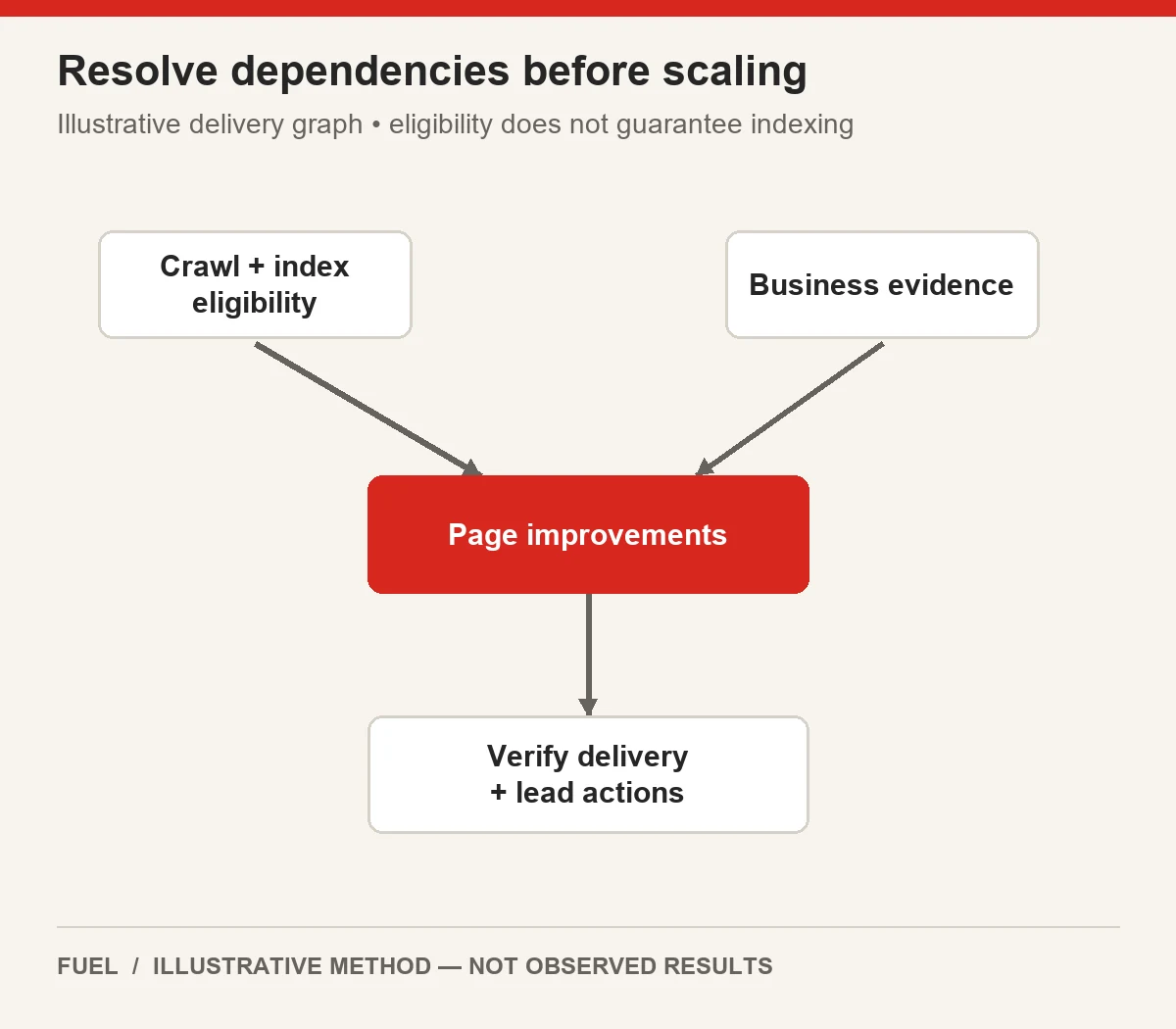
Use the dependency diagram to distinguish scoring from sequencing. A highly ranked page cannot skip the prerequisite that makes its delivery possible. Conversely, a shared prerequisite may deserve immediate work because it unlocks several useful pages. Commit first to robust choices whose evidence and feasibility remain strong under reasonable changes. Put fragile choices into an evidence queue with a review condition, so uncertainty leads to investigation rather than indefinite argument.
Turn the ranking into an implementation queue
Turn each selected priority into an implementation card. Include the owning URL, reader decision, observed gap, proposed change, evidence owner, delivery owner and acceptance checks. Add the prerequisite and the next review date. A card should let someone who missed the planning meeting understand why the work matters and how to tell whether it shipped correctly. The weighted score provides context; it does not replace the concrete task.
Acceptance checks should reflect the actual intervention. If the problem is an unclear service boundary, confirm that the revised page explains the approved boundary and that inquiry routing respects it. If the problem is a broken route, follow the repaired link to the correct public destination. If a template changes, test a justified sample across relevant variants and all critical exceptions. Do not mark a whole site verified because one convenient page passed.
Keep implementation acceptance separate from future performance review. Correct public content, functioning actions and consistent technical delivery can be checked after release. Indexing, query visibility and qualified opportunity changes need subsequent observation. Set the later review around the expected mechanism and available data. A completed content ticket is not evidence of business uplift, and an unobserved uplift should not remain hidden inside a green project status.
Limit work in progress to what the teams can verify and support. Starting every high-scoring page at once can create a queue of drafts waiting for the same developer, subject expert or proof asset. Complete a coherent set, learn from its delivery and then expand. Preserve accepted work when a later page fails; resolve the affected dependency rather than restarting the entire service inventory.
A service-page program should leave behind a decision record as well as improved pages. Retain the input evidence, chosen weights, confidence, sensitivity result and release checks. That allows a later owner to update the order when demand, capacity or the offer changes. If external support is needed, ask for that operational clarity along with content production. The useful output is a feasible sequence of justified improvements, not a spreadsheet whose scores cannot be explained.
For implementation support, review Fuel’s SEO services. Share the affected scope, actual evidence and the decision you need to make.
When the highest-volume service should wait
The highest-volume service should wait when its apparent opportunity is poorly matched to the business. Broad queries may describe jobs the company does not provide, buyers outside its market or an early learning task. A large estimate can also conceal an offer that is not ready to accept demand. Confirm the actual customer task and delivery capability before treating more visibility as an unqualified benefit.
A lower-volume page can reasonably come first when its offer is clear, its contribution is credible, its inquiry path works and its evidence gap is solvable. That is a conditional planning judgment, not a universal preference for niche services. Use the same evidence row and sensitivity tests for both candidates. If the larger opportunity becomes credible and feasible, the framework should allow it to move forward without defending an outdated order.
Revisit priorities when a material input changes: capacity opens, a shared template is repaired, new inquiry evidence becomes available or a service is retired. Keep the previous decision with its date rather than rewriting history to make every new choice appear obvious. Service page prioritization works when it helps the business choose its next defensible action, complete it and learn enough to make the following decision better.