
Bing AI Overviews ads can run through existing Microsoft Advertising campaigns, including Performance Max and AI Max, Microsoft confirmed on November 19, 2026. The company says the placement is available in all markets except China and requires no separate campaign setup. AI Max for Search is also getting URL inclusions. Start by auditing eligible landing pages, verifying conversion tracking, and measuring the cost of qualified leads. Only report AI Overview placement performance if your account provides a way to isolate it. Microsoft Advertising November announcement
This matters because AI answers can expand the range of questions around a purchase. Someone planning a road trip may ask for a weekend itinerary and get a lodging option alongside the answer. The same person might be ready to book or might just be gathering ideas for next summer. The account manager has to make sure both the page and the measurement system can handle that difference.
Which campaigns can serve Bing AI Overviews ads?
Microsoft identifies existing campaign types including Performance Max and AI Max. AI Max refers to AI Max for Search in this announcement. Its new URL inclusions relate to final URL expansion in that product. Check Performance Max controls in its own settings, since controls available in AI Max do not automatically apply there. Also distinguish ads alongside Bing AI Overviews from ads in Copilot, other Microsoft placements, and Google’s similarly named search features. The announcement describes a Microsoft surface. Microsoft Advertising announcement
An eligible campaign can serve in more than one place. Eligibility says a placement is possible. Confirmed delivery requires reporting or another reliable observation. A placement screenshot can establish that a specific ad appeared in a specific context, but it is insufficient to calculate volume, CPA, or return on ad spend.
1. Inventory campaign controls before changing anything
Choose one mature campaign you understand. Record the campaign type, markets, time zone, budget, bidding strategy, conversion goals, automation settings, current landing pages, and reporting exports. Mark whether final URL expansion is enabled and whether the new inclusions control is visible. Save a dated copy of the settings. Rollouts can arrive unevenly, especially when the account covers more than one market.
Next pull landing page and search term data the account actually exposes. Group the findings by intent, destination, and CRM outcome. For each page, check whether it is useful for the type of search that would land there. Searchers looking to compare warehouse controls might need a technical comparison and a clear route to sales. Searchers seeking installation in one metro area need to see the service territory before they fill out a form.
| Landing page group | Review criteria | Example disposition |
|---|---|---|
| High-intent product or service pages | In stock or available, accurate geography, visible action | Include when aligned to campaign intent |
| Comparison and buyer guides | Current evidence, relevant offer, clear commercial next step | Consider for research-oriented groups |
| Support and careers pages | Distinct audience and goals | Keep out of acquisition routing where controls allow |
| Expired offers or unavailable inventory | Date, stock status, redirects, and replacement page | Exclude or replace before relying on automation |
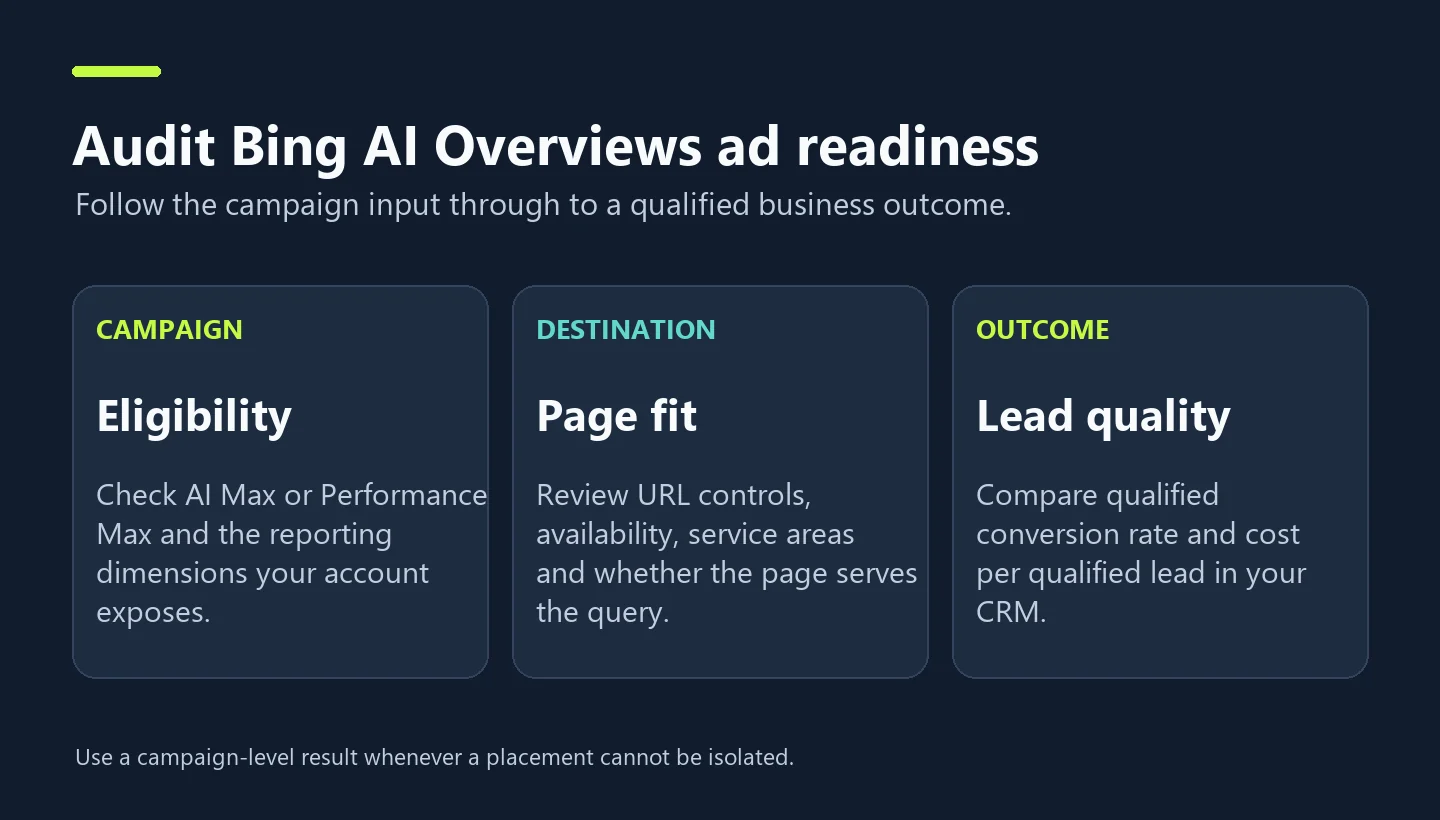
2. Review AI Max URL inclusions with the ad message in mind
Microsoft says the inclusion controls help identify pages for destinations and as source material for text customization and search term matching. That second use raises the stakes. A page can be acceptable as a reference for an existing customer and still be a poor source for a new customer’s ad. A support article might discuss warranty limitations, prior model names, or a discontinued configuration that does not belong in acquisition copy.
Start with a short, reviewed set of pages. Test status codes and redirects, mobile usability, price and availability statements, accessibility of the next action, market restrictions, and the ability to carry attribution into checkout or a form. Verify destination behavior in the account once settings are changed. Then review the generated ad assets and available search term reports. URL controls can guide what the campaign uses. The outcome still depends on your settings and the system’s matching.
Consider a hypothetical commercial security installer. It offers installation in three metro areas and sells supplies nationwide. Its broad service guide mentions both offers. If traffic outside those metros lands on the installation form, a report can look efficient until sales disqualifies inquiries. A practical split is to direct installation-focused traffic to pages with explicit coverage and separate sales paths for nationwide supplies. Measure each offer against its actual goal.
Inspect the exclusions as carefully as the inclusions
Review job openings, customer portals, account pages, internal search, expired promotions, out-of-stock items, legal directories, and thin location pages. Document which controls a campaign supports before promising that a URL can never show. Where there is a business reason for a more restrictive test, evaluate doing it in a campaign structure that supports the controls you need. Keep a change log so the team can trace a problematic destination to an explicit setting, a landing page change, or a rollout.
3. Establish a baseline for qualified conversions
Use Microsoft Universal Event Tracking, commonly called UET, to validate the online action the campaign sees. Then check whether you can associate ad traffic with CRM stages. For lead generation, capture the Microsoft click ID when available and appropriate, save it with the lead record, and test the approved offline workflow before making bidding changes. Ensure a successful form creates a single inquiry even if a user retries the confirmation view. Verify call tracking separately if a large share of customers call. Microsoft Advertising UET documentation and offline conversions documentation
Choose a comparable baseline, such as 28 days with a matching weekday mix, and allow the same follow-up window for test-period inquiries. Freeze definitions. A qualified lead could require the correct geography, service type, reachable contact, and a real purchase need. Use the same fields and deduplication method throughout. If finance reports closed revenue, record which leads are too recent to evaluate. Treat click-to-qualified-lead rate as qualified leads divided by ad clicks. Track lead qualification rate separately as qualified leads divided by unique inquiries.
Worked example: Why an apparent CPA win can be a loss
| Illustrative metric | Baseline | Follow-up |
|---|---|---|
| Spend | $4,800 | $5,040 |
| Ad clicks | 2,400 | 2,800 |
| Unique inquiries | 120 | 140 |
| Qualified leads | 48 | 42 |
| Cost per inquiry | $40.00 | $36.00 |
| Qualified leads per click | 2.00% | 1.50% |
| Cost per qualified lead | $100.00 | $120.00 |
The dashboard would show 10% cheaper inquiries, while sales sees a 20% increase in cost per qualified lead. The lead qualification rate fell from 40% to 30%. Investigate whether the mix shifted by eligibility, destination, market, device, or intent. The table is campaign data from an invented example and cannot isolate the effects of Bing AI Overviews.
4. Check whether the account actually reports AI Overviews placements
Start with the available reporting interface, including the campaign and placement-related reports relevant to the campaign type. Inspect dimensions and export labels. Look for a distinct designation that specifically identifies Bing AI Overviews before using that name in performance reporting. If paid search is the only verified grouping, report paid search. If the supported grain is the whole campaign, report at campaign level. Keep unavailable placement data as unavailable, even if platform tests or individual examples show the placement exists.
A simple reporting record includes campaign and type, dates, market, reporting grain, total spend and clicks, raw inquiries, qualified leads, and the action you plan to take. Add a row for placement only when there is direct data to populate it. Keep ad content and discovery metrics separate from the evidence for incremental sales. You can use a control group, test market, or staged rollout to strengthen an assessment of changed campaign settings. Those designs still need placement-level evidence to claim a placement-specific effect.
5. Decide in advance what would justify scaling
Tie your budget choice to qualified lead cost or profitable revenue, with volume as a guardrail. If approved capacity supports 40 additional qualified inquiries and your maximum cost is $110 each, the upper budget implied by that target is $4,400, conditional on delivery and economics holding. They rarely hold exactly as spend grows, so start smaller and check destination coverage and lead quality after the CRM data matures.
If qualified leads become more expensive, compare the device, market, landing page, and query mix you can observe before adjusting bids. If quality holds and the campaign produces credible additional volume, increase budget in a measured step with the same evaluation rules. For ecommerce, look at contribution after returns, discounts, shipping costs, and spend where possible. Revenue-based ROAS can look good on heavily discounted items that barely contribute to profit.
Separate brand and nonbrand demand in your baseline
Brand searches may come from people who already know the company or are trying to return to the site. Nonbrand searches can capture buyers choosing between alternatives. Where available reporting allows it, compare the two groups separately and reserve an unknown bucket for searches you cannot classify. If the mix shifts toward brand traffic, the overall cost per conversion can decline even while the cost of acquiring new customers increases.
For an ecommerce retailer, add new-customer share and net revenue after returns to the baseline. If you cannot reliably identify returning customers, document that gap. A clean sell-through measure for a deliberately narrow product group can still tell you more about changes in buying intent than an aggregate order total across thousands of unrelated items.
What to put in the Microsoft Advertising test log
Record one line per material change with the timestamp, approver, campaign, prior value, new value, and the expected outcome. Keep a previous landing page list and save a dated view of the current controls. When query matching, final URL handling, campaign budget, and CRM qualification all change in the same period, there is rarely a clean way to explain an increase in cost. This log helps the account manager reproduce the comparison in a weekly meeting without relying on screenshots of the newest dashboard.
Build a simple review cadence. On launch day, verify the tag, landing URLs, and ad approvals. In the first week, look for destination errors, broken form paths, and clusters of out-of-market inquiries. After the agreed conversion lag, review costs and sales outcomes with comparable dates. If the campaign has fewer than a handful of mature qualified leads, show counts and extend the evaluation window. Average cost is unstable when a single inquiry changes the result dramatically.
Decide what should stop the test immediately. Examples include an important page returning an error, a regulated or outdated claim appearing in generated copy, leads going to a disconnected phone number, and an escalation in inquiries for territories the sales team cannot cover. Define who has permission to correct the affected URL or setting and when a budget change deserves review. Revert the changed control when it is responsible for the problem and the previous setting remains viable.
You can also use this work to improve your organic and paid landing pages together. If several ad paths lead to a page that obscures geography, add a clear service area, availability statement, and realistic next step. Those updates help buyers who discover the offer from another channel, too. Record page edits separately from paid settings so you can interpret both groups of effects.
Finally, bring representative qualified and rejected lead examples to the review with identifying details omitted. A sales manager can often recognize a new pattern in a dozen records that averages hide. If rejected inquiries have the same service category and repeatedly land on the same page, give the page owner an actionable fix and recheck that cohort after the change.
When you review bidding, write down the goal the campaign uses and the stage the company needs. A quote request and a qualified opportunity can be different signals. If offline qualification arrives too late or too infrequently for bidding, keep it as the primary decision metric in your evaluation while comparing nearer-term signals with the sales team. Validate data delivery and volume before asking a campaign to optimize toward a new goal. A change in which stage is counted can break a historical CPA comparison even when the advertising experience itself has stayed consistent.
Bing AI Overviews advertising FAQs
Do I have to create a separate AI Overviews campaign?
Microsoft says eligible ads can appear through campaigns already in use, including AI Max and Performance Max. Inspect your current campaign type and settings first.
Can I see the cost per lead from AI Overviews alone?
Only calculate that figure if your reports identify that placement and expose the required costs and outcomes on a consistent basis. Otherwise give stakeholders a campaign-level result and disclose the reporting grain.
Is a Bing AI Overview citation the same as an ad placement?
A citation points to an organic source used by the answer. An ad is a paid placement that can appear alongside it. Use organic and paid evidence appropriate to each.
What should an advertiser fix first?
Verify that the landing page can serve the searcher’s real need and send a legitimate conversion into your measurement system. Then compare qualified outcomes before increasing investment. Fuel Online paid media management