
FUEL ONLINE / Bankruptcy Law Firms / Industry growth plan
Bankruptcy Law Marketing

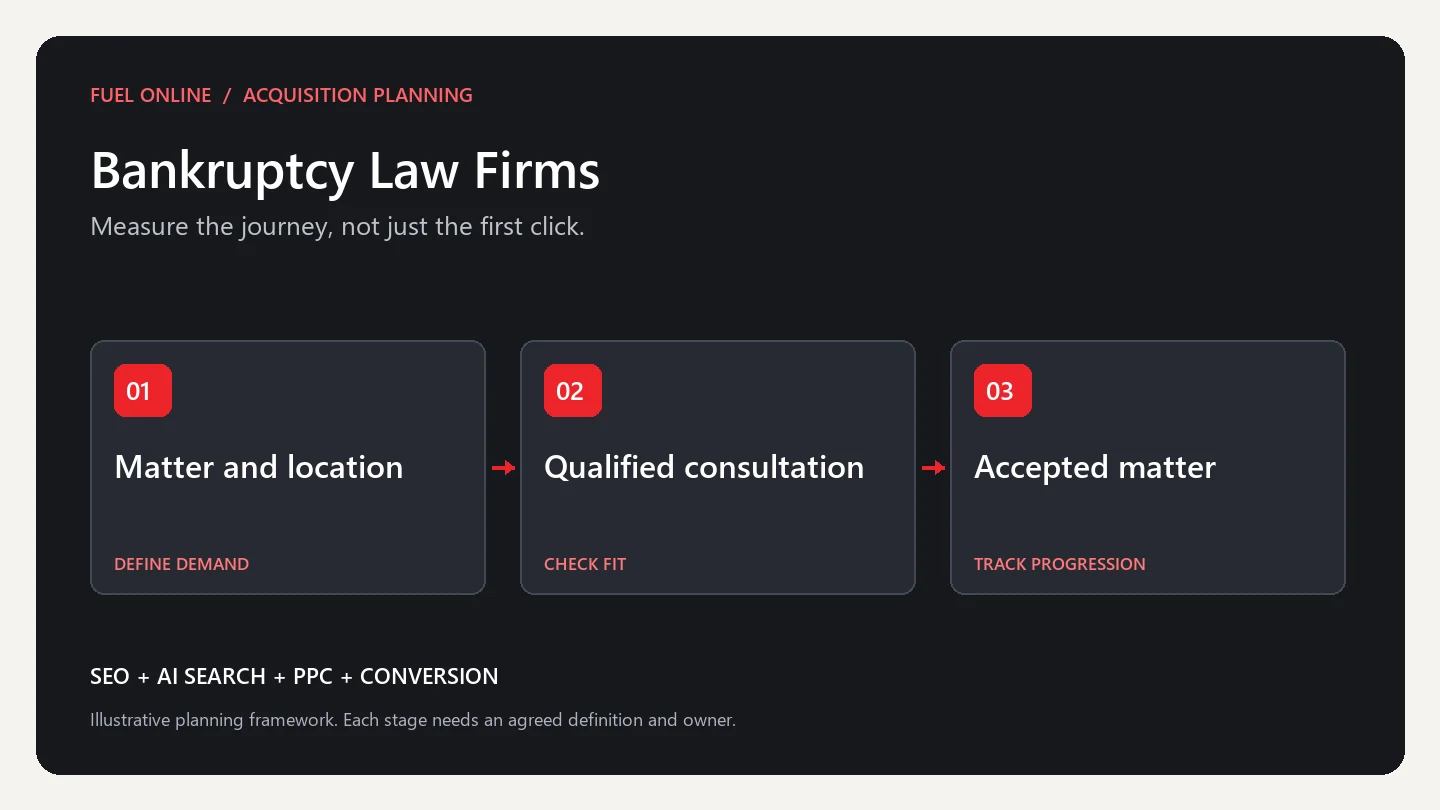
Bankruptcy firms need local matters that fit their chapter, jurisdiction, and case threshold, not calculators, creditor requests, or unrelated legal questions. Fuel builds a bankruptcy law marketing program around consumer or business need, potential chapter, jurisdiction, urgency, and consultation fit. We connect decision pages, approved proof, channel priorities, and the inquiry path, then use intake team feedback to improve fit. The goal is accepted bankruptcy consultations, with work prioritized against evidence and operating capacity rather than traffic alone.
Jurisdiction and accepted matter type; Consumer versus business representation; Consultation availability and process; Conflict screening and firm acceptance criteria
Bankruptcy law marketing: explain the next conversation clearly
A bankruptcy law marketing agency should help prospective clients understand the firm’s actual services and how an initial conversation begins. Personal and business-related inquiries may need different information and receiving arrangements. The marketing scope should follow the firm’s approved offer rather than a broad promise that every financial concern fits the practice.
Start with an attorney-approved service map and a named intake owner. Identify which public questions the website can answer and which need a person. Marketing should support an appropriate contact route without recommending legal or financial decisions for an individual.
Define the initial inquiry task
| Visitor task | Information to establish | Owner | Useful next step |
|---|---|---|---|
| Understand the practice | Actual client and service scope | Practice leadership | Relevant research destination |
| Request a first conversation | Approved consultation process | Intake | Recorded and connected request |
| Ask about business services | Whether the offering is supported | Responsible attorney | Correct specialist route |
| Provide detailed information | Authorized information process | Firm information owner | Appropriate later review |
| Contact an existing matter team | Recognizable service destination | Client service | Administrative handoff |
Use the map to choose what the page explains and what happens after contact. A submitted request does not establish eligibility, an accepted matter or representation.
Make the consultation promise concrete
Ask intake what the visitor is actually requesting. The page should explain that step in plain language and use the same meaning in campaign copy and confirmation. A brief message should not imply a result that the receiving process has not established.
Review initial fields with the firm. Each required item should support an approved action. Sensitive financial documents and detailed personal circumstances should follow the firm’s appropriate process instead of being added to a general marketing form to create a more detailed score.
Keep educational content distinct from an individual recommendation. Approved explanations can help people identify questions for the firm. They should not present a general paragraph as a determination of the person’s legal options or likely outcome.
Choose the first intervention from observed friction
If suitable prospects cannot identify the actual service, improve the practice description. If they find the information but cannot act, inspect navigation and the contact process. If relevant requests are stored but not connected, investigate routing and ownership before recommending more traffic.
Use useful aggregate reasons such as wrong practice area, existing-client service, duplicate and unable to connect. They point to different repairs. Preserve the underlying records through the firm’s approved workflow rather than removing difficult requests to make a channel look efficient.
For the pilot, trace an intended consultation request and an administrative exception with controlled details. Confirm the stored record, recipient and exact public wording together. This creates a business acceptance condition beyond a visually successful form submission.
Save a first-conversation packet with the approved service audience, receiving owner and exact action the website offers. Ask both the attorney reviewer and intake lead to assess it. Their agreement should cover what a prospective client is told and what staff actually does next. If the two accounts differ, resolve that operating question before another campaign variation is produced. This turns a broad request for better inquiries into a specific improvement the firm can inspect.
Measure consultation progression accurately
Separate contact attempts, recorded inquiries, connected intake conversations and consultation steps where reliable records exist. Later retained matters need the firm’s actual definitions and observation period. Marketing activity cannot establish a legal or financial outcome.
Compare compatible service audiences and periods, noting changes in the offer, intake team and reporting labels. Use aggregate stages in routine campaign reporting without exposing personal financial or legal narratives.
Ask the proposed agency what evidence would support expanding the plan. The answer should connect the recommended channel to a real bottleneck, name approval dependencies and explain how the first repair will be verified.
Explore law firm marketing for the wider strategy. Use agency evaluation questions and Fuel’s contact page to define one consultation-path review.
Separate consumer and business inquiry contexts
Bankruptcy-related searches can bring together people researching an individual concern, businesses seeking a legal conversation and visitors looking only for general information. The firm’s actual remit should determine how those audiences are described. If the practice supports consumer and business work, explain the distinct routes in approved language. If it supports one, make that boundary clear rather than use a broad financial-relief message that appears to accept every concern. Marketing should help someone find the appropriate contact without deciding the legal course they should take.
The page map should reflect real services rather than invite visitors to select a legal outcome for themselves. A broad practice page can explain the firm and consultation process. A genuinely distinct business offering can describe its own relationship and receiving team. The agency should not create a service-selection calculator that appears to assess eligibility from a few public inputs. Questions requiring professional judgment remain within the attorney’s process, while the website makes access and remit easier to understand.
Reduce practical uncertainty about the first conversation
A prospective client may need a plain explanation of what the contact request does before feeling ready to submit it. State whether the action requests a callback, asks for an appointment or begins another approved administrative step. Explain who responds and where the firm supplies further instructions. These are useful process facts. They should not imply that a consultation has already occurred, that representation has begun or that the firm has determined an individual’s legal or financial options.
Review the same explanation across the page, form and acknowledgment. If one promises immediate advice while another only records a request, resolve the inconsistency. The agency can make that correction without redesigning the entire site. A dependable first step can be more valuable than another broad article when the actual barrier is uncertainty about what happens after contact. Intake should recognize the exact process the visitor was told to expect.
Use respectful language grounded in the actual service
Persuasive bankruptcy law marketing does not need a guaranteed relief message or an exaggerated promise about financial outcomes. It can explain the real firm, its approved service remit and the way a conversation begins. Avoid language that assumes every visitor has the same circumstances. The page should help someone understand the organization without applying a label to that individual or suggesting a decision the legal team has not assessed.
Genuine attorney context can support trust. Use verified biographies, accurate office information and approved process descriptions. Preserve required language and the actual scope of any published evidence. If the practice cannot share a detailed example, do not invent a client story. The agency’s original contribution can be better navigation, clearer information and a more useful contact journey. Those are meaningful improvements even without a dramatic outcome claim.
Keep financial information in the appropriate workflow
Ask intake to identify the minimum information needed to route a first request. Each required field should have a clear purpose and owner. Detailed financial records and personal narratives belong in the firm’s approved process rather than a general acquisition form simply because they might improve a marketing score. Explain the route for later information at the appropriate point. A public page should not become a parallel financial assessment system operated by the agency.
The same boundary applies to reporting. Broad categories such as outside practice remit, existing-client service, duplicate request and unable to connect can guide commercial decisions. They do not require personal financial details in routine campaign reports. Keep the underlying professional records inside the authorized system and use aggregate patterns to identify whether the next improvement belongs in targeting, explanation or follow-up. This makes the evidence more useful as well as easier to maintain.
Evaluate agency proposals through a complete consultation artifact
Request a sample packet for one actual audience. It should show the proposed page purpose, approved service facts, existing proof, contact action and receiving owner. Include the acknowledgment and broad disposition definitions. Ask which useful current material remains and which missing question the addition resolves. This gives the firm a concrete basis for comparing proposals. A package promising many articles can still fail if none makes the first conversation more understandable or the handoff more dependable.
Channel recommendations should follow the actual bottleneck. A focused campaign may test demand for a defined consultation offer when the receiving process is ready. Organic content can support durable research about the firm and its real services. A professional referral route may need clearer organizational information and contact ownership. The agency should state the role and dependency of each activity rather than imply that every channel must expand at once to create progress.
Use an illustrative comparison to select the next release
Consider an illustrative consumer-focused firm attracting many general calculator visits but few relevant consultation requests. The first useful task may be clarifying the difference between educational information and the firm’s actual service, then making the contact route easier to find. In another illustrative firm, relevant requests may already arrive but staff cannot connect them reliably. That calls for a routing and ownership repair before more acquisition. These are operational marketing scenarios, not client results or advice about any person’s financial choices.
After a focused release, review compatible inquiry categories and the firm’s observed stages. Separate attempts, recorded requests, successful contact, consultation steps and later engagement progression. Note changes in the offer or receiving capacity alongside campaign changes. If classification improves because staff adopt clearer labels, report that as a measurement improvement rather than automatic demand growth. Choose the next investment from the remaining constraint, with a named owner and a clear validation condition.
Include an administrative-contact route in the release review. Existing clients may arrive through the same branded searches as prospective clients, yet need a different team. Clear labels reduce misrouting and prevent routine service activity from appearing to be new acquisition. Test that route alongside the consultation inquiry rather than assuming one successful form proves the whole experience works.
Ask the agency to explain how it will preserve useful measurement when the firm changes staff or the introductory offer. A short change log should record the date, affected audience and reporting definition. That context helps the firm distinguish a real acquisition pattern from a shift in classification or receiving capacity.
AGGRESSIVE FROM THE START
One month. The work many agencies stretch across three.
Our mandate: move faster, go deeper and put experienced specialists to work immediately.
Fuel attacks the work in parallel: site audits, technical errors, new content, internal links, backlink outreach and conversion improvements. Your agreed scope determines the channels; urgent fixes do not wait behind a drawn-out planning phase.
The bankruptcy law marketing brief identifies visibility and lead barriers. Actionable fixes move into production while deeper analysis continues.
Your bankruptcy law marketing agency work runs alongside industry-specific content, relevant links and earned-authority outreach, based on your agreed scope.
The marketing for bankruptcy law firms review shows completed work, lead quality and the next opportunities. You see who owns each action.
Fast execution is the operating standard. Access, approvals and scope shape delivery; search and revenue results have their own timelines.
What bankruptcy law marketing changes for bankruptcy law demand
A useful bankruptcy law marketing plan starts with the commercial constraint. Fuel identifies which buyers the organization wants more of, what they need to believe before contact, and which requests consume time without a realistic next step. For bankruptcy law, the fit decision turns on consumer or business need, potential chapter, jurisdiction, urgency, property and debt context, and consultation fit.
Fuel turns that definition into chapter, eligibility, process, attorney, jurisdiction, and consultation-preparation pages, channel priorities, proof requirements, and a handoff that retains case type, jurisdiction, urgency, safe contact details, approved intake facts, and conflict-screening status. Work that cannot be supported by attorney-reviewed information, accurate jurisdiction and representation statements, named authorship, and permissioned client evidence stays out of the public claim set.
A practical bankruptcy law hub diagnostic
Use this diagnostic when channel activity improves but the receiving team does not see a comparable change in accepted bankruptcy consultations. The diagnostic for bankruptcy law marketing starts with the observable symptom, checks the page, source, campaign, or handoff responsible for it, and ends with one reviewed action, owner, and validation method.
Observable symptom
Marketing activity rises, but the team still cannot tell why 'Chapter 7 attorney in Worcester' inquiries are mixed with demand closer to 'bankruptcy calculator spreadsheet'.
What to inspect in bankruptcy law marketing agency
Review source, page, offer, contact path, and the final acceptance or rejection reason together.
Decision criteria for marketing for bankruptcy law firms
Prioritize the page, message, exclusion, or handoff with the clearest connection to unsuitable demand.
Inspectable output
A one-page bankruptcy law marketing decision record naming the symptom, evidence, owner, release, and measure tied to accepted bankruptcy consultations.
Marketing for bankruptcy law firms deliverables you can inspect
The team receives a demand map, evidence register, prioritized channel backlog, conversion specification, and commercial decision cadence it can inspect and own.
- Buyer and offer map, used to define the bankruptcy law marketing scope.
- Evidence and approval register, used to govern the bankruptcy law marketing agency release.
- Prioritized page and campaign backlog, used to evaluate the marketing for bankruptcy law firms decision.
- Conversion and routing specification
- Commercial scorecard and decision cadence
Illustrative bankruptcy law example
Illustrative example, not a client result: Fuel would compare the path taken by a local consumer or business prospect seeking a chapter and matter type the firm handles with the activity created by calculators, creditor requests, out-of-jurisdiction matters, and unrelated legal questions. The decision is whether to fix the decision page, proof, contact path, or channel sequence before adding spend.
The bankruptcy law marketing agency work would produce a one-page demand map showing fit, friction, evidence, owner, and the next controlled release. The example becomes useful only when the team can trace the change to accepted bankruptcy consultations.
Within marketing for bankruptcy law firms, the buyer team can inspect the artifact, approval, and next investment decision.
How commercial progress is judged
Fuel connects page, query, campaign, or source context with acceptance, rejection reasons, response, capacity, and qualified consultations, attendance, accepted matters, and inquiry fit by jurisdiction. Diagnostic measures explain where the journey breaks; they do not replace the business outcome.
The decision record for bankruptcy law marketing states what changed, why it changed, who approved it, and whether the next action is to expand, revise, consolidate, or stop.
Reporting for marketing for bankruptcy law firms must connect the service-specific diagnostic to accepted bankruptcy consultations, explain data limits, and name the next decision rather than treating activity as proof of value.
Questions to ask a bankruptcy law agency
Ask for the first demand map and channel decision, then confirm who owns pages, campaigns, tracking, approvals, and the handoff to the receiving team. A useful proposal explains which channel waits and why.
When reviewing bankruptcy law marketing, require a named practitioner, implementation owner, approval path, and sample artifact. Reject unsupported promises of rankings, citations, lead volume, cost, or revenue.
How we measure bankruptcy law marketing agency
- qualified consultations
- attendance
- accepted matters
- inquiry fit by jurisdiction
Separate inquiry volume from usable demand
Qualified-inquiry rate = inquiries meeting your agreed criteria ÷ total inquiries reviewed.
Illustrative arithmetic: 20 suitable inquiries out of 50 reviewed inquiries is a 40% qualified-inquiry rate. Record why the other 30 did not fit before increasing investment.
Agree on the baseline, data source and qualification criteria before comparing results. Separate visibility from inquiries and accepted business opportunities.
CONNECTED SERVICES
Choose the right next step for your business
Explore Fuel’s Industry growth plan capabilities, published campaign work and team to evaluate how we would support your organization.
BEFORE YOU CHOOSE AN AGENCY
Questions about bankruptcy law marketing agency
What will Fuel deliver in the first 30 days?
During the first month, the bankruptcy law marketing scope produces a demand map, evidence register, prioritized journey decision, and the owner of the first controlled release. Fuel also records the client inputs and approval needed for the first release.
What does Fuel need from our bankruptcy law team?
Effective bankruptcy law marketing agency work requires a commercial owner, account and page access, approved proof, acceptance criteria, capacity limits, and feedback from the receiving team. Fuel identifies missing access or ownership before work is scheduled around it.
How will we know the work is commercially useful?
Under marketing for bankruptcy law firms, commercial usefulness depends on whether the diagnostic connects to accepted bankruptcy consultations, the data limits are stated, and the evidence supports a clear keep, revise, or stop decision.
Should we invest in SEO or paid acquisition first?
Choose the channel that addresses the closest constraint to accepted bankruptcy consultations. In bankruptcy law marketing, paid acquisition can test active demand quickly, while SEO is better for durable decision pages; both wait if the offer, proof, contact path, or receiving capacity is the real problem.
What does a credible bankruptcy law marketing agency scope include?
A credible bankruptcy law marketing agency scope includes buyer-fit criteria, evidence governance, journey priorities, channel sequencing, conversion ownership, and a commercial decision cadence. It also names the client dependencies, practitioner, deliverable, and approval path.
How should marketing for bankruptcy law firms report commercial progress?
Reporting under marketing for bankruptcy law firms should connect the service-specific diagnostic to accepted bankruptcy consultations, show what changed and why, state data limits, and name the next decision.
Make your next agency conversation specific.
Show us where bankruptcy law demand becomes unclear between 'Chapter 7 attorney in Worcester' and 'bankruptcy calculator spreadsheet'. The first working session on bankruptcy law marketing agency will identify the priority artifact, evidence, owner, and approval decision for accepted bankruptcy consultations.
Talk with a Fuel strategist →