
FUEL ONLINE / Bankruptcy Law Firms / Lead generation
Bankruptcy lead generation: Conversion Strategy

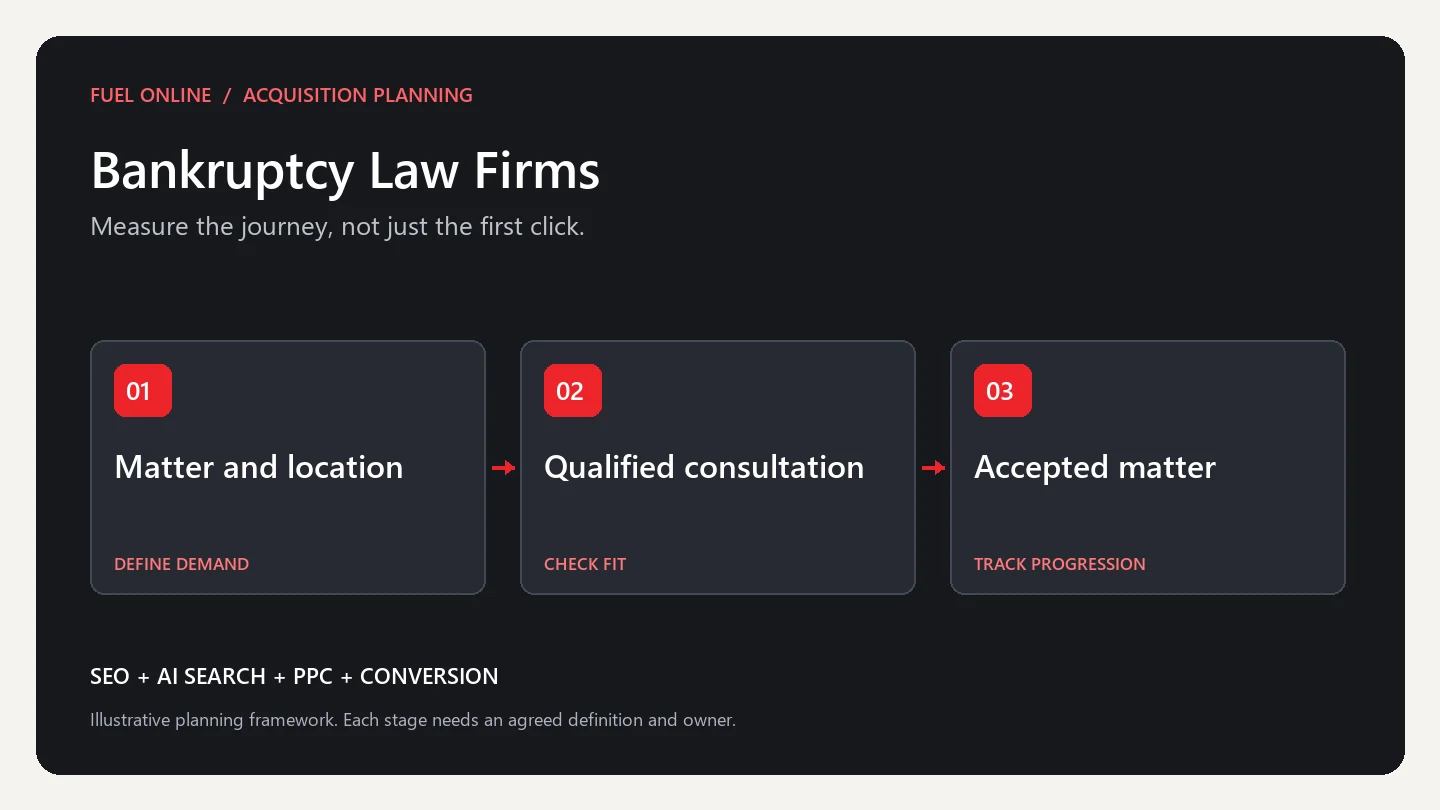
Bankruptcy firms need local matters that fit their chapter, jurisdiction, and case threshold, not calculators, creditor requests, or unrelated legal questions. For bankruptcy lead generation, Fuel defines fit through consumer or business need, potential chapter, jurisdiction, urgency, and consultation fit, then aligns pages, forms, calls, routing, and follow-up with that decision. The intake team receives useful source and qualification context, while marketing receives rejection and progression feedback. The aim is more accepted bankruptcy consultations without rewarding raw lead volume.
Jurisdiction and accepted matter type; Consumer versus business representation; Consultation availability and process; Conflict screening and firm acceptance criteria
Make bankruptcy law lead generation preserve the request and next contact
Choose a bankruptcy lead generation agency by comparing the administrative meaning of the requests it helps create. A useful conversion proposal shows what a visitor is asking for, what record the firm receives and how that conversation continues. It also separates a new inquiry from an existing contact returning to the practice. The buying decision should center on an understandable contact journey and usable information, rather than a larger total whose definition changes between a website interaction and the firm's receiving process.
Name the first contact event precisely
Begin with the public contact action. Ask the agency to write down what the button, form and confirmation say the person has done. If the action requests contact, the resulting record should preserve that meaning. A submitted form does not by itself describe an appointment, matter acceptance or professional engagement. The firm should supply its actual administrative process; the agency's role is to represent that process clearly and connect the public destination with the information the receiving team needs.
Separate the purpose of the first contact from the purpose of a later professional conversation. The initial route can help someone identify the relevant firm destination and supply the administrative information the firm chooses to request. It should not become a speculative legal interview assembled by a marketing supplier. Ask the firm to explain which information belongs at this first step. Then ask the agency to show how each field appears in the receiving record and how it contributes to the next administrative action.
A field dictionary makes this comparison practical. For every field, record its label, reason for collection at this stage, destination in the receiving record and person responsible for maintaining the definition. The value is not the size of the document. It is the ability to explain why the form asks a particular question and how the answer is used. This also exposes fields that increase effort for the visitor without helping the receiving team continue the conversation the contact action is meant to begin.
| Acceptance case | What to inspect | Meaning retained |
|---|---|---|
| New request | The visitor action, confirmation and resulting administrative record for the same test contact. | The initial request remains distinct from an appointment, engagement or accepted matter. |
| Repeated interaction | The form and call records together with the rule used to link or retain them separately. | The report explains whether it counts contact events or identifiable incoming conversations. |
| Existing contact | The public route and the receiving responsibility supplied by the firm for continuing conversations. | Returning contacts can find an appropriate route without becoming automatic acquisition claims. |
| Corrected detail | The original record, updated administrative information and the receiving role that can see the change. | The useful context remains connected without silently replacing the meaning of the original event. |
Preserve continuity without making the form a legal interview
A returning contact should have a deliberate path. Someone may reach a new-prospect landing page while trying to continue an existing conversation with the firm. Ask how the page helps that person locate the appropriate established route. The agency can improve navigation and administrative wording without creating a new client-service procedure. In the records, the firm should be able to distinguish that interaction where its process supports the distinction, so that a continuing conversation is not automatically counted as a newly acquired prospective client.
Repeated contacts provide a useful testing case. A person may submit a form and then call, or correct information after the first submission. Ask the agency to show how the available records preserve the connection and where matching requires human review. The proposal should state whether it configures this relationship, documents an existing process or depends on another supplier. Those are different scopes of work. They should remain visible even when all the shortlisted agencies use similar language about improving inquiry quality.
The confirmation message should be tested against the actual receiving event. Ask what the person sees after a completed submission, what record the firm receives and what happens if the confirmation cannot be displayed. This is a practical experience check, not a reason to add invented response promises. The completed journey should help the visitor understand the administrative action taken and use the firm's established route if they need to continue or correct their contact information.
Source information needs a clear role in the contact record. A campaign label may explain how the person reached the page, but it does not necessarily describe the legal topic that person wishes to discuss. Ask the agency to keep those meanings separate. A useful demonstration shows the original source label, the visitor-supplied administrative context and the receiving team's later classification as distinct fields when supported. This makes the records more useful without inferring the substance of an individual situation from an advertising message.
Test the difficult administrative cases
Compare reporting definitions through actual record examples chosen for the exercise. A button selection, a connected interaction, an identifiable inquiry and a later administrative disposition should not be presented as interchangeable. Ask which evidence supports each stage and how repeated contacts are handled. If a relationship cannot be established reliably, the report should retain that limitation. The firm can then understand whether a change in a total reflects new conversations, a measurement change or a different treatment of records it already receives.
A bounded acceptance test can include a complete new request, an incomplete form, a repeated contact, a corrected detail and an existing-contact route. For each example, record the public action, confirmation, resulting record and receiving responsibility. These cases test different parts of the journey without inventing legal outcomes. Ask the agency to retain the examples in a form another administrator can repeat after a destination edit, form change or replacement of the connected record system.
The commercial scope should identify who owns the contact destination, who can change the fields and who maintains the connection to the receiving process. If an existing supplier controls part of the system, specify what the agency will provide to that supplier and how completion will be checked. A proposal that makes those dependencies clear is easier to compare than one that promises a seamless journey without identifying which party can actually implement each necessary change.
Evaluate improvements through the administrative task they solve. A clearer field label may reduce ambiguity in the received record. A distinct returning-contact route may help the firm recognize continuing conversations. A revised confirmation may better describe the first event. Ask the agency to explain the expected information improvement and the evidence it will inspect afterward. This produces a concrete optimization discussion without promising that every change will generate more accepted matters or a particular financial result.
Give the firm understandable records
At handover, retain the field dictionary, route map, event definitions and completed tests alongside the actual configuration ownership. Another person should be able to explain what a request means and where its information goes. The handover should also show which decisions remain with the firm's receiving process. That distinction helps the business maintain its contact journey without requiring an outside supplier to reinterpret the meaning of each record whenever a form or destination is edited.
For the first release, choose a single contact journey with a clear receiving role. Define the source context, public action and administrative record before expanding to additional campaigns. The firm can then compare the next proposed improvement with a known baseline. This is a useful way to sequence conversion work: each release should leave one more understandable connection in the contact process rather than adding disconnected forms whose totals cannot be reconciled with the firm's actual incoming conversations.
The final agency comparison should use the same set of contact examples for every proposal. Ask each team to show how the public action becomes a usable record, how continuing conversations are recognized and how reported totals retain their meaning. A useful bankruptcy lead generation scope makes the information journey easier for both the visitor and the receiving team. It leaves the firm with an inspectable administrative system while preserving the separate role of the professional conversation that may follow.
A useful proposal demonstration starts with a person who submits a contact request and later corrects a telephone number. Ask each agency to show the first event, the changed information and the record visible to the receiving role. The exercise should explain whether the records are linked, manually reconciled or kept separate. Each approach has a different administrative consequence. The point is to make that consequence visible to the firm before it accepts a scope described broadly as conversion optimization, rather than discovering later that a crucial part of the contact journey belongs to another supplier.
Next, follow a returning contact who enters through a destination designed for new prospective clients. The person should be able to identify the firm's appropriate continuing-contact route using the process the firm has supplied. Ask the agency what the page says and how the interaction appears in any acquisition report. This example tests navigation and event classification together. It does not require the agency to design a new client-service system or determine the nature of a legal matter. The scope remains an understandable path through the firm's existing administrative destinations.
For measurement acceptance, give the agency a small exercise containing two form events and a related call. Ask for a written explanation of each total it would present, including what cannot be matched. The receiving team should be able to compare the explanation with the same test records. If a report describes three interactions, it should not silently relabel them as three distinct prospective clients. This simple exercise creates a shared vocabulary for future reporting discussions and makes the quality of the agency's record definitions visible without fabricating a performance benchmark.
Finally, ask another administrator to repeat one completed contact test using only the handover materials. They should locate the current form, explain the requested fields, find the resulting record and identify the role responsible for the next administrative step. If they need undocumented project knowledge, the handover needs a clearer connection to the actual system. This is a concrete acceptance decision. It helps the firm compare agencies on the continuity and usability of the delivered contact process instead of the volume of diagrams or the breadth of promotional language in the proposal.
For the related firm-wide scope, explore bankruptcy law marketing.
AGGRESSIVE FROM THE START
One month. The work many agencies stretch across three.
Our mandate: move faster, go deeper and put experienced specialists to work immediately.
Fuel attacks the work in parallel: site audits, technical errors, new content, internal links, backlink outreach and conversion improvements. Your agreed scope determines the channels; urgent fixes do not wait behind a drawn-out planning phase.
The bankruptcy lead generation brief identifies visibility and lead barriers. Actionable fixes move into production while deeper analysis continues.
Your bankruptcy law lead generation company work runs alongside industry-specific content, relevant links and earned-authority outreach, based on your agreed scope.
The lead generation services for bankruptcy law firms review shows completed work, lead quality and the next opportunities. You see who owns each action.
Fast execution is the operating standard. Access, approvals and scope shape delivery; search and revenue results have their own timelines.
What bankruptcy lead generation changes for bankruptcy law demand
Lead generation starts with the receiving team's decision. Fuel documents what counts as an accepted next step, what does not fit, and who owns each route. For bankruptcy law, acceptance depends on consumer or business need, potential chapter, jurisdiction, urgency, property and debt context, and consultation fit.
The conversion path asks only what changes fit, routing, or preparation. It preserves case type, jurisdiction, urgency, safe contact details, approved intake facts, and conflict-screening status, keeps sensitive details in approved systems, and gives unsuitable visitors a clear alternative instead of forcing every request into sales.
A practical bankruptcy law leadgen diagnostic
Use this diagnostic when form submissions and calls increase but the receiving team does not see a comparable change in accepted bankruptcy consultations. The diagnostic for bankruptcy lead generation starts with the observable symptom, checks the page, source, campaign, or handoff responsible for it, and ends with one reviewed action, owner, and validation method.
Observable symptom
Forms and calls increase, but suitable requests related to 'Chapter 7 attorney in Worcester' lose context, wait too long, or reach the wrong owner.
What to inspect in bankruptcy law lead generation company
Review the page promise, fields, call handling, routing, response time, follow-up attempts, and final sales, intake, or scheduling decision.
Decision criteria for lead generation services for bankruptcy law firms
Change the question, route, response rule, or follow-up step responsible for the lost or unsuitable request.
Inspectable output
A tested routing or follow-up change with an owner, acceptance rule, and measure tied to accepted bankruptcy consultations.
Lead generation services for bankruptcy law firms deliverables you can inspect
The team receives an accepted-request definition, path map, routing and response rules, CRM dispositions, and a controlled conversion-test log.
- Accepted-lead and exclusion specification, used to define the bankruptcy lead generation scope.
- Page, form, and call-path map, used to govern the bankruptcy law lead generation company release.
- Routing, response, and follow-up ownership, used to evaluate the lead generation services for bankruptcy law firms decision.
- CRM fields, dispositions, and duplicate rules
- Quality review and controlled test log
Illustrative bankruptcy law example
Illustrative example, not a client result: The consultation request loses consumer or business need, possible chapter, jurisdiction, urgency, safe contact details, or conflict-check facts. Fuel would test the page, form or call path, route, response rule, follow-up, and final disposition to find the first point where useful context disappears.
The bankruptcy law lead generation company test would document the changed field, route, response rule, or follow-up step and its owner. The revision stays only when the receiving team sees a clearer path to accepted bankruptcy consultations.
Within lead generation services for bankruptcy law firms, the buyer team can inspect the artifact, approval, and next investment decision.
How commercial progress is judged
Fuel connects page, query, campaign, or source context with acceptance, rejection reasons, response, capacity, and qualified consultations, attendance, accepted matters, and inquiry fit by jurisdiction. Diagnostic measures explain where the journey breaks; they do not replace the business outcome.
The decision record for bankruptcy lead generation states what changed, why it changed, who approved it, and whether the next action is to expand, revise, consolidate, or stop.
Reporting for lead generation services for bankruptcy law firms must connect the service-specific diagnostic to accepted bankruptcy consultations, explain data limits, and name the next decision rather than treating activity as proof of value.
Questions to ask a bankruptcy law agency
Ask for an accepted-request specification, route test, disposition set, and response ownership map. Confirm how the agency reviews missed, duplicate, unsuitable, and progressed inquiries.
When reviewing bankruptcy lead generation, require a named practitioner, implementation owner, approval path, and sample artifact. Reject unsupported promises of rankings, citations, lead volume, cost, or revenue.
How we measure bankruptcy law lead generation company
- qualified consultations
- attendance
- accepted matters
- inquiry fit by jurisdiction
Find the drop between interest and a useful next step
Next-step completion rate = qualified inquiries completing the agreed next step ÷ qualified inquiries reviewed.
Illustrative arithmetic: 15 completed appointments from 25 qualified inquiries is 60%. Use the next step that fits your business, such as a consultation, estimate or discovery meeting, and record the time allowed for completion.
Agree on the baseline, data source and qualification criteria before comparing results. Separate visibility from inquiries and accepted business opportunities.
CONNECTED SERVICES
Choose the right next step for your business
Explore Fuel’s Lead generation capabilities, published campaign work and team to evaluate how we would support your organization.
BEFORE YOU CHOOSE AN AGENCY
Questions about bankruptcy law lead generation company
What happens before Fuel changes the form?
During the first month, the bankruptcy lead generation scope produces an accepted-request definition, tested page and call paths, routing ownership, dispositions, and the first conversion repair. Fuel also records the client inputs and approval needed for the first release.
What does Fuel need from our bankruptcy law team?
Effective bankruptcy law lead generation company work requires page, form, call, CRM, routing, and response access plus an accepted-request definition, receiving owners, and consistent dispositions. Fuel identifies missing access or ownership before work is scheduled around it.
How will we know the work is commercially useful?
Under lead generation services for bankruptcy law firms, commercial usefulness depends on whether the diagnostic connects to accepted bankruptcy consultations, the data limits are stated, and the evidence supports a clear keep, revise, or stop decision.
Should we buy more traffic before fixing lead handling?
Usually not. The bankruptcy lead generation plan should first correct the form, call path, routing, response, follow-up, or disposition problem that is losing suitable requests. Additional traffic is useful only after the receiving path can handle it.
What does a credible bankruptcy law lead generation company scope include?
A credible bankruptcy law lead generation company scope includes acceptance criteria, path testing, field and call design, routing and response ownership, CRM dispositions, and controlled conversion tests. It also names the client dependencies, practitioner, deliverable, and approval path.
How should lead generation services for bankruptcy law firms report commercial progress?
Reporting under lead generation services for bankruptcy law firms should connect the service-specific diagnostic to accepted bankruptcy consultations, show what changed and why, state data limits, and name the next decision.
Make your next agency conversation specific.
Bring a sample of suitable and unsuitable requests and show us where response, routing, or follow-up breaks. The first working session on bankruptcy law lead generation company will identify the priority artifact, evidence, owner, and approval decision for accepted bankruptcy consultations.
Talk with a Fuel strategist →